Tag Archives: Rating

On the issues: assessing the 2016 Republican presidential candidates

Latest Republican presidential primary polls
Latest Republican presidential primary polls (click for larger image)

The PDF is here. (50 pages, but you only have to read about the candidates you might consider voting for)

Unfortunately, radically leftist Politico is the only one with a write-up on it, so here goes:

The hard-line conservative arm of the Heritage Foundation has tough criticism for much of the 2016 field, but high praise for the Texas senator.

The political arm of The Heritage Foundation has released a detailed assessment of the 2016 Republican presidential field — and it offers harsh words for many candidates. But not for Sen. Ted Cruz.

Cruz receives almost exclusively praise for his stances in the 50-page 2016 presidential policy scorecard, the first of its kind produced by Heritage Action. The report grades the candidates across six categories: growth, opportunity, civil society, limited government, favoritism and national security.

Many of the lines in the scorecard appear destined for future attack ads.

Jeb Bush, for instance, is accused of having “kowtowed to the state’s environmental lobby” in Florida. Chris Christie “has shown favoritism toward well-connected real estate developers.” Rand Paul’s “views at times veer outside the conservative mainstream.” And Donald Trump backs “massive tariffs that would damage the American economy.”

Cruz, by contrast, manages to emerge with barely a blemish, receiving only softly worded critiques of his adopting “sound policies advanced by others” rather than crafting his own.

[…]“Cruz has been willing to pay a political price for taking on government favoritism,” the report reads.

The group even forgives Cruz for one of the few trespasses he has made against its positions, voting for a bill that served “as a bargaining chip for [Export-Import Bank] allies to secure reauthorization.” The report credits him for later switching his vote and then publicly attacking Republican Senate Majority Leader Mitch McConnell for allegedly lying about his plans.

Bobby Jindal, who is running hard to the right in Iowa, receives among the more glowing reviews. So does Marco Rubio, who angered the right with his pursuit of a comprehensive immigration plan after first being elected with tea party support.

The two current front-runners in the polls, Ben Carson and Trump, were dinged for their lack of a record on conservative causes and a lack of specifics in their visions. “His unconventional foreign policy prescriptions raise more questions of significant consequence than they answer,” Heritage writes of Trump.

Bush was singled out for some of the most biting critiques. “Has shown favoritism toward Florida special interests and supports amnesty” for undocumented immigrants, reads one bullet point.

In its 2016 assessment, Heritage dings Bush for not supporting recent efforts to defund Planned Parenthood this fall because he said he opposed precipitating a government shutdown. The report accuses him of “playing to President [Barack] Obama’s talking points rather than reinforcing conservatives.”

No, everyone knows that my list of candidates favors governors who have a history of putting in place actual policies that actually affected real people in the real world and got real conservative results. So on that score, Cruz and Rubio way down the list because they have achieved very little:

  1. Scott Walker
  2. Bobby Jindal
  3. Rick Perry
  4. Ted Cruz
  5. Marco Rubio

Ted Cruz’s Twitter feed and his overall feel to me is that all he does is talk, talk, talk. He just doesn’t have the record of Bobby Jindal at putting policies into place. For example, as governor, Jindal actually cut spending. He actually put in place pro-life measures that actually saved lives. He actually put in place a school choice program that helped low-income students get out of failing schools. He actually cut off funding for Planned Parenthood. He actually defended religious liberty. Cruz is just a senator, so he hasn’t got that proven record. I believe he would be conservative, but I feel safer trusting someone with experience.

Having said that, the more I read reports like this Heritage Action Scorecard report, I am finding out that Cruz has been willing to at least pay a price politically for doing the right thing at various times. So, although he does not have the accomplishments that the governors have, he has been willing to push conservative values when it was not to his advantage, politically. I have to admit, there is some value to this in one sense – we know that he would do what he says no matter what. But there is a problem with Cruz. We don’t know whether he is able to create clever policies that will draw the votes of independents and even moderate Democrats. That’s what Walker and Jindal were able to do. So, although I respect what the Heritage Action team have written, I am not changing my rankings.

Tonight’s debate

Be sure and tune in to both debates tonight on Fox Business, as I am expecting Jindal and Cruz to outperform their competitors in their respective debates:

Republican debate – Fox Business/Wall Street Journal

Time – Primary: 9 p.m. ET. Secondary: 7 p.m. ET

Location – Milwaukee Theater, Milwaukee, Wisconsin

Moderators – Gerard Baker, Neil Cavuto, Maria Bartiromo

Primary: All candidates averaging at least 2.5 percent in four most recent national polls by Nov. 4.

Secondary: Remaining candidates averaging at least 1 percent in one of the four most recent polls.

Primary: Donald Trump, Ben Carson, Marco Rubio, Ted Cruz, Jeb Bush, Carly Fiorina, John Kasich, Rand Paul.

Secondary: Chris Christie, Mike Huckabee, Bobby Jindal, Rick Santorum.

Candidates on my list are in bold. The debate will be live-streamed, so you have no excuses for missing it. This one promises to be a good one. The moderators will not be amateurs as with the Democrat-biased CNBC debate.
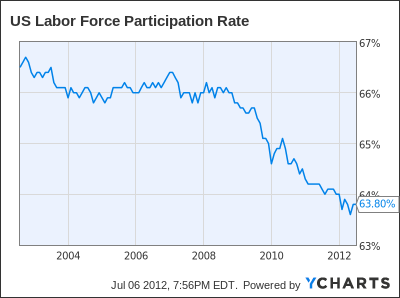
526 economists, including 5 Nobel prize winners, grade Romney and Obama plans

Labor Force Participation Rate

From the Daily Caller:

The 526 economists — including Nobel laureates Gary Becker, Robert Lucas, Robert Mundell, Edward Prescott, and Myron Scholes — point to six facets of Romney’s economic approach that they see as beneficial to future economic success.

  • Reduce marginal tax rates on business and wage incomes and broaden the tax base to increase investment, jobs, and living standards.
  • End the exploding federal debt by controlling the growth of spending so federal spending does not exceed 20 percent of the economy.
  • Restructure regulation to end “too big to fail,” improve credit availability to entrepreneurs and small businesses, and increase regulatory accountability, and ensure that all regulations pass rigorous benefit-cost tests.
  • Improve our Social Security and Medicare programs by reducing their growth to sustainable levels, ensuring their viability over the long term, and protecting those in or near retirement.
  • Reform our healthcare system to harness market forces and thereby reduce costs and increase quality, empowering patients and doctors, rather than the federal bureaucracy.
  • Promote energy policies that increase domestic production, enlarge the use of all western hemisphere resources, encourage the use of new technologies, end wasteful subsidies, and rely more on market forces and less on government planners.

Seven of the signatories are from Harvard University and five from Columbia University — two of President Barack Obama’s alma maters.

The economists’ statement of support pillories Obama’s economic record, claiming that his expansion of the federal government has resulted in “anemic economic recovery and high unemployment,” which will continue if his future plans are implemented.

Among the Obama policies with which the 526 economists take issue include:

  • Relied on short-term “stimulus” programs, which provided little sustainable lift to the economy, and enacted and proposed significant tax increases for all Americans.
  • Offered no plan to reduce federal spending and stop the growth of the debt-to-GDP ratio.
  • Failed to propose Social Security reform and offered a Medicare proposal that relies on a panel of bureaucrats to set prices, quantities, and qualities of healthcare services.
  • Favored a large expansion of economic regulation across many sectors, with little regard for proper cost-benefit analysis and with a disturbing degree of favoritism toward special interests.
  • Enacted health care legislation that centralizes health care decisions and increases the power of the federal bureaucracy to impose one-size-fits-all solutions on patients and doctors, and creates greater incentives for waste.
  • Favored expansion of one-size-fits-all federal rulemaking, with an erosion of the ability of state and local governments to make decisions appropriate for their particular circumstances.

We can’t afford four more years of incompetence and failure. We need to ask ourselves what economists like Thomas Sowell and Walter Williams would do. And they wouldn’t give Obama four more years. We need a change.

Census Bureau confirms DC schools spending $29,409 per pupil

Andrew J. Coulson of the Cato Institute explains how he got the Census Bureau to revise their numbers.

Excerpt: (links removed)

Four years ago, I wrote an op-ed for the Washington Post revealing that DC spent nearly $25,000 per pupil during the 2007-08 school year. I calculated this figure from the public budget documents of the District of Columbia, which I subsequently summarized and linked on this blog.

No education reporter followed up on my findings, and much lower per pupil figures continue to be reported to this day. My $25,000 figure was even greeted with skepticism by analysts at free market think tanks. One state education policy analyst wrote to say that my figure was “out of line with credible information,” and that I gave my critics “too much ammunition with this clearly questionable set of statistics.”

Indeed, the Census Bureau figures for DC’s total K-12 expenditures were substantially lower than mine. I made a note to track down the discrepancy, but other projects intervened. When I updated my calculation to use DC budget estimates for the 2008-09 school year, I found that District spending had risen to over $28,000 / pupil. The comparable number for that year reported by the Bureau of the Census was just $18,181 (which you get by dividing the total expenditure figure in Table 1 by the enrollment figure in Table 15).

So you can see why most folks were skeptical. Skeptical, but wrong.

Back in March of this year I asked my then research intern to contact the Census Bureau and ask where they got their total spending data. It turns out, they got them from a DCPS official. We presented evidence to the Bureau that that DCPS official had missed a few line items when completing the Census Bureau’s forms—to the tune of about $400 million. The Census Bureau agreed and is in the process of obtaining corrected data for the 2008-09 year. In the meantime, they made sure to ask DC officials to include all relevant items when filling out their forms for the 2009-10 school year. The result: Census Bureau data now show DC spent a total of $29,409 per pupil (obtained by dividing total expenditures in Table 1 by enrollment in Table 15). This is just a bit higher than my calculation for the preceding year.

Kudos to the Census Bureau for taking the initiative and getting DC to accurately report its public school expenditures. Now that education reporters can simply open a Census Bureau .pdf file and divide one number by another, I wonder if any will report what DC really spends per pupil? I suspect that they still will not, continuing to mislead the general public, but I would be delighted to be proven wrong.

Oh, and, BTW, this spending figure is about triple what the DC voucher program spends per pupil—and the voucher students have a much higher graduation rate and perform as well or better academically.

He’s talking about the D.C. Opportunity Scholarship voucher program which Obama dismantled and defunded in order to appease the teacher unions.

According to U.S. News, D.C. students are underperforming:

South Dakota, Nebraska, and Washington, D.C. performed the worst, with some of the worst student test scores and college readiness indexes in the nation.

Keep in mind that D.C. votes 92.5% to 6.5% for Obama in the 2008 election. This is where leftism in education comes from.

We ought to care about this, because the students in Washington D.C. are some of the poorest students in the nation – and they are often minority students. What sort of opportunity to succeed are we giving these children when we allow leftists like Obama to destroy voucher programs that are their only hope?