Tag Archives: Racist

Herman Cain gaining momentum with the Tea Party conservatives

Here’s a cute cartoon from Don Surber:
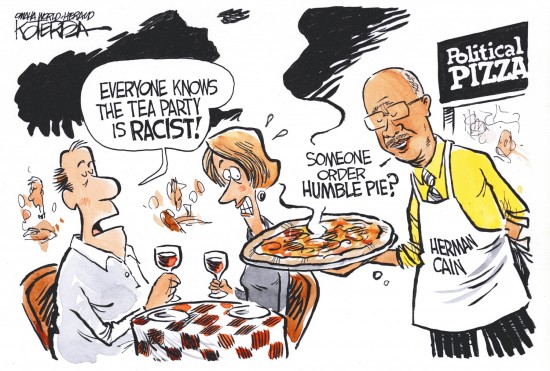
The Tea Party loves Herman Cain

And Herman Cain is even being recognized by the ultra-leftist New York Times, finally. (H/T The Other McCain)

Excerpt:

A Gallup poll released last week showed Mr. Cain with the highest voter intensity score of any Republican presidential contender — far higher than Ms. Palin, a former governor of Alaska, or Mr. Romney, a former governor of Massachusetts. While Mr. Cain’s name recognition was at 37 percent, it had risen 16 points since March.

Many pundits and voters declared him the winner of the first Republican debate last month. And he won the straw polls at the Tea Party Patriots convention in February and the Conservative Values Conference in Iowa in March.

If few people think Mr. Cain can win the nomination, he is satisfying voters’ desire to fall in love with a candidate. Their passion for him says as much about what the Republican field is lacking as it does about any specifics he is offering.

He captivates with his talk radio certainty, his pulpit cadences, and what he describes as his “common-sense business solutions” that make it sound as though solving the nation’s debt crisis is as simple as streamlining the number of pizza toppings on offer, as he did to improve performance at Godfather’s.

His rags-to-riches personal story and his talk of an “empowerment agenda” appeals to voters who believe that the federal budget has been corrupted by a culture of entitlement that no longer values sweat equity. As a black conservative, he appeals to Tea Party supporters who are angry at being tagged racists for their disagreements with the nation’s first black president. And in a country increasingly sour on Washington, his lack of political experience has become a calling card.

“Tea Party people love him,” said Jenny Beth Martin, the co-founder of Tea Party Patriots.

[…]Mr. Cain, 65, grew up poor in Georgia, his father working three jobs to finally buy a house for his family. Mr. Cain worked his way through Morehouse College and earned a master’s degree at Purdue University before becoming a vice president at Pillsbury.

Advised by the president of the company that he had to take a different route if he wanted to be a president of a company himself, Mr. Cain quit and entered the Burger King training program, where potential executives are trained from the grill up, working as “Whopper floppers” and cleaning bathrooms. Soon he was in charge of his region, and within a couple of years Pillsbury asked him to help turn around the Godfather’s chain, which he eventually joined in buying.

He became a folk hero among Republicans in 1994, when he challenged President Bill Clinton on his health care legislation during a televised town-hall-style meeting: “If I’m forced to do this, what will I tell all those people whose jobs I’m forced to eliminate?”

He ran for the Senate in Georgia in 2004, coming in second in the Republican primary ahead of a more seasoned politician, and parlayed his success into a career as a talk radio host.

[…]Liberals, he said, “are scared to death of me. They don’t want me to go up against their beloved Obama. I have done stuff, fixed stuff, can explain stuff and run stuff. He’s been a community organizer, he’s got failed policies. He reads from the teleprompter, I don’t. I’ve got common-sense solutions, he passes 2,700-page legislation. The contrast would be so obvious, and when you get past all of the quantitative stuff, they can’t use race to cover for him.”

Mr. Cain predicts he will finish in the top three or better in Iowa, New Hampshire and South Carolina. More and more voters seem to agree.

At a lunch in Concord, Kevin Attar, a small-business owner, listened to Mr. Cain’s pitch, then said: “I think this country is ready for someone with your platform. How do we get more people to know who you are?”

Mr. Cain urged him to spread the word.

He excused himself from the table, telling his guests he had someone to greet upstairs.

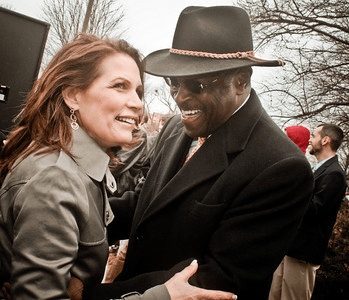
There, Ms. Bachmann, a congresswoman from Minnesota, was doing a radio interview. Mr. Cain put his arm around her and smiled for the assembled cameras. “She can run, that’s great,” he boomed. “The more the merrier. She’s a great friend. I have a lot of respect for her.”

Ms. Bachmann, finally allowed a word in, joked, “That’s why he supports me.”

“Did you all get what you need for pictures?” Mr. Cain asked. “Here, let me give you one more.”

He put his arm around Ms. Bachmann again, leaned far forward and smiled bigger than anyone in the room.

She’s Mrs. Bachmann, you stupid New York Times person. Oh well.

And I actually found the pictures:
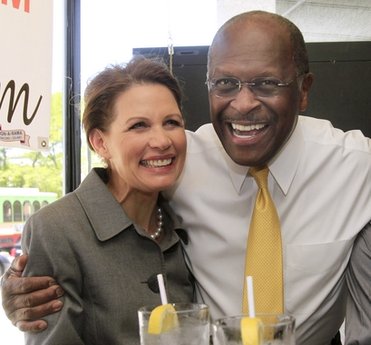
Cain/Bachmann 2012?
Cain/Bachmann 2012?

And another from earlier:

Bachmann/Cain 2012?
Bachmann/Cain 2012?

If I get Bachmann/Cain, or even Cain/Bachmann, I am going to be a very happy Knight. I’ll be Summery Knight, then. Well… for a little while. Then back to being gloomy and judgmental.

Gallup reports that Bachmann and Cain have the highest positive intensity scores with voters.

Excerpt:

Herman Cain and Michele Bachmann continue to earn the highest Positive Intensity Scores, at 25% and 21%, respectively. Below these two, several other candidates have Positive Intensity Scores in the 14 to 16 range, including two of the best-known candidates, Sarah Palin and Mitt Romney, and two who are less well-known — Tim Pawlenty and Rick Santorum.

That’s good news!

Fiscal assessments of the candidates

You can read Club For Growth’s assessment of Herman Cain’s fiscal conservatism. Club For Growth had mixed reviews of Newt Gingrich and Tim Pawlenty, but they are very positive about Herman Cain, based on his speeches. Cain does not have a record, so he is a bit more of a gamble. We don’t know if he would do what he says! But if he does what he says then he gets an A grade. By the way, these reports are excellent to print out and leave them out on your desk. (Read them first). We need to be getting into discussions with people in the office NOW. Be passionate about these policies! Memorize them, understand them, and explain them.

Once again, Michele Bachmann is my first choice, then Herman Cain, then Tim Pawlenty. This is strictly on policy. You can learn more about Michele Bachmann in this post, in which I beg her to run for President.

Was Mahatma Gandhi really a good person?

From the Wall Street Journal. (H/T Thinking Matters New Zealand)

Excerpt:

  • Although credited with leading India to independence from Britain, Gandhi actually undermined this effort. Between 1900 and 1922, he ­suspended his civil disobedience at least three times, even though more than 15,000 supporters were in jail for the cause. (When Britain finally did withdraw from India, it was largely motivated by their anti-imperialist Prime Minister, Clement Attlee, and the fact that Britain was nearly bankrupt from the war.)
  • Gandhi was dangerously politically incompetent. He ­advised the Jews to adopt nonviolence toward the Nazis, and wrote a letter to ­Hitler starting with the words “My friend”. He also advised the Jews of Palestine to “rely on the goodwill of the Arabs”. Fortunately for their existence, the Jews ignored him.
  • As well as calling Hitler his friend, Gandhi and Mussolini got on well when they met in December 1931. Gandhi praised Mussolini’s “service to the poor, his opposition to super-urbanization, his efforts to bring about a coordination between Capital and ­Labour, his passionate love for his people.”
  • Gandhi was outstandingly racist, describing “the raw Kaffir” as someone “whose occupation is hunting and whose sole ambition is to collect a number of cattle to buy a wife, and then pass his life in indolence and ­nakedness,” and saying of white Afrikaaners, “We believe as much in the purity of races as we think they do.”
  • He was also a hypocrite on many levels. He prevented his son marrying a Muslim despite publicly promoting Muslim-Hindu unity. He denounced lawyers, railways and parliamentary politics, yet he was a professional lawyer who constantly used railways to get to meetings to argue that India ­deserved its own parliament. And although he is known for his hunger strikes, his official position was that these were “the worst form of coercion, which militates against the fundamental principles of non-violence” (in which he believed).
  • His views on nakedness and sexual chastity were also belied by his depraved behavior: when he was in his 70s he encouraged his ­17-year-old great-niece, Manu, to be naked during her “nightly cuddles” with him. After sacking several long-standing and loyal members of his 100-strong ­personal entourage who might disapprove of this part of his ‘spiritual quest’, he began sleeping naked with Manu and other young women also.
  • Despite being thought of as a peaceful man, he was vicious and callous. “There will be no tears but only joy if tomorrow I get the news that all three of you were killed,” he once told some of his workers. To a Hindu he once said, “I do not mind if each and every one of the 500 families in your area is done to death.” And he forced Manu, his niece (remember the “nightly cuddles”), to walk through a jungle known for harboring rapists—just so she could retrieve a pumice stone he liked to use on his feet. When she returned in tears, he “cackled” with laughter and said: “If some ruffian had carried you off and you had met your death courageously, my heart would have danced with joy.”
  • In 1908 he left his wife for a German man named Hermann Kallenbach. “Your portrait (the only one) stands on my mantelpiece in my bedroom,” he wrote to Kallenbach. “The mantelpiece is opposite to the bed.” Gandhi nicknamed himself “Upper House” and Kallenbach “Lower House.” The two pledged “more love, and yet more love—such love as they hope the world has not yet seen.”

People ask about what will happen to the good people who never hear of Jesus, but who among us is really good? We all need a Savior to be reconciled with God. None of us is morally perfect.

More about Gandhi from ABC News. Don’t believe everything you see in the movies.

Are Tea party conservatives more racist than liberal socialist Democrats?

From the Daily Caller.

Excerpt:

Typical opinion polls reported in the news average a response rate of under 20%, and some observers speculate that the real response rates for some prominent surveys may be as low as 1% of the people they contact. The General Social Survey, on the other hand, usually averages about a 70% response rate, the highest in the industry for a large-scale survey of the general U.S. public.

The most recent survey for which results were available when I began this project a few weeks ago was the 2008 survey. (For an updated analysis that includes more recent data, see the Author’s Update on the last page of this editorial.) It asked the question:

Some people think that the government in Washington is trying to do too many things that should be left to individuals and private businesses. Others disagree and think that the government should do even more to solve our country’s problems. Still others have opinions somewhere in between.

Where would you place yourself on this scale . . . ?

1— I strongly agree the government should do more
2—
3— I agree with both
4—
5— I strongly agree the government is doing too much

Thus, those who agree that “the government is doing too much” would choose 4 or 5.

And what is the result of this survey?

Social scientists usually measure traditional racism against African Americans by looking at the survey responses of white Americans only. Among whites in the latest General Social Survey (2008), only 4.5% of small-government advocates express the view that “most Blacks/African-Americans have less in-born ability to learn,” compared to 12.3% of those who favor bigger government or take a middle position expressing this racist view (Figure 2). We social scientists sometimes like to express things in relative odds, especially for small percentages. Here the odds of small government whites not expressing racist views (21-to-1 odds) is three times higher than the odds of big-government whites not being racist (7-to-1 odds).

But advocates of smaller government can be found among Democrats and Independents as well as Republicans. What happens if we compare Republicans who think Washington is doing too much with those who think that government should do more or take a middle position? The relationships I’ve just described only get stronger.

Figure 3 shows that, among whites, Republican advocates of smaller government are even less racist (1.3% believing that blacks have less in-born ability) than the rest of the general public (11.3% expressing racist views). Thus, in 2008 Republicans who believe that the government in Washington does too much have 10 times higher odds of not expressing racist views on the in-born ability question than the rest of the population (79-to-1 odds v. 7.9-to-1 odds).

What about conservative Republicans more generally, not just the ones who want a smaller government? Surely they must be more racist. Actually not. In 2008, only 5.4% of white conservative Republicans expressed racist views on the in-born ability question, compared to 10.3% of the rest of the white population.

As Figure 4 shows, this same pattern holds for white Democrats compared to white Republicans: in 2008 12.3% of white Democrats in the U.S. believed that African Americans were born with less ability, compared to only 6.6% of white Republicans.

[…]Data from self-reports in the General Social Survey appear to support the notion that those who oppose income redistribution are somewhat more altruistic in their behavior than redistributionists (e.g., donating money, looking after pets or plants while friends are away), a conclusion also reached by the economist Arthur Brooks.

Click through for the charts and more analysis.