
Tag Archives: Public Works

Senator Tom Coburn lists some bad examples of government waste

Here’s the story.

Excerpt:

Coburn, R-Muskogee, whose office regularly churns out reports mocking federal projects and programs, said Monday that “cutting wasteful and low-priority spending from the budget is not only sensible, but essential.”

“In today’s economy, we can’t afford to spend nearly $2 million to showcase neon signs no longer in use at Las Vegas casinos; nor can Congress and federal agencies afford to spend nearly $1 billion a year on unnecessary printing costs.”

The 100 projects cited on Monday tread some familiar ground for Coburn reports — road signs paid for with stimulus funds, research projects that sound like folly — and are mostly domestic. There is no mention of Iraq or Afghanistan, despite government reports documenting millions lost to fraud and waste.

Topping Coburn’s list is the conclusion of a FOX News story that the Department of Veterans Affairs spends $175 million each year to maintain buildings it can’t use, in some cases because they’re in such disrepair.

Other items on the list:

• $217,000 for a University of California and Stanford University study on when and why political candidates are ambiguous.

• $90,000 to fund promotion of the Vidalia onion, including $60,000 for a campaign timed to coincide with the release of a Shrek movie.

•  $2.5 million on the Census Bureau’s television ad that aired during the Super Bowl to promote the head-count but left many viewers scratching their heads in confusion.

• $465,000 for an international AIDS conference in Austria.

• $35 million paid in fraudulent Medicare and Medicaid claims to an alleged Armenian crime ring.

• $48 million for a streetcar system in Atlanta that runs the same route as the city’s subway system.

• $900,000 to settle sexual harassment claims against a former housing director in Philadelphia.

•  And $28 million to print “rarely used” paper copies of the Congressional Record.

Here’s a recent post from the Washington Examiner that compares Democrats and Republicans on pork barrel spending. (H/T Gateway Pundit via Muddling)

Excerpt:

Press coverage of the budget frenzy on Capitol Hill has suggested that pork-barrel earmark spending is still a bipartisan problem, that after months of self-righteous rhetoric about fiscal discipline, Republicans and Democrats remain equal-opportunity earmarkers.

It’s not true. A new analysis by a group of federal-spending watchdogs shows a striking imbalance between the parties when it comes to earmark requests. Democrats remain raging spenders, while Republicans have made enormous strides in cleaning up their act.

In the Senate, the GOP made only one-third as many earmark requests as Democrats for 2011, and in the House, Republicans have nearly given up earmarking altogether — while Democrats roll on.

The watchdog groups — Taxpayers for Common Sense, WashingtonWatch.com, and Taxpayers Against Earmarks — counted total earmark requests in the 2011 budget. Those requests were made by lawmakers earlier this year, but Democratic leaders, afraid that their party’s spending priorities might cost them at the polls, decided not to pass a budget before the Nov. 2 elections. This week, they distilled those earmark requests — threw some out, combined others — into the omnibus bill that was under consideration in the Senate until Majority Leader Harry Reid pulled it Thursday night. While that bill was loaded with spending, looking back at the original earmark requests tells us a lot about the spending inclinations of both parties.

In the 2011 House budget, the groups found that House Democrats requested 18,189 earmarks, which would cost the taxpayers a total of $51.7 billion, while House Republicans requested just 241 earmarks, for a total of $1 billion.

This is why stimulus spending, which is advocated by Democrats, costs jobs. Democrats waste money. They take money out of the job-creating sector of the economy, and they waste on government spending. If private companies wasted money like government, they would go out of business. Unfortunately, government can waste money like this all the time, and they just borrow more money. When you hear a Democrat say that they want to “invest” money they stole from businesses and workers in order to “stimulate” the economy, what they are talking about is wasting money and/or buying votes from their favored special interest groups.
Republicans block Democrats’ attempt to raise taxes on job creators

From Fox News.

Excerpt:

Senate Republicans on Saturday voted against President Obama’s plan to extend the Bush tax cuts to only the middle class in a pair of votes Democrats are seizing to paint the GOP as guardians of the rich.

The Senate voted 53-36 to extend all expiring tax cuts on individuals with incomes of less than $200,000 a year and married couples making less than $250,000 — seven shy of the required 60 to advance.

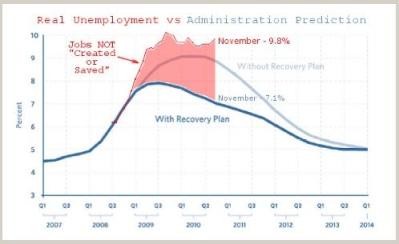
Now keep in mind that “the rich” are the very people who own the small businesses that create most of the jobs. That is why constant slamming of the rich with taxes and health care mandates has raised the unemployment rate to 9.8% and kept it above 9% for 19 months – a record never before seen in the history of the country. When Obama says “the wealthiest 2%”, you need to hear “9.8% unemployment”. The wealthy are the ones who create the jobs. Bash the wealthy, and you get fewer jobs.

Obama says:

President Obama said he was “very disappointed” in the Senate’s verdict.

“Those provisions should have passed,” he said.”It makes no sense to to hold tax cuts for the middle class hostage to permanent tax cuts for the wealthiest 2 percent of Americans especially when those high-income tax cuts would cost an additional $700 billion that we don’t have and would add to our deficit.”

“But with so much at stake, today’s votes cannot be the end of the discussion,” he said. “It’s absolutely essential to hardworking middle class families and to the economy to make sure their taxes don’t go up on Jan. 1.”

But the truth is:

Senate Minority Leader Mitch McConnell immediately slammed the political maneuvering by Democrats after the votes.

“According to the strange the logic of Democratic leaders in Congress, the best way to show middle class Americans that they care about creating jobs is to slam some of America’s top job creators with a massive tax hike,” he said on the Senate floor.

“Today’s vote was an affront to the millions of Americans who are struggling to find work and a clear signal that Democrats in Congress still haven’t got the message from the November elections,” he said.

Obama is anti-middle class because he is anti-small-business, and small businesses hire the middle class.

Democrats don’t understand how jobs are created

In fact, the unemployment rate has been steadily rising since the Democrats took control of the spending process by winning the House and Senate in January 2007. The left side of this graph begins when Nancy Pelosi and Harry Reid took control of the House and Senate in January 2007.

Democrats took control of the economy in 2007

The chart doesn’t lie. When the Democrats control the budget, spending and unemployment rise a lot. When the Republicans controlled the House and Senate, the unemployment rate was 4.5%. These numbers do not lie. When they told you that more spending (the “recovery plan”) to their favored special interest groups will create private sector jobs, they lied. The numbers show that they lied.

People like Michele Bachmann actually OWN SMALL BUSINESSES and they HIRE AMERICAN WORKERS. People like Michele Bachmann should be in charge of the economy. Not people like Obama. Obama had a rich grandmother who paid for all his schooling at expensive private schools. He had his life handed to him on a silver platter. Michele Bachmann grew up poor.

Obama says “there’s no such thing as shovel-ready projects”

From the radically-leftist New York Times.

Excerpt:

While proud of his record, Obama has already begun thinking about what went wrong — and what he needs to do to change course for the next two years. He has spent what one aide called “a lot of time talking about Obama 2.0” with his new interim chief of staff, Pete Rouse, and his deputy chief of staff, Jim Messina. During our hour together, Obama told me he had no regrets about the broad direction of his presidency. But he did identify what he called “tactical lessons.” He let himself look too much like “the same old tax-and-spend liberal Democrat.” He realized too late that “there’s no such thing as shovel-ready projects” when it comes to public works. Perhaps he should not have proposed tax breaks as part of his stimulus and instead “let the Republicans insist on the tax cuts” so it could be seen as a bipartisan compromise.

It would have been nice to know that 2.7 trillion dollars and 8 million jobs ago.

Economics in One Lesson

Perhaps it is time to review Henry Hazlitt’s Economics in One Lesson, chapter 4, entitled “Public Works Mean Taxes”.

Excerpt:

Therefore, for every public job created by the bridge project a private job has been destroyed somewhere else. We can see the men employed on the bridge. We can watch them at work. The employment argument of the government spenders becomes vivid, and probably for most people convincing. But there are other things that we do not see, because, alas, they have never been permitted to come into existence. They are the jobs destroyed by the $10 million taken from the taxpayers. All that has happened, at best, is that there has been a diversion of jobs because of the project. More bridge builders; fewer automobile workers, television technicians, clothing workers, farmers.

Excerpt that the government, lacking a profit motive, is never as efficient as private business is in spending money – government wastes money that it never earned in the first place.

And consider Chapter 5 as well, entitled “Taxes Discourage Production”.

In our modern world there is never the same percentage of income tax levied on everybody. The great burden of income taxes is imposed on a minor percentage of the nation’s income; and these income taxes have to be supplemented by taxes of other kinds. These taxes inevitably affect the actions and incentives of those from whom they are taken. When a corporation loses a hundred cents of every dollar it loses, and is permitted to keep only fifty-two cents of every dollar it gains, and when it cannot adequately offset its years of losses against its years of gains, its policies are affected. It does not expand its operations, or it expands only those attended with a minimum of risk. People who recognize this situation are deterred from starting new enterprises. Thus old employers do not give more employment, or not as much more as they might have; and others decide not to become employers at all. Improved machinery and better-equipped factories come into existence much more slowly than they otherwise would. The result in the long run is that consumers are prevented from getting better and cheaper products to the extent that they otherwise would, and that real wages are held down, compared with what they might have been.

There is a similar effect when personal incomes are taxed 50, 60 or 70 percent. People begin to ask themselves why they should work six, eight or nine months of the entire year for the government, and only six, four or three months for themselves and their families. If they lose the whole dollar when they lose, but can keep only a fraction of it when they win, they decide that it is foolish to take risks with their capital. In addition, the capital available for risk-taking itself shrinks enormously. It is being taxed away before it can be accumulated. In brief, capital to provide new private jobs is first prevented from coming into existence, and the part that does come into existence is then discouraged from starting new enterprises. The government spenders create the very problem of unemployment that they profess to solve.

George W. Bush cut taxes in his first term and created 1 million NEW JOBS. Government spending is a job killer. Companies understand that government spending has to be paid for eventually, so they stop hiring people now to save the money for later tax increases.