
Tag Archives: Public Sector

Explosion at government-run Amuay refinery, nationalized by Venezuela in 1976

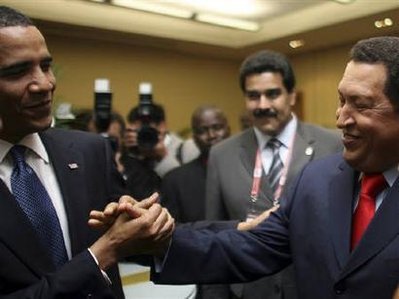
Are Barack Obama and Hugo Chavez very different?

In the United States, we’ve been seeing some efforts by the Marxist Obama administration to nationalize the auto industry and health care, too. This is what communists favor as the alternative to the free-market system. It makes sense, then, to look at how well the nationalization of assets, especially those owned by foreign-owned private companies, works out in the real world.

Let’s see:

The Creole Petroleum Corporation was an American oil company, formed in 1920 to produce fields on Lake Maracaibo, Venezuela.[1] The company was acquired by Standard Oil of New Jerseyin 1928. Until 1951 Creole Petroleum was the world’s number one oil producer.[2]

In 1950, Creole opened its refinery at Amuay.[3] This is now a part of the Paraguaná Refinery Complex.

The Venezuelan assets of Creole Petroleum Corporation were nationalized along with those of other foreign oil firms on January 1, 1976, becoming part of Lagoven, a Venezuelan government-owned operating company.[4]

And here is the latest triumph of Marxist economics in Venezuela:

A huge explosion rocked Venezuela’s biggest oil refinery early Saturday, killing at least 24 people and injuring more than 80 others in the deadliest disaster in memory for the country’s key oil industry.

Balls of fire rose over the Amuay refinery, one of the largest in the world, in video posted on the Internet by people who were nearby at the time.

At least 86 people were injured, nine of them seriously, Health Minister Eugenia Sader said at a hospital where the wounded were taken. She said 77 people suffered light injuries and were released from the hospital.

Officials said those killed included a 10-year-old boy, but that most of the victims were National Guard troops stationed at the refinery.

Filthy capitalist dogs! Making money on the backs of the poor workers! Making them work in filthy, unsafe – oh, wait. When workers are left free to take their skills to a number of private employers, then those employers are pressured to provide them with better working conditions, wages and benefits. Otherwise the employees leave for better companies. The only problem is that it doesn’t work if all the industries are state-run monopolies. Then, you just get KA-BOOM!

All you have to do to understand economic systems is to compare capitalist Chile with communist Venezuela. The people are the same, and both started out poor. One embraced free trade and privatization, and now that one is rich. The other one gets Chernobyl explosions because they elected a Marxist.

Venezuela’s economic policy is the same economic policy that Barack Obama wants to force on us with his takeover of General Motors, his frequent bailouts, his give-aways to campaign fundraisers, his blocking of free trade deals, his heavy-handed anti-business regulations, and his other intrusions into the private sector. Our entire economy is going KA-BOOM right now because of Marxism.

Related posts

Democrats join Republicans in demanding probe into Delphi pension scandal

From the Daily Caller.

Excerpt:

Twelve lawmakers wrote to House oversight committee Chairman Rep. Darrell Issa and Senate Homeland Security and Governmental Affairs Committee Chairman Sen. Joe Lieberman asking that they expand current probes into a Department of Treasury scandal that left 20,000 non-union Delphi retirees without their pensions after the 2009 General Motors bailout.

The members — Sens. Rob Portman of Ohio, Thad Cochran of Mississippi and Roger Wicker of Mississippi, and Reps. Pat Tiberi of Ohio, Steve Stivers of Ohio, Mike Kelly of Pennsylvania, Dan Burton of Indiana, Bill Johnson of Ohio, Paul Gosar of Arizona, Marcy Kaptur of Ohio and Gregg Harper of Mississippi — are led by Ohio Republican Rep. Mike Turner.

“We are writing to request that the committees which you chair submit additional requests for documents from the Department of the Treasury and the Pension Benefit Guaranty Corporation (PBGC) on matters pertaining to the unjust termination of Delphi salaried retiree pensions in the federal government’s bailout of General Motors,” the lawmakers wrote. “As you may know, the pensions of Delphi salaried retirees were significantly reduced in the aftermath of the bailout, while their union counterparts were made whole. These retirees, regardless of labor affiliation or not, spent their careers working alongside one another and should not be treated differently in their retirement. This decision of the Auto Task Force, Treasury, and the PBGC continues to affect roughly 20,000 current and future retirees across the nation.”

The bipartisan support for this renewed investigation call — Kaptur is a Democrat — undercuts the Obama campaign’s accusations that his GOP rival, Mitt Romney, and Turner are trying to “politicize” this scandal.

Portman, who’s widely considered to be on Romney’s short list of potential vice presidential candidates, said in a statement that he has “met with these hard-working Ohioans who lost a significant portion of their pension benefits while other retirees from the same company received far better treatment.”

“The idea that the administration played politics with their pensions is beyond disappointing, and it deserves answers,” Portman said. “The administration’s decisions have caused pain and loss to thousands of workers and their families as a result of their reduced benefits. This matter deserves continued scrutiny from Congress, and the administration must be called upon to account for its decisions.”

Remember way back in 2009 about how the auto bailouts favored the unions over the private sector creditors who would normally be paid more of whatever could be saved? This isn’t the first time that the private sector – which funds the government –  was screwed by the government. But “the private sector is fine”.

How did the Reagan tax cuts and Bush tax cuts affect unemployment?

Consider this article by the Cato Institute, a libertarian think tank, which discusses how the Reagan tax cuts affected the unemployment rate.

Excerpt:

In 1980, President Carter and his supporters in the Congress and news media asked, “how can we afford” presidential candidate Ronald Reagan’s proposed tax cuts?

Mr. Reagan’s critics claimed the tax cuts would lead to more inflation and higher interest rates, while Mr. Reagan said tax cuts would lead to more economic growth and higher living standards. What happened? Inflation fell from 12.5 percent in 1980 to 3.9 percent in 1984, interest rates fell, and economic growth went from minus 0.2 percent in 1980 to plus 7.3 percent in 1984, and Mr. Reagan was re-elected in a landslide.

[…]Despite the fact that federal revenues have varied little (as a percentage of GDP) over the last 40 years, there has been an enormous variation in top tax rates. When Ronald Reagan took office, the top individual tax rate was 70 percent and by 1986 it was down to only 28 percent. All Americans received at least a 30 percent tax rate cut; yet federal tax revenues as a percent of GDP were almost unchanged during the Reagan presidency (from 18.9 percent in 1980 to 18.1 percent in 1988).

What did change, however, was the rate of economic growth, which was more than 50 percent higher for the seven years after the Reagan tax cuts compared with the previous seven years. This increase in economic growth, plus some reductions in tax credits and deductions, almost entirely offset the effect of the rate reductions. Rapid economic growth, unlike government spending programs, proved to be the most effective way to reduce unemployment and poverty, and create opportunity for the disadvantaged.

The conservative Heritage Foundation describes the effects of the Bush tax cuts.

Excerpt:

President Bush signed the first wave of tax cuts in 2001, cutting rates and providing tax relief for families by, for example, doubling of the child tax credit to $1,000.

At Congress’ insistence, the tax relief was initially phased in over many years, so the economy continued to lose jobs. In 2003, realizing its error, Congress made the earlier tax relief effective immediately. Congress also lowered tax rates on capital gains and dividends to encourage business investment, which had been lagging.

It was the then that the economy turned around. Within months of enactment, job growth shot up, eventually creating 8.1 million jobs through 2007. Tax revenues also increased after the Bush tax cuts, due to economic growth.

In 2003, capital gains tax rates were reduced. Rather than expand by 36% as the Congressional Budget Office projected before the tax cut, capital gains revenues more than doubled to $103 billion.

The CBO incorrectly calculated that the post-March 2003 tax cuts would lower 2006 revenues by $75 billion. Revenues for 2006 came in $47 billion above the pre-tax cut baseline.

Here’s what else happened after the 2003 tax cuts lowered the rates on income, capital gains and dividend taxes:

  • GDP grew at an annual rate of just 1.7% in the six quarters before the 2003 tax cuts. In the six quarters following the tax cuts, the growth rate was 4.1%.
  • The S&P 500 dropped 18% in the six quarters before the 2003 tax cuts but increased by 32% over the next six quarters.
  • The economy lost 267,000 jobs in the six quarters before the 2003 tax cuts. In the next six quarters, it added 307,000 jobs, followed by 5 million jobs in the next seven quarters.

The timing of the lower tax rates coincides almost exactly with the stark acceleration in the economy. Nor was this experience unique. The famous Clinton economic boom began when Congress passed legislation cutting spending and cutting the capital gains tax rate.

Those are the facts. That’s not what you hear in the media, but they are the facts.