Tag Archives: Protectionism

Environmentalists and protectionists block economic growth in Puerto Rico

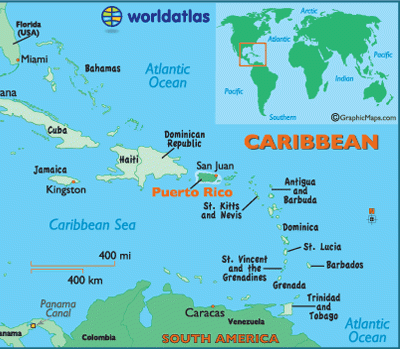
Puerto Rico Map
Puerto Rico Map

Here’s a story from Mary Anastasia O’Grady at the Wall Street Journal. She interviewed Puerto Rican Gov. Luis Fortuño and learned about his plan to boost the island’s economic growth.

Excerpt:

If [Luis Fortuño’s] plan to boost the island’s competitiveness by switching electricity generation from oil to natural gas is to succeed, he’s going to need relief from the pernicious 1920 Jones Act. It prohibits any ship not made in the U.S. from carrying cargo between U.S. ports. There are no liquefied-natural-gas (LNG) tankers made in the U.S. Unless Puerto Rico gets a Jones Act exemption, it cannot take advantage of the U.S. natural gas bonanza to make itself more competitive.

The Jones Act is good if you are a union shipbuilder who doesn’t like competition, or a member of Congress who takes political contributions from the maritime lobby. But it’s bad if you are a low-income Puerto Rican who needs a job. And there are plenty of those.

Puerto Ricans are American citizens but they are significantly poorer than the rest of the country. Per capita income on the island in 2010 was roughly $16,300 compared to just over $47,000 for the nation as a whole.

Life on the island is also expensive, in part because of the high price of electricity, 68% of which is produced using imported oil. The governor’s office says that the price of electricity here went up 100% from 2001 to 2011.

[…][B]ringing down high energy costs remains a fundamental challenge, and one that is exacerbated by new costly federal regulations on emissions that would require the installation of scrubbers on oil-fired electricity plants. To meet those regulations affordably, Mr. Fortuño wants to convert the island’s oil-fired plants to cheaper, cleaner natural gas. To that end, he proposes a pipeline from the southern LNG terminal at Punta Guayanilla across the island to San Juan. The U.S. Army Corps of Engineers has assessed the proposal and said it would produce no significant environmental impact.

It sounds like a plan to help the poor and unemployed. There are only two problems. First, the Sierra Club and local environmentalists have ginned up fears about the project and promised to sue to stop construction. Second, the Jones Act is still in the way.

The governor admits that his administration could have done a better job communicating the pipeline plan to Puerto Ricans, but he also points out that “some of the same groups that have opposed the pipeline have also opposed wind-power and solar projects. They are opposing everything, including waste-to-energy” projects which he maintains are less polluting than landfills.

Mr. Fortuño says that he expects Washington to give him a carve-out for LNG tankers, but he doesn’t have it yet. He also says that a large part of the environmentalist push-back is political, suggesting to me that he ought to be more worried than he is. This kind of politics needs to preserve the status quo of the welfare state. And that implies blocking Mr. Fortuño’s development agenda no matter what it means to the poor.

I thought this article was a neat little way to see how groups of people who understand economics try to pull themselves up out of messes, and who stands in their way. It’s something to think about when you think about poverty – what will really work to lift people out of poverty? And what is the real effect of labor unions and environmentalists on economies?
House passes free trade deals with Colombia, South Korea and Panama

From Investors Business Daily.

Excerpt:

The biggest free-trade pacts since NAFTA were passed by the House Wednesday night, with the Senate likely to follow. As a result, America will reap 250,000 jobs and $13 billion in exports. Where are the celebrations?

The strangest aspect of the passage of free trade treaties with Colombia, South Korea and Panama, with final votes taken after five long years, is the disconnect between the big economic gains expected for the U.S., and the reticence of congressional Democrats and the White House, both of which finally got something right on the economy.

As we went to press, the pacts had been passed by the House, with the Senate expected to vote soon. With bipartisanship like that, lawmakers should be cheering loudly for a true “jobs bill” that costs nothing.

Yet as a Democratic aide told Roll Call on Wednesday, “Republicans don’t want to give the president a victory, Democrats are split and everyone is distracted.”

Excuse us, but this is some of the best economic news in three years. It deserves a victory dance.

It’s a fact these treaties will bring new orders for factories, save family farms, strengthen strategic alliances with countries well worth having as allies, and open up breathtaking new opportunities in fast-growing markets. It needs to be acknowledged.

[…]President Obama paid lip service to the treaties, but wasted nearly three years attaching protectionist amendments and dithering. It harmed the economy and never changed this fact: Free trade had to pass if there was to be a real recovery.

Economist Greg Mankiw of Harvard University lists free trade as the #2 top item that economists of all ideological stripes agree on. This is a no-brainer.

Passing the free trade deals is important because it would make up for other anti-business policies of the Obama administration.

Excerpt:

Obama appointees at the National Labor Relations Board (NLRB) have not only blocked Boeing from making planes in South Carolina, but they have greased the speed of union elections, made decertification votes impossible, changed the requirement that a majority of workers vote for a union, and required almost every workplace in America to put posters up advising workers of their unionization rights.

The Obama Administration claims to want to double exports and support free trade, but it took it nearly three years to send the pending trade agreements with Panama, Colombia and South Korea to Congress. Which means that in all this time American companies have been paying higher tariffs for exports.

The Obama Administration has proposed 219 new rules affecting industries, each of which will cost at least $100 million to comply. While the Washington legal business is growing, every industry and business is affected, scared, and confused by the massive new proposals. Small businesses are especially overwhelmed and must hire lawyers to understand and comply with the massive amount of new regulation.

The Obama crown-jewel “achievements” of the new health care and Dodd-Frank financial laws adversely affect almost every American business, totaled almost 3,000 pages of statutory language, and will result in huge costs on employers.

Let’s hope the Senate passes these deals and Obama signs it. We need lower priced goods in a recession, and we need more markets to sell into. If this passes, it will be the first pro-growth action taken by the administration in three years.

A closer look at Michele Bachmann’s record on fiscal policy

Michele Bachmann: On the Issues

An analysis of Michele Bachmann’s record on economic policy, courtesy of the Club for Growth.

Summary:

Congresswoman Michele Bachmann was first elected to Congress in 2006 after serving in the Minnesota State Senate from 2001 to 2006. If elected President, she would be the first woman President and the second person elected directly from the U.S. House of Representatives since James Garfield. Congresswoman Bachmann received a 100% score in the Club for Growth’s 2010 scorecard and has a lifetime score of 94%. The average house Republican score from 2007-2010 was 78%. Congresswoman Bachmann also has a lifetime score of 94% from the Minnesota Taxpayers League during the time she served in the State Senate. The average score for Republican State Senators during that time was 76%.

These guys do the most thorough job of anyone vetting the candidates – they go over every bill, every speech, every vote, every editorial – even campaign advertisements.

The report covers the following areas:

  • TAXES
  • SPENDING
  • ENTITLEMENT REFORM
  • REGULATION
  • FREE TRADE
  • SCHOOL CHOICE
  • TORT REFORM
  • POLITICAL FREE SPEECH
  • POLITICAL ACTIVITY & ENDORSEMENTS

Excerpt:

SCHOOL CHOICE
The Club for Growth supports broad school choice, including charter schools and voucher programs that create a competitive education market including public, private, religious, and non-religious schools.  More competition in education will lead to higher quality and lower costs.
Congresswoman Bachmann not only has a strong record on school choice, she is the first major presidential candidate to actually found a charter school. In fact, Congresswoman Bachmann co-founded the first K-12 charter school in the nation, New Heights Charter School back in 1993.  Her record on school choice has, predictably, been flawless since then.
In 2011, Bachmann voted to re-establish the DC school voucher program.  As a member of the State Senate, Bachmann voted to prohibit teacher strikes during the school year.  She also voted to allow parents to use education tax credits for tuition at private schools.  She’s introduced legislation to make foster children eligible for education vouchers.
As far back as 2003, Bachmann was fighting the No Child Left Behind Act, filing a bill in the Minnesota legislature that would have prohibited the Dept. of Children, Families and Learning or any other state agency “from entering into a contract or other agreement under the provisions of the No Child Left Behind Act of 2001, unless the financial consequences to the state and each school district have been identified.”  Another bill, S.F. 1921, “requires all state plans, agreements and contracts associated with NCLB compliance to be nullified and revoked on June 1, 2004, unless the Legislature specifically affirms implementation of the federal law by that date.”

Conclusion:

With very few exceptions, Congresswoman Bachmann has supported pro-growth policies throughout her career. She especially deserves praise for her consistent defense of school choice. After reviewing her record, we are confident that Congresswoman Bachmann would be a pro-growth President.

For my social conservative friends: please print out the paper and read it. These guys are not indifferent to your concerns at all.

Pat Toomey and the Club for Growth

The past director of the Club for Growth is current Pennsylvania senator Pat Toomey.

Here’s a blurb from his web site:

Pat is pro-life and believes that children should be welcomed into the world and protected by its laws.

While reasonable people may differ on the question of abortion rights, we should all be able to agree on policies that encourage adoption over abortion, that avoid taxpayer funding of abortions, and that allow parental involvement in decisions that involve minors. As a senator, Pat will support policies that further these important goals.

Pat also believes the tradition of marriage is sacred and is best defined as between a man and a woman. As a congressman, Pat voted to protect the institution of marriage in many ways. For example, Pat voted to reduce the tax penalty on married couples and will support similar policies as a U.S. senator. Throughout his time in Congress, Pat voted for legislation to protect innocent life, strengthen marriage, and protect the traditional values upon which this country was founded.

His voting record on abortion:

  • Voted YES on making it a crime to harm a fetus during another crime. (Feb 2004)
  • Voted YES on banning partial-birth abortion except to save mother’s life. (Oct 2003)
  • Voted YES on forbidding human cloning for reproduction & medical research. (Feb 2003)
  • Voted YES on funding for health providers who don’t provide abortion info. (Sep 2002)
  • Voted YES on banning human cloning, including medical research. (Jul 2001)
  • Voted YES on banning Family Planning funding in US aid abroad. (May 2001)
  • Voted YES on federal crime to harm fetus while committing other crimes. (Apr 2001)
  • Voted YES on banning partial-birth abortions. (Apr 2000)
  • Voted YES on barring transporting minors to get an abortion. (Jun 1999)
  • Rated 0% by NARAL, indicating a pro-life voting record. (Dec 2003)

And on marriage:

  • Voted YES on establishing nationwide AMBER alert system for missing kids. (Apr 2003)
  • Voted YES on reducing Marriage Tax by $399B over 10 years. (Mar 2001)
  • Rated 100% by the Christian Coalition: a pro-family voting record. (Dec 2003)

This is the record of the former leader of the most fiscally conservative PAC. The most pro-business group. The most anti-spending group.

Fiscal conservatives are more socially conservative than you think. If you are a social conservative, but not a fiscal conservative, then you should print out the paper on Michele Bachmann, a radical social conservative, and see how these fiscal conservatives at the Club for Growth judge what counts as fiscally conservative. It might be the case that fiscally conservative positions actually dovetail nicely with socially conservative positions. I think they do.

Campaign speeches, interviews and debates

Speeches:

Reactions from her recent debate performance:

Profiles of Michele Bachmann:

Michele Bachmann on television news

Let Americans spend their own money

Time to prioritize spending

Obama’s plan is to raise your taxes

Michele Bachmann in the legislature

Against socialism:

For economic growth:

Against ACORN funding: