I watched this about a half-dozen times so far. It’s awesome! I love it!
I’m sure it will come as no surprise to everyone that I come out on Hayek’s side on this debate. I like the Austrian School of Economics. I’m a supply-sider. I believe in the free market, free trade, private property, saving and investing, entrepreneurship, distributed power, small government, and freedom from government intervention.
Who was F.A. Hayek?
F.A. Hayek was the greatest economist of the 20th century. He won the Nobel prize in Economics. His greatest works are “The Road to Serfdom”, “The Constitution of Liberty”, and “The Fatal Conceit”. If you take a look at the list of the top 10 books that all conservatives should read, you will see that The Road to Serfdom is #1 and The Constitution of Liberty is #10 on the list.
This is part 1 of a 3 part series produced for PBS called “The Command Heights: The Battle for the World Economy”. But the only part you need to watch to learn about Keynes and Hayek is part 1, which is 2 hours long.
This video is basically a history of the 20th century from the point of view of an economist. This is a must see for you young people who don’t know who Reagan and Thatcher were. These two leaders were the greatest defenders of freedom in the 20th century, along with Winston Churchill. And they’re both solid Christians, acting from a Christian and capitalist worldview that valued liberty, security and prosperity.
Today, Stephen Harper, the prime minister of Canada, best embodies the free-market, freedom-loving ideas of Hayek, while Barack Obama embodies the big-government, deficit-spending ideas of Keynes. Guess which economy is doing better?
China extended its lead over the U.S. as the world’s biggest auto market in November, with production and sales both surpassing 1 million vehicles, and India saw sales jump 71.9-percent.
[…]China’s auto market is sizzling, thanks largely to tax cuts and subsidies aimed at supporting the industry and encouraging use of more fuel-efficient vehicles. The boom has clinched China’s status as the world’s biggest vehicle market due to languishing sales in the U.S.
[…]The surge is also a sign of how the Indian consumer — encouraged by government tax cuts, a big disbursement of back pay for government employees and falling interest rates — is fueling economic growth in Asia’s third-largest economy.
As everyone knows, the Democrats chose to bail out auto companies with taxpayer money and reward people with taxpayer money for destroying fully functional vehicles. And we all know how well that has worked out.
Chile poised to jump from the third world to the first world
Chile is expected to win entry to OECD’s club of developed countries by Dec. 15 — a great affirmation for a once-poor nation that pulled itself up by trusting markets. One thing that stands out here is free trade.
[…]It’s not like Chile was born lucky. Only 30 years ago, it was an impoverished country with per capita GDP of $1,300. Its distant geography, irresponsible neighbors and tiny population were significant obstacles to investment and growth. And its economy, dominated by labor unions, wasn’t just closed, but sealed tight.
In the Cato Institute’s 1975 Economic Freedom of the World Report it ranked a wretched 71 out of 72 countries evaluated.
Today it’s a different country altogether. Embracing markets has made it one of the most open economies in the world, ranking third on Cato’s index, just behind Hong Kong and Singapore. Per capita GDP has soared to $15,000.
Besides its embrace of free trade, other reforms — including pension privatization, tax cuts, respect for property rights and cutting of red tape helped the country grow not only richer but more democratic, says Cato Institute trade expert Daniel Griswold.
But the main thing, Griswold says, is that the country didn’t shift course. “Chile’s economy is set apart from its neighbors, because they have pursued market policies consistently over a long period,” he said. “Free trade has been a central part of Chile’s success.”
I gave my Dad my copy of “Money, Greed and God” by Jay Richards, and although he thought that it started out slow, he’s warmed up to it. He calls me on the phone at least twice a day, and last night he alerted me to this web site, where you can track each countries average citizen’s life span and per-capita GDP over time. My Dad was pretty liberal on economics before, so naturally I’ve been working on him with lots of introductory books on economics. He’s read about a dozen now, and Thomas Sowell is his favorite.
Anyway, my Dad says that this is what a country needs to succeed:
free trade with other nations
the rule of law
low judicial activism
low tax rates
private property protections
currency not threatened by inflation
low government spending
minimal regulation of commerce
And at that web site, you can track the success of countries like Singapore and Hong Kong, which embrace conservative small government free market fiscal policies, and compare them with countries like Zimbabwe and North Korea, which embrace big government protectionist fiscal policies. Countries fail because they adopt the wrong policies. They succeed when they adopt the right policies. It doesn’t matter how poor they start, if they have the right policies, they grow rich over time.
Why are the Democrats so incompetent on economic policy?
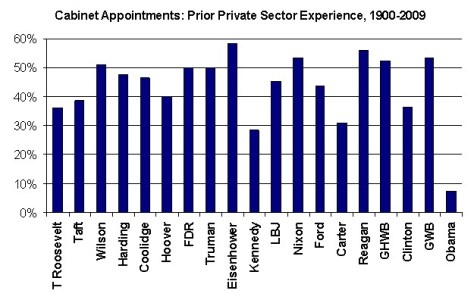
Well, it’s because there is almost no one in the Obama socialist regime who has ever run a business or worked in a business. Check out this graphic. (H/T Flopping Aces)
Hunger is spreading while the number of homeless families is increasing as a result of the recession and other factors, according to a report on Tuesday.
The U.S. Conference of Mayors said cities reported a 26 percent jump in demand for hunger assistance over the past year, the largest average increase since 1991.
Middle-class families as well as the uninsured, elderly, working poor and homeless increasingly looked for help with hunger, which was mainly fueled by unemployment, high housing costs and low wages.
Democrats really don’t know what they are doing. It’s like putting pre-schoolers in charge of Amazon.com. It doesn’t work. Their ivory tower, silver-spoon worldview cannot comprehend real-world, grown-up complexities. So long as the Democrats continue to attack the businesses that employ citizens while redistributing wealth from people who produce to people who vote Democrat, our economic troubles will continue.
The Mexican president shut down a money-losing state-owned electrical utility, taking a labor union down with it. The union is howling, but the shutdown is one of the best things to happen to Mexico.
For months, the SME union had been trying to intimidate Felipe Calderon into continuing to subsidize the Luz y Fuerza del Centro electrical distributor, even as its $16 billion in revenue didn’t come close to its $32 billion in salaries and pension costs.
And why not? The union had done the same thing to all the other reform-minded Mexican presidents and saw all of them back off.
But it didn’t have a clue about Calderon, a former energy minister who on Sept. 24 warned the union to cut costs or else. The union ignored the warning and tried to intimidate Calderon with political tactics, whipping up fear that he intended to privatize the utility. Calderon had a better idea: shut down the utility.
The stunning decision to disband the company and lay off 44,000 workers effectively ends the SME union.
Yes, he’s a conservative.
Check out the effects:
It took just hours for Mexico’s peso to rise on news that a huge financial burden had been lifted from the government. Luz y Fuerza del Centro was a money pit that cost the government $42 billion a year in subsidies. Analysts said the shutdown would save $25 billion — enough to enable the government to scrap a planned 2% tax hike.
The improved fiscal picture will keep interest rates in place and avert a ratings downgrade. All of this increases Mexican purchasing power, helps the government finance itself and releases money for lending and investment in a new economy.
Read the whole article. He sent in troops.
It’s a proud day for Mexico. Like Canada, Mexico is on the way up. But the United States is on the way down. Canada elected a conservative, and Mexico elected a conservative. Only the United States was blind and ignorant enough to elect a radical socialist.
One other thing: I was having lunch with one of my agnostic co-workers today, who was following this story. He was concerned that Mexico would start up a new company to take the place of the old, inefficient one. But that is not the case. The Mexican government has decided to liquidate the inefficient company and pass its customers to another firm.


 WINTERY KNIGHT