Tag Archives: Propaganda

Fact-checking the fact-checkers: is Politifact reliable or biased?

Politifact is a web site run by some left-wing journalists at the Tampa Bay Times. As you might expect from academic studies of media bias, their content might as well be written by the Democrat Party. But it’s not enough to just declare Politifact a Democrat propaganda operation – I need to actually give you details and examples. And so I will, in the rest of this post.

Let’s start with two recent examples, then I’ll show you the worst example of media bias I have ever seen from Politifact.

Missouri Senate Race

Here’s one analysis from the Daily Wire:

On Tuesday, Politifact, which purports to be a neutral fact-checking website but in fact leans heavily to the left, got caught protecting a member of the Democratic Party: Democratic Missouri Sen. Claire McCaskill.

Politifact took issue with the ad from The Senate Leadership Fund, a pro-Republican super PAC, that claimed that McCaskill said “normal people” could afford private planes.

[…]After they were corrected, Politifact acknowledged the mistake, writing,

Initially, we published this fact-check with a rating of False, because based on the video available, it did not appear that McCaskill was talking about private planes. After publication, we received more complete video of the question-and-answer session between McCaskill and a constituent that showed she was in fact responding to a question about private planes, as well as a report describing the meeting. We re-assessed the evidence, archived the original version here, and published the version you see here with a new rating of Half True. We apologize for the error.

Daily wire also linked to some more failed Politifact “fact checks”:  herehere, and here.

Arizona Senate Race

Politifact also screwed up their fact-check for the Arizona Senate race.

The Daily Caller explains:

PolitiFact incorrectly labeled it “mostly false” that Democratic Senate candidate Kyrsten Sinema “protested troops in a pink tutu” during its live fact-check of the Arizona Senate debate Monday night.

It’s an established fact that Sinema, a former Green Party activist who co-founded an anti-war group, wore a pink tutu at one of the multiple anti-war protests she attended in 2003.

“While we were in harm’s way, she was protesting our troops in a pink tutu,” Republican candidate Martha McSally, a former Air Force fighter pilot, said during Monday night’s debate.

Here’s their Politifact’s evaluation of McSally’s claim:

Who are you going to believe? Politifact, or your own eyes?

And here’s the photo of Kyrsten Sinema, protesting the troops, in a pink tutu:

Anti-war Democrat Senate candidate Kyrsten Sinema
Anti-war Democrat Senate candidate Kyrsten Sinema in a pink tutu

The Daily Caller notes:

A 2003 Arizona State University news article at the time described Sinema wearing “something resembling a pink tutu” at one of the protests.

[…]Sinema openly associated with fringe elements of the far-left during her anti-war activism.

She promoted an appearance by Lynne Stewart, a lawyer who was convicted of aiding an Islamic terrorist organization, in 2003.

Sinema also reportedly partnered with anarchists and witches in her anti-war activism and said she did “not care” if Americans wanted to join the Taliban.

Colonel Martha McSally, as I’ve blogged about before, is a former U.S. Air Force A-10 fighter pilot, and squadron commander. She logged a lot of hours leading actual combat missions against America’s enemies – the sorts of people who sell and rape Yazidi girls. She fought them.

And now for the big one: Politifact’s fact-checking of Obamacare.

Obama’s claims about Obamacare

Avik Roy, health care policy expert at Forbes magazine, wrote about Politifact’s assessment of Obama’s promise to Americans about keeping their health plans after Obamacare.

In 2008, before the presidential election, PolitiFact rated Obama’s claims about Obamacare “True”:

Roy writes: (links removed)

On October 9, 2008, Angie Drobnic Holan of PolitiFact published an article using the site’s “Truth-O-Meter” to evaluate this claim: “Under Barack Obama’s health care proposal, ‘if you’ve got a health care plan that you like, you can keep it.’”

And she concluded:

[…]…people who want to keep their current insurance should be able to do that under Obama’s plan. His description of his plan is accurate, and we rate his statement True.”

Roy notes:

PolitiFact’s pronouncements about Obamacare were widely repeated by pro-Obama reporters and pundits, and had a meaningful impact on the outcome of the election. Indeed, in 2009, PolitiFact won the Pulitzer Prize for its coverage of the 2008 campaign.

Here’s the screen capture from 2008:

Politifact caught with its pants on fire
Politifact says that everyone who likes their health care plan can keep it

Before the election, it’s true! And Obama got re-elected, because people believed that. But what happened after the election?

In 2013, after the 2012 election, PolitiFact rated Obama’s claims about Obamacare “Pants On Fire”:

Roy writes: (links removed)

On December 12, [2013] the self-appointed guardians of truth and justice at PolitiFact named President Obama’s infamous promise—that “if you like your health care plan, you can keep it”—its 2013 “Lie of the Year.”

[…][N]one of the key facts that made that promise “impossible” in 2008 had changed by 2013. The President’s plan had always required major disruption of the health insurance market; the Obamacare bill contained the key elements of that plan; the Obamacare law did as well. The only thing that had changed was the actual first-hand accounts of millions of Americans who were losing their plans now that Obamacare was live.

And the screen capture from 2013:
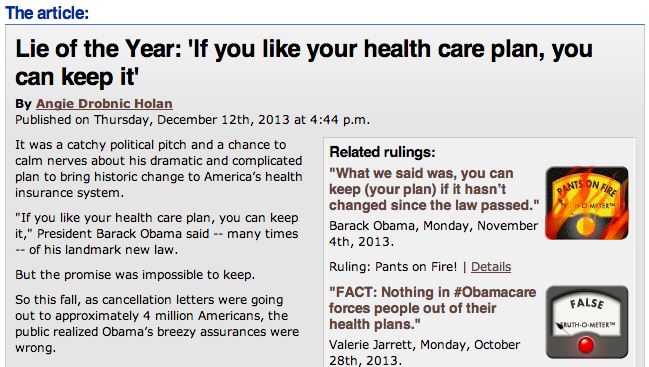
Politifact says: we were just kidding! Kidding!
Politifact said one thing before the election, and the opposite afterwards

So when Politifact rates a statement by a Democrat as true, what they really mean is that it’s pants-on-fire-false, but it’s election time so they don’t say that. It’s not like the critical assessments of Obamacare from health policy experts were not out there between 2007-2012. I know, because I blogged on every study and report on the predicted effects of the law that I could find. But the intellectually lazy journalism-major clowns at Politifact couldn’t be bothered to read those studies and reports.


What worldview does the maker of Star Wars movies want you to accept?

Lets take a closer look at a puzzle

I heard that there was a new Star Wars movie out, and that many of my Christian friends were going to see it. I passed on it, because there is something about that whole series that is creepy to me.

It looks like my concerns have some justification. I noticed a couple of reviews of the movie from Come Reason Ministries and Bnonn Tennant.

Here are 3 points that Lenny makes at Come Reason: (H/T Brian)

  1. Faith and tradition are disposable
  2. You don’t really need to put in years of work to be competent
  3. Men are inconsequential

All three points he makes seem to me to be exactly what the movie communicates, but I want to focus on point #3:

The most obvious message The Last Jedi sends is the one that Johnson clearly sought to send, that is that men offer nothing uniquely beneficial to society. The main protagonist, Rey, is female. So are all the leadership of the Resistance. Kylo Ren and Snoke are bad guys and are men. The double-dealing code-breaker is a man. The arms dealer is a man.

[…]As the film progressed, its agenda became more overt and more satirical. It is the women in this film who time and again save the day while the men just mess everything up. Poe is a hotshot who recklessly expends a number of lives taking out a ship that makes no difference in the rest of the film. His later plans are shown to be useless as Laura Dern’s Vice Admiral Holdo had a plan in the works all along.

[…]The egregiousness of this fiction is distressing. Men have long been the punching bags of media. War is an ugly thing, but it is and has always been men who time and again put their lives on the line to protect us from the evils that threaten our way of life. Men would willingly die to save women and children because they understood the weaker needed protection by the stronger. But now our society says the unique thing that makes men men is itself dangerous. It needs to be checked and men need to behave more like women. When you take away a man’s self-understanding as provider and protector, you rob him of his place in the world. Why then would men in this or future generations stand up and put their lives on the line when a real enemy?

I really like what he had to say here. Let’s look at one more from Bnonn Tennant, then I’ll say something. (H/T Wes)

Excerpt:

Throughout the second act, we are led to believe that Holdo [female] is an incompetent coward who has effectively frozen under pressure—stuck in a holding pattern rather than chancing anything risky in the hope of saving the fleet. An entire story arc is developed to support this assumption, where Poe [male] takes matters into his own hands with a dangerous hail-mary—building to a great anti-climax where this B-plot finally flops instead of paying off as the audience expects, and Holdo is revealed to have had a better plan all along. Many reviewers have expressed their frustration at how pointless this lengthy arc was—a misdirect and plot twist for the sake of saying “gotcha” rather than creating a payoff in terms of character development or plot advancement. But they are interpreting the movie through the framework of what makes a good story rather than what makes a good leftist porno. From that perspective, this was feminist gold.

In a scene reminiscent of Isaiah 55:8–9, the revelation of Holdo’s providence is unveiled—a mystery kept secret for long ages. We discover that she has been leading the fleet to a secret rebel base all along, sacrificing ships like chess pieces along the way in order to establish an unassailable stalemate in the end-game, rather than lose the king. (Sorry, the queen—in this chess game, the king and the queen swap places—obviously.)

It is the perfect feminine plan: one without fighting, in which the security of the collective is ensured. And by contrast, we see that Poe’s plan was reckless and foolhardy—pointlessly risking his life, and the life of Rose (who herself serves no particular purpose except to meet the racial-diversity-body-positivity quota), on a gambit that ultimately failed. His masculine impulse to solve the problem through direct action blinded him to the greater feminine wisdom. Worse, it nearly cost the entire Resistance their lives, as he sabotaged the female leadership through mutiny—and it did cost Holdo her life, as she had to buy the Resistance time after Poe’s plan backfired and alerted the First Order to the fleeing transport ships.

But why didn’t Holdo just confide her plan to Poe in the first place? Because she shouldn’t have needed to. Ultimately, Poe’s greatest sin was not his taking action—it was his taking action out of a failure to recognize and trust in the transcendence of feminine wisdom. His sin was faithlessness. Masculine arrogance prevented him from faithfully submitting to Holdo.

Women know how to do everything through intuition, and men with their “skills” and “experience” and “courage” and “problem-solving” just screw it all up.

I guess I want to say that this is why I don’t give money to Hollywood. I have not owned a television since around 2002. The only time I see what’s on television is in the gym, or at my parents’ house for family gatherings. I wouldn’t want to give my money to people like Clinton-donor and sexual harasser Harvey Weinstein or Kathleen Kennedy, the radical feminist president of Lucasfilm. I don’t like art that misleads, and pretty much everything that comes out of the entertainment industry these days misleads entertainment-addicts about what is real and true.

We are living in a culture where Christians have – for decades – failed to steward their money properly. Instead of refraining from funding secular leftist enemies in the entertainment industry, we have been giving them money for the rope that they are using to hang us. Politics is downstream from culture, and we made the culture by enriching secular leftists in the entertainment industry. Why? Because we couldn’t be bothered to hold every thought captive to Christ. We had to have our fun, and we are sure that God, if he exists, really just wants us to act to satisfy our desires so that we can be happy. We have to have our NFL football, our Comedy Channel news, our 50 Shades of Grey books, our Game of Thrones and our House of Cards. “Take our money”, we tell the secular left. If the special effects and CGI are good, then we’ll eat the sewage.

Maggie Gallagher does not like the message of the movie “La La Land”

Marriage and family
Marriage and family

I own a couple of books written by Maggie Gallagher, (“The Abolition of Marriage” and “The Case for Marriage”).

Here is an excerpt from her review of La-La Land, posted at The Stream: (excerpt contains spoilers)

The story begins as a classic story of two beautiful young people who meet in L.A. — a “city of magic, city of stars,” as the haunting lyric puts it, but clearly no longer City of Angels. Together they pursue their dreams both of love and success. Sebastian wants to become a jazz club singer. Mia wants to be a famous actress. The dramatic climax of the film comes after Sebastian at some personal sacrifice has given Mia the shot at her dreams, dreams she had given up on. And she chooses those dreams over him.

[…]In La La Land, [the director] chose to sharpen the clash between love and ambition. He does so in three ways:

  1. By making the choice to leave love behind the woman’s choice, rather than the man’s, brilliantly (in the commercial sense) situating the film among the emerging and popular female empowerment dramas in which women learn they do not need a man to be happy and fulfilled.
  2. By making the man a genuine hero — how else do you describe a guy who, after a woman has broken up with him and run home to Ohio to hide in the safety of her parents’ house, drives all night to deliver to her the message that she has a callback audition to a major movie? (She didn’t leave a forwarding address so he can’t just call her and let her know.)
  3. By portraying the obstacle to love as so feeble that it’s hard to imagine why it should destroy true love: Mia has to go to Paris for 6 months to make her movie. It’s her big break. Of course she has to go. But what is a love that cannot survive a few months in Paris? Is there no Skype? Are there no intercontinental flights?

One young online commentator described this twist on the iconic musical narrative, this “bittersweet ending,” as being more realistic, more grounded. I find it difficult to get into that young man’s head. How one can believe that however hard it is to find true love these days, becoming a famous Hollywood actress is a more “realistic” dream? Mia is not the loser for making this choice. She becomes famous and finds a new love, who seem a nice man, and they have a baby. She has it all, and has chosen correctly, because dreams are not transferable, but people can be replaced.

The message of the movie is clear: a good man is easier to find than a good career – especially a career that is fun, thrills and popularity. Follow your heart, and all these things will be added unto you.

She concludes with this:

[…]La La Land is a strange postmodern exercise in nostalgia, which tried to give us all the romantic feelings of the classic Hollywood musicals before ripping them away from us and substituting the idea that it is work alone on which we can rely.

If you Google La La Land, this synopsis pops up: “With modern day Los Angeles as the backdrop, this musical about everyday life explores what is more important: a once-in-a-lifetime love or the spotlight.”

I know a lot of Christian women who delay marriage because they want the spotlight.

Don’t give your money to Hollywood leftists

I don’t go to movie theaters except once every 1-3 years, because I don’t want to give Hollywood my money. If I like a movie, I buy it later on DVD for less than $10. The last movie I saw in the theater was “13 Hours”. I rarely see anything in the themes of popular movies (or popular music) that is true, good or beautiful. This movie does nothing to make me question my stewardship of my dollars. What I end up spending my money on these days is World War 2 and Korean War history audio books. Nothing in those books hurts my character. Reading military history helps me to be thankful and humble.

Consider Romans 12:1-2:

Therefore I urge you, brethren, by the mercies of God, to present your bodies a living and holy sacrifice, acceptable to God, which is your spiritual service of worship.

And do not be conformed to this world, but be transformed by the renewing of your mind, so that you may prove what the will of God is, that which is good and acceptable and perfect.

And Phil 4:8:

Finally, brethren, whatever is true, whatever is honorable, whatever is right, whatever is pure, whatever is lovely, whatever is of good repute, if there is any excellence and if anything worthy of praise, dwell on these things.

I don’t want to explain to God later why I gave the money he entrusted to me to radical leftists. What is frustrating to me about movies, (and entertainment in general, including far-left ESPN), is that all too often, my friends seem to think that my choice of entertainment is not something that God cares about.