Tag Archives: Privileged Planet

Guillermo Gonzalez lectures at UC Davis on the requirements for life

The 5 video clips that make up the full lecture.

The playlist for all 5 clips is here.

About the speaker

Guillermo Gonzalez is an Associate Professor of Physics at Grove City College. He received his Ph.D. in Astronomy in 1993 from the University of Washington. He has done post-doctoral work at the University of Texas, Austin and at the University of Washington and has received fellowships, grants and awards from such institutions as NASA, the University of Washington, the Templeton Foundation, Sigma Xi (scientific research society) and the National Science Foundation.

Learn more about the speaker here.

The lecture

Here’s part 1 of 5:

Habitability topics:

  • What is the Copernican Principle?
  • Is the Earth’s suitability for hosting life rare in the universe?
  • Does the Earth have to be the center of the universe to be special?
  • How similar to the Earth does a planet have to be to support life?
  • What is the definition of life?
  • What are the three minimal requirements for life of any kind?
  • Requirement 1: A molecule that can store information (carbon)
  • Requirement 2: A medium in which chemicals can interact (liquid water)
  • Requirement 3: A diverse set of chemical elements
  • What is the best environment for life to exist?
  • Our place in the solar system: the circumstellar habitable zone
  • Our place in the galaxy: the galactic habitable zones
  • Our time in the universe’s history: the cosmic habitable age
  • Other habitability requirements (e.g. – metal-rich star, massive moon, etc.)
  • The orchestration needed to create a habitable planet
  • How different factors depend on one another through time
  • How tweaking one factor can adversely affect other factors
  • How many possible places are there in the universe where life could emerge?
  • Given these probabilistic resources, should we expect that there is life elsewhere?
  • How to calculate probabilities using the “Product Rule”
  • Can we infer that there is a Designer just because life is rare? Or do we need more?

The corelation between habitability and measurability.

  • Are the habitable places in the universe also the best places to do science?
  • Do the factors that make Earth habitable also make it good for doing science?
  • Some places and times in the history of the universe are more habitable than others
  • Those exact places and times also allow us to make scientific discoveries
  • Observing solar eclipses and structure of our star, the Sun
  • Observing stars and galaxies
  • Observing the cosmic microwave background radiation
  • Observing the acceleration of the universe caused by dark matter and energy
  • Observing the abundances of light elements like helium of hydrogen
  • These observations support the big bang and fine-tuning arguments for God’s existence
  • It is exactly like placing observatories on the tops of mountains
  • There are observers existing in the best places to observe things
  • This is EXACTLY how the universe has been designed for making scientific discoveries

This lecture was delivered by Guillermo Gonzalez in 2007 at the University of California at Davis.

What is intelligent design?

Dr. Stephen C. Meyer explains the concept of intelligent design in a lecture, with lots of visual aids.

He is also the author of “Signature in the Cell“, the best book on intelligent design. (A Times Literary Supplement Book of the Year selection)

Related DVDs

Illustra also made two other great DVDs on intelligent design. The first two DVDs “Unlocking the Mystery of Life” and “The Privileged Planet” are must-buys, but you can watch them on youtube if you want, for free.

Here are the 2 playlists:

I also recommend “Darwin’s Dilemma”. All three of these are on sale from Amazon.com.
New study on tidal heating strengthens stellar habitability argument

Circumstellar Habitable Zone

Note: If you need a refresher on the habitability argument, click here.

Here’s an article entitled “Tidal heating shrinks the ‘goldilocks zone’: Overlooked factor suggests fewer habitable planets than thought”. It appeared in Nature, the most prestigious peer-reviewed science journal.

The gist of it is that tidal forces can alter orbits so that planets don’t spend all of their orbit in the habitable zone. If planets go outside the habitable zone, it damages their supply of liquid water, and any life chemistry going on in there is disrupted.

Excerpt:

A previously little-considered heating effect could shrink estimates of the habitable zone of the Milky Way’s most numerous class of stars — ‘M’ or red dwarfs — by up to one half, says Rory Barnes, an astrobiologist at the University of Washington in Seattle. That factor — gravitational heating via tides — suggests a menagerie of previously undreamt-of planets, on which tidal heating is a major source of internal heat. Barnes presented the work yesterday at a meeting of the American Astronomical Society’s Division on Dynamical Astronomy in Timberline Lodge, Oregon.

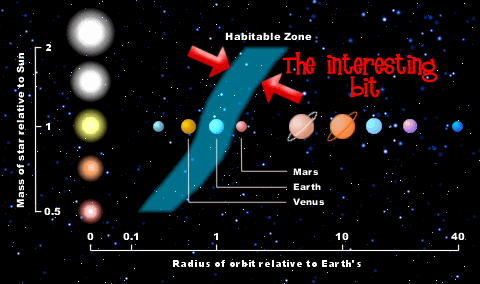
The habitable zone is the orbital region close enough to a star for a planet to have liquid water, but not so close that all of the water evaporates. For our Sun, the zone extends roughly from the inner edge of the orbit of Mars to the outer edge of that of Venus. For smaller, cooler stars, such as M-class dwarfs, the zone can be considerably closer to the star than Mercury is to the Sun. And because close-in planets are easier to spot than more distant ones, such stars have been a major target for planet hunters seeking Earth-like worlds.

There’s just one problem with finding habitable planets around such stars, says Barnes. Because tidal forces vary dramatically with the distance between a planet and its star, closer orbits also result in massively larger tidal forces.

Since planets do not have perfectly circular orbits, these tidal forces cause the planet to flex and unflex each time it moves closer to or further from its star; kneading its interior to produce massive quantities of frictional heat. Substantial heat can be produced, he added, with even slight deviations from a perfectly circular orbit. And, Barnes notes, other factors — such as the rate of the planet’s rotation and its axial tilt — can also influence heat production.

A similar tidal process makes Jupiter’s moon Io the most volcanic body in the Solar System. “I’m just scaling that Io–Jupiter system up by a factor of 1,000 in mass,” Barnes said at the meeting. “It’s the same process, on steroids.”

So, stars that are smaller and cooler will have a habitable zone that is closer to the star, exposing them to more tidal forces. More tidal forces makes their orbits less likely to stay circular – within the habitable zone around the star. These variations cause an increase in heat production on the planet. Too much heat means that the planet is unable to support liquid water on the surface, making it inhospitable for life. Therefore, solar systems with less massive stars can be ruled out as possible sites for life, because of these tidal forces.

Scientists discover that tides affect a planet’s habitability

Circumstellar Habitable Zone

Science Daily reports on a new factor that affects planetary habitability: tides. Specifically, tides can affect the surface temperature of a planet, which has to be within a certain range in order to support liquid water – a requirement for life of any conceivable kind.

Excerpt:

Tides can render the so-called “habitable zone” around low-mass stars uninhabitable. This is the main result of a recently published study by a team of astronomers led by René Heller of the Astrophysical Institute Potsdam.

[…]Until now, the two main drivers thought to determine a planet’s temperature were the distance to the central star and the composition of the planet’s atmosphere. By studying the tides caused by low-mass stars on their potential earth-like companions, Heller and his colleagues have concluded that tidal effects modify the traditional concept of the habitable zone.

Heller deduced this from three different effects. Firstly, tides can cause the axis of a planet`s rotation to become perpendicular to its orbit in just a few million years. In comparison, Earth’s axis of rotation is inclined by 23.5 degrees — an effect which causes our seasons. Owing to this effect, there would be no seasonal variation on such Earth-like planets in the habitable zone of low-mass stars. These planets would have huge temperature differences between their poles, which would be in perpetual deep freeze, and their hot equators which in the long run would evaporate any atmosphere. This temperature difference would cause extreme winds and storms.

The second effect of these tides would be to heat up the exoplanet, similar to the tidal heating of Io, a moon of Jupiter that shows global vulcanism.

Finally, tides can cause the rotational period of the planet (the planet’s “day”) to synchronize with the orbital period (the planet’s “year”). This situation is identical to the Earth-moon setup: the moon only shows Earth one face, the other side being known as “the dark side of the moon.” As a result one half of the exoplanet receives extreme radiation from the star while the other half freezes in eternal darkness.

The habitable zone around low-mass stars is therefore not very comfortable — it may even be uninhabitable.

Here is my previous post on the factors needed for a habitable planet. Now we just have one more. I actually find this article sort of odd, because my understanding of stars was that only high-mass stars could support life at all. This is because if the mass of the planet was too low, the habitable zone wouldbe very close to the star. Being too close to the star causes tidal locking, which means that the planet doesn’t spin on its axis at all, and the same side faces the star. This is a life killer.

This astrophysicist who teaches at the University of Wisconsin explains it better than me.

Excerpt:

Higher-mass stars tend to be larger and luminous than their lower-mass counterparts. Therefore, their habitable zones are situated further out. In addition, however, their HZs are much broader. As an illustration,

  • a 0.2 solar-mass star’s HZ extends from 0.1 to 0.2 AU
  • a 1.0 solar-mass star’s HZ extends from 1 to 2 AU
  • a 40 solar-mass star’s HZ extends from 350 to 600 AU

On these grounds, it would seem that high-mass starts are the best candidates for finding planets within a habitable zone. However, these stars emit most of their radiation in the far ultraviolet (FUV), which can be highly damaging to life, and also contributes to photodissociation and the loss of water. Furthermore, the lifetimes of these stars is so short (around 10 million years) that there is not enough time for life to begin.

Very low mass stars have the longest lifetimes of all, but their HZs are very close in and very narrow. Therefore, the chances of a planet being formed within the HZ are small. Additionally, even if a planet did form within the HZ, it would become tidally locked, so that the same hemisphere always faced the star. Even though liquid water might exist on such a planet, the climactic conditions would probably be too severe to permit life.

In between the high- and low-mass stars lie those like our own Sun, which make up about 15% percent of the stars in the galaxy. These have reasonably-broad HZs, do not suffer from FUV irradiation, and have lifetimes of the order of 10 billion years. Therefore, they are the best candidates for harbouring planets where life might be able to begin.

This guy is just someone I found through a web search. He has a support-the-unions-sticker on his web page, so he’s a liberal crackpot. But he makes my point, anyway, so that’s good enough for me.

Maybe the new discovery is talking about this, but I already knew about it because I watched The Privileged Planet DVD. Actually that whole video is online, and the clip that talks about the habitable zone and water is linked in this blog post I wrote before.

Atheism hates science

Theism loves science