Tag Archives: Private School

Is the secular left repectful of academic freedom?

A story from the Vancouver Sun. (H/T Mary)

Excerpt:

Since 2006, the Canadian Association of University Teachers (CAUT) has been targeting small, private, accredited, and invariably Christian, universities. Its method is to emit vague accusations that codes of conduct of such institutions somehow violate CAUT’s definition of academic freedom. It then appoints its own “commissioners” to “investigate” whether the schools are guilty as charged.

Last year, it used these tactics against Trinity Western University in the Fraser Valley. More recently, it has turned it sights on a Mennonite school in Manitoba, a Baptist academy in the Maritimes and similar Christian schools across Canada.

What’s risible about CAUT’s singling out of these Christian schools is that, by its own admission, it has absolutely no legislative or administrative authority to conduct such investigations.

CAUT has been around since 1951, primarily as a labour advisory body for academic staff. It also plays the role of equal opportunity foghorn on campus free-speech issues. Demonstrating classic mission creep, though, it has appointed itself Canada’s guardian of academic freedom and launched its campaign to root out attempts by universities to “ensure an ideologically or religiously homogeneous staff.”

The meaning of academic freedom is what CAUT says it means. A CAUT document has a footnote to give authority to what it calls the “conventional understanding of academic freedom” — and then cites itself as the authority.

CAUT’s campaign impugns the legal rights of faith-based institutions to require employees to conduct themselves in ways consistent with their affiliation to the organization’s religious mission. Settled human rights law and religious freedom rulings from the Supreme Court of Canada entitle such organizations — non-academic and academic alike — to do just that.

As Don Hutchinson, senior counsel for the Evangelical Fellowship of Canada, said recently about the case of Heintz versus Christian Horizons: “Christian institutions … have particular rights that permit them to engage in selective hiring, requiring their employees to agree with their mission, beliefs, and behaviours — provided the institution adequately explains … why they are essential to the performance of the individual’s work . . . .” Such rights are not, Hutchinson stressed, special exemptions or loopholes or simply sneaky ways to impose “Christian morality” within the academy. They are legal rights, straight up.

Sending unauthorized “commissioners” to snoop into entirely legal conduct is not just impudent. It offends the very fundamentals of freedom.

This is the kind of danger that needs to be on the map in Christian circles. Is it?
How hard is it to dismiss a public school teacher in New Jersey?

From the Wall Street Journal. (H/T ECM)

Excerpt:

As executive director of security for the Paterson, N.J., school system, one of James Smith’s jobs is to try to remove teachers accused of wrongdoing from the district. That, combined with his 25 years in the Paterson Police Department, has taught him an important lesson: Trying to get rid of teachers is “10 times more difficult than any criminal case I’ve ever worked on,” he said.

One recent case the retired police captain points to is that of a special-education teacher who for years had been accused by students, parents and other teachers of hitting students. The case dragged on for four years and cost Paterson more than $400,000 to finally get the teacher dismissed. That included more than $280,000 the teacher collected in salary (even though he was no longer working) while the case was argued.

Few in New Jersey attempt what Mr. Smith does. In 2008, the last year for which the state Department of Education provides statistics, only 35 tenure cases were filed in the state. Nineteen resulted in the loss of tenure. There are more than 120,000 teachers in the state, and more than 600 school districts. Paterson is one of the state’s largest districts, with 52 schools and 24,000 students.

Mr. Smith, 55 years old, estimates that he has filed one to two tenure charges a year—usually in cases where teachers won’t resign when confronted with his allegations.

[…]Setting up a winnable tenure case means gathering irrefutable evidence, much as in a criminal investigation. Mr. Smith leaves no stone unturned—even traveling out of state to interview retired employees who may have witnessed a teacher’s actions.

“People don’t realize what goes into it,” he said.

Sometimes, he sets up surveillance stakeouts. In one recent case, a teacher was being paid by the district to give lessons at home for two hours a day to a special-needs child who was bedridden. In fact, Mr. Smith said his videographer caught her dropping by for only a few minutes, then heading home or to a store. Another time, cameras caught a teacher who was out with back pain working vigorously in his yard.

This is one reason why parents should have a choice of schools, and receive a voucher so that they can register their child at any school that they think will teach their child the best. The public school system should have to compete for students with a robust “private option” education system. Once public schools have to care about the needs of their customers (students and their parents) then public schools will work fine. Right now, they don’t have to care about their customers – they keep their jobs and gets raises regardless of performance. That has to stop.

Education reform in India and in Bobby Jindal’s Louisiana

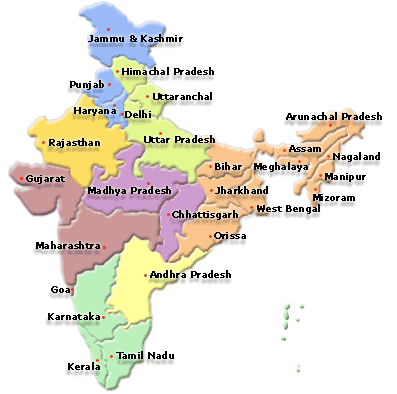
India is focused on education reform

Consider this article from the Philadelphia Bulletin.

Excerpt:

In 2007, the School Choice Campaign, a New Delhi-based education think tank, designed, funded, and implemented a pilot school choice program in the city. The program randomly selected students to be offered a school tuition voucher, which was taken up by 63 percent of students selected. The money could be used at any qualifying private school.

India’s teacher unions have fought the privately funded program tooth-and-nail. “They fight vouchers [because] they will enable students to leave the malfunctioning government schools and make the teachers redundant,” says Jan S. Rao, director of the School Choice Campaign in Delhi. “It is already happening in urban areas. In Delhi there are schools with more teachers than students, since the students have left.”

Oxford economist Francis Teal examined the effect of teacher unions on academic performance in India for a 2008 study. “We thus have in this data clear evidence that unions raise cost and reduce student achievement,” he bluntly states.

[…]For leaders of India’s education choice movement, the success of this trial is only the beginning. They will not be satisfied, says Dr. Parth J. Shah, president of India’s Centre for Civil Society, until “the Delhi government immediately adopts funding all new government schools on a per-pupil basis through vouchers.” That is already the national strategy in Sweden and Chile.

If I ever go totally crazy and just do whatever I want to do, then I’m moving to Chile. Just to see what it would be like. I’d like to move to India, but I’m told that there are a lot of mosquitoes, and the roads aren’t good. But that could change.

What about Louisiana?

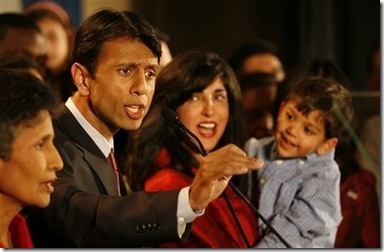
Bobby and Supriya Jindal

Well, Louisiana has an Indian-American Republican Governor – his name is Bobby Jindal, and he is very enthusiastic about education reform. What has he done to make education reform work better?

Consider this study done by the Thomas B. Fordham Institute. (H/T Independent Women’s Forum)

Excerpt:

The charter environment thrives in New Orleans. Louisiana state law places no cap on the number of schools that can operate, and it provides for adequate funding of both charters and authorizers. The Louisiana Charter School Start-Up fund also provides zero-interest loans for charter schools to use for facilities-an element of charter funding that many states ignore. New Orleans leads the country in its percentage of students in charters at 57 percent.

That’s right – Louisiana is number one in education reform!

And there’s more:

Every city that receives a D or an F in this analysis is in a collective-bargaining state. Meanwhile, two-thirds of the top nine scorers (cities receiving a B) are located in right-to-work states.  All of the cities located in right-to-work states included in this study received a B or C, and none received a D or F.

Right-to-work means that a teacher can work without having to join a union! And that means that they can be fired if they can’t perform – but if they can perform, then they make more money! So they have an incentive to work harder and to make their students learn more – there is no safe job for them if they underperform.

Is South Carolina next? South Carolina has an Indian-American Republican Nikki Haley running for governor, so they’re probably next for major education reforms. I’m being silly, but you have to wonder… is there something about the Indian culture that makes them take education more seriously?