
Tag Archives: Pride

Ronald Reagan’s 40th anniversary D-Day speech: the boys of Pointe du Hoc

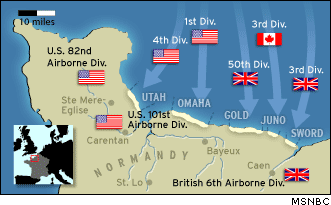
June 6, 1944 D-Day Normandy Invasion Map

It’s June 6th, today, and it’s the anniversary of D-Day: the Allied invasion of northern France – the beginning of the end of World War 2. One of the most pivotal events of that day was the assault on German gun emplacements by members of the Army Rangers at a fortified position called “Pointe du Hoc”.

President Ronald Reagan recognized the soldiers who attacked Pointe du Hoc back in 1984:

You can read the full transcript of that speech here.

Ronald Reagan also made the case for gratitude and vigilance:

Here’s the hymn that starts to play at the end:

The Boys of Pointe du Hoc

Here’s a summary of the Pointe du Hoc mission:

[Lt. Col. James Earl] Rudder took part in the D-Day landings as Commanding Officer of the United States Army’s 2nd Ranger Battalion. His U.S. Army Rangers stormed the beach at Pointe du Hoc and, under constant enemy fire, scaled 100-foot (30 meter) cliffs to reach and destroy German gun batteries. The battalion’s casualty rate for this perilous mission was greater than 50 percent. Rudder himself was wounded twice during the course of the fighting. In spite of this, they dug in and fought off German counter-attacks for two days until relieved. He and his men helped to successfully establish a beachhead for the Allied forces.

You can watch a three-clip documentary on it, too: part 1, part 2, part 3.

You can read the complete story about their successful effort to destroy the 6 155mm German guns here on Military History Online. Although initially, the Rangers did not find the guns where they had expected them, they did find them further back behind the cliffs and destroyed them there, removing a threat to the forces that would be landing later.

What does D-Day mean to Christians in particular?

A female Christian friend asked me what she should be thinking about when I sent her one of the videos above, and so I wrote her this to explain why I sent her the video:

To make you close your eyes and think in a more practical way about what it means for someone to sacrifice their lives to save you, of course. What it means to look up cliffs at machine guns, barbed wire and mortars raining death on you and to take a rope in your hands and to climb up a sheer cliff, under heavy fire, in order to save generations yet unborn and freedom itself.

To think about a concrete example helps us to be able to appreciate what Christ did for us in giving his life for us so that we could be free of sin, as well.

This is the insight that drives my entire interest in war and military history, in fact.

What does this mean: “Greater love has no man than this, that a man lay down his life for his friends.”

The more you know about D-Day, the more fearful what Jesus did appears, and the more you can be grateful.

Bullets and shrapnel are scary… and so are nails and lashes. Why on Earth would anyone endure either for me? And what should my response be to it?

I think it is helpful to explain Christianity to those who are not yet Christian, and for Christians to fully appreciate what Christianity is all about.

We were in peril. And now we have been saved. But at a cost.

I think that it’s important for Christians to look to history, art, poetry and music to help them to reflect and comprehend the sacrifice that Christ made for us in dying on the cross to protect us from peril. What must the cross have looked like to Jesus? It must have been something like what the Omaha beach looked like to the Americans landing in Normandy. Jesus saw whips, thorns and nails, and the heroes of Normandy saw 88 mm AT guns, 81 mm mortars and MG42 machine guns. How should you feel about people who face death on your behalf? Think about it.

Peter Williams debates Bart Ehrman on his book “Misquoting Jesus”

The audio for this Unbelievable radio show debate is available from Apologetics 315.

Details:

Bart Ehrman is the US author of the bestselling book “Misquoting Jesus” (In the UK “Whose word is it?”).  He calls into question the authority of the New Testament as scribal changes over time have changed the documents.

So can we trust the scripture? Bible scholar Peter Williams believes in the reliability of the New Testament and that Bart’s prognosis is far too pessimistic.

I think Justin Brierley breaks his record for saying “if you like” in this particular debate. So, if you like it when he says “if you like”, this debate is for you!

Summary of the Williams-Ehrman debate:

Note: this summary is snarky. When I get annoyed with whiners, I make things up.

Ehrman:

  • I had a mystical experience in childhood and became an evangelical Christian
  • I went to Moody Bible Institute, and they told me that the Bible was inerrant
  • For a while, I was committed to the view that there are no mistakes in the Bible
  • At Princeton, I was taught and graded by professors who did not accept inerrancy
  • I began to see that the Bible did have errors after all!
  • We don’t have the originals written by the authors, we only have thousands of copies
  • if the words of the Bible are not completely inerrant, then none of it is historical
  • if all of the words in the copies of the Bible are not identical, then none of it is historical

Williams:

  • I would say the New and Old testaments are the Word of God
  • We don’t need to have the original Greek writings in order to believe in the authority of the Bible
  • I believe in inerrancy, but doesn’t mean there are no problems
  • the doctrine of inerrancy has always referred to the original copies, not the translations

Moderator:

  • what are the main points of Misquoting Jesus?

Ehrman:

  • we don’t have the originals of any of the books of the New Testament
  • we have copies that are much later, sometimes even centuries later
  • the copies we have all differ from one another – they were changed by scribes
  • we have 5000 manuscripts in the original Greek language
  • there are hundreds of thousands of differences
  • most of the differences don’t matter
  • some differences are significant for meaning or doctrine
  • errors are propagated because the next scribe inherits the mistake of their source copy
  • a large gap between the time of writing and the first extant copy means more errors have crept in

Williams:

  • the reason we have so many variants is because the number of manuscripts is large

Angry Jesus or compassionate Jesus in Mark

Ehrman:

  • most manuscripts say that Jesus was compassionate when healing a leper, but one says he was angry
  • it makes a huge huge huge really really big difference if Jesus is compassionate or angry
  • the whole Bible needs to be thrown out because of this one word between different in one manuscript

Williams:

  • this variant is important for understanding the passage, but it has no great meaning
  • the change is probably just an accident – the two words are very similar visually in Greek
  • it’s just an accident – it emerged in one manuscript, and it impacted a few more
  • the tiny number of manuscripts that have the error are geographically isolated
  • I’m pretty sure that WK prefers the angry Jesus anyway – so who cares?

Ehrman:

  • no! someone changed it deliberately! it’s a conspiracy! you should buy my book! it’s a *big deal*!!!!!1!!1!one!!eleventy-one!

The woman caught in adultery in John

Ehrman:

  • it is isn’t in any of the earliest manuscripts
  • this is an apocryphical story that some scribe deliberately inserted into the text
  • most people don’t even know about this! it’s a cover-up! you need to buy my scandalous book!

Williams:

  • that’s right, it’s a late addition by some overzealous scribe
  • and it’s clearly marked as such in every modern Bible translation
  • the only people who don’t know about this are people who don’t read footnotes in their Bible
  • and in any case, this isn’t a loss of the original words of the New Testament – it’s an addition

Grace of God or apart from God in Hebrews

Ehrman:

  • well this is just a one word difference, but it makes a huge huge really really big difference!
  • the words are very similar, so it’s could be an accident I guess
  • but it wasn’t! this was a deliberate change! it’s a conspiracy! it’s a cover-up! scandal!
  • buy my book! It’s almost as good as Dan Brown!

Moderator:

  • hmmmn…. I kind of like “apart from God”, and I’m sure WK does too – why is this such a big scandal again?

Ehrman:

  • you don’t care? how can you not care? it has to be inerrant! or the whole thing is false!
  • Moody Bible Institute says!

Williams:

  • yeah Bart is always saying that every change is deliberate but it’s just an accident
  • the words are very similar, just a few letters are different, this is clearly an accident
  • I have no problem with apart from God, or by the Grace of God
  • please move on and stop screaming and running around and knocking things over

Moderator:

  • but what if pastors try to use this passage in a sermon?

Williams:

  • well, one word doesn’t make a big different, the meaning that appears is fine for preaching
  • it’s only a problem for people who treat the Bible as a magic book with magical incantations
  • they get mad because if one word is out of place then the whole thing doesn’t work for their spell
  • then they try to cast happiness spells but the spells don’t work and they experience suffering
  • the suffering surprises them since they think that fundamentalism should guarantee them happiness
  • then they become apostates and get on TV where they look wide-eyed and talk crazy

Ehrman:

  • hey! are you talking about me? a lot of people buy my books! i am a big success!
  • it is very important that people don’t feel bad about their sinning you know!

Is Misquoting Jesus an attack?

Williams:

  • it’s rhetorically imbalanced and misleading
  • it tries to highlight change and instability and ignore the majority of the text that is stable
  • he makes a big deal out of 5 or so verses that are different from the mainstream text
  • he says that scribes deliberately changed the scriptures, but he doesn’t prove that
  • it’s just as likely that the differences are just scribal errors made by accident

Ehrman:

  • well, maybe the variants aren’t a big deal, but what about one angel vs. two angels?
  • that’s a significant issue! significant enough for me to become an apostate – a rich apostate
  • if one word is different because of an accident, then the whole Bible cannot be trusted
  • it has to be completely inerrant, so a one word difference means the whole thing is unreliable
  • we don’t even know if Jesus was even named Jesus, because of one angel vs two angels
  • buy my book! you don’t have to read it, just put it on your shelf, then you’ll feel better about not having a relationships with God – because who’s to say what God really wants from you? Not the Bible!

Other debates:

Other critiques:

Why do young Christians become atheists in college?

Here’s a post on Sean McDowell’s blog about how Paul Vitz, professor of psychology at New York University, lost his faith in college.

Excerpt:

In fact, he believes the major barriers to belief in God are not rational but psychological. Psychological factors are not determinative, but strongly shape our perception and approach to God.

To see how this relates to kids leaving the faith, let’s briefly consider Vitz’ own story. He grew up in a “wishy-washy” Christian home in the Midwest. He became an atheist in grad school and remained so until his re-conversion back to Christianity in his late thirties. While he would have denied it at the time, he now realizes that his reasons for becoming an atheist from 18-38 were “intellectually superficial and largely without a deep thought basis”. Vitz is convinced that this phenomenon is widespread today.

Rather than reasoning to his atheistic beliefs, he was simply socialized into them. He cites three reasons for his initial conversion. First, he had a degree of social unease coming from the Midwest. It seemed terribly dull, provincial, middle class, and narrow. He wanted to be part of the glamorous secular world at Michigan when he arrived on campus as an undergrad. Just think about all the young people arriving in New York, Los Angeles, Chicago or other big cities or campuses who are embarrassed by their fundamental upbringing. This kind of socialization, says Vitz, has pushed many people away from God.

Second, he wanted to be accepted by the powerful and influential people in his field of psychology. His professors at Stanford had two things in common—their intense ambition and rejection of religion. Vitz concludes, “In this environment, just as I had learned how to dress like a college student by putting on the right clothes, I also learned to think like a proper psychologist by putting on the right, that is, atheistic or skeptical, ideas and attitudes”.

The third factor is personal convenience. Vitz explains, “The fact is, it is quite inconvenient to be a serious believer in today’s neo-pagan world. I would have to give up many pleasures, some money and a good deal of time. I didn’t have enough pleasures, I didn’t have enough time, and I didn’t have enough money to do any of that as far as I was concerned”. Doubts about God often follow when young people grasp how inconvenient Christianity can really be. I’ve had countless discussions with young people about God, the Bible, evolution, and other apologetic issues only to discover that what is really driving their doubts is immoral behavior (usually sex). This is not always true, but I’m surprised how many times it is.

This is what parents need to prepare for before sending their children off to college. Do you have a plan?