
Tag Archives: Premarital Sex

Does more relationship experience lead to better relationship success?

Published in the Journal of Marriage and Family

Marriage expert Brad Wilcox tweeted this article from the Institute for Family Studies.

It says:

In most areas of life, having more experience is good. Want to be great in your chosen field? Sustained experience is essential. Want to be great at a sport? There’s no substitute for practice. And anyone who runs a business can tell you that their best employees are those who have been in the job long enough to have learned how to handle the normal well and the unexpected with wisdom.

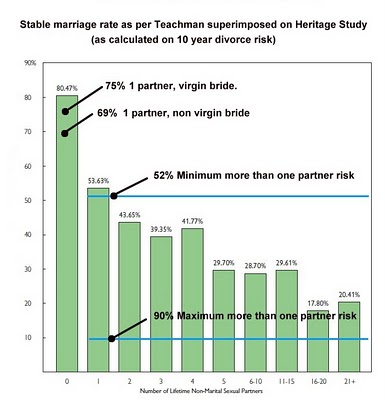
While more experience is often beneficial in life, the story looks different when it comes to some types of experience before marriage. For example, in our Before “I Do” report, we surveyed a national longitudinal sample of young adults about their love lives prior to marriage to examine factors associated with future marital quality. We found that having more sexual and cohabiting partners before marriage is associated with lower relationship quality once married. In particular, having only ever lived with or had sex with one’s spouse was associated with higher marital quality. Our findings are consistent with other studies showing that cohabiting with more partners before marriage is associated with greater likelihood of divorce1 and that a higher number of sexual partners before marriage is associated with lower marital quality and greater likelihood of divorce.2 As we noted, what happens in Vegas may not always stay in Vegas. But why?

There are many reasons why having more romantic partners before marriage may put one at higher risk of difficulties in marriage. One of the most important explanations comes under the heading of what some call selection effects. For many people, an elevated risk of difficulties in marriage was present before they had their first relationship experience. Background characteristics such as parental divorce, low education, and economic disadvantage are associated both with having more sexual and cohabiting partners and also with lower marital quality and/or divorce.3So it may not be that having more sexual or cohabiting partners causes further risk because a lot of risk was already in motion. Selection is a big part of how relationships unfold, but is it the whole story? We believe that, in addition to selection, behavior matters and has plausible connections to marital outcomes. We are going to explain four reasons why having more relationship experience before tying the knot might make it harder to succeed in marriage.

Here are the 4 reasons:

  1. More Awareness of Alternatives
  2. Changed Expectations: The Perfect Sexual Lover (in Your Mind)
  3. More Experience Breaking It Off
  4. Babies

I have to quote the one that I’ve personally encountered in my mentoring – number three: more experience breaking it off. I’ve seen this commitmentphobia in two women who had “wild” periods in their past who had broken up with cohabitating boyfriends.

It says:

Cohabitation has characteristics that seem paradoxical. Living with a partner makes it harder to break up than dating, all other things being equal, and often now comes at a time in relationship development where people have not really chosen each other for the future.8 And yet, cohabiting couples frequently break up, and they are more likely than any other time in history not to end up marrying.9

These days, cohabitation has become more a part of the dating scene than a lead-up to marriage. Let’s call the phenomenon cohabidating. In this context, some people are getting a lot of experience at leaving serious relationships (or surviving being left). Just as with our prior point, that does not sound bad in one way—at least insofar as people are breaking off relationships that had no future. But it’s also true that people tend to get good at things they have a lot of experience doing. People can get good at moving out and moving on.

How does that impact marriage? Some people probably so deeply learn that they can survive leaving a relationship when they are unhappy with it that they leave reasonably good marriages that would have given them and their children the best outcomes in life. They bail too quickly.

Obviously, many others leave very poor or even dangerous marriages only after a lot of agonizing and effort. We’re not suggesting divorce is ever easy or that it is not sometimes the best course. But in a day and age when people get so much experience moving out and moving on, we think many may learn to do so too rapidly, and to their detriment.

If you want to get good at relationships, experience may not be the answer. Reading good studies like this, and making decisions that line up with the research is much wiser. As always, never follow your heart. Always follow rational arguments and evidence, and keep connected to a good panel of advisors who have had long-term relationships success. That’s the best way to avoid disaster.


Are Christians cherry-picking which verses to obey from the Old Testament?

Bible study that hits the spot

Here’s a wonderful article from Peter Saunders.

The challenge:

An argument frequently advanced by those attempting to defend homosexual practice is that Christians ‘cherry pick’ the commands in the Bible – that is, they chose to emphasise some commands while ignoring others.

The Old Testament may forbid homosexual acts (Leviticus 18:2; 20:13) but it also forbids eating seafood without fins and scales (Leviticus 11:9-12; Deuteronomy 14:9, 10).

So how can Christians then justify upholding laws on sexual morality whilst at the same time ignoring the food laws from the very same books of the Bible? Why may they eat shellfish but not be allowed to have sex outside marriage? Isn’t this inconsistent and hypocritical?

The solution is that God enters into “covenants” with his people, and the terms of those covenants change.

Especially dietary laws:

The answer to this question lies in an understanding of biblical covenants.

A covenant is a binding solemn agreement made between two parties. It generally leaves each with obligations. But it holds only between the parties involved.

There are a number of biblical covenants: Noahic, Abrahamic, Sinaitic (Old), Davidic and New.

Under the Noahic covenant, which God made with all living human beings (Genesis 9:8-17), people were able to eat anything:

‘Everything that lives and moves about will be food for you. Just as I gave you the green plants, I now give you everything’ (Genesis 9:3).

But under the Sinaitic (Old) Covenant, which God made with the nation of Israel, people were able to eat certain foods, but not others.

Jesus clearly created a new covenant with his followers, where the dietary laws are lifted:

Jesus said that he had come to fulfil the ‘Law and the Prophets’ (Matthew 5:17; Luke 24:44). He would establish this new covenant with new laws, with himself as high priest based on his own sacrificial death on the cross.

This new covenant would completely deal with sin (Hebrews 10:1-18) and protect all those who put their faith in him from God’s wrath and judgement…

[…]‘In the same way, after the supper (Jesus) took the cup, saying, “This cup is the new covenant in my blood, which is poured out for you”’ (Luke 22:20). ‘…we have been made holy through the sacrifice of the body of Jesus Christ once for all’ (Hebrews 10:10)

People would come under the protection of this new covenant, not by virtue of belonging to the nation of Israel, but through faith in Christ. In fact the function of the Old Testament Law (Sinaitic covenant) was to point to Christ as its fulfilment.

[…]So what then did Christ say about foods? He pronounced all foods clean for his followers to eat:

‘ “Don’t you see that nothing that enters a person from the outside can defile them?  For it doesn’t go into their heart but into their stomach, and then out of the body.” (In saying this, Jesus declared all foods clean.) He went on: “What comes out of a person is what defiles them.  For it is from within, out of a person’s heart, that evil thoughts come—sexual immorality, theft, murder,  adultery, greed, malice, deceit, lewdness, envy, slander, arrogance and folly.  All these evils come from inside and defile a person.” (Mark 7:18-23)

Jesus was making that point that under the new covenant God required purity of the heart. Internal thoughts and attitudes were as important as external actions.

So, for Christians, the dietary / ceremonial laws don’t apply, but the moral laws do apply. Food is OK for Christians, but sexual immorality – which includes premarital sex and adultery – are NOT OK for Christians.

I think sometimes when you are talking to people whose motivation is just to get rid of any objective moral law entirely, they tend to ask questions without really wanting a good answer. This is especially true when it comes to the morality of sex. They ask the question not to get an answer, but to justify getting rid of the moral rules governing sexuality. The answers are there for people who are willing to respect God in their decision-making. The answers are not found only by people who have a reason to not want to find them.

Women, under the influence of feminism, are willing participants in the hook-up culture

A man leading a woman upward
Another post in which I try to pull women out of the quagmire of radical feminism

Note: in this article, when I refer to women, I mean young, unmarried women who have been influenced by feminism. I do not mean all women, and especially not married women.

My good friend Tom sent me this article from the ultra left-wing Vanity Fair. Tom is a veteran of the New York City dating scene and has been telling me for years about the practices described in this article.

The article is very, very long, so I can only quote a little, and then I’ll encourage you to read it, although be warned, it’s filled with sex and bad language, and it tries to present women as victims.

Excerpt:

It’s a balmy night in Manhattan’s financial district, and at a sports bar called Stout, everyone is Tindering. The tables are filled with young women and men who’ve been chasing money and deals on Wall Street all day, and now they’re out looking for hookups. Everyone is drinking, peering into their screens and swiping on the faces of strangers they may have sex with later that evening.

Tinder is a hook-up app that people use to find people to have sex with, based solely on their photograph. This is actually what studies say about how women choose men – it’s all physical appearance, and nothing that is learned subsequently alters that first impression.

The article says this:

“Romance is completely dead, and it’s the girls’ fault,” says Alex, 25, a New Yorker who works in the film industry. “They act like all they want is to have sex with you and then they yell at you for not wanting to have a relationship. How are you gonna feel romantic about a girl like that? Oh, and by the way? I met you on Tinder.

“Women do exactly the same things guys do,” said Matt, 26, who works in a New York art gallery. “I’ve had girls sleep with me off OkCupid and then just ghost me”—that is, disappear, in a digital sense, not returning texts. “They play the game the exact same way. They have a bunch of people going at the same time—they’re fielding their options. They’re always looking for somebody better, who has a better job or more money.” A few young women admitted to me that they use dating apps as a way to get free meals. “I call it Tinder food stamps,” one said.

Even the emphasis on looks inherent in a dating game based on swiping on photos is something men complain women are just as guilty of buying into. “They say in their profiles, ‘No shirtless pictures,’ but that’s bulls**t,” says Nick, the same as above. “The day I switched to a shirtless picture with my tattoos, immediately, within a few minutes, I had, like, 15 matches.”

And if women aren’t interested in being treated as sexual objects, why do they self-objectify in their profile pictures? some men ask. “There’s a lot of girls who are just like, Check me out, I’m hot, I’m wearing a bikini,” says Jason…

Men talk about the nudes they receive from women. They show off the nudes. “T*t pics and booty pics,” said Austin, 22, a college student in Indiana. “My phone is full of ‘em.”

Although the article, and the women who are interviewed, try to pass themselves off as victims, it’s very clear that they are full participants in this hook-up culture. It’s “fun” for them to be free and independent – no responsibilities, expectations or obligations from a relationship.

Feminist writer Hanna Rosin says that this hook-up culture is great:

Some, like Atlantic writer Hanna Rosin, see hookup culture as a boon: “The hookup culture is … bound up with everything that’s fabulous about being a young woman in 2012—the freedom, the confidence.”

The Vanity Fair author comments:

“Short-term mating strategies” seem to work for plenty of women too; some don’t want to be in committed relationships, either, particularly those in their 20s who are focusing on their education and launching careers.

Previously, I quoted a feminist professor writing in the New York Times. She also thought that it was great that women were hooking up with hot guys for fun, but staying focused on their educations and careers.

Here’s Amanda to explain it:

“There is no dating. There’s no relationships,” says Amanda, the tall elegant one. “They’re rare. You can have a fling that could last like seven, eight months and you could never actually call someone your ‘boyfriend.’ [Hooking up] is a lot easier. No one gets hurt—well, not on the surface.”

[…]It’s not, she says, that women don’t want to have sex. “Who doesn’t want to have sex? But it feels bad when they’re like, ‘See ya.’ ”

Who doesn’t want to have sex? Well, me for one. At least, not till I’m married.

Amanda later explains that she doesn’t want to care, because that would mean that she “somehow missed the whole memo about third-wave feminism”. She has to be independent – able to dismiss responsibilities, expectations and obligations in a real relationship – because third-wave feminism tells her so. I know Christian women who think they are fundamentalists who have this exact same attitude. They think that relationships are somehow compatible with doing whatever they want to do – that doing whatever makes them happy each and every moment is compatible with a lasting relationship. Married people laugh at this, but this is what most young, unmarried women believe. And of course most men are only to happy to take advantage of this and treat women like objects.

Why don’t women reject the men who use them like kleenexes? Why is the man’s appearance so much more important than his character and suitability for the marriage roles of husband and father? Feminism tells women that gender distinctions are “sexist”, that chivalry is “sexist”, that chastity is “repressive” because it blocks having recreational sex, that marriage is boring and must be delayed, and that having lots of sexual experience makes you more attractive. All nonsense, but this is what the vast majority of American women believe. They measure men by how the man makes them feel and whether he will be impressive physically to their peers. They believe in feminism and the denial of specific male roles and male virtues. I can’t speak for all the men, but all my male friends are either virgins or married, and we are horrified because we don’t know who we are supposed to marry.

Probably the most traumatic experiences that I have ever heard in my life are the stories I hear from women who are raised in Christian homes, with two married Christian parents, who nevertheless dump their Christianity late in high school, or sometimes when they get to university. One minute, they are adorable little kids playing with teddy bears or riding horses. The next minute they are hooking up and shacking up and avoiding marriage and child-bearing in order to have as much fun as possible.

Two interesting things about this. First, their parents never find out what is really going on. The parents always believe that the daughters are as pure as the driven snow, no matter how long the “lost” period is, where their daughters went crazy. Second, the young woman’s core desire to have fun and seek thrills never goes away. Conversion to Christianity doesn’t make an irresponsible woman responsible. And she usually is careful to surround herself with people who will affirm her in her recklessness, perhaps confidently calling her emotional desires “the voice of God speaking to her”. My friend Dina likes to tell me that these women do not want to be rescued – they are having a good time doing what they want to do, and they think it will go on forever – that the attention from men will always be there, and that chasing happiness will somehow “work out”.

What is interesting is how the parents don’t fix the problem when the girls are young. They are too busy with their careers, their own traveling and fun, etc. Usually, the girl’s mother has chosen a man who is not really strong on truth or moral convictions, because then he is easier to get along with and will not judge her. Women do not like being judged by men, either about factual claims or about moral claims. When the girl starts to act up, and the mother turns to the non-judgmental, postmodern relativist man she chose, and expects him to do something about it. Unfortunately, he does nothing to set boundaries on the daughter.

Finally, you might think that the pastors would be aware of this, and be doing something about restoring women back to the way they used to be. I was talking with a friend who is also in his 30s, also a virgin, also an engineer, and also went to graduate school. We both agreed that the church was doing nothing to counter the radical feminism that exalts this retreat from relationship, and denigrates chastity, marriage and child-bearing. There’s no response from the church to radical feminism.

As always, should you, as a young Christian man of some means, desire to get married, then I recommend using my checklist to validate your candidate. And remember, the right answers are unimportant – only the willingness to learn matters.