Tag Archives: Poverty

What policies can we enact to help poor children out of poverty?

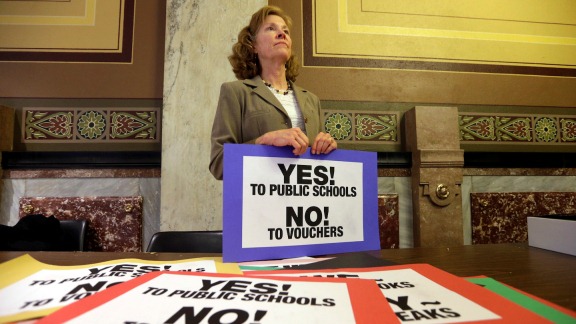
Teacher union says no to vouchers

Well, obviously pro-marriage policies will help – encouraging people to get married before they have children, then sticking together to raise the children. That will help.

Economist Stephen Moore has another idea, which I support.

He writes about it at the Daily Signal.

Excerpt:

The scenes of Baltimore set ablaze have many Americans thinking: What can be done to rescue families trapped in an inner-city culture of violence, despair and joblessness?

There are no easy answers, but down the road from Baltimore in Washington, D.C., an education program is giving children in poor neighborhoods a big lift up.

The D.C. Opportunity Scholarship Program, which George W. Bush signed into law in 2004, has so far funded private school tuition for nearly 5,000 students, 95 percent of whom are African-American. They attend religious schools, music and arts schools, even elite college-prep schools. Last month at The Heritage Foundation in Washington, I met with about 20 parents and children who participate in the program. I also visited several of these families in their homes—which are located in some of the most beaten-down neighborhoods in the city, places that in many ways resemble the trouble spots in Baltimore.

These families have now pulled together to brace for a David vs. Goliath fight to save the program. For the seventh straight year, President Obama has proposed eliminating this relatively tiny scholarship fund, which at $20 million accounts for a microscopic 0.0005 percent of the $4 trillion federal budget.

Why would Obama want to end the program? Because if children can choose schools that don’t fail them, the teachers are the failing schools might lose their jobs. Since Obama needs the votes and the political support of the teacher unions, he cannot put the interests of the children above the interests of the unionized teachers.

More from the article:

An Education Department-funded study at the University of Arkansas recently found that graduation rates rose 21 percentage points—to 91 percent, from 70 percent—for students awarded the scholarship vouchers through a lottery, compared with a control group of those who applied for but didn’t get the scholarships. For all D.C. public schools, the high school graduation rate is closer to an abysmal 56 percent.

“If you’ve got a program that’s clearly working and helping these kids, why end it?” asks Pamela Battle, whose son Carlos received a voucher and was able to attend the elite Georgetown Day School. He’s now at Northeastern University in Boston. She says Carlos “almost surely wouldn’t have gone to college” without the voucher. “We send all this money overseas for foreign aid,” she adds, “why not save the kids here at home first?”

Well, as I said, the Democrats don’t like the law:

Amazingly, these energized parents are opposed by almost every liberal group, even the NAACP, and nearly every Democrat in Congress—including Eleanor Holmes Norton, who represents the District of Columbia in Congress but opposes a program that benefits her own constituents.

There is little question what stirs this opposition. The teachers union sees the program as taking away union jobs, and it is so powerful that the Democratic establishment falls in line. “It is so sad that our public schools aren’t doing what’s best for the kids,” laments Ford, but instead are looking out for “the adults.”

[…]Obama won’t even meet with these parents. A few years ago the voucher supporters held a rally with 3,000 minority and disadvantaged families in front of the Capitol to protest President Obama’s proposed elimination of the program for all new students. Republicans in Congress, including House Speaker John Boehner, one of the program’s strongest supporters, stood in solidarity with the families, while Nancy Pelosi and her Democratic colleagues were nowhere to be seen.

So, the next time someone accuses conservatives of not caring about children, be sure and tell them the story of the D.C. voucher program. We conservatives are very much in favor of helping poor children. It’s the people on the left who are not. Don’t let your conversations with leftists be about vague things like racism and “the rich”. Bring it down to the level of details – “I support voucher programs for poor children to get out of failing schools. Do you? Why don’t your Democrat leaders support them?” Go on the attack with the facts.

By the way, read the whole post by Moore – it’s chock full of parents giving their opinion about the program, and telling stories of how vouchers worked for them. Children first, adults second. That has to be our rule.

Economist Walter Williams explains how to not be poor

Economist Walter Williams

Here is his article on wealth and poverty on Creators.

First, there is no real poverty in the United States:

There is no material poverty in the U.S. Here are a few facts about people whom the Census Bureau labels as poor. Dr. Robert Rector and Rachel Sheffield, in their study “Understanding Poverty in the United States: Surprising Facts About America’s Poor”, report that 80 percent of poor households have air conditioning; nearly three-quarters have a car or truck, and 31 percent have two or more. Two-thirds have cable or satellite TV. Half have one or more computers. Forty-two percent own their homes. Poor Americans have more living space than the typical non-poor person in Sweden, France or the U.K. What we have in our nation are dependency and poverty of the spirit, with people making unwise choices and leading pathological lives aided and abetted by the welfare state.

Second, the “poverty” is not caused by racism, but by poor choices:

The Census Bureau pegs the poverty rate among blacks at 35 percent and among whites at 13 percent. The illegitimacy rate among blacks is 72 percent, and among whites it’s 30 percent. A statistic that one doesn’t hear much about is that the poverty rate among black married families has been in the single digits for more than two decades, currently at 8 percent. For married white families, it’s 5 percent. Now the politically incorrect questions: Whose fault is it to have children without the benefit of marriage and risk a life of dependency? Do people have free will, or are they governed by instincts?

There may be some pinhead sociologists who blame the weak black family structure on racial discrimination. But why was the black illegitimacy rate only 14 percent in 1940, and why, as Dr. Thomas Sowell reports, do we find that census data “going back a hundred years, when blacks were just one generation out of slavery … showed that a slightly higher percentage of black adults had married than white adults. This fact remained true in every census from 1890 to 1940”? Is anyone willing to advance the argument that the reason the illegitimacy rate among blacks was lower and marriage rates higher in earlier periods was there was less racial discrimination and greater opportunity?

Third, avoiding poverty is the result of good choices:

No one can blame a person if he starts out in life poor, because how one starts out is not his fault.

If he stays poor, he is to blame because it is his fault. Avoiding long-term poverty is not rocket science. First, graduate from high school. Second, get married before you have children, and stay married. Third, work at any kind of job, even one that starts out paying the minimum wage. And finally, avoid engaging in criminal behavior. It turns out that a married couple, each earning the minimum wage, would earn an annual combined income of $30,000. The Census Bureau poverty line for a family of two is $15,500, and for a family of four, it’s $23,000. By the way, no adult who starts out earning the minimum wage does so for very long.

Fourth, what stops people from making good choices is big government:

Since President Lyndon Johnson declared war on poverty, the nation has spent about $18 trillion at the federal, state and local levels of government on programs justified by the “need” to deal with some aspect of poverty. In a column of mine in 1995, I pointed out that at that time, the nation had spent $5.4 trillion on the War on Poverty, and with that princely sum, “you could purchase every U.S. factory, all manufacturing equipment, and every office building. With what’s left over, one could buy every airline, trucking company and our commercial maritime fleet. If you’re still in the shopping mood, you could also buy every television, radio and power company, plus every retail and wholesale store in the entire nation”. Today’s total of $18 trillion spent on poverty means you could purchase everything produced in our country each year and then some.

Walter Williams is one of my two favorite economists, the other being Thomas Sowell. By sheer coincidence, they both happen to have grown up poor, and they both happen to be black. They understand what causes poverty very well. I recommend their books to you if you want to understand poverty, too.

Thomas Sowell: if we care about poverty and crime, then we should encourage marriage

Economist Thomas Sowell

My favorite economist Thomas Sowell writes about poverty and crime in National Review.

Excerpt:

The “legacy of slavery” argument is not just an excuse for inexcusable behavior in the ghettos. In a larger sense, it is an evasion of responsibility for the disastrous consequences of the prevailing social vision of our times, and the political policies based on that vision, over the past half century.

Anyone who is serious about evidence need only compare black communities as they evolved in the first 100 years after slavery with black communities as they evolved in the first 50 years after the explosive growth of the welfare state, beginning in the 1960s.

You would be hard-pressed to find as many ghetto riots prior to the 1960s as we have seen just in the past year, much less in the 50 years since a wave of such riots swept across the country in 1965.

We are told that such riots are a result of black poverty and white racism. But in fact — for those who still have some respect for facts — black poverty was far worse, and white racism was far worse, prior to 1960. But violent crime within black ghettos was far less.

Murder rates among black males were going down — repeat, down — during the much-lamented 1950s, while it went up after the much celebrated 1960s, reaching levels more than double what they had been before. Most black children were raised in two-parent families prior to the 1960s. But today the great majority of black children are raised in one-parent families.

Such trends are not unique to blacks, nor even to the United States. The welfare state has led to remarkably similar trends among the white underclass in England over the same period. Just read Life at the Bottom, by Theodore Dalrymple, a British physician who worked in a hospital in a white slum neighborhood.

You cannot take any people, of any color, and exempt them from the requirements of civilization — including work, behavioral standards, personal responsibility, and all the other basic things that the clever intelligentsia disdain — without ruinous consequences to them and to society at large.

Non-judgmental subsidies of counterproductive lifestyles are treating people as if they were livestock, to be fed and tended by others in a welfare state — and yet expecting them to develop as human beings have developed when facing the challenges of life themselves.

One key fact that keeps getting ignored is that the poverty rate among black married couples has been in single digits every year since 1994. Behavior matters and facts matter, more than the prevailing social visions or political empires built on those visions.

So skin color has nothing to do with it, the real problem is that social programs encourage people to make poor choices – including more poverty and crime. We reward failure, and we are surprised when we get more failure.

The book he mentioned – Life at the Bottom – is one of my favorite books. It really shows how social programs that redistribute wealth actually teach poor people to make poor choices, and then refuse to take responsibility for their own poor choices. I posted links to the full text of the book here.