There has never been a purely free market economic system, just as there has never been a purely communist system. However, we can rank economies and see whether ones that are closer to the free market end of the economic spectrum are better than ones that are closer to the communist end.
Let’s try it.
First, list countries according to whether they are closer to the free market or the communist end of the economic spectrum. Then rank countries according to per capita gross domestic product. Finally, rank countries according to Freedom House’s “Freedom in the World” report.
People who live in countries closer to the free market end of the economic spectrum have far greater income than people who live in countries toward the communist end — and enjoy far greater human rights protection.
According to the 2012 “Economic Freedom of the World” report by James Gwartney, Robert Lawson and Joshua Hall, nations ranking in the top quartile with regard to economic freedom had average per capita GDP of $37,691 in 2010 compared with $5,188 for those in the bottom quartile.
In the freest nations, the average income of the poorest 10% of their populations was $11,382. In the least free nations, it was $1,209.
Remarkably, the average income of the poorest 10% in the economically freer nations is more than twice the average of those in the least free nations.
Free market benefits aren’t only measured in dollars and cents.
Life expectancy is 79.5 years in the freest nations and 61.6 years in the least free.
Political and civil liberties are considerably greater in the economically free nations than in unfree nations.
Leftists might argue that the free market doesn’t help the poor. That argument can’t even pass the smell test.
Imagine that you are an unborn spirit and God condemned you to a life of poverty but gave you a choice of the country in which to be poor. Which country would you choose?
To help with your choice, here are facts provided by Robert Rector and Rachel Sheffield in their report “Understanding Poverty in the United States: Surprising Facts About America’s Poor.”
Eighty percent of American poor households have air conditioning.
Nearly three-fourths have a car or truck, and 31% have two or more.
Almost two-thirds have cable or satellite TV.
Half have one or more computers.
Forty-two percent own their homes.
The average poor American has more living space than the typical non-poor person in Sweden, France and the U.K. Ninety-six percent of poor parents stated that their children were never hungry; in other words, they could afford food.
The bottom line is that there is little or no material poverty in the U.S.
At the time of our nation’s birth, we were poor, but we established an institutional structure of free markets and limited government and became rich.
This might be a good article send along to people who want to bash our free-market system. It’s easy for them to make assertions that we have to do this or that policy to redistribute wealth. But the real solution to helping the poor is not to take from one and give to another, it’s to put into place a system that causes wealth to be created for all. That’s what happened in the United States, and you can see how it happened in other capitalist economies like Chile, Hong Kong and Singapore. Capitalism turns poor nations into rich nations.
Investors Business Daily has some good news for us. The Democrat Party of Venezuela has been CRUSHED in a recent election.
Excerpt:
Venezuela’s voters delivered a sledgehammer blow to the country’s ruling Chavista socialists Sunday, winning a likely supermajority in the National Assembly. It’s a great awakening from a 17-year nightmare.
Given the past two decades of near-victories, electoral fraud, chicanery and fractious political opposition mistakes, many Venezuelans are still in disbelief at the scale of the victory in the nation’s legislative elections, which have decisively handed one of Venezuela’s leading governing bodies over to the democratic, pro-free-market opposition.
As this was written, the opposition, known by its Spanish initials MUD, had declared a 112-seat, or two-thirds, supermajority in the National Assembly as a result of Sunday’s vote. The Chavistas won just 46 seats.
It’s total victory in legislative terms and will enable the legislature to throw out politicized Supreme Court justices and appoint honest ones.
The new Congress can also boot corrupt election officials and appoint fair ones. And they will even be able to declare President Nicolas Maduro — the late dictator Hugo Chavez’s hand-picked successor — mentally unstable and unfit for office, or remove him for incompetence. They can also stop his executive orders dead.
The Congress also will have the power to free the 71 or so political prisoners now rotting in Chavista dungeons without trial, including top opposition leader Leopoldo Lopez. And Venezuela’s central bank will stop destroying the country’s money, now nearly worthless.
[…]Most important, the leftist government’s mismanagement of the economy — through currency controls that prevented imports of spare parts, created shortages of basics such as toilet paper and devastated the health care system — and the central bank’s infamous money-printing spree, which has pushed Venezuelan inflation to near 700%, made ordinary life for Venezuelans hellish. There also was corruption, with as much as 1 trillion dollars in oil earnings stolen or misappropriated over the years by high-living Chavista elites, whose lavish lifestyles mocked ordinary, poor Venezuelans.
Top it with the monstrous infiltration of the country by the drug lords, and the likelihood of an electoral housecleaning was perfectly clear.
Still, an element of disbelief remains, given how dirty the Chavista rulers have played their democracy game.
They have broken election rules, violated ballot secrecy, shut voters out and banned popular candidates from running. Many of those dirty tricks were evident in this election, too — the Chavistas illegally extended voting hours and campaigned at polling stations, to cite just a couple of examples.
But the opposition won anyway — with turnout so high, at 74.5%, and margins of victory so wide that the election was impossible to steal.
It helped that the the opposition had the wind at its back with the disastrous result of socialism. But it also helped that MUD had improved its electoral game over the years, learning from each near-miss election.
It also helped that MUD had strong leaders such as Maria Corina Machado and put out strong candidates with a clear, unified message — often summed up as “Down with the left.” And with all the pain of 17 years, it helped most of all that they never lost heart.
There is literally no different between the socialists of Venezuela and the Democrat Party in the United States. They are in lock step on every issue. Should the Democrat Party continue to hold power in America, we can look forward to a reckoning like this one in the future.
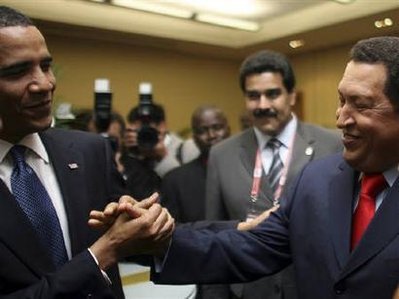
Two socialists shake hands: Barack Obama and Hugo Chavez
The Wall Street Journal says that the whole country is basically in the grip of ignorant socialists at every level, so there is lots to do.
Excerpt:
Pulling out of that death spiral, economists say, will require a series of painful and unpopular adjustments, rolling back more than a decade of populist and statist policies. Among the measures needed is raising the price of the world’s cheapest gasoline—which goes for less than one U.S. penny a gallon—overhauling a cumbersome and inefficient foreign-exchange system, and cutting generous social programs on which Venezuela’s poor depend.
[…]The government still controls more than 20 governorships, hundreds of mayors, the judiciary, much of the press and all auditing agencies. It will be up to Mr. Maduro whether to take steps to stabilize the economy, like loosening currency or price controls.
It’s not just Venezuela that has hit bottom under socialism. Recently, the people of Argentina also threw out their socialists after years and years of disastrous leftist policies.
The Chicago Tribune reports on last month’s election in Argentina.
Excerpt:
Under the current president, Cristina Fernandez, Argentina has become an international financial pariah. The country defaulted on debt last year in a long-running feud with hedge funds — remarkably, that was the eighth default in Argentina’s history.
Fernandez refused to settle. That’s left the country to squeak by in isolation, using protectionism and capital controls in a quixotic battle with globalism. The economy is stagnant, foreign currency reserves are dwindling and the inflation rate is around 30 percent. Last week, American Airlines said it stopped accepting pesos for ticket sales because it was tired of collecting revenue it couldn’t convert to dollars.
At times Argentina has embraced trade and economic openness, only to slip back into bad habits thanks to populist Peronistas like Fernandez. Macri, a conservative, wants to re-establish free market principles, but there are a lot of details he didn’t fully explain before his November victory because they will require some short-term pain, and he wanted to win the election.
Everything Macri is talking about makes sense. He says he will lift the capital controls that have wrecked the peso’s credibility. Like other backwaters it shouldn’t resemble, Argentina has a thriving black market because the government insists the peso is worth a lot more than its actual value. Freeing the currency would devalue it, a first step toward making Argentina more competitive.
The next big step would be to negotiate a settlement with the hedge funds that bought up Argentina’s debt after its previous default in 2002 and demand repayment. Fernandez got political mileage from attacking the “vultures,” but Macri seems to understand Argentina can’t get unstuck when it’s essentially shut out of international capital markets. He sounds like he wants to do a deal.
Macri’s got a tremendous balancing act to pull off: He’ll need to cut spending and reduce taxes without destroying the country’s big social safety net, while walking the country through a devaluation.
This is how countries that are ruled for a prolonged period by the political left eventually end up. I know so many of you lose heart and think that there is no hope, but there is hope. Even in countries where the left is running everything from the universities, to the judiciaries, to the mainstream media, there is hope.
Over the last 7 years, Obama added $10 trillion to the national debt. And although few of his Democrat low-information voters know about that, they will be able to tell the difference between prosperity and poverty when the United States reaches the Venezuela / Argentina tipping point. There comes a time when there are no more bailouts for the economics deniers. Reality wins in the end.
A great episode of the Unbelievable podcast. This is a great debate. I really enjoyed it. All three speakers were excellent putting forward their points. It’s nice to hear an American voice, a British voice and an Australian voice debating an important issue. HIGHLY RECOMMENDED.
Wayne Grudem is a theologian known for his conservative approach to both doctrine and economics. His new book “The Poverty of Nations: A Sustainable Solution” (co-authored with economist Barry Asmus) makes the case that pouring aid into developing countries is a failed strategy. Grudem debates whether the Bible supports free market, capitalist economics with Australian economist and theologian Richard Glover who wrote a critique of the book for the Australian Bible Society.



 WINTERY KNIGHT