Eric Metaxas shared this on Facebook, so here it is.
Full text:
Facing a political firestorm, President Obama today announced his intent to make changes to a controversial rule that would require religious institutions, in violation of their conscience, to pay for contraception, sterilization, and abortifacient drugs. But this “compromise” is an exercise in obfuscation, not a good faith effort to solve the problem. Thousands of churches, religious organizations, businesses, individuals, and others will still be forced to violate their religious beliefs.
For example, the fake compromise will not help the Becket Fund’s clients Belmont Abbey College in North Carolina, Colorado Christian University, and Eternal Word Television Network (EWTN), a Catholic media organization. They will still be forced to pay for insurance that provides contraceptive coverage. The White House’s claim that “the insurance companies will pay for it” is silly. For-profit insurance companies aren’t going to donate contraceptives and abortion drugs to employees; the employer will pay for it one way or the other. More fundamentally, the Becket Fund’s clients still face the same chilling dilemma they did yesterday: choosing between helping their employees buy immoral abortion drugs or paying huge fines.
“This is a false ‘compromise’ designed to protect the President’s re-election chances, not to protect the right of conscience,” says Hannah Smith, Senior Legal Counsel for The Becket Fund. “No one should be fooled by what amounts to an accounting gimmick. Religious employers will still have to violate their religious convictions or pay heavy annual fines to the IRS.”
According to a White House “fact sheet,” some religious employers will no longer be required to provide insurance coverage for contraception, sterilization, and abortion-causing drugs; coverage for those services will instead be provided for free directly by insurance companies. This does not protect anyone’s conscience. First, the problem is helping employees get abortion drugs, not the cost of providing those drugs. Since providing insurance benefits would still help employees get insurance, religious employers still have to choose between providing health benefits that help employees get abortion drugs, and paying annual fines. Second, thousands of religious organizations self insure, meaning that they will be forced to pay directly for these services in violation of their religious beliefs. Third, it is unclear which religious organizations are permitted to claim the new exemption, and whether it will extend to for-profit organizations, individuals, or non-denominational organizations.
“It is especially telling that the details of this fake ‘compromise’ will likely not be announced until after the election,” said Smith. “Religious freedom is not a political football to be kicked around in an election-year. Rather than providing full protection for the right of conscience, President Obama has made a cynical political play that is the antithesis of ‘hope and change.’”
The Obama administration has revised its controversial mandate that had forced religious employers to pay for health insurance coverage that includes birth control and drugs like Plan B, the morning after pill, and ella that can cause abortions.
Responding to a firestorm of opposition from pro-life organizations, Catholics groups and even some Democrats, the Obama administration has revised the mandate in a way that pro-life advocates are saying is even worse.
The revised Obama mandate will make religious groups contract with insurers to offer birth control and the potentially abortion-causing drugs to women at no cost. The revised mandate will have religious employers refer women to their insurance company for coverage that still violates their moral and religious beliefs. Under this plan, every insurance company will be obligated to provide coverage at no cost.
Essentially, religious groups will still be mandated to offer plans that cover both birth control and the ella abortion drug.
According to Obama administration officials on a conference call this morning, a woman’s insurance company “will be required to reach out directly and offer her contraceptive care free of charge. The religious institutions will not have to pay for it.”
The birth control and abortion-causing drugs will simply be “part of the bundle of services that all insurance companies are required to offer,” White House officials said.
“We are actually more comfortable having the insurance industry offer and market this to women than religious institutions,” the White House said on the conference call LifeNews listened to because they “understand how contraception works” and it “makes sense financially.”
[…]Republican Study Committee Chairman Jim Jordan told LifeNews in response to the revised mandate that it violates the right to religious freedom guaranteed by the First Amendment to the Constitution.
“This ObamaCare rule still tramples on Americans’ First Amendment right to freedom of religion. It’s a fig leaf, not a compromise. Whether they are affiliated with a church or not, employers will still be forced to pay an insurance company for coverage that includes abortion-inducing drugs,” he said. “This is not just a problem for church-affiliated hospitals and charities. Under these rules, a small business owner with religious objections to abortion-inducing drugs and contraception must either violate his religious beliefs or violate the law.”
“The liberal Obama administration thinks its political goals trump the religious faith of American citizens. That isn’t right, fair, or constitutional,” he said.
The abortions will still be paid for by the religious groups. They are going to pay for the drugs through medical insurance premiums. So religious organizations are still being forced to provide abortions for their workers.
Who is to blame for this? I blame Catholic bishops. Catholic bishops do believe in socialism. They do want a secular government to take money from religious people. And they do want government to hand out medical care to people, instead of letting individuals, businesses and charities provide health care.
Rick Santorum agrees with me on this.
Consider this interview with Rick Santorum in which he reacts Obama’s health care mandate.
Excerpt:
HH: Now I want to talk to you about two substantive issues, Senator Santorum. The first are these new regulations from the Obama administration. I read the letter from Archbishop Olmstead of Phoenix on the air. Archbishop Jose Gomez of Los Angeles has written a new article in First Things. It’s shocking, actually, what’s going on. Should this be a centerpiece of whoever the nominee’s campaign is?
RS: I talked about it in every speech I’ve given today. And here’s what I said, though, Hugh. I said that I took issue with the Catholic Bishops Conference, because Hugh, you may remember, they embraced Obamacare.
HH: Yes.
RS: They embraced it and said…here’s what I said to them. Be careful when you have government saying that they can give you rights, that you have a right to health care, and government’s going to give you something, because once you are now dependant on government, they, not only can they take that right away, they can tell you how to exercise that right, and you can either like it or not. And that’s the problem. That’s what the Catholic Bishops Conference didn’t get, that there’s no free lunch here, folks. If you’re going to give people secular power, then they’re going to use it in a secular fashion. And that’s why, you know, I hate to say it, but you know, you had it coming. And it’s time to wake up and realize that government isn’t the answer to the social ills. It’s people of faith, and it’s families, and it’s communities, and it’s charities that need to do this as it has in America so successfully for so long.
HH: Rick Santorum, what do you advise Catholic hospitals, Catholic colleges, Catholic…the centers of poverty assistance, the adoption agencies? What do you advise them to do in the face of, as Archbishop Olmstead said, we cannot comply with this unjust law?
RS: Civil disobedience. This will not stand. There’s no way they can make this stand. The Supreme Court, eventually, this thing’s going to get to the Supreme Court just like the ministerial hiring issue that was just decided by the Supreme Court the other day. And it was a 9-0 decision that said the Obama administration can’t roll over people of faith when it comes to hiring. Yet in the face of that decision, this radical, secular government of Barack Obama continues to have faith be the least important of the 1st Amendment. And I just think they fight. They fight in the courts, and they fight by civil disobedience, and go to war with the federal government over this one.
Evangelical protestants feel comfortable with Catholics like Rick Santorum. He gets it. If the bishops are wrong on socialized medicine and wrong on the death penalty and wrong on other things, then so much the worse for the bishops.
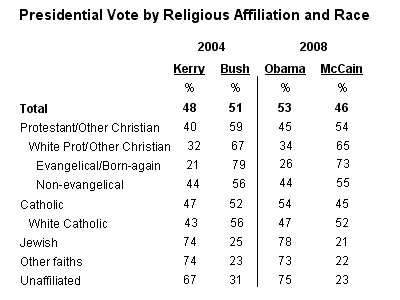
Obama did very well with Catholics in 2008 even though Obama is the most pro-abortion president in the history of the United States. Catholics tend to be more liberal on economic issues than evangelicals, which is why many of them voted for Obama. Evangelicals oppose economic liberalism, because they oppose government taking tax money from workers in order to provide services for other people aren’t trying to be self-sufficient. Evangelicals oppose increasing the dependence of individuals on a secular government. Evangelicals don’t want a secular government to take money from individuals and then use it to push secular leftist ideas like global warming, Darwinism and sex education in government run institutions, e.g. – public schools, public broadcasting, etc. Evangelicals trust individuals to care for the poor, and they don’t want to make it too easy for people to make reckless decisions and then get a check in the mail or a free abortion.
What causes this difference between Catholics and evangelicals? Evangelicals believe in salvation through grace ALONE through faith ALONE in Christ ALONE. Evangelicals put the emphasis on what you believe – it has to be true in order to please God. Catholics, just like Mormons, Jews and other religions, emphasize good works as a requirement for salvation. Many Catholics also support inclusivism, which is the view that you can be saved in other religions like Judaism and Islam. This means that for these Catholics, specific Christian doctrines are not essential for salvation, so long as you have sincerity and good works. On the other hand, evangelicals are exclusivists who emphasize the need for each person to arrive at true beliefs about God in order to be saved, and good works are just natural outworkings of their beliefs.
Evangelicals emphasize the responsibility of the individual to discover truth with their Bibles, reasoning, science and history. This belief in individual responsibility carries over into their approach to charity. Evangelicals believe individuals are responsible for deciding what to do about charity – you earn your own money and then you choose yourself how to share with others. But the responsibility to give away money wisely is an individual responsibility – you share your money in a way that is consistent with your beliefs. Evangelicals don’t generally accept the idea of handing money off to someone else and letting them decide what to do with it. We think that everything is our responsibility, starting with Bible study and theology, and going on through to economics and politics.
And this emphasis on individuals over big government has this effect:
Note that this chart puts evangelicals together with born-again Christians. But evangelical Christians differ from born-again Christians, because they are firm on exclusive salvation and evangelism. Evangelicals like to study so that they can discuss their beliefs in public, using reasons and evidence to persuade others. A born-again Christian does not have that same emphasis on study and persuasion, because they don’t focus on evangelism. So, if you separate out the born-agains from that 26%, number for Obama support, then you are likely to get a much lower number for evangelicals who support Obama. We don’t like health care mandates covering abortion. Evangelicals are used to having to puzzle things out for themselves – so they puzzled out what Obama believed and then they voted against him.
I’m seeing a lot of ignorance in the mainstream media, including in the conservative media, and even from some Republican politicians. So it’s time to set the record straight on what Mormons and Christians really believe.
Do Mormons and Christians have the same beliefs?
First, let’s take a look at what the founder of Mormonism, Joseph Smith, believes about the origin of the universe:
“The elements are eternal. That which had a beggining will surely have an end; take a ring, it is without beggining or end – cut it for a beggining place and at the same time you have an ending place.” (“Scriptural Teachings of the Prophet Joseph Smith”, p. 205)
“Now, the word create came from the word baurau which does not mean to create out of nothing; it means to organize; the same as a man would organize materials and build a ship. Hence, we infer that God had materials to organize the world out of chaos – chaotic matter, which is element, and in which dwells all the glory. Element had an existance from the time he had. The pure principles of element are principles which can never be destroyed; they may be organized and re-organized, but not destroyed. They had no beggining, and can have no end.”
(“Scriptural Teachings of the Prophet Joseph Smith”, p. 395)
A Mormon scholar named Blake Ostler summarizes the Mormon view in a Mormon theological journal:
“In contrast to the self-sufficient and solitary absolute who creates ex nihilo (out of nothing), the Mormon God did not bring into being the ultimate constituents of the cosmos — neither its fundamental matter nor the space/time matrix which defines it. Hence, unlike the Necessary Being of classical theology who alone could not not exist and on which all else is contingent for existence, the personal God of Mormonism confronts uncreated realities which exist of metaphysical necessity. Such realities include inherently self-directing selves (intelligences), primordial elements (mass/energy), the natural laws which structure reality, and moral principles grounded in the intrinsic value of selves and the requirements for growth and happiness.” (Blake Ostler, “The Mormon Concept of God,” Dialogue: A Journal of Mormon Thought 17 (Summer 1984):65-93)
So, Mormons believe in an eternally existing universe, such that matter was never created out of nothing, and will never be destroyed.
What do the best Christian theologians believe about the origin of the universe?
“By what means did you make heaven and earth? What tool did you use for this vast work? You did not work as a human craftsman does, making one thing out of something else as his mind directs… Nor did you have in your hand any matter from which you could make heaven and earth, for where could you have obtained matter which you had not yet created, in order to use it as material for making something else? It must therefore be that you spoke and they were made. In your Word you created them.” (Augustine, Confessions 11.5.7.)
“As said above (Question 44, Article 2), we must consider not only the emanation of a particular being from a particular agent, but also the emanation of all being from the universal cause, which is God; and this emanation we designate by the name of creation. Now what proceeds by particular emanation, is not presupposed to that emanation; as when a man is generated, he was not before, but man is made from “not-man,” and white from “not-white.” Hence if the emanation of the whole universal being from the first principle be considered, it is impossible that any being should be presupposed before this emanation. For nothing is the same as no being. Therefore as the generation of a man is from the “not-being” which is “not-man,” so creation, which is the emanation of all being, is from the “not-being” which is “nothing”.” (Summa Theologica, part 1, question 45)
“Let this, then, be maintained in the first place, that the world is not eternal, but was created by God.” (John Calvin, Genesis)
“We firmly believe and simply confess that there is only one true God … the Creator of all things visible and invisible, spiritual and corporeal; who from the very beginning of time by His omnipotent power created out of nothing both the spiritual beings and the corporeal.” (The Fourth Lateran Council of 1215)
So who is right? Has the universe always existed or did it come into being out of nothing?
Breaking the tie
To break the tie, we must use the ordinary tools of investigation – logic, science, historical methods, and so on. Let’s use science this time.
The standard Big Bang model thus describes a universe which is not eternal in the past, but which came into being a finite time ago. Moreover,–and this deserves underscoring–the origin it posits is an absolute origin ex nihilo. For not only all matter and energy, but space and time themselves come into being at the initial cosmological singularity. As Barrow and Tipler emphasize, “At this singularity, space and time came into existence; literally nothing existed before the singularity, so, if the Universe originated at such a singularity, we would truly have a creation ex nihilo.“
[…]On such a model the universe originates ex nihilo in the sense that at the initial singularity it is true that There is no earlier space-time point or it is false that Something existed prior to the singularity.
Christian cosmology requires such a creation out of nothing, but this is clearly incompatible with what Mormons believe about the universe. The claims about the universe made by the two religions are in disagreement, and we can test empirically to see who is right, using science.
Taking religion seriously
You can find other disagreements between Christianity and Mormonism, if you are not so busy putting on make-up like politicians and journalists are. For example, Christianity is monotheistic (one God) and Mormonism is polytheistic (many gods). That means Mormonism is more like Hinduism than it is like Christianity – Mormonism and Hinduism even agree on the eternally oscillating universe. You can read all about it, with citations from Mormon scholars, in this article, authored by Baylor University professor Francis J. Beckwith. Or you could take a look at the history of Mormonism, and see if the claims made in the religious texts of Mormonism are historical. Or you could take a look at the prophetic claims of the founder of Mormonism and see if they were accurate.
Here’s an examination of the historical basis for the Mormon Scriptures, for example:
This is how responsible people evaluate religions to see whether they are all the same as the others, and, more importantly, if one is true. The point of religion is not to make people feel good, or to make them have a sense of community. The point of religion is to know how we got here, where we are going, and what we are supposed to be doing – as matters of fact.
As long as you don’t assume, before doing any research, that all religions are the same, and that all of their claims are equally untestable, then you can actually investigate things and come to some conclusions. Investigating is good, but watching debates with different views that feature public, testable evidence is also a good idea. The important thing is that you are serious about evaluating the testable claims of different religions, and that you don’t assume that choosing a religion is just like taste in clothes or taste in food, which varies by time and place and is really not making objective propositional claims about reality, instead of subjective claims about individual tastes and preferences. Just because you were born into a country that believed that the Earth was flat (or round) that wouldn’t take away the obligation on you to test those views and go looking at other views using the tools of logic, science and historical analysis.

 WINTERY KNIGHT