Tag Archives: Political Correctness

How schools of social work stifle conservative views in the name of diversity

Here’s a great story from The Weekly Standard. It’s hard for me to slice it up so I can make the point of the article, but I’ll try, and if you like it, you go read the whole thing.

The author Devorah Goldman says this:

“I can’t have you participate in class anymore.”

I was on my way out of class when my social welfare and policy professor casually called me over to tell me this. The friendliness of her tone did not match her words, and I attempted a shocked, confused apology. It was my first semester at the Hunter College School of Social Work, and I was as yet unfamiliar with the consistent, underlying threat that characterized much of the school’s policy and atmosphere. This professor was simply more open and direct than most.

I asked if I had said or done anything inappropriate or disrespectful, and she was quick to assure me that it was not my behavior that was the problem. No: It was my opinions. Or, as she put it, “I have to give over this information as is.”

I spent the rest of that semester mostly quiet, frustrated, and missing my undergraduate days, when my professors encouraged intellectual diversity and give-and-take. I attempted to take my case to a higher-up at school, an extremely nice, fair professor who insisted that it was in my own best interest not to rock the boat. I was doing well in his class, and I believed him when he told me he wanted me to continue doing well. He explained to me that people who were viewed as too conservative had had problems graduating in the past, and he didn’t want that to happen to me. I thought he was joking .  .  . until I realized he wasn’t.

[…]Two hundred thirty-five master’s programs in the United States are accredited by the Council on Social Work Education (CSWE), which requires schools to “advocate for human rights and social and economic justice” and to “engage in practices that advance social and economic justice” as part of their curricula. As Greg Lukianoff, president of the Foundation for Individual Rights in Education (FIRE), points out, the CSWE standards act as “an invitation for schools to discriminate against students with dissenting views.”

Lukianoff discovered the abusive culture fostered by CSWE after several students complained about their treatment in social work programs. Emily Brooker, a Christian student at Missouri State University’s School of Social Work in 2006, was asked by her professor to sign a letter to the Missouri legislature in favor of homosexual adoption. When she explained that doing so would violate her religious beliefs and requested a different assignment, she was subjected to a two-and-a-half-hour interrogation by an ethics committee and charged with a “Level Three Grievance” (the most severe kind). Brooker was not permitted to have an advocate or a tape recorder with her at the ethics meeting, during which she was told to sign a contract promising that she would “close the gap” between her religious beliefs and the values of the social work profession. At the risk of having her degree withheld, Brooker acquiesced.

Bill Felkner, a student at Rhode Island College’s School of Social Work, was instructed to lobby the Rhode Island legislature for several policies he did not support. In addition, RIC’s policy internship requirements for graduate students included forcing students to advance policies that would further “progressive social change.” When Felkner accepted an internship in the policy department of Republican Rhode Island governor Don Carcieri’s office, he received a letter from Lenore Olsen, chair of the Social Work Department, informing him that he had violated their requirements and could no longer pursue a master’s degree in social work policy.

[…]And so I sat, zombie-like, through the strange and sad reality that is groupthink for two long years. In a publicly funded school in America’s greatest city, I was censored, threatened, and despised by my teachers. I left school after graduation feeling that something had been stolen from me. I wanted to go back and argue with my teachers some more, ask them, for example, whether a description of Reagan’s economic policies as “nightmarish” in a textbook could be considered unbiased in any context. I wished I had stood up more often for my white male friends in class, asked people if they really believed that Band-Aids that were not exactly fair and not exactly dark in color were racist. Realizing that I had been awarded a diploma in part because I kept my opinions to myself was deeply unsatisfying.

Conservative students need to be aware that they are likely to face discrimination in social work programs on campus, and probably in many other programs as well. They will either have to silence themselves or change their views to be in compliance with secular leftist ideology. What’s even scarier, though, is when students who are raised in traditional evangelical homes go off to college and swallow secular leftist values uncritically. It always shocks me a little when I meet students who were raised in a married home with two evangelical parents and they tell me that they vote for Democrats. I just had a conversation this week with a young woman who claimed to be pro-life and pro-marriage who voted for Obama in 2008 and 2012. She is studying journalism, and I would bet that there are no conservative professors in her program. She told me that she voted for Obama because of environmentalism and Obamacare. She also expressed preference for big government over small government.

It’s definitely something to be aware of – the lack of critical thinking and respectful dialog in some of these programs. I’m going to be giving her a list of conservative news sites to read, like The Stream, The Weekly Standard, The Daily Signal, and so on. I wonder if she has ever read a conservative economist or journalist before… I’ll find out.

If you insist on going to programs that are more ideology than marketable skills, then expect to have to keep your mouth shut all the way through in order to graduate. And then after you graduate, whenever you get the chance, vote for smaller government, lower taxes, and more academic freedom laws that protect a diversity of views in the classroom. I also recommend donating to legal groups who defend basic liberties, such as Alliance Defending Freedom.

Why is it so hard to reason with college-educated millenials about spiritual things?

Why is it hard to reason with students?

The first article today is from lesbian feminist Camille Paglia. She is a university professor, but liberal (in the classical sense) in her outlook.

An hour-long interview is posted at Reason, and there’s a transcript.

Camille says:

reason: Clarify what’s the difference between a legitimate gripe and whining?

Paglia: Well, in my point of view, no college administration should be taking any interest whatever in the social lives of the students. None! If a crime’s committed on campus, it should always be reported to the police. I absolutely do not agree with any committees investigating any charge of sexual assault. Either it’s a real crime, or it’s not a real crime. Get the hell out. So you get this expansion of the campus bureaucracy with this Stalinist oversight. But the students have been raised with helicopter parents. They want it. The students of today—they’re utterly uninformed, not necessarily at my school, the art school, I’m talking about the elite schools.

reason: So it’s those kids over at that other school.

Paglia: It’s the grade grubbers, the bright overachievers. I’m not at that kind of school [here at University of the Arts in Philadelphia] . I’m at a school of arts and communication where people already have a vocational trend. To be admitted here, you have to already have demonstrated a vocational aptitude. I’m talking about the Ivy League. Now, I’ve encountered these graduates of Harvard, Yale, the University of Pennsylvania, and Princeton, I’ve encountered them in the media, and people in their 30s now, some of them, their minds are like Jell-O. They know nothing! They’ve not been trained in history. They have absolutely no structure to their minds. Their emotions are unfixed. The banality of contemporary cultural criticism, of academe, the absolute collapse of any kind of intellectual discourse in the U.S. is the result of these colleges, which should have been the best, have produced the finest minds, instead having retracted into caretaking. The whole thing is about approved social positions in a kind of misty, love of humanity without any direct knowledge of history or economics or anthropology.

reason: Maybe the university is not the place where that sort of stuff is happening anymore. So, for instance, you have think tanks that do a lot of economic or policy work. You have popular historians who are not academic. Fiction and poetry, even as there’s been a rise in for decades now of creative writing programs and what not. Nobody looks to the university to be cutting edge on almost anything really, so maybe it’s just that you picked the wrong hors. Maybe you should have followed the campus radicals’ suggestion and not gone into academia?

Paglia: [As a] writer of cultural criticism, I find that I’m happiest when I’m writing for the British press, and I write quite a bit for The Sunday Times magazine in London. I find that the general sense of cultural awareness means that I can have an authentic discourse about ideas with international journalists from Brazil or Germany or Italy or Norway or Canada even—somewhat, but they have a P.C. problem themselves. I can feel the vacuum and the nothingness of American cultural criticism at the present time. It is impossible—any journalist today, an American journalist, you cannot have any kind of deep discussion of ideas.

The students at the Ivy league universities are so insulated from “vocation” (working for money) and so indoctrinated in political correctness, that they cannot have a civil conversation about ideas. All they can do is state their own views, and if you disagree with them, then they call you names then retreat to “safe spaces”, where all unpleasant communication is blocked . They can’t even explain why they hold their own views except they have been taught to believe that all smart people believe them. They are traumatized by dissent, and they are not able to critically assess arguments and evidence.

Here’s a second article by Eleanor Taylor writing in the ultra-leftist New York Times.

She writes:

KATHERINE BYRON, a senior at Brown University and a member of its Sexual Assault Task Force, considers it her duty to make Brown a safe place for rape victims, free from anything that might prompt memories of trauma.

So when she heard last fall that a student group had organized a debate about campus sexual assault between Jessica Valenti, the founder of feministing.com, and Wendy McElroy, a libertarian, and that Ms. McElroy was likely to criticize the term “rape culture,” Ms. Byron was alarmed. “Bringing in a speaker like that could serve to invalidate people’s experiences,” she told me. It could be “damaging.”

Ms. Byron and some fellow task force members secured a meeting with administrators. Not long after, Brown’s president, Christina H. Paxson, announced that the university would hold a simultaneous, competing talk to provide “research and facts” about “the role of culture in sexual assault.” Meanwhile, student volunteers put up posters advertising that a “safe space” would be available for anyone who found the debate too upsetting.

The safe space, Ms. Byron explained, was intended to give people who might find comments “troubling” or “triggering,” a place to recuperate. The room was equipped with cookies, coloring books, bubbles, Play-Doh, calming music, pillows, blankets and a video of frolicking puppies, as well as students and staff members trained to deal with trauma. Emma Hall, a junior, rape survivor and “sexual assault peer educator” who helped set up the room and worked in it during the debate, estimates that a couple of dozen people used it. At one point she went to the lecture hall — it was packed — but after a while, she had to return to the safe space. “I was feeling bombarded by a lot of viewpoints that really go against my dearly and closely held beliefs,” Ms. Hall said.

Safe spaces are an expression of the conviction, increasingly prevalent among college students, that their schools should keep them from being “bombarded” by discomfiting or distressing viewpoints. Think of the safe space as the live-action version of the better-known trigger warning, a notice put on top of a syllabus or an assigned reading to alert students to the presence of potentially disturbing material.

I have had the opportunity to interact with people who went through the college system in non-STEM programs. The combination of binge-drinking, hooking-up, co-habitating, and indoctrination in secular leftist ideologies like feminism, postmodernism, moral relativism really seems to break down their ability to reason calmly with someone who disagrees with them. They become very brittle and defensive when their indoctrinated views are confronted with critical thinking. I think the indoctrinated views were accepted largely because of emotions, intuitions and peer-pressure, so any kind of questioning using reason, evidence, wisdom and experience are met with this fight-or-flight response. People who are wiser and more experienced aren’t allowed to speak in the “safe space”.

There are two ways I see this playing out. On the one hand, any attempt to lead the thinking of an indoctrinated person is going to be met with insults. For example, trying to teach basic economics is going to be called “manipulation”. Or, trying to tell them to that they have an obligation to behave a certain way towards others is going to be dismissed because others have to take “personal responsibility”. These are just smokescreens that cover the fact that indoctrinated millenials cannot be reasoned with, cannot be led, cannot be told to do the right thing. When challenged, they block all communication and retreat to a “safe space” where their similarly indoctrinated friends are there to reassure them. Unfortunately for them, reality has a way of breaking through the illusions in the long run.

Muslim student wants to censor showing of “American Sniper” on campus

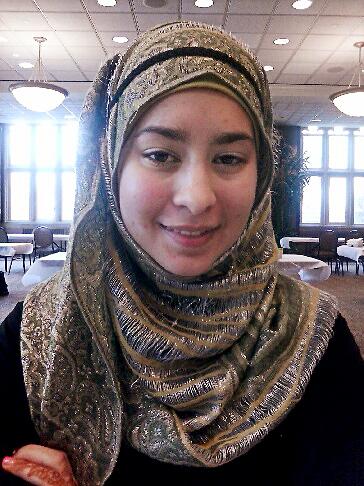
Muslim student Farah ElJayyousi
Muslim student Farah El-Jayyousi

This is from The College Fix.

It says:

[A] Muslim student activist who declared showing the film on campus would make her feel “unsafe” and demanded an “apology and explanation” as to how and why the movie was even selected for Mizzou audiences.

The uproar was taken quite seriously, and prompted the student government to conduct a meeting to determine whether the flick should be shown.

“This film is blatant racist, colonialist propaganda that should not be shown under any circumstances and especially not endorsed by a branch of student government that purports to represent me and have my best interests in mind,” student Farah El-Jayyousi had stated.

She made the comments in a letter to the editor to the campus newspaper earlier this month, denouncing the decision to show the blockbuster – the highest grossing film of 2014. El-Jayyousi accused the movie of dehumanizing Muslims and glorifying the murder of Iraqis, and referred to Chris Kyle, the Navy SEAL featured in the film, as “a killer with no regard for human life.”

What do you think she is studying to have such blindness to the violence and anti-woman discrimination in the Middle East? She is double-majoring in psychology and women’s and gender studies. Of course!

Let’s just see what sort of violence happens in the Middle East.

This is from the leftist BBC about the conflict in Syria:

Some 6,000 women have been raped since the start of the conflict in March 2011, the Euro Mediterranean Human Rights Network (EMHRN) says.

A spokeswoman for the group said these women were then socially stigmatised, and often forced to flee their homes.

Women are being targeted by snipers and used as human shields, often with their children, the report also says.

Violence against Women, a Bleeding Wound in the Syrian Conflict is based on interviews with victims and medical staff in the first half of 2013.

The report describes how hundreds of Syrian women have been subjected to arbitrary arrests and enforced disappearances and have undergone various forms of torture, in state detention facilities.

[…]The report also says the kidnapping of women has also become a strategy of exchanging prisoners and exacting revenge, and that the nature of the crimes – rape and gang-rape – leaves many women isolated.

That’s not a concern to our Muslim student. She is more concerned about soldiers who go to the Middle East to try to liberate women from the rule of regimes that genitally mutilate them, honor-murder them, keep them illiterate, stone them, rape them, imprison them and “marry” them when they are still children. And so on. That’s what she is learning to parrot at an American university. And of course she learns that sex-selection abortions are the height of women’s rights, too.

Imagine if a Christian student went to a Muslim university (is there one that accepts women in Afghanistan? Oh right, there isn’t) and wrote a similar article, but against the practice of genital mutilation in Mali, for example. What would happen to her, do you think? Exactly. But that’s not a concern to our intrepid Muslim student. It must take some powerful self-deluding to be this self-contradictory, but that’s why we have non-STEM departments in universities, isn’t it?