Tag Archives: Philosophy of Religion

Angus Menuge’s ontological argument against naturalism

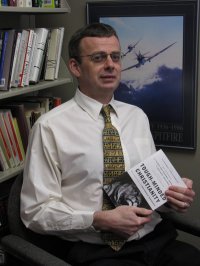
Dr. Angus Menuge
Dr. Angus Menuge

(Note: this is NOT the ontological argument, which I do not use, and do not recommend. This is the ontological argument from reason, and it’s a good argument which I would use in a debate. If you’re not good at science, use the moral argument and this argument – you can do pretty well with them!)

Here’s some information about Dr. Menuge:

Dr. Angus Menuge joined Concordia University Wisconsin in 1991. He earned his BA from the University of Warwick, England, and his MA and Ph.D. degrees from the University of Wisconsin-Madison, where he studied philosophy, computer science and psychology. Menuge’s dissertation was on the philosophy of action explanation, and his current research interests include philosophy of mind, philosophy of science and Christian apologetics.

In 2003, Menuge earned a Diploma in Christian Apologetics from the International Academy of Apologetics, Evangelism and Human Rights, which meets each July in Strasbourg, France. His thesis, a critique of scientific materialism, went on to become the book Agents Under Fire: Materialism and the Rationality of Science (Lanham, MD: Rowman and Littlefield, 2004).

Menuge has also edited volumes on C. S. Lewis, Christ and culture and the vocation of scientist, and has written several Bible studies. He is currently working with Joel Heck (Concordia Texas) on a collection of essays defining Lutheran education for the 21st century, entitled Learning at the Foot of the Cross (Concordia University Press, forthcoming).

A frequent speaker, Menuge has given presentations on Christianity and culture, science and vocation, philosophy of mind, C. S. Lewis, Intelligent Design and the case against scientific materialism. He is a member of the Evangelical Philosophical Society.

Dr. Menuge presented a paper at a recent Evangelical Philosophical Society conference for students and professors of philosophy, and you can download the paper here in Word format. (here’s a PDF version I made). I got these straight from the source, and got permission to post them, too.

Here is the introduction to the paper that Dr. Menuge read at the EPS conference:

The argument from reason is really a family of arguments to show that reasoning is incompatible with naturalism. Here, naturalism is understood as the idea that foundationally, there are only physical objects, properties and relations, and anything else reduces to, supervenes on, or emerges from that. For our purposes, one of the most important claims of naturalism is that all causation is passive, automatic, event causation (an earthquake automatically causes a tidal wave; the tidal wave responds passively): there are no agent causes, where something does not happen automatically but only because the agent exerts his active power by choosing to do it. The most famous version of the argument from reason is epistemological: if naturalism were true, we could not be justified in believing it. Today, I want to focus on the ontological argument from reason, which asserts that there cannot be reasoning in a naturalistic world, because reasoning requires libertarian free will, and this in turn requires a unified, enduring self with active power.

The two most promising ways out of this argument are: (1) Compatibilism—even in a deterministic, naturalistic world, humans are capable of free acts of reason if their minds are responsive to rational causes; (2) Libertarian Naturalism—a self with libertarian free will emerges from the brain. I argue that neither of these moves works, and so, unless someone has a better idea, the ontological argument from reason stands.

The paper is 11 pages long, and it is awesome for those of you looking for some good discussion of one of the issues in the area of philosophy of mind. The thing you need to know about Dr. Menuge is that he is quite strong and forceful in his writing and presentation, and to me, that is an excellent thing for a scholar to be. Very direct, and very confrontational. You can even read an account of his debate with that radical atheist nutcase P.Z. Myers in 2008 here.

By the way, the epistemological argument from reason (P(R) on N & E is low) is the argument made by the famous Christian philosopher Alvin Plantinga. I blogged about that argument before. It’s good to know BOTH of these arguments. They both work, and they are both awesome. If you put these two arguments together with William Lane Craig’s moral argument, that’s three strong philosophical arguments that are easy to use, but backed by solid analytic philosophy.

Powerpoint slideshow

But there is more than just the paper! At the EPS apologetics conference, which is meant for lay people as well as scholars, he presented this Powerpoint slideshow, (here’s a PDF version I made) . The slides are easier to understand than the paper, but the paper is not too bad.

And here is another article by Dr. Menuge on intelligent design.

William Lane Craig discusses faith and reason with university students

This is an interview of Dr. William Lane Craig before college students at the University of Central Florida. (95 minutes)

You can get an MP3 of the lecture here. (33 MB)

Questions from the interviewer: (40 minutes)

  • What started you on his journey of studying faith and reason?
  • How would you define the word “faith”?
  • Are faith and reason compatible? How are they related?
  • How can reasonable faith help us to avoid the two extremes of superstition and nihilism?
  • Who makes the best arguments against the Christian faith?
  • Why are angry atheists like Dawkins and Hitchens more well known than better-informed academic atheists?
  • Does the Bible require Christians to give the unbeliever reasons for their faith?
  • How does faith spur Christians to think carefully about the big questions in life?
  • Should the American church prod churchgoers to develop their minds so they can engage the secular culture?
  • When talking about Christianity intellectually, is there a risk of neglecting the experience of being a Christian?
  • Which Christian apologist has shaped your thinking the most?
  • Which Christian philosopher has shaped your thinking the most?
  • Does the confidence that comes from apologetics undermine humility and reverence?
  • If you had to sketch out a 5 minute case for Christianity, what would you present?
  • Can non-Christians use their reason to arrive at truth?
  • Are there cases where atheists must affirm irrational things in order to remain atheists?
  • Can the universe have existed eternal, so that there is no need to explain who created it?
  • Even if you persuade someone that Christianity is true, does that mean they will live it out?

There is also a long period of questions, many of them hostile, from the audience of students (55 minutes).

  • Haven’t you said nasty things about some atheists? Aren’t you a meany?
  • What do you make of the presuppositional approach to apologetics?
  • Can a person stop being a Christian because of the chances that happen to them as they age?
  • Why did God wait so long after humans appeared to reveal himself to people through Jesus?
  • Can a person be saved by faith without have any intellectual assent to truth?
  • How do you find time for regular things like marriage when you have to study and speak so much?
  • How would you respond to Zeitgeist and parallels to Christianity in Greek/Roman mythology?
  • Do Christians have to assume that the Bible is inerrant and inspired in order to evangelize?
  • If the universe has a beginning, then why doesn’t God have a beginning?
  • Can you name some philosophical resources on abstract objects, Platonism and nominalism?
  • How can you know that Christianity more right than other religions?
  • Should we respond to the problem of evil by saying that our moral notions are different from God’s?
  • Define the A and B theories of time. Explain how they relate to the kalam cosmological argument.
  • How can Christians claim that their view is true in the face of so many world religions?
  • What is the role of emotions in Christian belief and thought?
  • Can evolution be reconciled with Christian beliefs and the Bible?
  • When witnessing person-to-person, should you balance apologetics with personal testimony?
  • Is there a good analogy for the trinity that can help people to understand it? [Note: HE HAS ONE!]
  • How can Christians reconcile God’s omniscience, God’s sovereignty and human free will?

This is a nice introductory lecture that is sure to get Christians to become interested in apologetics. As you watch or listen to it, imagine what the world would be like if every Christian could answer the questions of skeptical college students and professors like Dr. Craig. What would non-Christians think about Christianity if every Christian had studied these issues like Dr. Craig? Why aren’t we making an effort to study these things so that we can answer these questions?

It is really fun to see him fielding the questions from the skeptical university students. My favorite question was from the physics student who sounds really foreign, (at 1:19:00), then you realize that he is a Christian. I do think that Dr. Craig went a little far in accommodating evolution, but I put that down to the venue, and not wanting to get into a peripheral issue.

Stephen Cowan asks: does God have a reason for allowing evil and suffering?

Theology that hits the spot
Philosophy of religion that hits the spot

Here is an article by Steven Cowan about the problems of evil and suffering.

Intro:

The problem of evil is no doubt the most serious challenge to belief in God. Even religious believers find it troubling that evil exists in the world—and so much evil! It is puzzling, to say the least, that an all-powerful, absolutely good being would allow evil to exist in his creation. And yet it does. Evil and suffering exist and they are often overwhelming in their magnitude.

Now let’s find out what a noseeum is, and how it relates to the existence of evil and suffering:

However, perhaps God’s existence is incompatible with a certain kind of evil that exists. For example, the atheist William Rowe has argued that God’s existence is inconsistent with pointless or gratuitous evil. By “pointless evil,” Rowe means evil that does not and cannot serve a greater good. And Rowe believes that there is such pointless evil in the world. He thus concludes that God does not exist. Rowe’s argument may be simply stated as follows:

  1. If God exists, there would be no pointless evil.
  2. There is pointless evil.
  3. Therefore, God does not exist.

[…]But, is there pointless evil in the world? Rowe thinks there is. To show that there is pointless evil, Rowe introduces what he calls the “noseeum inference.” Like the pesty little bugs that some readers may be familiar with, a “noseeum” is something that you cannot see—it is a “no-see-um.” And a noseeum inference is a conclusion drawn on the basis of what one does not see. The basic structure of all noseeum inferences looks like this:

  1. I cannot see an x.
  2. Therefore, there probably is no x.

We all make noseeum inferences everyday of our lives. Every time I go to cross a street, I look both ways and I step out into the street only after I “no-see-um” a car coming.

[…]Rowe applies this kind of noseeum reasoning to God and evil. Rowe suggests that if we cannot see a reason for a particular instance of evil, then there is probably not a reason. Suppose we hear about a very young child who is tortured to death to amuse some psychotic person. We think about this event and we examine all the circumstances surrounding it. No matter how hard we try, we cannot see any good reason why this child had to suffer the way she did. Since we cannot see a reason why God would allow this child to suffer, there probably is not a good reason—the child’s suffering was pointless. Of course, Rowe would be quick to point out that he is not speaking merely hypothetically. There are cases like this in the news every day—real-life cases in which we shake our heads in frustration, wondering why God would allow such a thing.

Is Rowe correct in his conclusion? Do such examples prove that there is pointless evil in the world? I don’t think so. To see why, we must recognize that noseeum inferences are not all created equal. Some noseeum inferences, as we have seen, are reasonable and appropriate. But, many are not. Suppose I look up at the night sky at the star Deneb and I do not see a planet orbiting that star. Would it be reasonable for me to conclude that there is no planet orbiting Deneb? Of course not. Suppose that using the best telescopes and other imaging equipment presently available, I still cannot see a planet around Deneb. I would still be unjustified in concluding that there was no such planet.

In that example, the planet is the noseeum. Just because you look really hard, you can’t be confident that the planet is not there. And similarly with the problem of evil and suffering, looking really hard and finding no reason does not mean that there is no reason. It just means that you are not in a good position to see the reason. You don’t know enough to to be sure that there is no reason, because of your limitations as a human being.

To know that any given instance of evil or suffering is gratuitous/pointless requires a high level of knowledge. How much knowledge? Well, consider this paper by the late William Alston of Syracuse University, who lists six problems with the idea that humans can know that any particular instance of evil and suffering is gratuitous. (You can get the PDF here)

According to the paper, human beings just do not have the capability to know for certain that God has NO morally sufficient reason for allowing any particular instance of evil and/or suffering. God’s morally sufficient reason is a noseeum. To know for sure that there is no reason, we would need to have more knowledge than we do.

Also, remember that on the Christian view, the good aim that God has is NOT to make humans have happy feelings in this life, regardless of their knowledge, wisdom and character. That’s what atheists think, though. They think that God, if he exists, is obligated to make them feel happy all the time. They don’t think that God’s goal is being actively involved in forming their knowledge, wisdom and character. God has a purpose – to work in the world so that everyone who can freely respond to him will respond to him. The Bible says that allowing pain and suffering is one of the ways that he gets that group of people who are willing to respond to respond to him – FREELY. To be able to claim that evil is gratuitous, the atheist has to show that God can achieve his goal of saving all the people he wants to save while permitting less suffering in the world. And that is a very difficult thing for an atheist to show, given our human cognitive limitations.

I also found this opening speech from a debate that Steven Cowan did on the problem of evil, which may also be useful to you.

The best place to learn more about no-see-ums is in this excellent lecture by Biola University professor Doug Geivett.