Tag Archives: Personhood

Brian Auten interviews pro-life debater Scott Klusendorf on pro-life apologetics

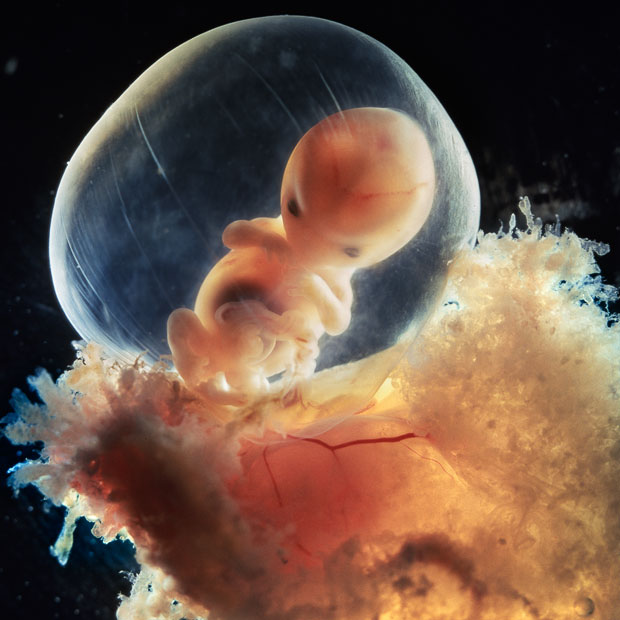
Unborn baby scheming about pro-life apologetics

Scott Klusendorf is the director of the excellent Life Training Institute, and he’s been interviewed by Brian Auten on Apologetics 315.

Details of the interview:

Today’s interview is with Scott Klusendorf, president of Life Training Institute. LTI is the first place to look for excellent resources to get better equipped to defend the pro-life position. Scott talks about defining abortion and its terms, the issue of the debate, the legal history of abortion, defending the pro-life view using science and philosophy, the four pillars of the pro-life argument, answering a litany of objections to the pro-life position, the right and wrong use of emotional appeals, taking on the right tone in the debate, how to get better equipped, and more.

Grab the MP3 file here at Apologetics 315.

The article Scott mentions “How to Defend Your Pro-Life Views in 5 Minutes or Less” is worth the read, and it’s a good summary of some of the points he makes in the lecture.

If you like this interview, please be sure and buy the best basic book on pro-life apologetics – Scott Klusendorf’s “The Case for Life“.

And there is actually a full transcript, and here’s an excerpt:

BA: Great stuff. Now I want you to go into these pillars if you will of defending the pro-life position with science and philosophy, and in your web site prolifetraining.com one of the things that you provide is sort of a four point acronym, some would say sled S-L-E-D. Can you lay out what those main pillars are and their relevance to the issue?

SK: Well as I mentioned a moment ago, pro-life advocates argue that elective abortion unjustly takes the life of a developing human being, and we defend that claim using science and philosophy. We use science to determine what kind of thing the unborn is, and we use philosophy to show that there’s no relevant deference between the embryos we once were and the adults we are today that would justify killing us at that earlier stage of development. Scientifically, as I mentioned just moments ago embryology text books worldwide indicate that from the very beginning you and I were distinct living whole human beings. You can’t see that I’m doing this right now, Brian, but at the moment I’m picking cells off the back of my hand. These cells, which we call somatic cells, contain my entire DNA and coding. But you don’t thing I just committed mass murder by sending a couple hundred of those puppies hurling to their deaths on the floor in front of me. And the reason is, you know that these cells though they contain my DNA and coding are merely part of a larger human being, me. They are not distinct whole living organisms the way that you were when you were an embryo. The way I was when I was an embryo. In other words, there is a difference in kind between each of our bodily cells and the embryonic human beings we once were. That’s what science teaches us; that’s what the science of embryology lays down for us.Philosophically, we argue using that SLED acronym that you mentioned a moment ago that there’s no difference between that embryo we once were and the adult we are today. The adults we are today that justify killing us at that earlier stage of development and as Steven Schwarz points out, the differences between that embryo and the adult that you are today are one of size, level of development, environment and degree of dependency. Think of the acronym SLED and you will remember those four differences. Size, yeah you were smaller as an embryo, but since when does body size determine the rights that you have. Shaquille O’Neal, the seven foot two basketball star with the Boston Celtics, is a foot taller than I am, but he doesn’t have a greater right to life simply because he’s bigger.

Level development? Sure, we were less developed as embryos but since when is a matter of principal does that mean we can kill you? Two-year-old girls are less developed than twenty-year-old young women. We don’t think though the two year old girl has less to a right to life simply because she can’t function at the level that the twenty year old can. Level of size, I should say level of development. What about environment; where you are located there is the letter “E” in that SLED acronym. You were once in the womb now you’re out but sense when does were you are determine what you are? When you walk from your living room into the studio to do this interview. You changed location but you didn’t stop being you. When I jump on an airplane and fly from Atlanta to London’s Heathrow airport. I get off the plane I’m in a new location, but I’m the same being as I was when I left Atlanta. If that’s true how does a journey of eight inches down the birth canal suddenly change me from non-human, non-valuable thing that we can kill? To a valuable human being that we can’t kill. And the answer is, if I wasn’t already human and valuable I’m not going to get there by changing my address. And then finally, degree of dependency—yes we depended on our mother for survival but sense when does dependency on another human being mean we can kill you? Conjoined twins depend on each other for survival and unless one of the twins is killing its partner we don’t go ahead and slit the throat of both twins simply because they can’t live independent of each other. Size, level of development, environment, degree of dependency, think “SLED” those are the only four differences between that embryo you once were and the adult you are today. And the pro-lifer would argue that not one of those four differences justifies killing you at that earlier stage.

You can see Scott in a debate about abortion right here.

And if you like that interview, I have some more things for you to read from Dr. Francis Beckwith.

Learn more by reading

Frank Beckwith is the author of “Defending Life: A Moral and Legal Case Against Abortion Choice“. He wrote that book for Cambridge University Press, a top academic press. But before Cambridge University Press, Beckwith wrote easy-to-understand essays for the Christian Research Journal.

Here are four essays that answer common arguments in favor of legalized abortion.

I have a copy of Dr. Beckwith’s previous book “Politically Correct Death”, which I read bit-by-bit on my lunch hours 10 years ago. Excellent stuff.

A response to Judith Jarvis Thompson’s violinist argument for abortion rights

Amy posted this on the Stand to Reason blog, and it got a ton of comments.

Excerpt:

The “Violinist” argument for keeping abortion legal is an illustration created by Judith Jarvis Thompson for the purpose of clarifying our moral intuitions about abortion by considering a parallel situation. The Violinist story goes like this (see the full, original story here): A woman wakes up to find she’s been attached without her consent to a famous violinist who needs the help of her kidneys for the next nine months in order to live. If the woman detaches herself from him, he will die.

According to Thompson, since it’s clear that the woman ought not be forced by law to remain attached to this man (though he is a person with rights), in the same way, the law ought not force a woman to remain attached to an unborn child who is similarly using her body to live (though he is a person with rights).

In response to this bodily rights argument, Stephen Wagner, Josh Brahm, and Timothy Brahm (along with others—see acknowledgments) have developed a new illustration that more closely parallels the situation of a pregnant woman (including those who are pregnant by rape), which they call “The Cabin in the Blizzard.” From Stephen Wagner’s paper, “De Facto Guardian and Abortion”:

Imagine that a woman named Mary wakes up in a strange cabin. Having gone to sleep in her suburban home the night before, she starts to scream frantically. She goes to the window and sees snow piled high. It appears she is snowed in. On the desk by the window, she finds a note that says,

“You will be here for six weeks.
You are safe, and your child is, too.
There is plenty of food and water.”

Since she just gave birth a week ago, she instinctively begins tearing through each room of the cabin looking for her infant son. She finds an infant in a second room, but it is not her infant. It is a girl who appears to be about one week old, just like her son. Mary begins to scream.

Pulling herself together, she goes to the kitchen area of the cabin and finds a huge store of food and a ready source of water. The baby begins to cry, and she rightly assesses that the baby is hungry. Mary sees a three-month supply of formula on the counter in the kitchen area.

Now imagine that the police show up at the cabin six weeks later, and Mary emerges from the cabin. After determining she is in good health, albeit a good bit frazzled, one policeman says, “We’ve been investigating this situation for some time. The Behavioral Psychologists from the nearby University of Lake Wobegon are responsible. We’ll bring them to justice. We’re so glad you’re okay. Is there anyone else in the cabin?”

Mary said quietly, “There was.”

“There was?” The police hurry past her to the cabin. They search the cabin and find the infant formula unopened on the counter. They find the infant dead on a bed. The coroner confirms that the infant died from starvation.

We can see that Mary was wrong for not feeding the baby in this situation, regardless of the fact that she did not consent to these demands being placed on her. As Wagner points out, our moral intuition tells us her obligation to feed the child exists even if her only option is to use her own body to breastfeed that child, causing her great discomfort.

Another problem with the violinist argument is that it neglects the fact that the baby is there as a result of the woman’s own decision to have sex without being ready for a baby. In the violinist example, the woman is a helpless victim of some group of music lovers. But in a real pregnancy, the woman had to have made a decision that resulted in the baby being born, (except in the case of rape).

Triablogue explains it thus:

Thompson seems to make a distinction between consent to pregnancy and consent to sex (as Beckwith and others point out). But it seems that pregnancy is the designed result of sex, even though it may not be the desired result. It would seem that our sex organs have the purpose of being ordered towards procreation. Applying this to the violinist then: What if I engaged in an activity, say, spelunking, that regularly created rare kidney diseases in violinists? Say that every time I dropped 50 ft into the cave, a violinist was almost sure to develop the disease that only I had the blood type to correct or fix. If I did so, should I not be hooked up to him, voluntarily or not? Say that there was protection, some kind of spelunking helmet. Say that it was not 100% effective. If my helmet ripped, should I be attached to the violinist? Or say I tried to “pull up” before I hit 50 ft. Unfortunately, it felt so good to decend that I pulled up a little too late and my right foot passed the 50 ft mark. Should I be attached to the violinist? I don’t see why not. Indeed, say that the statistical evidence was that the first two people that ever spelunked together would eventually cause 6 billion violinists to come down with rare kidney diseases, I dare say the Society of Music Lovers, and almost everyone else for that matter, would call for abstaining from spelunking unless you agreed to take care of the violinists until they got better. This seems fatal to Thompson’s argument.

It’s very helpful illustration for dealing with pro-abortion people who admit that unborn children are human persons, but who still think that women should have a right to terminate their pregnancy.

Brian Auten interviews pro-life debater Scott Klusendorf

Unborn baby scheming about pro-life apologetics

Scott Klusendorf is the director of the excellent Life Training Institute, and he’s been interviewed by Brian Auten on Apologetics 315.

Details of the interview:

Today’s interview is with Scott Klusendorf, president of Life Training Institute. LTI is the first place to look for excellent resources to get better equipped to defend the pro-life position. Scott talks about defining abortion and its terms, the issue of the debate, the legal history of abortion, defending the pro-life view using science and philosophy, the four pillars of the pro-life argument, answering a litany of objections to the pro-life position, the right and wrong use of emotional appeals, taking on the right tone in the debate, how to get better equipped, and more.

Grab the MP3 file here at Apologetics 315.

The article Scott mentions “How to Defend Your Pro-Life Views in 5 Minutes or Less” is worth the read, and it’s a good summary of some of the points he makes in the lecture.

If you like this interview, please be sure and buy the best basic book on pro-life apologetics – Scott Klusendorf’s “The Case for Life“.

And there is actually a full transcript, and here’s an excerpt:

BA: Great stuff. Now I want you to go into these pillars if you will of defending the pro-life position with science and philosophy, and in your web site prolifetraining.com one of the things that you provide is sort of a four point acronym, some would say sled S-L-E-D. Can you lay out what those main pillars are and their relevance to the issue?

SK: Well as I mentioned a moment ago, pro-life advocates argue that elective abortion unjustly takes the life of a developing human being, and we defend that claim using science and philosophy. We use science to determine what kind of thing the unborn is, and we use philosophy to show that there’s no relevant deference between the embryos we once were and the adults we are today that would justify killing us at that earlier stage of development. Scientifically, as I mentioned just moments ago embryology text books worldwide indicate that from the very beginning you and I were distinct living whole human beings. You can’t see that I’m doing this right now, Brian, but at the moment I’m picking cells off the back of my hand. These cells, which we call somatic cells, contain my entire DNA and coding. But you don’t thing I just committed mass murder by sending a couple hundred of those puppies hurling to their deaths on the floor in front of me. And the reason is, you know that these cells though they contain my DNA and coding are merely part of a larger human being, me. They are not distinct whole living organisms the way that you were when you were an embryo. The way I was when I was an embryo. In other words, there is a difference in kind between each of our bodily cells and the embryonic human beings we once were. That’s what science teaches us; that’s what the science of embryology lays down for us.Philosophically, we argue using that SLED acronym that you mentioned a moment ago that there’s no difference between that embryo we once were and the adult we are today. The adults we are today that justify killing us at that earlier stage of development and as Steven Schwarz points out, the differences between that embryo and the adult that you are today are one of size, level of development, environment and degree of dependency. Think of the acronym SLED and you will remember those four differences. Size, yeah you were smaller as an embryo, but since when does body size determine the rights that you have. Shaquille O’Neal, the seven foot two basketball star with the Boston Celtics, is a foot taller than I am, but he doesn’t have a greater right to life simply because he’s bigger.

Level development? Sure, we were less developed as embryos but since when is a matter of principal does that mean we can kill you? Two-year-old girls are less developed than twenty-year-old young women. We don’t think though the two year old girl has less to a right to life simply because she can’t function at the level that the twenty year old can. Level of size, I should say level of development. What about environment; where you are located there is the letter “E” in that SLED acronym. You were once in the womb now you’re out but sense when does were you are determine what you are? When you walk from your living room into the studio to do this interview. You changed location but you didn’t stop being you. When I jump on an airplane and fly from Atlanta to London’s Heathrow airport. I get off the plane I’m in a new location, but I’m the same being as I was when I left Atlanta. If that’s true how does a journey of eight inches down the birth canal suddenly change me from non-human, non-valuable thing that we can kill? To a valuable human being that we can’t kill. And the answer is, if I wasn’t already human and valuable I’m not going to get there by changing my address. And then finally, degree of dependency—yes we depended on our mother for survival but sense when does dependency on another human being mean we can kill you? Conjoined twins depend on each other for survival and unless one of the twins is killing its partner we don’t go ahead and slit the throat of both twins simply because they can’t live independent of each other. Size, level of development, environment, degree of dependency, think “SLED” those are the only four differences between that embryo you once were and the adult you are today. And the pro-lifer would argue that not one of those four differences justifies killing you at that earlier stage.

You can see Scott in a debate about abortion right here.

And if you like that interview, I have some more things for you to read from Dr. Francis Beckwith.

Learn more by reading

Frank Beckwith is the author of “Defending Life: A Moral and Legal Case Against Abortion Choice“. He wrote that book for Cambridge University Press, a top academic press. But before Cambridge University Press, Beckwith wrote easy-to-understand essays for the Christian Research Journal.

Here are four essays that answer common arguments in favor of legalized abortion.

I have a copy of Dr. Beckwith’s previous book “Politically Correct Death”, which I read bit-by-bit on my lunch hours 10 years ago. Excellent stuff.