
Tag Archives: Peace

Ronald Reagan’s 40th anniversary D-Day speech: the boys of Pointe du Hoc

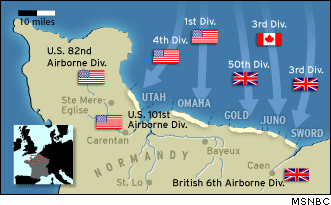
June 6, 1944 D-Day Normandy Invasion Map

It’s June 6th, today, and it’s the anniversary of D-Day: the Allied invasion of northern France – the beginning of the end of World War 2. One of the most pivotal events of that day was the assault on German gun emplacements by members of the Army Rangers at a fortified position called “Pointe du Hoc”.

President Ronald Reagan recognized the soldiers who attacked Pointe du Hoc back in 1984:

You can read the full transcript of that speech here.

Ronald Reagan also made the case for gratitude and vigilance:

Here’s the hymn that starts to play at the end:

The Boys of Pointe du Hoc

Here’s a summary of the Pointe du Hoc mission:

[Lt. Col. James Earl] Rudder took part in the D-Day landings as Commanding Officer of the United States Army’s 2nd Ranger Battalion. His U.S. Army Rangers stormed the beach at Pointe du Hoc and, under constant enemy fire, scaled 100-foot (30 meter) cliffs to reach and destroy German gun batteries. The battalion’s casualty rate for this perilous mission was greater than 50 percent. Rudder himself was wounded twice during the course of the fighting. In spite of this, they dug in and fought off German counter-attacks for two days until relieved. He and his men helped to successfully establish a beachhead for the Allied forces.

You can watch a three-clip documentary on it, too: part 1, part 2, part 3.

Although initially, the Rangers did not find the guns where they had expected them, they did find them further back behind the cliffs and destroyed them there, removing a threat to the forces that would be landing later.

What does D-Day mean to Christians in particular?

A Christian friend asked me what she should be thinking about when I sent her one of the videos above, and so I wrote her this to explain why I sent her the video:

To make you close your eyes and think in a more practical way about what it means for someone to sacrifice their lives to save you, of course. What it means to look up cliffs at machine guns, barbed wire and mortars raining death on you and to take a rope in your hands and to climb up a sheer cliff, under heavy fire, in order to save generations yet unborn and freedom itself.

To think about a concrete example helps us to be able to appreciate what Christ did for us in giving his life for us so that we could be free of sin, as well.

This is the insight that drives my entire interest in war and military history, in fact.

What does this mean: “Greater love has no man than this, that a man lay down his life for his friends.”

The more you know about D-Day, the more fearful what Jesus did appears, and the more you can be grateful.

Bullets and shrapnel are scary… and so are nails and lashes. Why on Earth would anyone endure either for me? And what should my response be to it?

I think it is helpful to explain Christianity to those who are not yet Christian, and for Christians to fully appreciate what Christianity is all about.

We were in peril. And now we have been saved. But at a cost.

I think that it’s important for Christians to look to history, art, poetry and music to help them to reflect and comprehend the sacrifice that Christ made for us in dying on the cross to protect us from peril. What must the cross have looked like to Jesus? It must have been something like what the Omaha beach looked like to the Americans landing in Normandy. Jesus saw whips, thorns and nails, and the heroes of Normandy saw 88 mm AT guns, 81 mm mortars and MG42 machine guns. How should you feel about people who face death on your behalf? Think about it.

New study: prayer improves self-control and emotional stability

Mysterious WGB posted this article from the UK Daily Mail.

Excerpt:

Praying helps people stay in control of their emotions and behaviour, according to a new study.

People turn to prayer ‘as a coping response to the high demands in life’ and are rewarded with increased strength and ability to resist temptation, researchers said.

Previous findings have shown that when people try hard to control their emotions and thoughts, the risk of aggressive outbursts and binge drinking or eating rises.

But the latest study, by German psychologists at Saarland University and the University of Mannheim, found that praying helps people maintain self-control.

‘A brief period of personal prayer buffered the self-control depletion effect’, wrote the team, whose findings are published in the Journal of Experimental Social Psychology online.

‘These results are consistent with and contribute to a growing body of work attesting to the beneficial effects of praying on self-control.’

Praying has already been linked in the past to reduced levels of infidelity and alcohol consumption.

Also, I feel that I should mention this interesting study, if we are going to have a Twilight Zone post today. (H/T STR)

Excerpt:

Abstract

We examined whether atheists exhibit evidence of emotional arousal when they dare God to cause harm to themselves and their intimates. In Study 1, the participants (16 atheists, 13 religious individuals) read aloud 36 statements of three different types: God, offensive, and neutral. In Study 2 (N = 19 atheists), ten new stimulus statements were included in which atheists wished for negative events to occur. The atheists did not think the God statements were as unpleasant as the religious participants did in their verbal reports. However, the skin conductance level showed that asking God to do awful things was equally stressful to atheists as it was to religious people and that atheists were more affected by God statements than by wish or offensive statements. The results imply that atheists’ attitudes towards God are ambivalent in that their explicit beliefs conflict with their affective response.

Now, I am blogging about this because it’s interesting, but I would classify this as being in the camp of near-death experiences and the Shroud of Turin. It’s interesting, but it’s not something that I would use to prove anything in a debate. Ever since I read this article from Christianity Today a while back, I’ve been sort of cautious about using prayer studies to argue for anything. Take this prayer study with a grain of salt.

Israel PM calls Democrats’ proposed deal with Iran “a very bad deal”

The Weekly Standard reports.

Here’s what BB Netanyahu said about a U.S. proposal on Iran’s nuclear ambitions:

“I met Secretary Kerry right before he leaves to Geneva,” said Netanyahu. “I reminded him that he said that no deal is better than a bad deal. That the deal that is being discussed in Geneva right now is a bad deal. It’s a very bad deal. Iran is not required to take apart even one centrifuge. But the international community is relieving sanctions on Iran for the first time after many years. Iran gets everything that it wanted at this stage and it pays nothing. And this is when Iran is under severe pressure. I urge Secretary Kerry not to rush to sign, to wait, to reconsider, to get a good deal. But this is a bad deal–a very, very bad deal. It’s the deal of a century for Iran; it’s a very dangerous and bad deal for peace and the international community.”

Foreign Policy Initiative says that the deal will weaken sanctions against Iran.

Excerpt:

As the United States and other world powers resume nuclear talks with Iran this week, a senior official in the Obama administration recently told reporters in Geneva that they seek a short-term interim agreement that gives Iran partial and reversible relief from U.S.-led international sanctions, with the goal of getting a package of short-term Iranian concessions that “stops Iran’s nuclear program from moving forward for the first time in decades” and “potentially rolls part of it back.” While this is a laudable goal, the potential package of Iranian concessions that has been discussed in the media would fail to fully freeze Iran’s nuclear program, let alone roll it back.

[…]If it costs the United States nothing to persuade Iran to implement the rumored package of short-term Iranian nuclear concessions, then we should welcome that outcome.   But while U.S. diplomats have not publicly said what they will offer in Geneva, they reportedly are considering relaxing restrictions on Iran’s oil revenues held in overseas accounts and perhaps also on trade in gold and petrochemicals.  Given the difficulties faced at times by the United States in getting allies and partners to support the sanctions regime against Iran’s nuclear program, the Obama administration’s potential forms of sanctions relief could be too dear a price to pay for the rumored package of Iranian concessions.

I was listening to the latest episode of the Weekly Standard podcast this morning and Lee Smith said the real reason that the Obama administration is doing this is to justify an American withdrawal from the Middle East and to abandon our allies in the region – not just Israel, but Saudi Arabia as well.

The Republicans are moving to block the Democrats from lifting sanctions on Iran.