Tag Archives: Outsourcing

Would the Buffett Rule “stabilize our debt and deficits”?

The Buffett Tax (click for larger image)

The Wall Street Journal assesses Obama’s claims about the Buffett Tax.

Excerpt:

Forget Warren Buffett, or whatever other political prop the White House wants to use for its tax agenda. This week the Administration officially endorsed what in essence is the Obama Rule: Taxes must be high simply to spread the wealth, never mind the impact on the economy or government revenue. It’s all about “fairness,” baby.

This was long apparent to those fated to closely watch the 2008 campaign, but some voters might have missed the point amid the gauzy rhetoric about hope and change. Now we know without any doubt. White House aides made it official Tuesday in their on-the-record briefing on the new federal minimum tax that travels under the political alias known as the “Buffett rule.”

The policy goal is to impose an effective minimum tax of 30% on the income of anyone who makes more than $1 million a year. When President Obama first proposed this new minimum tax he declared that the rule “could raise enough money” so that we “stabilize our debt and deficits for the next decade.”

Then he added: “This is not politics; this is math.” Well, remedial math maybe.

The Obama Treasury’s own numbers confirm that the tax would raise at most $5 billion a year—or less than 0.5% of the $1.2 trillion fiscal 2012 budget deficit and over the next decade a mere 0.1% of the $45.43 trillion the federal government will spend. When asked about those revenue projections, White House aide Jason Furman backpedaled from Mr. Obama’s rationale by explaining that the tax was never intended “to bring the deficit down and the debt under control.”

So if it doesn’t do what Obama says it’s supposed to do, what would really do?

The Buffett rule is really nothing more than a sneaky way for Mr. Obama to justify doubling the capital gains and dividend tax rate to 30% from 15% today. That’s the real spread-the-wealth target. The problem is that this is a tax on capital that is needed for firms to grow and hire more workers. Mr. Obama says he wants an investment-led recovery, not one led by consumption, but how will investment be spurred by doubling the tax on it?

The only investment and hiring the Buffett rule is likely to spur will be outside the United States—in China, Germany, India, and other competitors with much more investment-friendly tax regimes. The Buffett rule would give the U.S. the fourth highest capital gains rate among OECD nations, according to a new study by Ernst & Young, to go along with what is now the highest corporate tax rate (a little under 40% for the combined federal and average state rate). That’s what happens when politicians pursue fairness over growth.

When you make it less attractive for people with capital to invest their capital here at home then they will take their capital and invest it abroad. What Obama’s proposal accomplishes is to outsource jobs – the exact thing that he is always complaining about. It’s higher taxes and more regulation, especially EPA regulation, that causes capital (and consequently jobs) to move overseas. If you want capital to come into America, you lower the tax rates.

In other news, the Obama administration is suing a company owned by Warren Buffett for unpaid taxes.
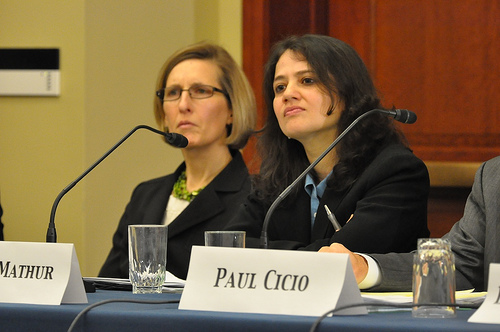
New paper on income inequality: Does taxing the rich hurt the middle class?

Aparna Mathur (right)

Here’s an article by Indian economist Aparna Mathur.

She writes (in part):

In a recent paper that I co-authored with Kevin Hassett, we explored the effect of high corporate taxes on worker wages. The motivation for the paper came from the international tax literature (summarized by Roger Gordon and Jim Hines in a 2002 paper1) that suggested that mobile capital flows from high tax to low tax jurisdictions. In other words, in any set of competing countries, investment flows are determined by relative rates of taxation. The current U.S. headline rate of corporate tax is 35 percent. The combined federal and state statutory rate of 39 percent is second only to Japan in the OECD. With Japan set to lower its statutory rate later this year, the U.S. rate will soon be the highest in the OECD and one of the highest in the world. What effect do these high rates have on worker wages?

When capital flows out of a high tax country, such as the United States, it leads to lower domestic investment, as firms decide against adding a new machine or building a factory. The lower levels of investment affect the productivity of the American worker, because they may not have the best machines or enough machines to work with. This leads to lower wages, as there is a tight link between workers’ productivity and their pay. It could also lead to less demand for workers, since the firms have decided to carry out investment activities elsewhere.

Our paper was one of the first to explore the adverse effect of corporate taxes on worker wages. Using data on more than 100 countries, we found that higher corporate taxes lead to lower wages. In fact, workers shoulder a much larger share of the corporate tax burden (more than 100 percent) than had previously been assumed. The reason the incidence can be higher than 100 percent is neatly explained in a 2006 paper by the famous economist Arnold Harberger.2 Simply put, when taxes are imposed on a corporation, wages are lowered not only for the workers in that firm, but for all workers in the economy since otherwise competition would drive workers away from the low-wage firms. As a result, a $1 corporate income tax on a firm could lead to a $1 loss in wages for workers in that firm, but could also lead to more than a $1 loss overall when we look at the lower wages across all workers.

Following our paper, several academic economists substantiated our results, using different data sets and applying varied econometric modeling and techniques. Some examples of these studies include a 2007 paper by Mihir A. Desai and C. Fritz Foley of Harvard Business School and James Hines Jr. of Michigan University Law School, a 2007 paper by R. Alison Felix of the Federal Reserve Bank of Kansas City, a 2009 paper by Robert Carroll of The Tax Foundation, and a 2010 paper by Wiji Arulampalam of the University of Warwick and Michael Devereux and Giorgia Maffini of Oxford.3 A recent Tax Notes article that I co-authored summarizes these various studies and also the lessons from the theoretical literature on the topic. The general consensus from theory and empirical work is that while we may argue academically about the size of the effect, there is no disagreement among economists that a sizeable burden of the corporate income tax is disproportionately felt by working Americans. On average, a $1 increase in corporate tax revenues could lead to a dollar or more decline in the wage bill.

Conservatives and liberals have the same goal. We both want to help the poor. Liberals think that taking money from the rich and giving it to the poor helps, but all it does it cause the rich to move their capital and jobs elsewhere, leaving the poor poorer. Conservatives let the rich keep their money and encourage them to risk it trying to make more money by engaging in enterprises that create wealth – creating products and services from less valuable raw materials. In a socialist system, the rich get poorer, but so do the poor. In a capitalist system, the rich get very rich, but the poor also gain more wealth. That’s what happens when corporations like Apple make IPads out of junky raw materials. That’s how wealth is created – by letting people who want to make things keep more of what they earn. We all benefit from encouraging people to make new things and provide value for their neighbors.

Related articles

Democrat Jim Cramer explains how Obamacare forces businesses to outsource

Transcript:

CNBC’s Jim Cramer:  “This is — look, I think the debate is a fabulous one to have, but it has completely taken away from the fact that we are really going to have a hard time hiring once this plan is put in place. I’ve had a couple of CEOs come on just in the last few weeks. When you talk about whether they want to hire, this is what they bring up. Chipotle, look, use this as maybe one of the great job creators in this country and they pay a lot for their people. This is a company that is very forward. When I ask them, what does ObamaCare do for you? They just say well, nothing we hope because the Supreme Court has got to say no to it. I mean, this is at the front and center of what could derail the economy.”

MSNBC’s Joe Scarbarough: “You’re talking about health care reform?”

CNBC’s Jim Cramer:  “I’m just saying, look, the issue the Catholic charities issue, front and center, I want church and state separation, but whatever I want doesn’t matter as much as what I’m telling you. Business leaders fear this more than anything, they don’t want to hire, this is part of the underground economy. It’s gonna develop because no one wants people on the books because of ObamaCare and people have to recognize that this is a front and center issue for every CEO I deal with and another reason why they don’t want to hire here, they want to hire there. They want to put the jobs in Asia, they want to put the jobs in Mexico because they don’t want to think about how much more it’s going to cost to hire a new person. Don’t lose that debate. That is a major debate for the economy.”

Is Jim Cramer some sort of radical tea party conservative?

He wrote this in 2008:

What will New York look like a year from now? The answer: bad and probably worse, and perhaps downright catastrophic. Three degrees of awful. The first step was passing the bank-bailout legislation. Now that it’s done—and if it didn’t get done we would have been looking at a guaranteed economic collapse—the critical issue will be presidential leadership. And while any president will be an improvement over the current one, there is a growing belief on Wall Street that Barack Obama has the capacity to lead us out of this wilderness while John McCain does not. I’ll go a step further: Obama is a recession. McCain is a depression.

Cramer back Barack Obama for President and is a well-known Democrat.