Tag Archives: New Testament

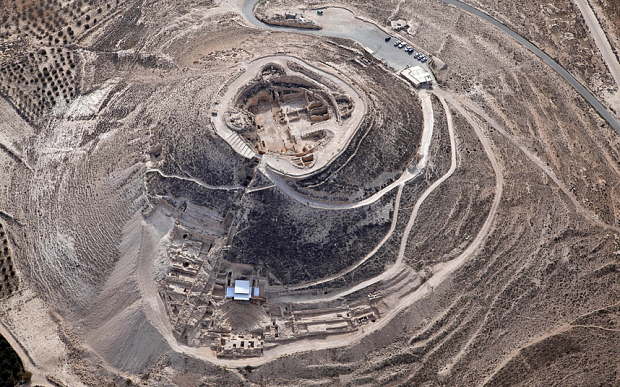
Archaeologists discover entrance to Herod’s palace near Bethlehem

Herod's palace
Herod’s palace

Baptist Press reports on the story.

Full text:

Israeli archeologists have uncovered an impressive entrance to Herod’s palace at Herodium. Located only three miles southeast of Bethlehem, Herodium played an important part in the events surrounding the early life of Christ.

The December announcement by Hebrew University archeologists Roi Porat, Yakov Kalman and Rachel Chachy dovetails well with the seasonal interest in the nativity accounts of Luke and Matthew in the New Testament.

While both Luke and Matthew wrote that King Herod governed Judea during the era of Jesus’ birth at Bethlehem (Luke 1:5, Matthew 2:1), they included nothing concerning Herod’s massive palace/fortress complex at nearby Herodium.

Herodium, like Herod’s other isolated palace/fortress complexes at Masada and Machaerus, was built on a mountain. To enhance its impressive scale, Herod artificially extended the height of the hill to make it the tallest mountain in the Judean desert.

While the site included the usual Herodian luxuries such as a palace, bathhouse, theatre and garden, Herodium was essentially a fortress, a place where Herod could find refuge if his people revolted.

Herod’s fear of a Jewish revolt led him to establish many fortresses in both urban centers (he maintained two in Jerusalem itself) and in isolated rural areas away from the urban centers.

A small community close to the fortress housed the construction teams and, later, the garrison soldiers and palace servants. The servants who waited on the king indeed worked in an impressive palace.

The newly uncovered entranceway apparently was still being constructed near the time of the monarch’s death.

As shown in one of the photographs, the entryway included three levels of arches in a 65-foot corridor that was 19 feet across and 65 feet in height leading to the palace’s courtyard. Curiously enough, the nearly completed entrance was abruptly stopped and backfilled around the time of Herod’s death. The archeologists speculated that the now-aging Herod instead sought to convert the entire palace into a memorial mound for his upcoming burial at the site.

Indeed, Herod’s plans for Herodium unfolded as Jesus was born and as He spent His early life in nearby Bethlehem. When the magi arrived in Jerusalem and announced they had come to worship the “king of the Jews,” Herod sent them to Bethlehem after learning the location of the Messiah’s birthplace from the chief priests and learned scholars. The monarch hoped to ascertain from the magi which of the town’s small children was the designated royal candidate. Then Herod hoped to execute the child (Matthew 2:1-8, 2:16).

When the magi failed to return with this information, Herod ordered his soldiers into Bethlehem to murder all children age 2 and under. Warned to flee to Egypt, the holy family escaped Herod’s plans, but an undisclosed number of children were killed by Herod’s soldiers. Although never stated in the biblical account, the soldiers who carried out the old king’s infamous order were either stationed in Jerusalem (seven miles from Bethlehem) or in the closer post at Herodium. In fact, Herodium overlooked Bethlehem and could have functioned as a convenient headquarters for Herod’s deadly operation.

While the holy family resided in Egypt, another Herodium connection to the early life of Christ took place. After a long and terribly painful illness, Herod died. His surviving eldest son (Herod had murdered his three oldest sons), Archelaus, then buried him in Herodium at a pre-selected tomb and gave his father an elaborate funeral at the site and spared no expense, according to the Jewish historian Josephus (Jewish War, 1,673).

Israeli archeologist Ehud Netzer claimed to have found Herod’s tomb and damaged sarcophagus (stone coffin) in 2007 at Herodium, but in 2013 and 2014 other archeologists have raised doubts about the tomb and the sarcophagus. Israeli archeologists Joseph Patrich and Benjamin Arubas largely based their doubts on the modest tomb site and the unimpressive sarcophagus. They believe that the mega-maniacal Herod would have commissioned a larger tomb and a more elaborate sarcophagus.

With Herod now buried in Herodium and with Archelaus eventually ruling over much of his father’s former kingdom as an “ethnarch” (“ruler of the people”), the New Testament noted the change in political leadership (Matthew 2:19-22). The change prompted Joseph to consider a move back to Judea (perhaps back to Bethlehem itself where the family had lived for about two years), but his misgivings about a Judea under the rule of an already unpopular Archelaus and a warning in a dream led him to reconsider. The decision was a wise one. A return to Bethlehem in the “shadow of Herodium” and the nearby royal city of Jerusalem placed the holy family at potential risk.

Instead, Joseph took his family back to Nazareth in Galilee (Matthew 2:22-23). Galilee was governed by Herod Antipas, the younger brother of Archelaus. At the time, this Herodian ruler, with the title of “tetrarch” (“ruler over a fourth”), was regarded as a milder alternative to the volatile Archelaus. Located far away from the recent unpleasant associations connected to Herodium and the slaughter of the children in Bethlehem, Joseph and Mary would raise Jesus in the peaceful surroundings of Nazareth.

The recent archeological find in Herodium and the continuing dispute concerning Herod’s tomb and sarcophagus calls attention to the background story of the early life of Christ as detailed in the Gospel of Matthew. Perhaps some further archeological discoveries at Herodium will uncover additional information about the familiar nativity narrative.

I liked this article on Baptist Press so much, I pasted it here in full – because of the links between history and the Bible. It’s also reported in secular news sources like NBC News and the UK Telegraph.

When I read stories like this, it really makes me question people who think that the New Testament books were not intended to be history. I think the default view has to be that the authors intended to write history, and then we do the work to see which parts pass historical tests – i.e. – how early, how many sources, how many eyewitnesses, etc. And, do we have archaeological evidence to corroborate the narrative.

Is the story of the woman being stoned for adultery in John 7-8 authentic?

Here’s the leading conservative New Testament scholar Daniel Wallace to explain.

Excerpt:

One hundred and forty years ago, conservative biblical scholar and Dean of Canterbury, Henry Alford, advocated a new translation to replace the King James Bible. One of his reasons was the inferior textual basis of the KJV. Alford argued that “a translator of Holy Scripture must be…ready to sacrifice the choicest text, and the plainest proof of doctrine, if the words are not those of what he is constrained in his conscience to receive as God’s testimony.” He was speaking about the Trinitarian formula found in the KJV rendering of 1 John 5:7–8. Twenty years later, two Cambridge scholars came to the firm conclusion that John 7:53–8:11 also was not part of the original text of scripture. But Westcott and Hort’s view has not had nearly the impact that Alford’s did.

For a long time, biblical scholars have recognized the poor textual credentials of the story of the woman caught in adultery (John 7:53–8:11). The evidence against its authenticity is overwhelming: The earliest manuscripts with substantial portions of John’s Gospel (P66 and P75) lack these verses. They skip from John 7:52to 8:12. The oldest large codices of the Bible also lack these verses: codex Sinaiticus and Vaticanus, both from the fourth century, are normally considered to be the most important biblical manuscripts of the NT extant today. Neither of them has these verses. Codex Alexandrinus, from the fifth century, lacks several leaves in the middle of John. But because of the consistency of the letter size, width of lines, and lines per page, the evidence is conclusive that this manuscript also lacked the pericope adulterae. Codex Ephraemi Rescriptusalso from the fifth century, apparently lacked these verses as well (it is similar to Alexandrinus in that some leaves are missing). The earliest extant manuscript to have these verses is codex Bezae, an eccentric text once in the possession of Theodore Beza. He gave this manuscript to the University of Cambridge in 1581 as a gift, telling the school that he was confident that the scholars there would be able to figure out its significance. He washed his hands of the document. Bezae is indeed the most eccentric NT manuscript extant today, yet it is the chief representative of the Western text-type (the text-form that became dominant in Rome and the Latin West).

When P66, P75, Sinaiticus, and Vaticanus agree, their combined testimony is overwhelmingly strong that a particular reading is not authentic. But it is not only the early Greek manuscripts that lack this text. The great majority of Greek manuscripts through the first eight centuries lack this pericope. And except for Bezae (or codex D), virtually all of the most important Greek witnesses through the first eight centuries do not have the verses. Of the three most important early versions of the New Testament (Coptic, Latin, Syriac), two of them lack the story in their earliest and best witnesses. The Latin alone has the story in its best early witnesses.

Even patristic writers seemed to overlook this text. Bruce Metzger, arguably the greatest textual critic of the twentieth century, argued that “No Greek Church Father prior to Euthymius Zigabenus (twelfth century) comments on the passage, and Euthymius declares that the accurate copies of the Gospel do not contain it” (Textual Commentary, 2nd ed., loc. cit.).

It is an important point to note that although the story of the woman caught in adultery is found in most of our printed Bibles today, the evidence suggests that the majority of Bibles during the first eight centuries of the Christian faith did not contain the story. Externally, most scholars would say that the evidence for it not being an authentic part of John’s Gospel is rock solid.

But textual criticism is not based on external evidence alone; there is also the internal evidence to consider. This is comprised of two parts: intrinsic evidence has to do with what an author is likely to have written;transcriptional evidence has to do with how and why a scribe would have changed the text.

Intrinsically, the vocabulary, syntax, and style look far more like Luke than they do John. There is almost nothing in these twelve verses that has a Johannine flavor. And transcriptionally, scribes were almost always prone to add material rather than omit it—especially a big block of text such as this, rich in its description of Jesus’ mercy. One of the remarkable things about this passage, in fact, is that it is found in multiple locations. Most manuscripts that have it place it in its now traditional location: between John 7:52 and 8:12. But an entire family of manuscripts has the passage at the end of Luke 21, while another family places it at the end of John’s Gospel. Other manuscripts place it at the end of Luke or in various places in John 7.

The pericope adulterae has all the earmarks of a pericope that was looking for a home. It took up permanent residence, in the ninth century, in the middle of the fourth gospel.

Wallace teaches at the ultra-conservative fundamentalist Dallas Theological Seminary, and is the foremost evangelical manuscript expert in the world.

Why is this important? I think it is important because this story is very prominent for a great many Christians, especially Christian women, who use this to justify a variety of positions that are inconsistent with the rest of the Bible. These Christians do not like the idea of anyone being judged and so they are naturally inclined to blow this disputed passage into an entire theology that repudiates making moral judgments on such things as capital punishment. In fact, in another post, I was accused of being the equivalent of one of the people who wanted to stone the woman taken for adultery because I oppose fornication and single motherhood. That’s how far this has gone, where some Christians, especially Christian feminists, have leveraged this passage to redefine the Bible so that women are no longer responsible to the Bible’s moral rules and can never be blamed for acting irresponsibly.

Was the message of the New Testament corrupted?

This video is from the Dallas Theological Seminary Hendricks Center blog:

Apologetics Guy Mikel Del Rosario writes:

During a special event called “Jesus in Primetime,” Dr. Darrell Bock, Dr. Ben Witherington, and Dr. Dan Wallace discussed a variety of topics surrounding Jesus and the Bible in the public square. One of the topics they discussed was the issue of variant readings in the New Testament. Are there really hundreds of thousands of textual differences in our New Testament manuscripts? What does it all mean?

In this video clip, Dr. Dan Wallace identifies four categories of textual variants and explains why these differences don’t need to shake our faith in the New Testament.

The first and largest category is made up of spelling differences in the text, accounting for over 75% of all textual variants. What about the other 25%?

The next largest category represents synonyms, word order differences or articles with proper nouns; issues which don’t affect the meaning of text at all. For example, Greek writers would use the definite article before people’s names (e.g. “The Jesus”). In this case, whether or not the definite article is there makes no difference in English translations.

The third largest category is made up of variants that actually make a difference in the meaning of the text. But the differences in this category are unlikely to represent any of the original words of the New Testament because the manuscripts where they appear are very late–far removed from the time of Jesus and his original followers.

Finally, the fourth category is made up of variants that both make a difference and may possibly represent the original readings of the text. But this is less than 1% of all variants in the New Testament. For example, most scholars discuss whether the story about the woman caught in adultery was not originally in In John’s text at this point. This is a genuine discussion that notes in a good study discuss. Many do question its presence. Others still argue the event does describe something that did happen in Jesus’ life. What is impacted by this?

Bock answers this question: “What is impacted is whether or not a particular passage teaches a particular point, but in the big scheme of things, there is no fundamental doctrine of the Christian faith that is impacted by this one percent.” Wallace agrees: “There is no cardinal doctrine that is impacted by the viable variants.”

Indeed, it seems a bit misleading for certain scholars to declare that there are between 300,000 and 400,000 textual variants amongst the existing manuscripts we have today and leave it at that. We have so many variants because we have so many New Testament manuscripts. If all we had was one codex with all the books of the New Testament in it, we wouldn’t have any variants!

But having over 5,800 Greek New Testament manuscripts is a good thing because it can help us have more confidence in the readings which best represent the text of the original autographs.

Bart Ehrman tries to sell a lot of books by fussing about these variants, but in a debate with another expert, he quickly folded and admitted that there were only four variants that touched on anything important.

Bart Ehrman’s screeching about variants: should we care?

In Ehrman’s debate with Peter Williams on the UK-based Unbelievable radio show, and in Ehrman’s debate with Dan Wallace, Ehrman lists the 4 worst problems caused by the variants:

  1. the woman caught in adultery (John 7:53-8:11) is a late addition not present in the earliest manuscripts
  2. the long ending of Mark (Mark 16:9-20) is a late addition not present in the earliest manuscripts
  3. Jesus was angry and not compassionate when he healed the leper (Mark 1:41)
  4. that Jesus died apart from God, and not by the grace of God (Hebrews 2:9)

I personally dislike that story in 1), because I think a lot of feminized Christians like it because they do not want to have their happiness diminished by moral judgments. They misunderstand this passage to support self-serving moral relativism and postmodern hedonism. Or worse, anti-capital-punishment. Eww. I say, get rid of the wimpy passage and good riddance. It’s hundreds of years too late from the earliest manuscripts, anyway.

Regarding 2), I like that long ending because it’s more useful from an apologetics standpoint. So I do care about this invariant, and I just don’t use that ending when I debate these historical issues. For 3), I prefer angry Jesus to compassionate Jesus, but I don’t really care because Jesus is angry in lots of places. And for 4) It doesn’t really matter to any core doctrine. It’s theological stuff, not historical fact.