

Tag Archives: New Testament

Bible study: Was the resurrection body of Jesus spiritual or physical?

Sherlock Holmes and John Watson are going to take a look at the data

So, everyone from left to right accepts the early creed in 1 Corinthians 15:3-7 being dated to 1-3 years after the death of Jesus, even atheists like Crossley, Ludemann and Crossan. The thing is, some people are not sure that the appearances of Jesus to individuals, groups, and skeptics really were physical appearances. They say “well, Paul’s appearance was non-physical, so the other ones must have been, too”.

Let’s take a look.

Here’s a paragraph from my friend Eric Chabot, from his blog Think Apologetics. He explains why Paul’s use of the word “resurrection” to describe what the other witnesses saw means bodily resurrection.

He writes:

If Paul did have a vision then the term “vision” is vague and must be defined. As Licona points out, visions are either objective (i.e., something that is seen without the use of our natural senses) or subjective (i.e., a  product of our minds). The real  problem is with the vision hypothesis is that it doesn’t explain Paul’s use of resurrection to explain what had happened to Jesus.  The two words are used for resurrection in the New Testament “anastasis” (rising up) and “egersis” (waking up), both imply a physical body. Furthermore, the use of the word “opethe” (the Greek word for appeared) shows the Gospel writers did believe that Jesus appeared physically. “There you will see (opethe) him” (Matt. 28:7); “The Lord has risen and has appeared (opethe) to Simon” (Luke 24:24). When they used “opethe” here, it means that He appeared physically to them.

So when Paul gives his list of appearances in 1 Cor. 15, the issues becomes whether the appearance to him is the same as it was to the disciples. There is no doubt the post resurrection body of Jesus (after the ascension) had to be somewhat different than the body the disciples saw. Also, whenever the New Testament mentions the word body, in the context of referring to an individual human being, the Greek word “soma” always refers to a literal, physical body.Greek specialist Robert Gundry says “the consistent and exclusive use of soma for the physical body in anthropological contexts resists dematerialization of the resurrection, whether by idealism or by existentialism.” [9] Furthermore, in N.T. Wright’s  The Resurrection of the Son of God shows that the Greek word for resurrection which is “anastasis” was used by ancient Jews, pagans, and Christians as bodily in nature.

Now, I think my view on this, and I’m not sure if Eric would correct me, is that Paul got an objective but non-physical vision of Jesus. There was something there that everyone else could see and hear, in my view. But in my view Paul’s “veridical” vision was post-ascension, and so non-physical. Paul uses the word resurrection to describe what the other eyewitnesses saw (and he met them at least twice, according to Gal 1 and Gal 2), and that means physical resurrected body.

Eric Chabot writes this in another place:

Acts 9- Paul’s Damascus Road Experience

Here we see whatever happened,  this was after the ascension. Hence, to say Paul saw the exact same Jesus before he ascended is hard to infer from the text. There simply isn’t enough information here.  The Bible says, “they heard” the same voice Paul did ” (Acts 9: 7). But they “did not see anyone ” (Acts 9: 7). Notice  Paul was physically blinded by the brightness of the light.  One way or the other, the experience involved something that was external to Paul. It wasn’t something that was the same thing as a vision that Paul talks about in 2 Cor. 12:1.  Furthermore, the phrase “he let himself be seen’” (ōphthē , aorist passive, ), is the word Paul uses  in 1 Cor. 15:7 to describe of his own resurrection appearance as the other ones in the creed. As Paul Barnett says:

“It is sometimes claimed that the word appeared (ōphthē) means a mystical seeing, as of a vision, and that since this was what Paul “saw” it was what the other apostles “saw.” In other words, after death, Jesus was taken directly to heaven whence he “appeared” to various people, mystically, as it were. This however, is not all the meaning of Paul’s words. First, the word ōphthē, “appeared” is not limited to visionary seeing it is also used for physical seeing. Moreover, the verb raise used in the phrase ‘raised on the third day” is used elsewhere in combination with the words “from the dead” which literally means “from among the corpses.” Thus raised preceding  appeared gives the latter a physical not a mystical meaning. Christ, as “raised from the dead” ….appeared.”  Furthermore, when Paul asks “ Am I not free? Am I not an apostle? Have I not seen Jesus our Lord?”(1 Cor. 9: 1), he is using the ordinary word horan, “to see” for physical sight. If “seeing” the Lord “raised from the dead” qualified others to be apostles, then Paul is, indeed, an apostle. It was no mere subjective vision that arrested Paul en route to Damascus. (8) .

In the end, word studies can’t entirely resolve this issue. We need to remember the etymological fallacy as well. We  would have to look at all the texts that speak of resurrection (including the entire 1 Cor. 15 chapter in their entire context as well as the anthropology of the New Testament. We also need to study the resurrection in light of the Second Temple Jewish period. See our reading list here for some resources that may help.

But conservative ancient historian Gary Habermas seems to think that Paul got the physical body as well.

He says:

Now, I said before in 1 Corinthians 15, Paul could have chosen to only use the word pneuma. He doesn’t. He does say “spiritual,” but he’s got an adjective there. He also says, soma, “body.” What did Paul mean?

Philippians Chapter 3. It’s a short chapter. There are 21 verses, but Paul says three things in one chapter that indicate he’s talking about a physical resurrection. In the opening verses he says, “I was a Hebrew of the Hebrews” and “as touching the law,” he says, “I was a Pharisee.” Now, it’s very well known that the Pharisee believed in a bodily resurrection. In fact, according to Acts 23, as Paul was being taken captive by the Romans to prevent his being killed, he shouted out to the group of people and said, “Why are you taking me? Because I believe in the resurrec­tion of the dead?” He meant a literal resurrection.
When the Pharisees heard that, they said there’s nothing wrong with this guy. But the Sadducees [who didn’t believe in the Resurrection] didn’t like it. So as a Pharisee, he’s agreeing with the Pharisees.
So, the first evidence is from Philippians 3. As a Pharisee, Paul believes in a physical resur­rection.
Secondly, in verse 11 he says, “That I may attain the resurrection of the dead.” Now, the normal Greek word for resurrection is anastasis, but in this passage, Philippians 3:11, he puts a prefix on there, ek anastasis. Ekanastasis, according to all Greek scholars that I know of, is translated in this passage: “The out resurrection from among the dead.” Paul said, “I want to attain the out resurrection.”
Now, to a Jew, “out resurrection” means “what goes down is what comes up.” You come out from death. And then just a few verses later, Philippians 3:20,21, he said, “From Heaven, we look for Jesus who will change our vile soma (body) to be like unto His glorious soma (or body),” when he should have said pneuma, according to this other view.
So he’s a Pharisee who believes in a physical resurrection. Ek anastasis—“resurrection from out among the dead ones.”
Thirdly, Paul says, “He Jesus will change my body to be like His body.”

So right there in Philippians 3 alone, I think the picture of Jesus being some wispy spirit that appeared to him on the road to Damascus doesn’t fit Paul’s own data.

Yes, that’s why Philippians is my favorite book. You can get so much useful theology out of it. Something about the resurrection in Phil 3, something about Jesus’ divinity in Phil 2, and loads of practical advice on stewardship, charity, fellowship, endurance and practical love for others throughout. Some of it takes a little digging, but that’s what commentaries are for, am I right? But I digress.

If you want to read something a little more challenging, I found a paper from the Evangelical Theological Society (ETS) from their journal, where it talks more about soma and anastasis. If you want a bit of a challenge, download the PDF and read it. It’s by Kirk R. MacGregor and the title is “1 Corinthians 15:3B–6A, 7 And The Bodily Resurrection Of Jesus”.
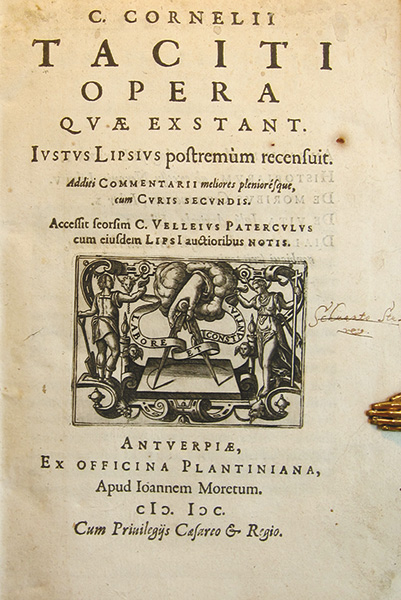
What do ancient non-Christian sources tell us about the historical Jesus?

The Annals, by Roman historian Tacitus

This article from Biblical Archaeology covers all the non-Christian historical sources that discuss Jesus.

About the author:

Lawrence Mykytiuk is associate professor of library science and the history librarian at Purdue University. He holds a Ph.D. in Hebrew and Semitic Studies and is the author of the book Identifying Biblical Persons in Northwest Semitic Inscriptions of 1200–539 B.C.E. (Atlanta: Society of Biblical Literature, 2004).

Here are the major sections:

  • Roman historian Tacitus
  • Jewish historian Josephus
  • Greek satirist Lucian of Samosata
  • Platonist philosopher Celsus
  • Roman governor Pliny the Younger
  • Roman historian Suetonius
  • Roman prisoner Mara bar Serapion

And this useful excerpt captures the broad facts about Jesus that we get from just the first two sources:

We can learn quite a bit about Jesus from Tacitus and Josephus, two famous historians who were not Christian. Almost all the following statements about Jesus, which are asserted in the New Testament, are corroborated or confirmed by the relevant passages in Tacitus and Josephus. These independent historical sources—one a non-Christian Roman and the other Jewish—confirm what we are told in the Gospels:31

1. He existed as a man. The historian Josephus grew up in a priestly family in first-century Palestine and wrote only decades after Jesus’ death. Jesus’ known associates, such as Jesus’ brother James, were his contemporaries. The historical and cultural context was second nature to Josephus. “If any Jewish writer were ever in a position to know about the non-existence of Jesus, it would have been Josephus. His implicit affirmation of the existence of Jesus has been, and still is, the most significant obstacle for those who argue that the extra-Biblical evidence is not probative on this point,” Robert Van Voorst observes.32 And Tacitus was careful enough not to report real executions of nonexistent people.

2. His personal name was Jesus, as Josephus informs us.

3. He was called Christos in Greek, which is a translation of the Hebrew word Messiah, both of which mean “anointed” or “(the) anointed one,” as Josephus states and Tacitus implies, unaware, by reporting, as Romans thought, that his name was Christus.

4. He had a brother named James (Jacob), as Josephus reports.

5. He won over both Jews and “Greeks” (i.e., Gentiles of Hellenistic culture), according to Josephus, although it is anachronistic to say that they were “many” at the end of his life. Large growth
in the number of Jesus’ actual followers came only after his death.

6. Jewish leaders of the day expressed unfavorable opinions about him, at least according to some versions of the Testimonium Flavianum.

7. Pilate rendered the decision that he should be executed, as both Tacitus and Josephus state.

8. His execution was specifically by crucifixion, according to Josephus.

9. He was executed during Pontius Pilate’s governorship over Judea (26–36 C.E.), as Josephus implies and Tacitus states, adding that it was during Tiberius’s reign.

Some of Jesus’ followers did not abandon their personal loyalty to him even after his crucifixion but submitted to his teaching. They believed that Jesus later appeared to them alive in accordance with prophecies, most likely those found in the Hebrew Bible. A well-attested link between Jesus and Christians is that Christ, as a term used to identify Jesus, became the basis of the term used to identify his followers: Christians. The Christian movement began in Judea, according to Tacitus. Josephus observes that it continued during the first century. Tacitus deplores the fact that during the second century it had spread as far as Rome.

I remember reading the 1996 book by Gary Habermas entitled “The Historical Jesus: Ancient Evidence for the Life of Christ“. This book is a little before the time of most of you young Christian apologists, but back before the time of Lee Strobel and J. Warner Wallace, this is the stuff we all read. Anyway, in the book he makes a list of all that can be known about Jesus from external sources. And fortunately for you, you don’t have to buy the book because you can read chapter 9 of it right on his web site.

From Tacitus he gets this:

From this report we can learn several facts, both explicit and implicit, concerning Christ and the Christians who lived in Rome in the 60s A.D. Chronologically, we may ascertain the following information.

(1) Christians were named for their founder, Christus (from the Latin), (2) who was put to death by the Roman procurator Pontius Pilatus (also Latin), (3) during the reign of emperor Tiberius (14 37 A.D.). (4) His death ended the “superstition” for a short time, (5) but it broke out again, (6) especially in Judaea, where the teaching had its origin.

(7) His followers carried his doctrine to Rome. (8) When the great fire destroyed a large part of the city during the reign of Nero (54 68 A.D.), the emperor placed the blame on the Christians who lived in Rome. (9) Tacitus reports that this group was hated for their abominations. (10) These Christians were arrested after pleading guilty, (11) and many were convicted for “hatred for mankind.” (12) They were mocked and (13) then tortured, including being “nailed to crosses” or burnt to death. (14) Because of these actions, the people had compassion on the Christians. (15) Tacitus therefore concluded that such punishments were not for the public good but were simply “to glut one man’s cruelty.”

And from Josephus he gets this:

(1) Jesus was known as a wise and virtuous man, one recognized for his good conduct. (2) He had many disciples, both Jews and Gentiles. (3) Pilate condemned him to die, (4) with crucifixion explicitly being mentioned as the mode. (5) The disciples reported that Jesus had risen from the dead and (6) that he had appeared to them on the third day after his crucifixion. (7) Consequently, the disciples continued to proclaim his teachings. (8) Perhaps Jesus was the Messiah concerning whom the Old Testament prophets spoke and predicted wonders. We would add here two facts from Josephus’ earlier quotation as well. (9) Jesus was the brother of James and (10) was called the messiah by some.

So when you are reading the New Testament, these facts are the framework that you read within. It’s a good starting point when dealing with people who have never looked into who Jesus was and what he taught and what his followers believed about him, right from the start.

How to respond to an atheist who complains about slavery in the Bible

Lets take a closer look at a puzzle

I often hear atheists going on and on about how the Bible has this evil and that evil. Their favorite one seems to be slavery. Here are three things I say to atheists when they push this objection.

The Bible and slavery

First, you should explain to them what the Bible actually says about slavery. And then tell them about the person responsible for stopping slavery in the UK: a devout evangelical named William Wilberforce.

Here’s an article that works.

Excerpt:

We should compare Hebrew debt-servanthood (many translations render this “slavery”) more fairly to apprentice-like positions to pay off debts — much like the indentured servitude during America’s founding when people worked for approximately 7 years to pay off the debt for their passage to the New World. Then they became free.

In most cases, servanthood was more like a live-inemployee, temporarily embedded within the employer’s household. Even today, teams trade sports players to another team that has an owner, and these players belong to a franchise. This language hardly suggests slavery, but rather a formal contractual agreement to be fulfilled — like in the Old Testament.3

Atheism and moral judgments

Second, inform them that moral values are not rationally grounded on atheism. In an accidental universe, there is no way we ought to be. There is no design for humans that we have to comply with. There are no objective human rights, like the right to liberty (that would block slavery) or the right to life (that would block abortion). Although you may find that most atheists act nicely, the ones who really understand what atheism means and live it out consistently are not so nice.

Famous atheist Richard Dawkins has previously written this:

The total amount of suffering per year in the natural world is beyond all decent contemplation. During the minute that it takes me to compose this sentence, thousands of animals are being eaten alive, many others are running for their lives, whimpering with fear, others are slowly being devoured from within by rasping parasites, thousands of all kinds are dying of starvation, thirst, and disease. It must be so. If there ever is a time of plenty, this very fact will automatically lead to an increase in the population until the natural state of starvation and misery is restored. In a universe of electrons and selfish genes, blind physical forces and genetic replication, some people are going to get hurt, other people are going to get lucky, and you won’t find any rhyme or reason in it, nor any justice. The universe that we observe has precisely the properties we should expect if there is, at bottom, no design, no purpose, no evil, no good, nothing but pitiless indifference.

(“God’s Utility Function,” Scientific American, November, 1995, p. 85)

When atheists like Dawkins talk about morality, you have to understand that they are pretending. To them, morality is just about personal preferences and cultural conventions. They just think that questions of right and wrong are arbitrary. Things that are wrong in one time and place are right in another. Every view is as right as any other, depending on the time and place. That’s atheist morality.

What’s worse than slavery? Abortion!

Third, you should ask the atheist what he has done to oppose abortion. Abortion is worse than slavery, so if they are sincere in thinking that slavery is wrong, then they ought to think that abortion is wrong even more. So ask them what they’ve done to oppose the practice of abortion. That will tell you how sincere they are about slavery.

Here’s atheist Richard Dawkins explaining what he’s done to stop abortion:

That’s right. The head atheist supports killing born children.