
Tag Archives: Morality

Was Stalin an atheist? Is atheism or communism responsible for mass murders?

I have a key that will unlock a puzzling mystery

Let’s take a look at what Josef Stalin did during his rule of Russia in the 1920s and 1930s.

The Library of Congress offers this in their “Soviet Archives exhibit”:

The Soviet Union was the first state to have as an ideological objective the elimination of religion. Toward that end, the Communist regime confiscated church property, ridiculed religion, harassed believers, and propagated atheism in the schools. Actions toward particular religions, however, were determined by State interests, and most organized religions were never outlawed.

The main target of the anti-religious campaign in the 1920s and 1930s was the Russian Orthodox Church, which had the largest number of faithful. Nearly all of its clergy, and many of its believers, were shot or sent to labor camps. Theological schools were closed, and church publications were prohibited. By 1939 only about 500 of over 50,000 churches remained open.

Let’s see more from a peer-reviewed journal article authored by Crispin Paine of the University College, London:

Atheist propaganda and the struggle against religion began immediately after the Bolsheviks seized power in 1917. While social change would, under Marxist theory, bring religion to disappear, Leninists argued that the Party should actively help to eradicate religion as a vital step in creating ‘New Soviet Man’. The energy with which the Party struggled against religion, though, varied considerably from time to time and from place to place, as did its hostility to particular faith groups. The 1920s saw the closure of innumerable churches and synagogues (and to a lesser extent mosques) and the active persecution of clergy and harassment of believers. From 1930, though, Stalin introduced a less aggressive approach, and wartime support for the government earned for the Russian Orthodox Church, at least, a level of toleration which lasted until Stalin’s death. Under Khrushchev antireligious efforts resumed, if spasmodically, and they lasted until the end of the Soviet Union.

An article from the pro-communism Marxist.com web site says this about Stalin:

During the ultra-left period of forcible collectivisation and the Five Year Plan in Four an attempt was made to liquidate the Church and its influence by government decree. Starting in 1929 churches were forcibly closed and priests arrested and exiled all over the Soviet Union. The celebrated Shrine of the Iberian Virgin in Moscow – esteemed by believers to be the “holiest” in all Russia was demolished – Stalin and his Government were not afraid of strengthening religious fanaticism by wounding the feelings of believers as Lenin and Trotsky had been! Religion, they believed, could be liquidated, like the kulak, by a stroke of the pen. The Society of Militant Atheists, under Stalin’s orders, issued on May 15th 1932, the “Five Year Plan of Atheism” – by May 1st 1937, such as the “Plan”, “not a single house of prayer shall remain in the territory of the USSR, and the very concept of God must be banished from the Soviet Union as a survival of the Middle Ages and an instrument for the oppression of the working masses.”!

Now, if all you read were atheist web sites, you’d think that Stalin loved religion and wasn’t opposed to Christianity at all. An atheist I know told me that Stalin was a Christian because that’s what he was as a child at one point. Funny sort of way to carry out your Christian faith, isn’t it? If you read atheist web sites, you’d expect Stalin to have had the career of a William Lane Craig or a J.P. Moreland. And yet in the fever swamp of atheist web sites, this is what they tell themselves. They believe it because they want to believe it. They have to believe it, in order to keep God at bay.

Now, if you were going to pick a hero of the Christian faith, you’d probably pick a real fundamentalist like William Wilberforce, who freed the slaves – because of his evangelical Christian convictions. Wilberforce took Christianity seriously – he believed every verse of the Bible, he tried to convert people to his faith, and he pushed his faith on others by passing laws. He was the worst nightmare of atheism – a politically active Evangelical Christian.

But who is a great atheist who was politically active? When I think of a great atheist, someone who really did the most to oppose the “lie” of God’s existence, I think of Josef Stalin. So what kind of morality can we expect from someone who takes the message of Richard Dawkins and Dan Barker seriously and has the political power to really do something about it?

The Ukraine Famine

Take a look at this UK Daily Mail article about a great achievement of the atheist Josef Stalin, which occurred in 1932-1933.

Excerpt:

Now, 75 years after one of the great forgotten crimes of modern times, Stalin’s man-made famine of 1932/3, the former Soviet republic of Ukraine is asking the world to classify it as a genocide.

The Ukrainians call it the Holodomor – the Hunger.

Millions starved as Soviet troops and secret policemen raided their villages, stole the harvest and all the food in villagers’ homes.

They dropped dead in the streets, lay dying and rotting in their houses, and some women became so desperate for food that they ate their own children.

If they managed to fend off starvation, they were deported and shot in their hundreds of thousands.

So terrible was the famine that Igor Yukhnovsky, director of the Institute of National Memory, the Ukrainian institution researching the Holodomor, believes as many as nine million may have died.

[…]Between four and five million died in Ukraine, a million died in Kazakhstan and another million in the north Caucasus and the Volga.

By 1933, 5.7 million households – somewhere between ten million and 15 million people – had vanished. They had been deported, shot or died of starvation.

This is what follows when you believe that the universe is an accident, that there is no objective good and evil, that human beings are just animals, that no God will hold us accountable, and that human beings are not made in the image of God for the purpose of freely choosing to come into a relationship with him. The Ukrainian famine is an action that came from a man whose worldview was passionate atheism.

Atheism today

You might think that today’s atheists are much different than Josef Stalin, but understand that according to a recent survey of atheists conducted by atheists, 97% of atheists are pro-abortion. How many people have been killed by abortion? 56 million in the United States alone. Atheists in a society like ours, founded on Judeo-Christian values, are obviously going to live a lot better than Stalin. For one thing, they don’t have the power that Stalin had to eradicate theism, although you can see Stalinism in the anti-Christian activities of groups like the Freedom From Religion Foundation. But take away the Judeo-Christian foundations of this society, and what would you see atheists doing?

Remember the words of Richard Dawkins:

The total amount of suffering per year in the natural world is beyond all decent contemplation. During the minute that it takes me to compose this sentence, thousands of animals are being eaten alive, many others are running for their lives, whimpering with fear, others are slowly being devoured from within by rasping parasites, thousands of all kinds are dying of starvation, thirst, and disease. It must be so. If there ever is a time of plenty, this very fact will automatically lead to an increase in the population until the natural state of starvation and misery is restored. In a universe of electrons and selfish genes, blind physical forces and genetic replication, some people are going to get hurt, other people are going to get lucky, and you won’t find any rhyme or reason in it, nor any justice. The universe that we observe has precisely the properties we should expect if there is, at bottom, no design, no purpose, no evil, no good, nothing but pitiless indifference.

(“God’s Utility Function,” Scientific American, November, 1995, p. 85)

Now, having said that, I readily admit that many atheists adopt Judeo-Christian values if their society is saturated with them, but they are acting better than their worldview requires. They are acting inconsistently with what atheism really teaches. It’s good for us that they do, but for how long?

Atheist Jerry Coyne explains why morality is impossible for atheists

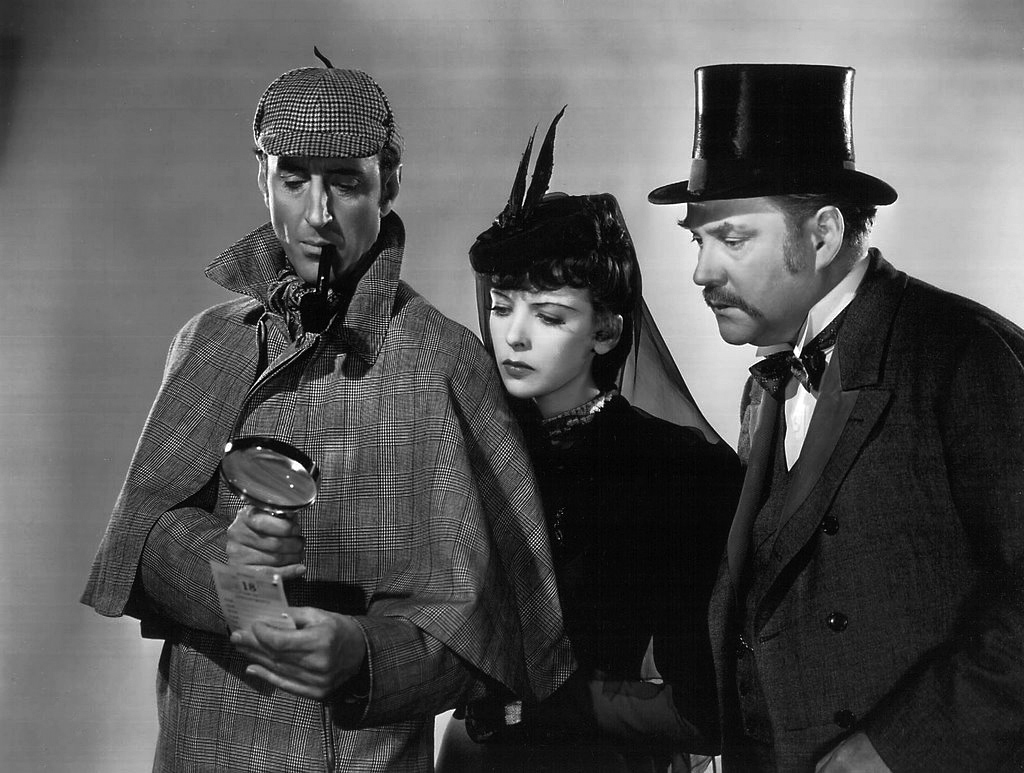
Sherlock Holmes and John Watson about to do philosophy

Let’s review what you need in your worldview in order to have a rationally grounded system of morality.

You need 5 things:

1) Objective moral values

There needs to be a way to distinguish what is good from what is bad. For example, the moral standard might specify that being kind to children is good, but torturing them for fun is bad. If the standard is purely subjective, then people could believe anything and each person would be justified in doing right in their own eyes. Even a “social contract” is just based on people’s opinions. So we need a standard that applies regardless of what people’s individual and collective opinions are.

2) Objective moral duties

Moral duties (moral obligations) refer to the actions that are obligatory based on the moral values defined in 1). Suppose we spot you 1) as an atheist. Why are you obligated to do the good thing, rather than the bad thing? To whom is this obligation owed? Why is rational for you to limit your actions based upon this obligation when it is against your self-interest? Why let other people’s expectations decide what is good for you, especially if you can avoid the consequences of their disapproval?

3) Moral accountability

Suppose we spot you 1) and 2) as an atheist. What difference does it make to you if you just go ahead and disregard your moral obligations to whomever? Is there any reward or punishment for your choice to do right or do wrong? What’s in it for you?

4) Free will

In order for agents to make free moral choices, they must be able to act or abstain from acting by exercising their free will. If there is no free will, then moral choices are impossible. If there are no moral choices, then no one can be held responsible for anything they do. If there is no moral responsibility, then there can be no praise and blame. But then it becomes impossible to praise any action as good or evil.

5) Ultimate significance

Finally, beyond the concept of reward and punishment in 3), we can also ask the question “what does it matter?”. Suppose you do live a good life and you get a reward: 1000 chocolate sundaes. And when you’ve finished eating them, you die for real and that’s the end. In other words, the reward is satisfying, but not really meaningful, ultimately. It’s hard to see how moral actions can be meaningful, ultimately, unless their consequences last on into the future.

Theism rationally grounds all 5 of these. Atheism cannot ground any of them.

Let’s take a look at #4: free will and see how atheism deals with that.

Atheism and free will?

Here’s prominent atheist Jerry Coyne’s editorial in USA Today to explain why atheists can’t ground free will.

Excerpt:

And that’s what neurobiology is telling us: Our brains are simply meat computers that, like real computers, are programmed by our genes and experiences to convert an array of inputs into a predetermined output. Recent experiments involving brain scans show that when a subject “decides” to push a button on the left or right side of a computer, the choice can be predicted by brain activity at least seven seconds before the subject is consciously aware of having made it. (These studies use crude imaging techniques based on blood flow, and I suspect that future understanding of the brain will allow us to predict many of our decisions far earlier than seven seconds in advance.) “Decisions” made like that aren’t conscious ones. And if our choices are unconscious, with some determined well before the moment we think we’ve made them, then we don’t have free will in any meaningful sense.

If you don’t have free will, then you can’t make moral choices, and you can’t be held morally responsible. No free will means no morality.

Here are some more atheists to explain how atheists view morality.

William Provine says atheists have no free will, no moral accountability and no moral significance:

Let me summarize my views on what modern evolutionary biology tells us loud and clear — and these are basically Darwin’s views. There are no gods, no purposes, and no goal-directed forces of any kind. There is no life after death. When I die, I am absolutely certain that I am going to be dead. That’s the end of me. There is no ultimate foundation for ethics, no ultimate meaning in life, and no free will for humans, either.

Richard Dawkins says atheists have no objective moral standards:

In a universe of blind physical forces and genetic replication, some people are going to get hurt, other people are going to get lucky, and you won’t find any rhyme or reason in it, or any justice. The universe that we observe has precisely the properties we should expect if there is, at bottom, no design, no purpose, no evil and no good, nothing but blind, pitiless indifference… DNA neither knows nor cares. DNA just is. And we dance to its music. (Richard Dawkins, River Out of Eden: A Darwinian View of Life (1995))

When village atheists talk about how they can be moral without God, it’s important to ask them to justify the minimum requirements for rational morality. Atheists may act inconsistently with their worldview, believing in free will, expecting praise and blame for complying with the arbitrary standards of their peer group, etc. But there is nothing more to morality on atheism that imitating the herd – at least when the herd is around to watch them. And when the herd loses its Judeo-Christian foundation – watch out. That’s when the real atheism comes out – the atheism that we’ve seen before in countries that turned their backs on God, and the moral law. When God disappears from a society, anything is permissible.

Was Hitler a Christian? Is Nazism similar to Christianity?

A conflict of worldviews

One of the strangest things I have heard from atheists is the assertion that Christianity is somehow connected to the fascism, such as the fascism that existed under Adolf Hitler. Two posts by Jewish author Jonah Goldberg from National Review supply us with the facts to set the record straight.

Let’s start with the first post.

Here are some of the points:

1) Hitler wanted Christianity removed from the public square

Like the engineers of that proverbial railway bridge, the Nazis worked relentlessly to replace the nuts and bolts of traditional Christianity with a new political religion. The shrewdest way to accomplish this was to co-opt Christianity via the Gleichschaltung while at the same time shrinking traditional religion’s role in civil society.

2) Hitler banned the giving of donations to churches

Hitler banned religious charity, crippling the churches’ role as a counterweight to the state. Clergy were put on government salary, hence subjected to state authority. “The parsons will be made to dig their own graves,” Hitler cackled. “They will betray their God to us. They will betray anything for the sake of their miserable little jobs and incomes.”

3) Hitler replaced Christian celebrations with celebrations of the state

Following the Jacobin example, the Nazis replaced the traditional Christian calendar. The new year began on January 30 with the Day of the Seizure of Power. Each November the streets of central Munich were dedicated to a Nazi Passion play depicting Hitler’s Beer Hall Putsch. The martyrdom of Horst Wessel and his “old fighters” replaced Jesus and the apostles. Plays and official histories were rewritten to glorify pagan Aryans bravely fighting against Christianizing foreign armies. Anticipating some feminist pseudo history, witches became martyrs to the bloodthirsty oppression of Christianity.

4) Hitler favored the complete elimination of Christianity

When some Protestant bishops visited the Fuhrer to register complaints, Hitler’s rage got the better of him. “Christianity will disappear from Germany just as it has done in Russia . . . The Germanrace has existed without Christianity for thousands of years . . . and will continue after Christianity has disappeared . . . We must get used to the teachings of blood and race.”

5) Hitler favored the removal of mandatory prayers in schools

In 1935 mandatory prayer in school was abolished…

6) Hitler favored the banning of Christmas carols and nativity plays

…and in 1938 carols and Nativity plays were banned entirely.

7) Hitler abolished religious instruction for children

By 1941 religious instruction for children fourteen years and up had been abolished altogether….

And now the second post.

8) Hitler opposed the ideas of universal truth and objective moral absolutes

…Just as the Nazi attack on Christianity was part of a larger war on the idea of universal truth, whole postmodern cosmologies have been created to prove that traditional religious morality is a scam, that there are no fixed truths or “natural” categories, and that all knowledge is socially constructed.

Practically everything this man believed was 100% anti-Christian. But he fits in fine on the secular left.

Conclusion

Adolf Hitler was a man influenced by two big ideas: evolution and socialism. His party was the national SOCIALIST party. He favored a strong role for the state in interfering with the free market. He was in favor of regulating the family so that the state could have a bigger influence on children. And he favored the idea of survival of the fittest. His ideas are 100% incompatible with Christianity and with capitalism as well. Christians value individual rights and freedoms, small government and the autonomy of the family against the state. The commandments about not coveting and not stealing are incompatible with redistribution of wealth from those who produce to those who “need”. The differences are clear and significant. The Bible favors voluntary charity by individuals and churches. It does not favor redistribution of wealth by a secular government to equalize life outcomes regardless of personal responsibility.

Ignorant atheists and their myths

In a recent debate between Matt Dillahunty and David Robertson, Dillahunty made the claim that Hitler was a Christian, because in a campaign speech, he told a Catholic audience that secular schools were bad, and religious schools were good. Dillahunty thought that this meant that Hitler was a Christian. Robertson asked him when those words were spoken, and whether they formed the basis of any POLICY after Hitler was elected. Dillahunty didn’t know, because he just cited the quotation without knowing anything about the context, or about the historical period. Robertson informed him that the words were spoken in a campaign speech, prior to Hitler’s rise to power, and that nothing in Hitler’s policies ever took the words seriously after he came to power. It was the equivalent of Obama claiming to support natural marriage, then legalizing same-sex marriage once elected. He lied in order to be elected. This kind of ignorance is very prominent in the atheist (“secular humanist”) community, which survives on mythology which is never subjected to rational inquiry. Here’s another good example of this ignorance.

Incidentally, Dillahunty later said, in the same debate no less, that he “didn’t know” if the Holocaust was morally wrong. Right – because on atheism right and wrong are meaningless concepts, rationally speaking. They are reduced to personal preferences only, where each opinion is as valid as the opposite opinion, since there is no objective standard by which to judge different opinions. That’s why atheists can’t make moral judgements about anything, they just have preferences, like their preference for certain foods and certain clothes. Very important to realize this when talking to atheists, because they use moral language to describe their personal feelings and opinions.

Whenever I hear atheists speculating about whether Hitler was a Christian, I immediately know that they have not investigated anything very carefully, and are merely being insulting. It’s not worth having a conversation with people who are stupid AND insulting.