Tag Archives: Money

Scott Walker’s plan to reform public sector unions

Political contributions to public sector unions
Political contributions to public sector unions (click for larger image)

(Source: OpenSecrets.org)

I am not sure if I really explained the importance of Scott Walker’s plan to rein in public sector unions in my last post.

Basically, public sector unions generate a lot of money from forced collection of union dues, and they turn around and use that money to donate to politicians who are in favor of growing government. Unions want bigger government, because they make more money if government grows.

This Wall Street Journal article explains that unions donate mostly to Democrats.

Excerpt:

Corporations and their employees… tend to spread their donations fairly evenly between the two major parties, unlike unions, which overwhelmingly assist Democrats. In 2008, Democrats received 55% of the $2 billion contributed by corporate PACs and company employees, according to the Center for Responsive Politics. Labor unions were responsible for $75 million in political donations, with 92% going to Democrats.

So how much money are we talking about?
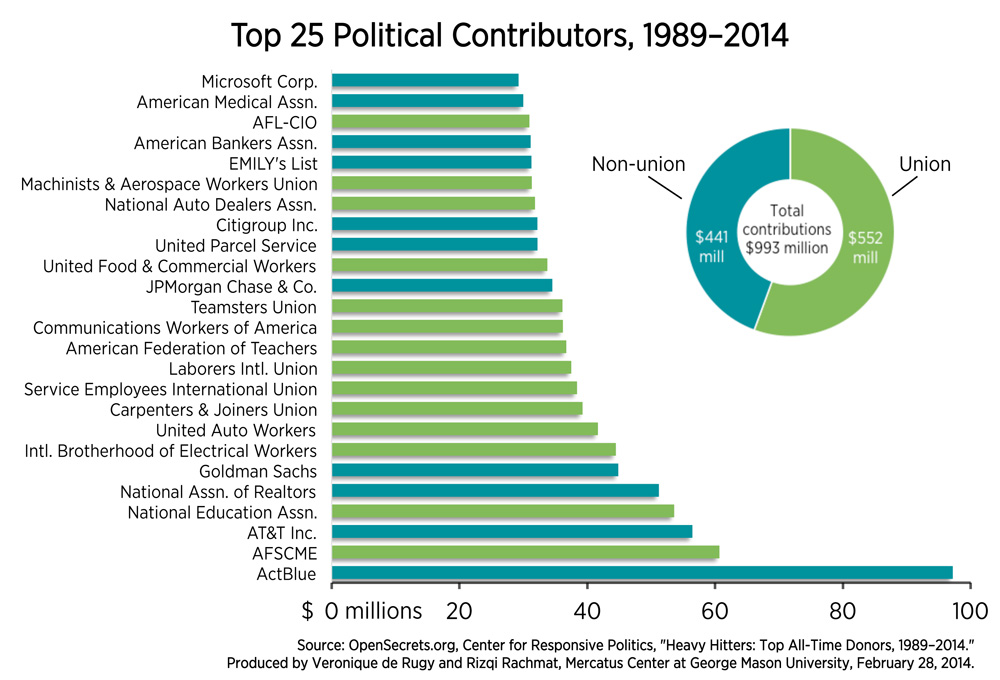
Total political contributions in 2014 election cycle
Total political contributions in 2014 election cycle (click for larger image)

To see how much unions control government, take a look at this story from National Review, written by economist Veronique to Rugy.

It says:

  • The top campaign donor of the last 25 years is ActBlue, an online political-action committee dedicated to raising funds for Democrats. ActBlue’s political contributions, which total close to $100 million, are even more impressive when one realizes that it was only launched in 2004. That’s $100 million in ten years.
  • Fourteen labor unions were among the top 25 political campaign contributors.
  • Three public-sector unions were among the 14 labor groups: the American Federation of State, County, and Municipal Employees; the National Education Association; and the American Federation of Teachers. Their combined contributions amount to $150 million, or 15 percent of the top 25’s approximately $1 billion in donations since 1989.
  • Public- and private-sector unions contributed 55.6 percent — $552 million — of the top 25’s contributions.

Where does the money go? The Daily Caller notes:

“Nearly all of labor’s 2012 donations to candidates and parties – 90 percent – went to Democrats,” the report from CRP concluded. “Public sector unions, which include employees at all levels of government, donated $14.7 million to Democrats in 2014.”

But someone has a plan to do something about this: Scott Walker.

This Investors Business Daily article by economist Veronique de Rugy explains what he would do to the unions if elected President in 2016.

She writes:

Wisconsin Gov. Scott Walker just proposed a plan to overhaul the country’s labor laws, called “My Plan to Give Power to the People, Not the Union Bosses.”

It would do that by expanding employee choice and holding unions accountable to their members.

One of the main underlying themes of the Republican presidential hopeful’s private-sector reforms is transferring power and decision-making from unions to their members.

For instance, the plan would guarantee employees’ rights by strengthening secret-ballot elections. Under current law, unions have ways to work around the protections, making such elections less than secret. The change would protect workers from retaliation by not disclosing their choices to unions during workplace elections.

Though federal laws outlaw extortion, the Supreme Court has ruled that they usually do not apply to unions. Walker’s plan would change that to protect workers from threats, violence and extortion from unions.

Similarly, his reforms would protect whistleblowers who report wrongdoing on the part of a union from being fired or discriminated against.

[…][Public sector unions]… also make the government less effective and more expensive.

That’s why a President Walker would work with Congress to prohibit public employee unions altogether. Meanwhile, he would implement taxpayer and paycheck protections.

As Heritage Foundation labor economist James Sherk explained for National Review, “Walker proposes cracking down on the use of ‘union time’ — that is, allowing federal employees to work for their unions at taxpayer expense.

“He also wants to stop unions from using federal resources to collect the portion of dues that they spend on political causes and lobbying.”

Walker’s plan also would establish a nationwide right-to-work law, making voluntary union dues the default option for all private- and public-sector workers. It would give workers the freedom to choose whether they want to be in a union or not.

States that want to take this freedom away from their workers would have to affirmatively vote to opt out of right-to-work status.

[…]The Walker plan includes many more reforms, such as a repeal of the Davis-Bacon wage controls, which alone could save taxpayers nearly $13 billion over the next 10 years. If implemented, it would be a giant step toward freeing businesses, employers, workers and taxpayers from the incredible burden imposed on them by federal labor laws and union bosses.

Why should we believe that he’ll really do it? Well, unlike some of the talker candidates, Walker has already done it in his state. And it worked – a $3.6 billion dollar deficit was erased.

If you are concerned about the growth of government, and all that that entails, e.g. – higher taxes, massive spending, bloated welfare state, huge levels of corruption, government waste, abortion, gay marriage, etc – then you should know that all of that is driven by the political donations of unions.

And I don’t want anyone to think that union workers are the same as union bosses. In Wisconsin, as soon as the union workers got the right to work without having the pay union dues, the vast majority of them chose not to pay union dues.

Wayne Grudem explains what the Bible says about spending, saving and charity

Theology that hits the spot

A practical lecture on money – spending, saving, charitable giving – from famous pastor Wayne Grudem.

If you’re like me and you struggle with Bible study and church sermons unless you get something practical out of it, then these Bible studies are for you. You’ll like the way that Grudem navigates the Bible finding the passages that tell you who God is, so that you can make better decisions by analyzing alternatives and choosing the one that gives your Boss a maximum return on investment.

The MP3 file is here.

The PDF outline is here.

Spending:

  • Christianity does not teach asceticism (= don’t enjoy anything in this world), Paul condemns it in 1 Timothy 4:1-5
  • When you buy nice things, even if it is a little more expensive, it’s an opportunity to be thankful for nice things that God has provided
  • Even being rich is OK, but don’t let it make you haughty and arrogant, and don’t set your hopes on your money (see 1 Tim 6:17)
  • It is important for you to earn money, and you are supposed to use it to support yourself and be independent
  • It is possible to overspend and live recklessly (Luke 15:13) and it’s also possible to overspend and live too luxuriously
  • Increasing your income through career progression is wise, because it allows you to give away more and save more
  • God gives us freedom to decide how much we spend, how much we give away, and how much we save
  • every choice a Christian makes with money will give him or her more or less reward in his or her afterlife
  • Do not spend more than you have – you should make every effort to get out of debt as quickly as possible

Saving:

  • Saving money is wise so you can help yourself and others, and have money in your old age when you will not be working
  • If you do not save your own money, you end up being dependent on others (e.g. – family or taxpayers)
  • Not saving money for the future is a way of “putting God to the test” (Matt 4:7)
  • You are to “be dependent on no one”, to the extent that you can (1 Thes 4:12)
  • We don’t know the future, that’s why we should prepare for an emergency, and buy insurance to guard (James 4:13-17)
  • It’s right for us to learn how to save to be able to buy bigger assets, like a car or a college education
  • Saving and investing in stocks and bonds lets people in business start and grow companies, creating jobs and new products
  • Don’t over-save, trusting too much in money more than you trust in God (Ps 62.10; Matt 6:19,24; Luke 12:15-21)

Giving:

  • it is required for the people of God to give something out of what they earn, but no percentage is specified (Deut 26:12-13)
  • you do not give money to become right with God, you can’t earn your salvation
  • a Christian gives to show God that you trust him to take care of you, and to experience trusting him through your giving
  • the quality of your resurrection life with God is affected by giving you do for the Kingdom (Phil 4, Matt 6:19-21; 1 Tim 6:18-19)
  • when you get involved in the lives of others and give to them, you have the joy of experiencing caring for others (Acts 20:35)
  • it’s possible to give too little, but it’s also possible to give too much – be careful about pride creeping in as well

The first part of this lecture made me think of my treat for the week, which is to go to an Indian buffet on Wednesdays, if I can. It costs $10, which is more than my usual $3.50 for a frozen meal for lunch and another $3.50 for a frozen meal for dinner. Spending a little more on a yummy plate of my favorite food makes it easy for me to remember to say grace, which is what Grudem said about spending making you thankful.

Theology that hits the spot
My weekly treat causes me to be VERY thankful

I was so happy listening to this talk because he was condemning bad stewardship, which I see in a lot of young people these days. I was happy until he got to the part about trusting in your savings for your security, and then I thought – that’s what I do wrong! I save a lot but it’s not just for emergencies and to share with others, like he was saying – I want a sense of security. This was more of a temptation in my 20s than it is now in my 30s, though.

Ironically, I woke up Wednesday morning and was singing this song in the shower:

It’s a song about being wanting to be righteous, and yet being unable to attain it on your own. I must think that being justified by faith in Jesus is more important than money, because I never wake up singing about the security I get from my savings. Still, I consider myself warned.

I can remember being in my first full-time job as a newly hired junior programmer when the 2001 recession struck. I would cry while signing checks to support William Lane Craig’s Reasonable Faith ministry, because I was so scared. I had no family or friends where I lived to help me if anything went wrong, and that’s been the story of my working life. If anything goes wrong, there is no backup. But it’s that experience of crying when I gave that allows me to say today “that’s when I became the man I am, that’s what a man does when he is a follower of Jesus”. If you are not doing the actions of charity, then you will not having the experience of trusting God and letting him lead you. There is more to the Christian life than just saying the right things – you have to do the right things.

If you’re scared about giving when you are young, then do what I did in my 20s: work 70-hour weeks, get promoted often, and save everything you earn. I volunteered every Saturday for 9 months in order to get my first white-collar part-time job when I was still in high-school. The faster you increase your savings, the easier it’s going to be to take a genuine interest in caring for the people around you. Read Phil 1 (fellowship), Phil 2 (concern for others), and Phil 4 (charity). Turn off your emotions and desires, and put Philippians into practice. Note that your freedom to give is very much tied to the quality of your decisions of what to study, where to work, how much you spend on entertainment, and so on. That’s why you need to turn off your feelings and desires and do what works, even it it’s not fun, and even if it involves responsibilities and obligations.

J. Warner Wallace: practical advice on becoming an effective one-dollar apologist

As promised, below is my summary of J. Warner Wallace’s most recent Please Convince Me podcast, and my comments.

Details:

J. Warner continues examining the Christian life in light of God’s desire for all of us to become Christian Case Makers. Jim reads listener email highlighting some of the typical frustrations involved in starting an apologetics ministry and then provides a template to help you become the Case Maker you’ve always wanted to be. Jim also answers the question: Why Didn’t Jesus Reveal Scientific Facts to Demonstrate His Deity?

You can grab the MP3 file here.

This episode is probably one of the best episodes of the Please Convince Me podcast I’ve ever heard, because it’s practical. I like listening to the cold-case detective talk about practical things.

Summary:

  • e-mail from someone trying to start an apologetics ministry for college students and facing difficulties
  • the challenge of getting Christians to take an evidential approach to their faith
  • tips for getting Christians exposed to apologetics materials
  • there are a lot of Christians who are making a daily contribution to apologetics even with a full-time job
  • Wallace himself started his apologetics ministry while working full-time
  • Wallace, as an atheist, was initially skeptical of religion because he thought it was too focused on money
  • His plan as an apologist was to take money right out of it – do it for free, and  be self-funded
  • 1 Cor 9: “But I have made no use of any of these rights, nor am I writing these things to secure any such provision.”
  • People in ministry deserve to be supported, but Paul dispensed with that right to raise support for his ministry
  • Paul self-financed his ministry in order to avoid all appearance of doing his ministry for financial gain
  • Similarly, Wallace’s goal of being self-financed was to avoid the appearance of doing ministry for money
  • If you plan your life carefully enough in the first half, you’ll have the money you need to do ministry in the second half
  • Wallace wanted the liberty to pursue things without any financial need, and he achieved this by working full-time
  • The problem with money is that it often causes us to not cooperate well with other people
  • Ministries and churches sometimes avoid working with other people, like scholars and apologists
  • They do this because they are afraid of losing their own people to these scholars and apologists
  • Wallace wants to get the money out of it and be able to serve anyone with a need
  • Wallace: you need to work hard in the first half of life, in order to have freedom to serve in the second half
  • First area: financial preparation – you need to escape financial needs so that it doesn’t restrict your passion
  • Wallace married well, to a woman who was a good saver, very frugal, and not materialistic – he saved 30% of his income
  • Second area: need to prepare yourself educationally for being able to teach apologetics materially
  • That doesn’t always mean doing the MA in apologetics, but you do have master the material – continuous learning
  • Third area: try to focus on the parts of your career that might have some connection to apologetics
  • You want to have experiences in your work where you learn something that can be used in your ministry
  • Wallace actually made career choices to focus on evidence, case-making and teaching
  • It’s hard because men are naturally competitive – we focus on promotions, money and consumer goods
  • It’s not always the right move in your career to get promoted if it takes you away from skills related to apologetics
  • Christian apologists need to not neglect to develop leadership skills and to develop influence
  • He recommends a book called “Platform” by Michael Hyatt, which Doug Groothuis also recommended to me
  • If you are financially independent, then if an unpaid opportunity arises, you have the freedom to take it
  • You can volunteer for positions that you want to have, instead having to take what pays
  • Wallace writes for Breakpoint, and he is able to dispense with the 1000-word limit that gets a fee
  • Money opens up the danger of corruption, so it’s another reason to just take it out of the picture
  • You can be very effective in your apologetics ministry while still working full-time
  • The second half is a good time to have even more freedom because your kids are grown up
  • A good wife can really help you if she is picking up the slack so that you can work on your ministry
  • Jane Pantig works for Ratio Christi, an organization that promotes apologetics on campus
  • Jane’s model: she is in full-time ministry, with a BS in biology and an MA in apologetics (Biola)
  • Jane is able to get many high-quality speakers to speak for free/cheap at San Jose State University

The rest of the podcast deals a question that was asked at the San Jose State University event that Wallace did for Ratio Christi. I blogged about it this morning. I  laughed my butt off while listening to that podcast, starting at around 62:50 and on. It’s pretty funny when he does the role-pay between Jesus and the people listening to him.

My comments:

The reason I wanted to post this is because I think that a lot of people feel obligated to quit their jobs and raise support because they think that you have to do apologetics full time. It’s not true. Wallace explains that he worked as a cold-case detective until just recently when he took his pension. His pension is now underwriting his ministry. Similarly with me, I work a full-time job and run the blog out of my income. In addition, I probably donate a few thousand dollars each year to people who are organizing apologetics lectures, debates and conferences – events featuring speakers I like best.

This blog gets about 1 million page views per year, depending on the year (election years are better), so that’s not an insignificant impact. In addition, I meet a lot of young Christians in university in different countries who want advice or mentoring, so I spend a few hours here and there mentoring them, and sometimes sending them rewards (books) for doing difficult degrees at good universities and getting good grades. My full-time job helps me to do all of these things. And before I could have a full-time job in information technology, I had to put in the time and effort to get the Bachelor and Masters degree in computer science.

So I think that Christian men especially need to be thinking about how much the apologetics enterprise of a one-dollar apologist relies on money. We really need to be thinking about that early on, in high school, and choosing to study hard things and to do well in those hard subjects. The higher-paying jobs that are more secure tend to be in fields like science, math, technology and engineering. We need to be thinking of doing these courses in high school – especially the men, but also the women – in order to be able to pay for our apologetics ministry. In addition, my decision to not marry (unless I meet a woman who can support me in my plan) gives me even more freedom to work on my ministry while working full time.

I fully approve of what Wallace said about self-financing your apologetics ministry – and supporting other apologetics ministries – in order to avoid all appearance of self-interest. In fact, I have long admired Wallace for his intentional, practical way of doing his ministry. He doesn’t take donations, and he gives away tons of materials for free. I like that.