Tag Archives: Minimum Wage

Neil Cavuto explains basic economics to college student who wants free tuition

She has $280,000 in student loan debt for "Chinese medicine"
She has $280,000 in student loan debt for “Chinese medicine”

The video, which goes about 10 minutes. This is a must watch.

The description of the video explains the contents:

Keely Mullen, an organizer for the Million Student March movement, joined Fox Business Network anchor Neil Cavuto on the air Thursday to discuss the movement’s demands for free public college, student debt cancelation and a $15-an-hour minimum wage for student workers. In the awkward 9-minute interview, Cavuto repeatedly cited facts and figures that seemed to fluster the student.

When asked who would pick up the tab for the demands she listed, Mullen said, “The 1 percent of people who are hoarding the wealth and causing a catastrophe students are facing.”

“If the 1 percent just had their taxes raised a few years ago back to almost 40 percent then to pay for the healthcare law, they had them raised another few percentage points, then they had their deductions limited to raise another couple points — depending on the state or locality — they’re pushing over about 50 percent in taxes,” Cavuto told Mullen. “How much more do you think they should pay?”

Cavuto’s question, asked within the first two minutes of the interview, became the centerpiece of the entire discussion, as Mullen was unable to provide a clear answer.Mullen did say the rate should be raised to “enough until we have a system where not one in two families are threatened with poverty.” And when asked if she and her friends and family would pay more in taxes for her demands, she said “we already are.” However, according to Forbes, 45 percent of households pay no federal income taxes.

Cavuto asked Mullen where the money would come from should “these 1 percent hoarders” leave the country, and Mullen insisted there would always be wealthy people in the U.S. However, later in the interview, Cavuto told his guest that countries around the world, using Greece as an example, have run out of money because the top earners are fleeing.

When Cavuto asked her if she think the 1 percent could actually fund all her demands, Mullen said, “Absolutely.” However, Cavuot claimed taxing the 1 percent at 100 percent wouldn’t even fund Medicare for three years — let alone all of her demands for free services.

“They’ve done studies on this, Keeley, I don’t want to get boring here, but even if you were to take the 1 percent and take all of their money — tax it 100 percent — do you know that couldn’t keep Medicare, just Medicare, in this country going for three years?” Cavuto asked. “Did you know that?”

“Yeah, I don’t believe that,” Mullen said in response. “Yeah, I’m sorry, that just sounds completely ludicrous to me.”

Toward the end of the interview, Cavuto told Mullen taxing the 1 percent on 100 percent of their income would only yield “about one trillion” toward any entitlement program.

I took a look and found out that her father owns a million-dollar home. Also, she is studying two non-STEM subjects – political science and sociology. Both of these have some value, but they are also not the STEM areas that are in demand by employers.

By the way, Cavuto is not joking about how much money you can get by taking everything the 1% make.

The radically leftist New York Times explains how much you can get from “the rich” with a reasonably high tax rate:

To get the most accurate picture possible, throw in all the scraps of income, from the most obvious (like wages, interest and dividends) to the least (like employer contributions to health plans, overseas earnings and growth in retirement accounts). According to that measure — used by the Tax Policy Center, a joint project of the Urban Institute and the Brookings Institution — the top 1 percent includes about 1.13 million households earning an average income of $2.1 million.

Raising their total tax burden to, say, 40 percent would generate about $157 billion in revenue the first year. Increasing it to 45 percent brings in a whopping $276 billion.

The Wall Street Journal has computed the costs of Bernie Sanders’ spending plan, and it came out to $18 trillion. Getting rid of all the current outstanding student loan balances would cost $1.2 trillion alone. I’ve already talked about the consequences of raising the minimum wage for young, minority workers – they won’t be able to find the entry level jobs they need to get their careers started, so they can move up.

The real question that needs to be asked is the one that Cavuto asked – do you expect the wealthy to continue producing at the same level when you take half or all of what they make. On the student’s view, the rich would work just as hard even if you took all their money and gave it to students taking underwater basket weaving, medieval pottery and puppetry. This is the question that people on the left never ask – what are the consequences of these policies for ALL of the parties who will be affected. That’s a simple question, but apparently not something that leftist professors teach their students to ask. College is generally little narcissists learning from big narcissists, at least in non-STEM programs. It certainly is not the place to learn basic economics and basic civics.
Is there any downside to raising the minimum wage to $15 an hour?

They told me if I voted Republican, we'd lose jobs, and they were right!
They told me if I voted Republican, we’d lose jobs, and they were right!

This article is from the libertarian Reason.com. They’re terrible at social issues, but really really good at economics.

They write:

Raising the minimum wage like this is an idea that’s become increasingly common amongst more liberal Democratic politicians and policymakers: The city of Seattle, Washington passed a law raising its minimum wage to $15 last year, and the Los Angeles city council voted to follow suit. Soon after, New York state announced a plan to raise the minimum wage of all fast food workers to $15, and the state’s governor, Andrew Cuomo, recently said he believes it should apply to all workers.

Many of these plans start from the assumption, implicitly or explicitly, that these minimum wage hikes would be relatively cost-free, pointing to several studies seeming to show that increases in the minimum wage don’t have much effect on jobs.

Here is what the author of some of the most influential of those studies, former Obama administration economic adviser Alan B. Krueger, had to say about raising the federal minimum wage to $15 an hour in an op-ed for The New York Times last week:

15 an hour is beyond international experience, and could well be counterproductive. Although some high-wage cities and states could probably absorb a $15-an-hour minimum wage with little or no job loss, it is far from clear that the same could be said for every state, city and town in the United States.

Krueger goes on to warn of greater risk, and the potential for “severe” trade-offs, if policymakers pursue a $15 minimum wage, warning that it would go beyond what any research supports. Ultimately, he concludes, it is  “a risk not worth taking.”

Krueger wasn’t disowning his own work or abandoning his position. He still supports raising the minimum wage to $12 an hour over a period of years, which he thinks could be done with essentially no job loss.

There are some reasons to be skeptical of that claim too: The Congressional Budget Office, which generally tries to take a moderate approach to economic evidence and put its estimates right in the middle of the consensus range, found that even a more modest hike to $10.10 an hour nationally would most likely cost about a half a million jobs, and while it’s possible such a raise might produce minimal job loss, it’s equally possible that it would cost a million jobs.

Overall, as David Neumark and William Wascher have found, the bulk of the evidence from research into the minimum wage suggests that hikes tend to decrease employment.

Let’s review the facts on minimum wage.

Abstract from a National Bureau of Economic Research study:

We estimate the minimum wage’s effects on low-skilled workers’ employment and income trajectories. Our approach exploits two dimensions of the data we analyze. First, we compare workers in states that were bound by recent increases in the federal minimum wage to workers in states that were not. Second, we use 12 months of baseline data to divide low-skilled workers into a “target” group, whose baseline wage rates were directly affected, and a “within-state control” group with slightly higher baseline wage rates. Over three subsequent years, we find that binding minimum wage increases had significant, negative effects on the employment and income growth of targeted workers.

[…]Over the late 2000s, the average effective minimum wage rose by 30 percent across the United States. We estimate that these minimum wage increases reduced the national employment-to-population ratio by 0.7 percentage point.

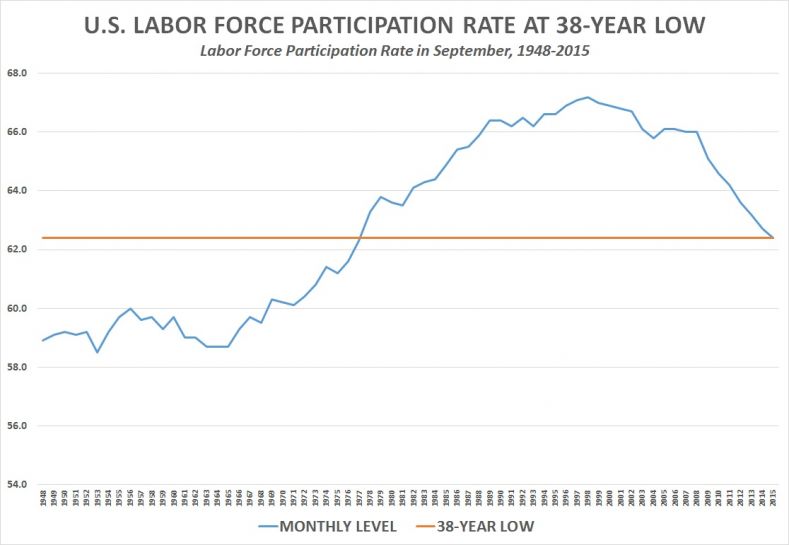
That comes out to 1.4 million workers who lost their jobs, thanks to minimum wage mandates. And those are primarily young, unskilled workers who are affected – people trying to get a start in the workplace and build their resumes, so they can move up.

Harvard economist Greg Mankiw explains the top 14 views that a majority professional economists agree on, and here’s #12:

12. A minimum wage increases unemployment among young and unskilled workers. (79%)

This is not controversial. This is the kind of basic “how America works” economics stuff that people used to learn in their civics classes before the schools became so politicized.

Five liberal Democrat policies that hurt minorities

Marriage and Poverty

The five policies are:

  • higher minimum wage rates
  • opposition to school voucher programs
  • releasing criminals from jail
  • affirmative action
  • single mother welfare

This article is by Jason L. Riley, and it appeared in the Wall Street Journal.

Excerpt:

At the urging of labor unions, President Obama has pushed for higher minimum wages that price a disproportionate percentage of blacks out of the labor force. At the urging of teachers unions, he has fought voucher programs that give ghetto children access to better schools.

Both policies have a lengthy track record of keeping millions of blacks ill-educated and unemployed. Since the 1970s, when the federal government began tracking the racial achievement gap, black test scores in math, reading and science have on average trailed far behind those of their white classmates. And minimum-wage mandates have been so effective for so long at keeping blacks out of work that 1930, the last year in which there was no federal minimum-wage law, was also the last year that the black unemployment rate was lower than the white rate. For the past half-century, black joblessness on average has been double that of whites.

Last week the Justice Department said it would release some 6,000 inmates from federal prison starting later this month. The goal, according to the White House, is to ease overcrowding and roll back tough sentencing rules implemented in the 1980s and ’90s.

But why are the administration’s sympathies with the lawbreakers instead of their usual victims—the mostly law-abiding residents in low-income communities where many of these inmates eventually are headed? In dozens of large U.S. cities, violent crime, including murder, has climbed over the past year, and it is hard to see how these changes are in the interest of public safety.

The administration assures skeptics that only “nonviolent” drug offenders will be released, but who pays the price if we guess wrong, as officials have so often done in the past?

When Los Angeles asked the Rand Corp. in the 1990s to identify inmates suitable for early release, the researchers concluded that “almost no one housed in the Los Angeles jails could be considered non-serious or simply troublesome to their local communities” and that “jail capacity should be expanded so as to allow lengthier incarceration of the more dangerous.”

A 2002 federal report tracked the recidivism rate of some 91,000 supposedly nonviolent offenders in 15 states over a three-year period. More than 21% wound up rearrested for violent crimes, including more than 700 murders and more than 600 rapes. The report also noted the difficulty of identifying low-risk inmates. Auto thieves were rearrested for committing more than a third of the homicides and a disproportionate share of other violent offenses.

Keep in mind that when criminals are release, they don’t go move into wealthy progressive neighborhoods. It’s not the wealthy leftists elites who have to deal with the released inmates. It’s the poor, low-income minority neighborhoods that have to deal with them.

By the way, I covered the minimum wage argument here, and I covered the school choice argument here.

That covers the first 3 policies. This article from The College Fix covers the fourth policy, affirmative action.

It says:

A UCLA law professor critiques affirmative action as detrimental to the very people it strives to aid: minority students.

Professor Richard Sander, though liberal-leaning, has deemed affirmative action practices as harmful, a notion that contradicts a liberal view in college admissions, said Stuart Taylor, a nonresident senior fellow at the Brookings Institution.

[…]Sander began teaching law at UCLA in 1989. After a few years he garnered an interest in academic support and asked permission to analyze which strategies most effectively assist struggling students.

After reviewing statistics on performance, especially those of students with lower academic merit, he noticed correlations between race and academic success.

“I was struck by both the degree to which it correlated with having weak academic entering credentials and its correlation with race,” Sander said in a recent interview with The College Fix. “And as I looked into our admissions process I realized that we were giving really a large admissions preference.”

Sander noticed that students admitted into the law school with lower academic credentials than their peers had significantly lower percentages of passing the Multistate Bar Examination, Sander said. This especially pertained to minority students who were given special consideration in the admittance process due to their race rather than their academic preparedness.

He then began thinking about whether or not these students would have better chances of succeeding if they went to a less elite university, he said.

He called this discrepancy a mismatch; when minority students with lower credentials than their peers are accepted into more challenging universities and then suffer academically as a result.

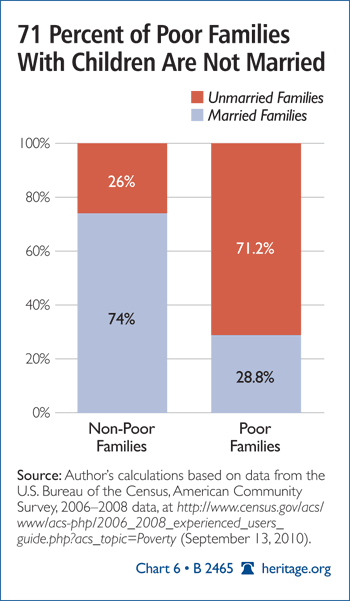
And the fifth policy is welfare. Welfare encourages women to not marry the men that they have sex with, since they will lose their single mother benefits if they do. Children who are raised fatherless are more likely to struggle in a number of areas, and they are especially likely to be poor. What we should be doing (if we really want to help the poor) is paying people to get married and stay married. But Democrats are opposed to that. The connection between welfare, fatherlessness, poverty and crime is explained in a previous post.