Tag Archives: MicroAggression

Ben Shapiro speaks out against “microaggression” oversensitivity at U of Missouri

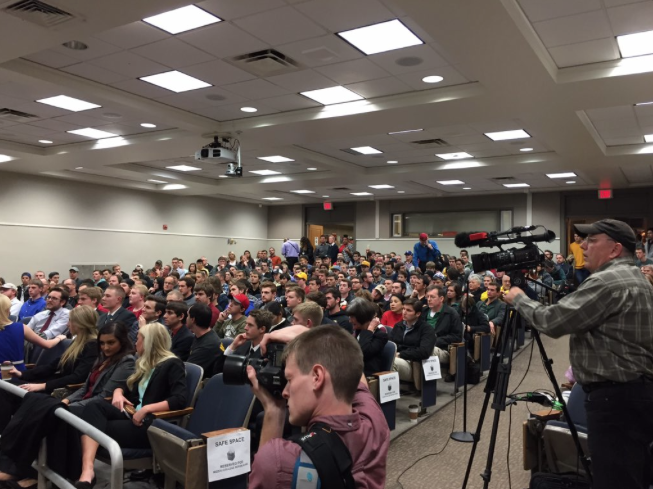
Nearly 400 students showed up to hear Ben Shapiro speak

My favorite political podcast is The Weekly Standard, and my favorite cultural podcast is Ben Shapiro. I really recommend subscribing to both and listening to them. The video of this lecture shows you what makes Ben Shapiro special. (H/T Kevin the Super Husband)

Lecture:

Question and Answer:

And here’s a news article for those who cannot watch from Breitbart News.

Excerpt:

Ben Shapiro’s speech Thursday evening at the University of Missouri was a galvanizing moment for the campus and community that became the national focus of media attention in early November after a group of radical black liberation activists, assisted by leftist faculty members, forced the resignation of the university’s president and chancellor.
The event marked the first large, public backlash to the political correctness gone wild that had overtaken Mizzou in the past several months.

Towards the end of his rousing speech, Shapiro discussed how the “micro aggression” culture of taking offense at minor, even unintended things leads to real aggression. Shapiro said, “There’s never been a bad person on planet Earth who has not felt justified in doing his or her bad thing. All colleges do now is give people reasons to feel justified in doing the bad things that they want to do.”

Shapiro lit into the very real aggressions that had played out at the University of Missouri, including the story that Breitbart News covered of Mizzou faculty member Dr. Melissa Click, who blocked a student reporter with a camera when he attempted to enter a public space on campus that #ConcernedStudent1950 activists had declared a “safe space” for themselves.

[…]The audience of over 350 responded immediately with applause that lasted several seconds. The crowd’s applause showed the cathartic impact of someone speaking the truth out loud at the University of Missouri.

Shapiro was invited to speak by the Young America’s Foundation. My first thought when I see an event like this is why aren’t Christian churches more involved in applying the Bible and Christian theology to the culture. My pastor almost never applies the Bible to anything that is happening in real life. He almost never references anything that is happening in the culture, much less current events.

Thank goodness there are brave conservatives like Ben Shapiro who are willing to put rounds downrange onto the target, rather than focus on pious language doesn’t equip anyone to declare or defend their conservative beliefs. There are so many ideas that are undermining the life plans of Christian men these days – feminism, postmodernism, relativism, global warming alarmism, socialism, pacificism, unilateral surrender and appeasement, and so on. And yet so few pastors can see these threats and how they differ with the Bible’s teachings. Even those that see seem to lack the courage of those who speak out about them. We need to be talking about what is happening in politics and in the culture, so that we can make a world where it is safe to speak out about Christian things without fear – even if the truth makes people feel “offended”.

Pew Research: 40% of millenials oppose free speech

Pew Research: the next generation opposes free speech

First, let’s see the data, then we’ll talk about who made this happen, and what Christians can do about it.

This is the raw data is from the leftist Pew Research Center.

It says:

American Millennials are far more likely than older generations to say the government should be able to prevent people from saying offensive statements about minority groups, according to a new analysis of Pew Research Center survey data on free speech and media across the globe.

We asked whether people believe that citizens should be able to make public statements that are offensive to minority groups, or whether the government should be able to prevent people from saying these things. Four-in-ten Millennials say the government should be able to prevent people publicly making statements that are offensive to minority groups, while 58% said such speech is OK.

[…]In the U.S., our findings also show a racial divide on this question, with non-whites more likely (38%) to support government prevention of such speech than non-Hispanic whites (23%).

Nearly twice as many Democrats say the government should be able to stop speech against minorities (35%) compared with Republicans (18%). Independents, as is often the case, find themselves in the middle. One-third of all women say the government should be able to curtail speech that is offensive to minorities vs. 23% of men who say the same.

Furthermore, Americans who have a high school degree or less are more likely than those with at least a college degree to say that speech offensive to minority groups should be able to be restricted (a 9-percentage-point difference).

Now why is this happening? This is happening for two reasons.

First, we have a retreat from masculinity. A significant part of being a man is being able to tell the truth about good and evil, as well as telling the truth about spiritual things. That’s why whenever I list the male roles, I start with protector and provider, but I also mention moral leader and spiritual leader. It’s no accident that men are more conservative than women on issues like abortion and gay marriage, especially married men. Just look at the 75% of young, unmarried women who vote Democrat. Men are more comfortable with conflict, and more comfortable with expressing views that offend. Men are more likely to speak out for the truth regardless of how other people feel about it. Men are more likely to stick to their convictions in the face of peer-disapproval. But in a society where women dominate the education system, and discourage masculinity, the next generation is naturally going to shy away from speaking the truth on moral and spiritual issues, and everyone will focus more on feelings and compassion. One last point: we should not be supporting policies that get fathers out of their homes and away from their children, e.g. – no-fault divorce, single mother welfare benefits, sex education curriculum designed by Planned Parenthood, etc.

To illustrate this first point, recall a post that I wrote before about a day care worker who explained in the Washington Post how she teaches children, especially boys, not to make moral judgments, by shaming them.

Second, Christian parents retreated away from apologetics, and integrating Bible teaching with worldview concerns like politics, economics and current events. Parents, rather than fighting for policies and moral values that make Christianity viable, and focused on feelings and piety divorced from evidence.There is no emphasis on teaching that Christianity is true, nor that Christian teachings about morality are true. Without a focus on showing why speech is true, younger Christians start to believe that words are just things that make them feel good. They learn that speech is not true or false, but just about good feelings from the parents. And so, naturally, when someone from the secular left comes along and tells them that speech is not allowed if it makes someone feel bad, they go along with this. They don’t see that speech is supposed to be about truth and falsehood, they learned from their parents dismissal of apologetics and worldview that it is about piety and feelings and peer-approval.

To illustrate, recall a post that I wrote before about my own journey to a robust, lasting Christianity, in which I gave the example of a Christian mother who thought that apologetics was pointless, and that’s what she taught her kids.

So there are two solutions to this. First, we need to be mindful of how female-dominated schools crush the ability of men to stand up for what they believe, and second, we need to be careful to teach our children about Christianity with an emphasis on truth and evidence, not on feelings and dogma.