
Tag Archives: Marriage

Five liberal Democrat policies that hurt minorities

Marriage and Poverty

The five policies are:

  • higher minimum wage rates
  • opposition to school voucher programs
  • releasing criminals from jail
  • affirmative action
  • single mother welfare

This article is by Jason L. Riley, and it appeared in the Wall Street Journal.

Excerpt:

At the urging of labor unions, President Obama has pushed for higher minimum wages that price a disproportionate percentage of blacks out of the labor force. At the urging of teachers unions, he has fought voucher programs that give ghetto children access to better schools.

Both policies have a lengthy track record of keeping millions of blacks ill-educated and unemployed. Since the 1970s, when the federal government began tracking the racial achievement gap, black test scores in math, reading and science have on average trailed far behind those of their white classmates. And minimum-wage mandates have been so effective for so long at keeping blacks out of work that 1930, the last year in which there was no federal minimum-wage law, was also the last year that the black unemployment rate was lower than the white rate. For the past half-century, black joblessness on average has been double that of whites.

Last week the Justice Department said it would release some 6,000 inmates from federal prison starting later this month. The goal, according to the White House, is to ease overcrowding and roll back tough sentencing rules implemented in the 1980s and ’90s.

But why are the administration’s sympathies with the lawbreakers instead of their usual victims—the mostly law-abiding residents in low-income communities where many of these inmates eventually are headed? In dozens of large U.S. cities, violent crime, including murder, has climbed over the past year, and it is hard to see how these changes are in the interest of public safety.

The administration assures skeptics that only “nonviolent” drug offenders will be released, but who pays the price if we guess wrong, as officials have so often done in the past?

When Los Angeles asked the Rand Corp. in the 1990s to identify inmates suitable for early release, the researchers concluded that “almost no one housed in the Los Angeles jails could be considered non-serious or simply troublesome to their local communities” and that “jail capacity should be expanded so as to allow lengthier incarceration of the more dangerous.”

A 2002 federal report tracked the recidivism rate of some 91,000 supposedly nonviolent offenders in 15 states over a three-year period. More than 21% wound up rearrested for violent crimes, including more than 700 murders and more than 600 rapes. The report also noted the difficulty of identifying low-risk inmates. Auto thieves were rearrested for committing more than a third of the homicides and a disproportionate share of other violent offenses.

Keep in mind that when criminals are release, they don’t go move into wealthy progressive neighborhoods. It’s not the wealthy leftists elites who have to deal with the released inmates. It’s the poor, low-income minority neighborhoods that have to deal with them.

By the way, I covered the minimum wage argument here, and I covered the school choice argument here.

That covers the first 3 policies. This article from The College Fix covers the fourth policy, affirmative action.

It says:

A UCLA law professor critiques affirmative action as detrimental to the very people it strives to aid: minority students.

Professor Richard Sander, though liberal-leaning, has deemed affirmative action practices as harmful, a notion that contradicts a liberal view in college admissions, said Stuart Taylor, a nonresident senior fellow at the Brookings Institution.

[…]Sander began teaching law at UCLA in 1989. After a few years he garnered an interest in academic support and asked permission to analyze which strategies most effectively assist struggling students.

After reviewing statistics on performance, especially those of students with lower academic merit, he noticed correlations between race and academic success.

“I was struck by both the degree to which it correlated with having weak academic entering credentials and its correlation with race,” Sander said in a recent interview with The College Fix. “And as I looked into our admissions process I realized that we were giving really a large admissions preference.”

Sander noticed that students admitted into the law school with lower academic credentials than their peers had significantly lower percentages of passing the Multistate Bar Examination, Sander said. This especially pertained to minority students who were given special consideration in the admittance process due to their race rather than their academic preparedness.

He then began thinking about whether or not these students would have better chances of succeeding if they went to a less elite university, he said.

He called this discrepancy a mismatch; when minority students with lower credentials than their peers are accepted into more challenging universities and then suffer academically as a result.

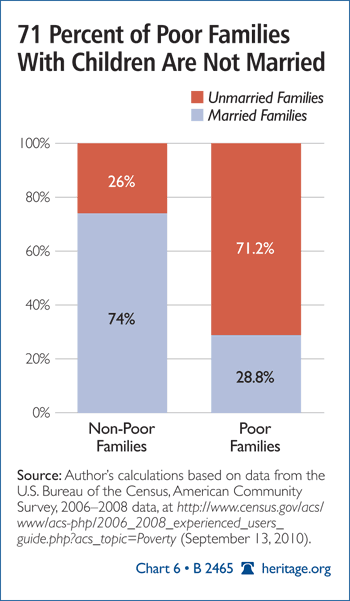
And the fifth policy is welfare. Welfare encourages women to not marry the men that they have sex with, since they will lose their single mother benefits if they do. Children who are raised fatherless are more likely to struggle in a number of areas, and they are especially likely to be poor. What we should be doing (if we really want to help the poor) is paying people to get married and stay married. But Democrats are opposed to that. The connection between welfare, fatherlessness, poverty and crime is explained in a previous post.

New study: a good credit score is a key performance indicator for marriage success

Financial responsibility is a key performance indicator for marriage success

Story from the leftist Washington Post.

Excerpt:

When people are looking for a significant other, they often try to find someone whose values, education, earnings, hobbies and even height match their own. But new research suggests there’s one promising measure for finding a committed partner that most daters overlook — credit scores.

A credit score is a number that is supposed to reflect the risk of lending money to someone, based mostly on their past history of borrowing, repaying and defaulting on debt. Banks have long used credit scores to evaluate customers, but these days potential employers, landlords, insurance companies, cellphone companies and many other businesses do, too.

A new working paper from the Federal Reserve Board that looks at what role credit scores play in committed relationships suggests that daters might want to start using the metric as well. The researchers found that credit scores — or whatever personal qualities credit scores might represent — actually play a pretty big role in whether people form and stay in committed relationships. People with higher credit scores are more likely to form committed relationships and marriages and then stay in them. In addition, how well matched the couple’s credit scores are initially is a good predictor of whether they stay together in the long term.

The paper analyzed a large proprietary data set of 12 million randomly selected U.S. consumers from the credit reporting agency Equifax over a period of about 15 years. Researchers used an algorithm to find a swathe of committed couples, including some who live together and are not legally married.

They found that people with higher (i.e. better) credit scores are more likely to form a committed relationship, as the chart below shows. This was true even after controlling for other differences between partners, like education level, race or income.

The researchers also found that having higher credit scores when they started the relationship meant that couples were less likely to separate over the next few years… In fact, for every extra 100 points in the couple’s average credit score when beginning the relationship, their odds of splitting in the second year fell by around 30 percent.

So what do I want to say about this story? I want to tell you that marriage is not something that you just jump into when you feel like it, without any preparation. Relationships work well when both people have trained their character to be ready to do the most important thing in a relationship: to commit. And your credit score is a good measure of your ability to do that.

A high credit score is an excellent measure of a person’s ability to be responsible with money, and to take their obligation to pay their money back seriously. Marriage is all about whether two people are comfortable with being responsible, and whether two people can put aside their desire for fun and thrills and meet their obligations, even when they don’t feel like it. If a person is uncomfortable with marriage obligations, because it is too “transactional” and they want to be feelings-led, that’s a clear sign they are not ready for a commitment through thick and thin. The credit score is a measure of one’s ability to be responsible to others regardless of feelings and desires, and that’s what you need to commit.

When I meet someone I am interested in for marriage, if they have problems with their education, career or finances, the first thing I do is to try to push them to study for a degree with a good employment rate, and good starting salaries. I push them to get good jobs with reputable companies, and to work in the summer if they are students. I push them to pay off their debts and start investing. I do this because I am trying to make them marriage-ready. That is, I am trying to get them to be comfortable with responsibilities, expectations and obligations.

One girl I used to mentor just got married. She started out living with her parents, doing a degree in English, and working minimum wage service jobs. Then something happened. She moved out of her parents house, got a real job, cut expenses, and married an employed non-student who works and saves money. They are both paying down debt like crazy, and she has a plan to invest soon. Most of what she did was self-directed, all I did was cheer, make suggestions and send the occasional gift. But she never viewed this advising and rewarding as “manipulative”. She was happy to get the opinion of someone with qualifications in those areas. She didn’t rebel against people who were leading her upward, she embraced it. Now she’s committed to a man for life and they are executing a sound plan to have an influence as Christians. It has not been easy for her. She is punching well above her weight now, though.

If you want to get married, you need to develop the ability to commit. That means that you need to get comfortable with self-sacrifice and self-denial. You need to change your character through studying hard things, working boring jobs, saving instead of spending, and investing early. These are the life experiences that change your character so that you are able to commit to another person for life.

Should we be trying to change the world from the bottom up or the top down?

Two Air Force JTACs discuss mission parameters prior to calling in CAS

Dr. Paul Gould is a professor of philosophy (PhD from Purdue) at Southwestern Baptist Theological Seminary.

Here is his bio, which says, in part:

I have a Masters in Philosophy of Religion and Ethics from Talbot School of Theology and a Ph.D. in Philosophy from Purdue University.

I am an Assistant Professor of Philosophy and Christian Apologetics at Southwestern Baptist Theological Seminary in Fort Worth, Texas.

What his bio page doesn’t say is that he left a career in business to go onto this apologetics/philosophy track. I find that very interesting, because like most professionals with an interest in apologetics, I had the same dream – to go and do a PhD and get into a college and be a positive influence on Christian kids. But the main thing is that he has had some experience in the real world.

Anyway, Dr. Gould has written two posts on how to change the world, and I want you to look at an excerpt from the first one.

First post:

Christians like to talk—and aspire—to changing the world. This language stems very naturally from our God-given desire to make a difference, to live a life that matters. In a very real sense, making a difference is to change the world. But, usually, when Christians talk about “changing the world” they mean something like “winning the world for Christ” or “helping the gospel to gain a hearing in culture” or “contributing toward shalom.”Recently, there have been a number of very helpful books written by folks who challenge the common view of how to go about the task of world-changing, and call into question the relationship between Christ and culture. One of the most important books to enter this discussion is James Davison Hunter’s To Change the World. I highly recommend it to anyone interested in the topic of world-change. In this post I will share his critique of the “common view” of world change. I think his critique is dead on.

Hunter argued that by and large, Christians have gone about the task of world changing in completely the wrong way and the result is that Christianity in our country at least and in the western world in general, represents a weak culture.

He focuses on world-view ministries (primarily from the US such as Chuck Colson’s Wilberforce Forum and Focus on the Families’ Truth Project) and those like them that offer the following view of how to change the world:

Common view of world change: as we change the individual beliefs and values of persons, and change enough persons, then we will ultimately change society. This is a bottom up approach.

On the common view, the implicit view of culture is that “the essence of culture is found in the hearts and minds of individuals” and that culture change will come as enough individual lives are transformed.

Hunter argues that this approach fails to take into account cultural elites and the institutions that yield power within culture.

Instead, cultural change has always been top-down: it is always elites—those who have cultural capital to exert influence and power—who have changed the culture. This is why the university, and the media, and the arts are so important in shaping the culture.

All of this leads to a fascinating conclusion: some ideas have consequences—namely ideas propagated by those within society who possess cultural capital and a supporting network of other individuals and institutions also within the center of cultural influence and production.

Second post is here. The second post has a link to his review of Hunter’s book (PDF), which is published by Oxford University Press.

I agree completely with the top-down thesis of James Davison Hunter, and I think that it is a tragedy that the Christian parents and Christian churches don’t do a good job of challenging and guiding young Christians to study the things that will allow them to have an influence. Most Christians I talk to have a negative view of steering young Christians towards advanced degrees, or towards making a lot of money, or towards positions of cultural influence, etc. Instead of focusing on being effective, they tell me “I will do what I want to do, because God has a mysterious will for me to be happy”. I don’t buy it. I am happy to consider alternative plans that serve God better, but I don’t think that the “I’ll do what feels good” view is interested in producing a return for God in terms of money and/or influence. Crazy plans do not work out just because we want them to. There are costs to every plan, and not every plan is as likely to lead to influencing the culture as any other plan. This is reality.

I also think it is important to steer children into positions where they can be prosperous and/or influential. Again, many Christians disagree with guiding children that way. In my experience, it is assumed that children need to be happy, and that they are the best people to decide what they should be doing in life. Well, I’m not a heavy-handed bully, but I am not letting my children do whatever they like, because they don’t have enough wisdom and experience to know what to do. For example, I am not letting my children study ballet in university. It doesn’t pay the bills, and it isn’t likely that they will have an influence compared to other choices. Money is important because money can be used to fund Christian scholars, apologetics ministries and apologetics events. Marriage is a great way to have an influence, but marriage costs money, and that means that marriage-minded people should have a plan to pay the bills before they consider marriage. We do not have the right to do whatever we feel like, because we have a boss who expects a return on his investment. If a person is capable of doing hard things that produce a better return (money or influence or children, etc.) then he should do that.

We have a problem in this country as it is with young people borrowing tens of thousands of dollars to study things that either don’t pay off, or that don’t allow them to have an influence. It’s not unloving to tell children the truth about the choices they make. Especially when the cost of having a child is over six figures per child. You can have a huge Christian influence with that kind of money if you spent it on other things, like apologetics scholars, their ministries and their events. So, if you are going to have children and spend it on them, you’d better have some sort of plan, and look for a spouse who is on board with that idea of providing God with a good return on his investment. Everything we do – including the choices to marry and have children – should be focused on serving God. If people shy away from the idea of steering children to have an influence, I don’t think it’s a good idea to get married at all. Save the money and use it for the kingdom somewhere else. Marriage is about making the best decisions you can in order to serve God, and you can’t marry someone who puts their own happiness over the need to produce that return for the boss.

Having said that, if you are already married, stick with it. I am advocating for making smarter decisions before you commit. And before you go off to college, ask yourself: is what you are thinking of studying worth it? Trade school is an excellent option that will give you an income that can support a family AND give to apologetics ministries, with less exposure to debt. If you must go to university, then it’s generally wiser to stick with STEM degrees, so that you can get a job and actually pay off those loans. Marriages and children are NOT free. Retirement is not free. Health care is not free. Christian apologetics ministries do not run on wishes and hopes. Christian scholars do not get their degrees for free – they need support. I think another good plan is to have one person do philosophy or history and then be supported by other people with jobs in STEM fields. That’s what I do – I help out Christian scholars on my team to finish their graduate degrees in fields related to apologetics. Those non-STEM degrees are the best way to have an influence, but it’s easier to get them as a multi-disciplinary team effort. Everyone has to pull their weight!

And one last point. The most amazing thing in the world is when I meet people who are very very skeptical about mentoring young people and steering children towards prosperous and influential areas, even though they themselves may be facing the results of their own poor decisions. You would think that someone who has burned $60,000 on a degree in Women’s Studies and can’t find a job would be on your side about helping other young people to make better decisions, but they are often not on your side. Why is that? Somewhere along the way, this culture stopped liking the Mr. Knightleys who were praised for loving people by telling them the truth about their bad decisions. Now we think that the Emmas can do whatever they want, and no one should be giving them any guidance. How sad.