Tag Archives: Manufacturing

What caused Silicon Valley companies to outsource jobs?

Article from the center-right Manhattan Institute.  (H/T ECM)

Excerpt:

Silicon Valley faces a serious threat, however: the fiscal and regulatory earthquakes rocking California, which verges on becoming a failed state. Measured by per-household state and local government spending, California ranks third-highest in the nation, behind Alaska and New York. The state government is trying desperately to squeeze money out of any profitable activity to meet the crippling costs. Further, California continues to impose onerous regulations on the private sector. High taxes and stifling regulations give companies a strong incentive to move elsewhere. In this increasingly business-hostile environment, will Silicon Valley’s unique entrepreneurial spirit survive?

[…]California has piled every imaginable burden on businesses. Minimum-wage laws are among the highest in the country, and health and safety regulations are among the strictest; cities like San Francisco and San Jose require businesses to offer employees health insurance; labor laws are extremely union-friendly; environmental policies drive up energy costs—and on and on. Small firms have the toughest time in this business-toxic climate. A recent study by Sanjay Varshney, dean of the College of Business Administration at California State University in Sacramento, estimates that the cost of state regulations in 2007 reached an average of $134,122 per small business—the equivalent of one job lost per company. And it’s not just the small guys: Google, which uses colossal amounts of electricity, is building its data centers in other states or abroad, where energy is much cheaper.

Hank Nothhaft is the CEO of Tessera, a firm in the field of semiconductor miniaturization. He shows me the vacant office parks and empty lots around his company’s San Jose factory. Silicon Valley, he observes, lost more than a quarter of its computer, microchip, and communications-equipment manufacturing jobs from 2001 to 2008, and Tessera proved no exception. The company has kept some of its assembly lines and industrial operations going here, but it now produces two-thirds of its nanotechnology chips in less expensive North Carolina and in various countries overseas, with China becoming the latest contender for a production facility. Just back from a trip there, Nothhaft says that he has been offered terms he “cannot decently refuse.” Using the Internet and videoconferencing, he can manage Tessera factories around the globe without leaving his San Jose office. “The business environment is becoming awful in California,” Nothhaft complains—just by moving his headquarters to Nevada, he’d save $5 million a year in taxes.

I quoted the interesting part of the article above, the rest is just more details about the past, present and future of Silicon Valley.
More companies announce massive losses as a result of Obamacare

From Associated Press. (H/T Ace of Spades via ECM)

Excerpt:

Insurer Prudential Financial Inc. said Monday that it will take a $100 million charge in the first quarter in relation to the recent health care overhaul legislation.

The life insurance and annuities provider said in a regulatory filing that it will take the charge against earnings in the first quarter.

Prudential joins a growing list of companies that have said they will take accounting charges because of the health care bills. AT&T said last week it would take a $1 billion charge in the first quarter. AK Steel Corp., 3M Co., Caterpillar Inc., Deere & Co. and Valero Energy have also said they would take smaller charges.

Prudential said in a filing with the Securities and Exchange Commission that the health bill signed into law by President Barack Obama last week and a companion measure he is expected to sign Tuesday will reduce its tax deduction for retiree health care costs beginning in 2013.

Companies that provide prescription drug benefits for retirees have been getting subsidies covering 28 percent of eligible costs but could deduct everything they spent on the benefits — including the federal money — from their taxable income.

Normally I oppose subsidies, but this one one was keeping the elderly off the even more wasteful Medicare prescription drug plan. (I hate that plan – it was a huge mistake made by an otherwise good president). These companies are going to dump the pensioners onto Medicare and it will cost EVEN MORE to have an inefficient government run the program, with all the waste and fraud that plagues Medicare now.

Ace writes:

That subsidy was to induce companies to keep retirees on their own corporate plans rather than dump them into taxpayer-funded Medicare. Now that they’ve cut the subsidy, not only is it costing these businesses money, but many are thinking of giving up the subsidy and dumping them into government health care.

Remember, if you like your insurance, you get to keep your insurance.

And Henry Waxman is going to drag these CEOs in front of his committee, to harass and threaten them, and badger them into answering why they’re bound to accurately account for additional new tax costs.

In fact, Waxman doesn’t want an answer to that; what he wants is for companies to hide these new, embarrassing costs illegally, so that Democrats don’t have to answer questions about them. And he figures harassment and the threat of punitive legislative action should be enough to give other companies the hint.

Preemptive Strike? Rich Lowry says it’s part of the Democrats’ plan to claim that all negative consequences of this bill are due to a conspiracy between evil corporations.

Meanwhile, National Review has a related story from PRNewswire. (H/T ECM)

Excerpt:

Illinois Tool Works Inc. (NYSE: ITW) today announced that as a result of certain provisions in the recently enacted Patient Protection and Affordable Health Care program, future Medicare prescription drug subsidies received by the Company for retiree prescription drug coverage will now be taxable.  As a result, the Company expects to record a discrete tax adjustment of $22 million, or 4 cents of diluted income per share from continuing operations, in its 2010 first quarter results to reflect this change in tax treatment.  This discrete tax adjustment was not included in the Company’s March 15, 2010 revised earnings forecast.

Wow. We’re in freaking North Korea now. Next time, don’t vote for the radical socialist. Socialism makes jobs go away. This is not a surprise to anyone on the right. We know these things because we’re grown ups. We know how the world works. Happy talk doesn’t grow the economy.

Related: Other companies take massive losses after Obamacare passes.

How are big companies responding to Obamacare?

Caterpillar and John Deere. (H/T Hot Air via ECM)

Excerpt:

Caterpillar Inc. said Wednesday it will take a $100 million charge to earnings this quarter to reflect additional taxes stemming from newly enacted U.S. health-care legislation.

[…]The charge is expected to be a one-time cost, but Caterpillar has argued that higher taxes and other potential cost increases related to insurance coverage mandates in the legislation will hinder the company’s recovery this year after a 75% plunge in income during 2009.

“From our point of view, a tax increase like this cannot come at a worse time,” said Jim Dugan, a Caterpillar spokesman.

[…]Farm equipment maker Deere expects after-tax expenses to rise by $150 million this year as a result of the health care reform law President Barack Obama signed this week.

Most of the higher expense will come in Deere’s second quarter, the company said on Thursday. The expense was not included in the company’s earlier 2010 forecast, which called for net income of about $1.3 billion.

The law could raise expenses for large U.S. employers. Industrial companies, which typically have large numbers of retirees, may be among those facing the biggest bill. Caterpillar had argued before the legislation passed that health reform would put it at a disadvantage against global competitors.

And National Review reports on Verizon. (H/T ECM)

Excerpt:

Yesterday I posted a memo that Verizon sent to its employees concerning its view that the Democrats’ health-care bill would probably cause its costs to go up. Specifically, the memo keyed in on a change in the tax treatment of the Medicare Part D retiree drug subsidy. This is a subsidy that the government pays to employers that offer prescription-drug coverage to their retirees; it was created as part of the Medicare prescription-drug entitlement to encourage employers not to dump their retirees into the public system. As the Wall Street Journal editorial board reports today, the subsidy costs taxpayers $665 per person, “while the same Medicare coverage would cost $1,209.”

As part of their effort to keep their health-care bill deficit-neutral, the Democrats changed the law and exposed the subsidy to the 35 percent corporate income tax rate, adding $5.4 billion in revenue to the bill. In its memo to employees, Verizon warned that this tax change would make the subsidy “less valuable to employers, like Verizon, and as a result, may have significant implications for both retirees and employers.” This is a clear sign that Verizon and other employers will probably drop their retiree prescription-drug coverage, leaving Medicare Part D to pick up the slack.

UPDATE: More from National Review. (H/T ECM)

Excerpt:

AK Steele Holding Corp., “the third largest U.S. steelmaker by sales, said it will record a non-cash charge of about $31 million resulting from the health-care overhaul signed into law by President Barack Obama. The charge will be recorded in the first quarter of 2010.”

Valero Energy “will take a $15 million to $20 million charge to second-quarter earnings for the same reason.”

Medical-device maker Medtronic “warned that new taxes on its products could force it to lay off a thousand workers.”

And more from National Review. (H/T ECM)

Excerpt:

Wow: “U.S. companies employed 3.9 million fewer workers in January 2010 than they did one year earlier.”

If you will recall, when touting the stimulus, President Obama and his team declared that “a package in the range that the President-Elect has discussed is expected to create between three and four million jobs by the end of 2010 . . . More than 90 percent of the jobs created are likely to be in the private sector.”

90 percent of three million jobs would be 2.7 million jobs. Yet we’re 3.9 million lower than when we started.

To meet the goal by the deadline, the country would have to create 6.6 million jobs in the next nine months. or more than 733,000 jobs per month for three quarters of the year.

UPDATE 2: Now Business Week reports that AT&T is screwed.

Excerpt:

AT&T Inc. will book $1 billion in first-quarter costs related to the health-care law signed this week by President Barack Obama, the most of any U.S. company so far.

A change in the tax treatment of Medicare subsidies triggered the non-cash expense, and the company will consider changes to the benefits it offers current and retired workers, Dallas-based AT&T said today in a regulatory filing.

Hey! Do you know what causes outsourcing of jobs? DEMOCRATS. Democrats cause jobs to be shipped overseas. Democrats hate companies. Companies hire people. Democrats cause American manufacturing jobs to be shipped overseas. Democrats cause unemployment. That’s why the unemployment rate is double what it was under Ronald Reagan and George W. Bush. Democrats cause unemployment.

How do jobs get created, anyway?

Do you know what really works to create jobs?

I mean – do you know what actually has worked in the past to create jobs?

The Heritage Foundation reports:

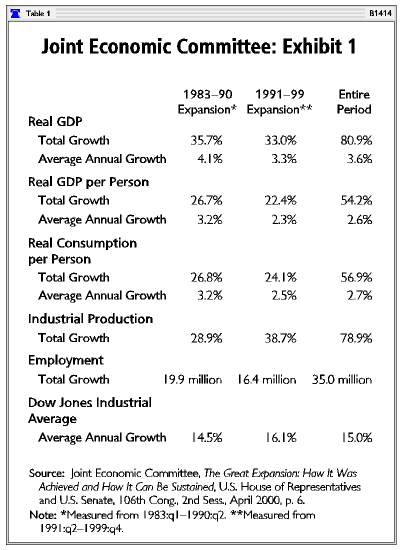
President Ronald Reagan’s record includes sweeping economic reforms and deep across-the-board tax cuts, market deregulation, and sound monetary policies to contain inflation. His policies resulted in the largest peacetime economic boom in American history and nearly 35 million more jobs.

See:

That’s what actually worked.

Free. Market. Capitalism. Works.