Tag Archives: Life

A simple case for the pro-life position by Scott Klusendorf

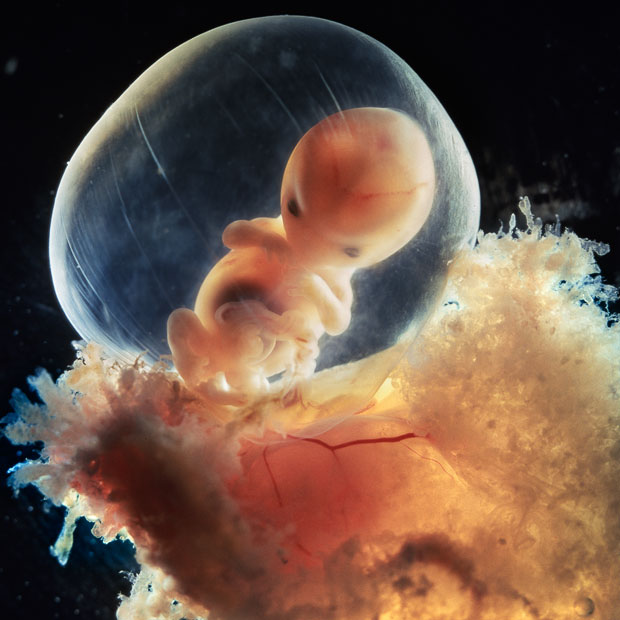
I'm Scheming Unborn Baby, and I approve this study
I’m Scheming Unborn Baby, and I approve this message

Are you able to make a basic case for the pro-life view?

Here’s a short 38-lecture by Scott Klusendorf, president of the Life Training Institute.

This is a long treatment that talks about the challenge of moral relativism and the case for the pro-life view. He does show a clip of abortion in the video to the audience.

There’s also a 35-minute audio recording of Scott on the LTI web site. (H/T Apologetics 315) You can put that on your podcast player and listen to it. Listen to it a lot and soon you’ll sound like Scott.

Scott also has an article posted on the LTI web site for those who don’t have time for the video or the audio.

In the article makes three points:

  1. Clarify the issue
  2. Defend your pro-life position with science and philosophy
  3. Challenge your listeners to be intellectually honest

Here’s the second point:

Scientifically, we know that from the earliest stages of development, the unborn are distinct, living, and whole human beings. Leading embryology books confirm this.2 For example, Keith L. Moore & T.V.N. Persaud write, “A zygote is the beginning of a new human being. Human development begins at fertilization, the process during which a male gamete or sperm … unites with a female gamete or oocyte … to form a single cell called a zygote. This highly specialized, totipotent cell marks the beginning of each of us as a unique individual.”3 Prior to his abortion advocacy, former Planned Parenthood President Dr. Alan Guttmacher was perplexed that anyone, much less a medical doctor, would question this. “This all seems so simple and evident that it is difficult to picture a time when it wasn’t part of the common knowledge,” he wrote in his book Life in the Making.4

Philosophically, we can say that embryos are less developed than newborns (or, for that matter, toddlers) but this difference is not morally significant in the way abortion advocates need it to be. Consider the claim that the immediate capacity for self-awareness bestows value on human beings. Notice that this is not an argument, but an arbitrary assertion. Why is some development needed? And why is this particular degree of development (i.e., higher brain function) decisive rather than another? These are questions that abortion advocates do not adequately address.

As Stephen Schwarz points out, there is no morally significant difference between the embryo that you once were and the adult that you are today. Differences of size, level of development, environment, and degree of dependency are not relevant such that we can say that you had no rights as an embryo but you do have rights today. Think of the acronym SLED as a helpful reminder of these non-essential differences:5

Size: True, embryos are smaller than newborns and adults, but why is that relevant? Do we really want to say that large people are more human than small ones? Men are generally larger than women, but that doesn’t mean that they deserve more rights. Size doesn’t equal value.

Level of development: True, embryos and fetuses are less developed than the adults they’ll one day become. But again, why is this relevant? Four year-old girls are less developed than 14 year-old ones. Should older children have more rights than their younger siblings? Some people say that self-awareness makes one human. But if that is true, newborns do not qualify as valuable human beings. Six-week old infants lack the immediate capacity for performing human mental functions, as do the reversibly comatose, the sleeping, and those with Alzheimer’s Disease.

Environment: Where you are has no bearing on who you are. Does your value change when you cross the street or roll over in bed? If not, how can a journey of eight inches down the birth-canal suddenly change the essential nature of the unborn from non-human to human? If the unborn are not already human, merely changing their location can’t make them valuable.

Degree of Dependency: If viability makes us human, then all those who depend on insulin or kidney medication are not valuable and we may kill them. Conjoined twins who share blood type and bodily systems also have no right to life.

In short, it’s far more reasonable to argue that although humans differ immensely with respect to talents, accomplishments, and degrees of development, they are nonetheless equal because they share a common human nature.

That’s the core of the basic pro-life case right there. There’s also a good interview of Mr. Klusendorf that I blogged about.

Advanced Objections

You can learn more by reading basic pro-life apologetics… from Francis Beckwith. You might recognize Frank Beckwith as the author of “Defending Life: A Moral and Legal Case Against Abortion Choice“. He wrote that book for Cambridge University Press, a top academic press. But before Cambridge University Press, Beckwith wrote easy-to-understand essays for the Christian Research Journal.

Here are four essays that answer common arguments in favor of legalized abortion.

Here’s an excerpt from Part II:

Excerpt:

A woman who becomes pregnant due to an act of either rape or incest is the victim of a horribly violent and morally reprehensible crime. Although pregnancy as a result of either rape or incest is extremely rare, [1] there is no getting around the fact that pregnancy does occur in some instances.

[…]Despite its forceful appeal to our sympathies, there are several problems with this argument. First, it is not relevant to the case for abortion on demand, the position defended by the popular pro-choice movement. This position states that a woman has a right to have an abortion for any reason she prefers during the entire nine months of pregnancy, whether it be for gender-selection, convenience, or rape. [3] To argue for abortion on demand from the hard cases of rape and incest is like trying to argue for the elimination of traffic laws from the fact that one might have to violate some of them in rare circumstances, such as when one’s spouse or child needs to be rushed to the hospital. Proving an exception does not establish a general rule.

[…]Fourth, this argument begs the question by assuming that the unborn is not fully human. For if the unborn is fully human, then we must weigh the relieving of the woman’s mental suffering against the right-to-life of an innocent human being. And homicide of another is never justified to relieve one of emotional distress. Although such a judgment is indeed anguishing, we must not forget that the same innocent unborn entity that the career-oriented woman will abort in order to avoid interference with a job promotion is biologically and morally indistinguishable from the unborn entity that results from an act of rape or incest. And since abortion for career advancement cannot be justified if the unborn entity is fully human, abortion cannot be justified in the cases of rape and incest. In both cases abortion results in the death of an innocent human life. As Dr. Bernard Nathanson has written, “The unwanted pregnancy flows biologically from the sexual act, but not morally from it.” [5]Hence, this argument, like the ones we have already covered in this series, is successful only if the unborn are not fully human.

Scott Klusendorf wrote the The Case for Life, which is the best book for beginners on the pro-life view. For those looking for advanced resources, Francis Beckwith, a professor at Baylor University, published the book Defending Life, with Cambridge University Press, 2007.

I found a very polished hour-long talk by Scott on Viemo. That talk was delivered to students and faculty at Furman University.

Finally, if you want to see Scott Klusendorf in a debate with a former ACLU executive, you can see it right here.

My friend Papa Georgio sent me a post that features THREE talks by Scott Klusendorf. (H/T Religio-Political Talk)

Is the probability of getting a universe that supports complex life 100%?

Apologetics and the progress of science

Let’s have a quick review of the famous fine-tuning argument to start.

The argument from cosmic fine-tuning looks at various constants and quantities in our universe that are set at particular values and notes that if any of the values of these constants and quantities were to change, then complex embodied life of any kind could not exist. The argument is fully in line with the standard Big Bang cosmology, and is based on mainstream science.

There are two kinds of finely-tuned initial conditions: 1) constants and 2) quantities. These constants and quantities have to be set within a narrow range in order to permit intelligent life. There are three explanations for this observation: law, chance or design. Law is rejected because the numerical values of constants and quantities are set at the beginning of the universe – when there was no matter, space or time. The values of the constants and quantities were not determined by anything causally prior to the moment the universe began to exist. Chance is not a good explanation, because the probabilities are far, far too small for us to reasonably believe them (e.g. – the chance is 1 in X, where X is much higher than the number of subatomic particles in the visible universe). Since the fine-tuning is not due to law or chance, it must be due to design.

Here’s one example of something that is set correctly to allow complex, embodied life from The New Scientist:

The feebleness of gravity is something we should be grateful for. If it were a tiny bit stronger, none of us would be here to scoff at its puny nature.

The moment of the universe‘s birth created both matter and an expanding space-time in which this matter could exist. While gravity pulled the matter together, the expansion of space drew particles of matter apart – and the further apart they drifted, the weaker their mutual attraction became.

It turns out that the struggle between these two was balanced on a knife-edge. If the expansion of space had overwhelmed the pull of gravity in the newborn universe, stars, galaxies and humans would never have been able to form. If, on the other hand, gravity had been much stronger, stars and galaxies might have formed, but they would have quickly collapsed in on themselves and each other. What’s more, the gravitational distortion of space-time would have folded up the universe in a big crunch. Our cosmic history could have been over by now.

Only the middle ground, where the expansion and the gravitational strength balance to within 1 part in 1015 at 1 second after the big bang, allows life to form.

Changing the value at all means there would be no complex, embodied life of any kind anywhere in this universe.

Here’s a quick video clip to explain what The New Scientist is saying:

Now, this is going to surprise you, but there are some non-theists who try to argue that the finely-tuned constants and quantities that were set up at the beginning of the universe – long before we ever existed – are actually explained by our existence today. 

Atheist Jeffery Lowder summarizes a debate between William Lane Craig and Doug Jesseph, and Jesseph says something like this:

Craig’s argument is like asking the question, “What are your chances of landing in a universe hospitable to life, assuming you were tossed into any old universe whatever.” That is precisely not the point. It’s presupposed in the question that you’re already in a universe which favors life. Confuses conditional probability with unconditional probability.

Unlike me, Lowder is never snarky in his summaries, so this is guaranteed to be accurate.

Here’s what Dr. William Lane Craig says to that idea that our being here explains the fine-tuning:

Now some people have tried to avoid this conclusion by saying that we really shouldn’t be surprised at the enormous improbability of the fine-tuning of the universe because, after all, if the universe were not fine-tuned then we wouldn’t be here to be surprised about it. Given that we are here we should expect the universe to be fine-tuned. But I think the fallacy of this reasoning can be made clear simply by a parallel illustration. Imagine that you were traveling abroad in a third world country and you were arrested on trumped up drug charges, and you were dragged in front of a firing squad of 100 trained marksmen, all with rifles aimed at your heart to be executed. And you hear the command given – “Ready, aim, fire!” And you hear the deafening roar of the guns. And then you observe that you are still alive, that all of the 100 marksmen missed! Now, what would you conclude? Well, I guess I really shouldn’t be surprised that they all missed; after all, if they hadn’t all missed I wouldn’t be here to be surprised about it. Given that I am here, I should expect them all to miss. Of course not. You would immediately suspect that they all missed on purpose. That the whole thing was a set up engineered by some person for some reason. And in exactly the same way, given the incomprehensible improbability of the fine-tuning of the initial conditions for intelligent life, it is rational to believe that this is not the result of chance but of design.

Does it make sense? It’s true that any arrangement of bullet holes in a condemned spy is as unlikely as any other, but the vast majority of possible arrangements of 100 bullet holes result in you being dead. Being marksmen, the shooters definitely know how to hit a target at close range. It doesn’t matter if some hit your head and some hit your heart and some hit your throat – the most common consequence of a hundred bullets fired by expert marksmen at you is “dead you” – regardless of the specific arrangement of bullet holes. If you find yourself not dead, that requires an explanation. The explanation is design.

If unborn babies don’t have consciousness or don’t feel pain, may we kill them?

Unborn baby scheming about pro-life apologetics

Was having a conversation by e-mail yesterday with a pro-abortion atheist, and he gave two reasons why he supported abortion in the first and second trimester. First, he said that unborn babies can’t feel pain, so it’s OK to kill them. Second, he said that unborn babies don’t have consciousness, so it’s OK to kill them. I thought it might be useful to link to something that answers both of these objections.

Frank Beckwith is the author of “Defending Life: A Moral and Legal Case Against Abortion Choice“. He wrote that book for Cambridge University Press, a top academic press. But before Cambridge University Press, Beckwith wrote four easy-to-understand essays for the Christian Research Journal. Part IV is the one that has the response to the two questions raised by my atheist friend.

Part I. The Appeal to Pity

Part II. Arguments from Pity, Tolerance, and Ad Hominem

Part III. Is The Unborn Human Less Than Human?

Part IV. When Does a Human Become a Person?

Excerpt:

Some ethicists argue that the unborn becomes fully human sometime after brain development has begun, when it becomes sentient: capable of experiencing sensations such as pain. The reason for choosing sentience as the criterion is that a being that cannot experience anything (i.e., a presentient unborn entity) cannot be harmed. Of course, if this position is correct, then the unborn becomes fully human probably during the second trimester and at least by the third trimester. Therefore, one does not violate anyone’s rights when one aborts a nonsentient unborn entity. [13]

There are several problems with this argument. First, it confuses harm with hurt and the experience of harm with the reality of harm. [14] One can be harmed without experiencing the hurt that sometimes follows from that harm, and which we often mistake for the harm itself. For example, a temporarily comatose person who is suffocated to death “experiences no harm,” but he is nevertheless harmed. Hence, one does not have to experience harm, which is sometimes manifested in hurt, in order to be truly harmed.

Second, if sentience is the criterion of full humanness, then the reversibly comatose, the momentarily unconscious, and the sleeping would all have to be declared nonpersons. Like the presentient unborn, these individuals are all at the moment nonsentient though they have the natural inherent capacity to be sentient. Yet to countenance their executions would be morally reprehensible. Therefore, one cannot countenance the execution of some unborn entities simply because they are not currently sentient.

Someone may reply that while these objections make important points, there is a problem of false analogy in the second objection: the reversibly comatose, the momentarily unconscious, and the sleeping once functioned as sentient beings, though they are now in a temporary state of nonsentience. The presentient unborn, on the other hand, were never sentient. Hence, one is fully human if one was sentient “in the past” and will probably become sentient again in the future, but this cannot be said of the presentient unborn.

There are at least three problems with this response. First, to claim that a person can be sentient, become nonsentient, and then return to sentience is to assume there is some underlying personal unity to this individual that enables us to say that the person who has returned to sentience is the same person who was sentient prior to becoming nonsentient. But this would mean that sentience is not a necessary condition for personhood. (Neither is it a sufficient condition, for that matter, since nonhuman animals are sentient.) Consequently, it does not make sense to say that a person comes into existence when sentience arises, but it does make sense to say that a fully human entity is a person who has the natural inherent capacity to give rise to sentience. A presentient unborn human entity does have this capacity. Therefore, an ordinary unborn human entity is a person, and hence, fully human.

Second, Ray points out that this attempt to exclude many of the unborn from the class of the fully human is “ad hoc and counterintuitive.” He asks us to “consider the treatment of comatose patients. We would not discriminate against one merely for rarely or never having been sentient in the past while another otherwise comparable patient had been sentient….In such cases, potential counts for everything.” [15]

Third, why should sentience “in the past” be the decisive factor in deciding whether an entity is fully human when the presentient human being “is one with a natural, inherent capacity for performing personal acts?” [16] Since we have already seen that one does not have to experience harm in order to be harmed, it seems more consistent with our moral sensibilities to assert that what makes it wrong to kill the reversibly comatose, the sleeping, the momentarily unconscious, and the presentient unborn is that they all possess the natural inherent capacity to perform personal acts. And what makes it morally right to kill plants and to pull the plug on the respirator-dependent brain dead, who were sentient “in the past,” is that their deaths cannot deprive them of their natural inherent capacity to function as persons, since they do not possess such a capacity.

These four essays are a very good introduction to common responses to pro-abortion arguments. I recommend that people get familiar with this, as once you look into it, you will see that the abortion issue can be debated with as much confidence as William Lane Craig defends Christian theism. You will have the same access to scientific evidence and rational arguments on this topic, and so you will have the upper hand. And that’s fun.

The best introductory book on the abortion / right to life issue is “The Case for Life” by pro-life debater Scott Klusendorf. The best comprehensive book is a tie between “The Ethics of Abortion” by Christopher Kaczor, and Frank Beckwith’s “Defending Life: A Moral and Legal Case Against Abortion Choice“.