

Tag Archives: Liberal

Was Hitler a Christian? Is Nazism similar to Christianity?

A conflict of worldviews

One of the strangest things I have heard from atheists is the assertion that Christianity is somehow connected to the fascism, such as the fascism that existed under Adolf Hitler. Two posts by Jewish author Jonah Goldberg from National Review supply us with the facts to set the record straight.

Let’s start with the first post.

Here are some of the points:

1) Hitler wanted Christianity removed from the public square

Like the engineers of that proverbial railway bridge, the Nazis worked relentlessly to replace the nuts and bolts of traditional Christianity with a new political religion. The shrewdest way to accomplish this was to co-opt Christianity via the Gleichschaltung while at the same time shrinking traditional religion’s role in civil society.

2) Hitler banned the giving of donations to churches

Hitler banned religious charity, crippling the churches’ role as a counterweight to the state. Clergy were put on government salary, hence subjected to state authority. “The parsons will be made to dig their own graves,” Hitler cackled. “They will betray their God to us. They will betray anything for the sake of their miserable little jobs and incomes.”

3) Hitler replaced Christian celebrations with celebrations of the state

Following the Jacobin example, the Nazis replaced the traditional Christian calendar. The new year began on January 30 with the Day of the Seizure of Power. Each November the streets of central Munich were dedicated to a Nazi Passion play depicting Hitler’s Beer Hall Putsch. The martyrdom of Horst Wessel and his “old fighters” replaced Jesus and the apostles. Plays and official histories were rewritten to glorify pagan Aryans bravely fighting against Christianizing foreign armies. Anticipating some feminist pseudo history, witches became martyrs to the bloodthirsty oppression of Christianity.

4) Hitler favored the complete elimination of Christianity

When some Protestant bishops visited the Fuhrer to register complaints, Hitler’s rage got the better of him. “Christianity will disappear from Germany just as it has done in Russia . . . The Germanrace has existed without Christianity for thousands of years . . . and will continue after Christianity has disappeared . . . We must get used to the teachings of blood and race.”

5) Hitler favored the removal of mandatory prayers in schools

In 1935 mandatory prayer in school was abolished…

6) Hitler favored the banning of Christmas carols and nativity plays

…and in 1938 carols and Nativity plays were banned entirely.

7) Hitler abolished religious instruction for children

By 1941 religious instruction for children fourteen years and up had been abolished altogether….

And now the second post.

8) Hitler opposed the ideas of universal truth and objective moral absolutes

…Just as the Nazi attack on Christianity was part of a larger war on the idea of universal truth, whole postmodern cosmologies have been created to prove that traditional religious morality is a scam, that there are no fixed truths or “natural” categories, and that all knowledge is socially constructed.

Practically everything this man believed was 100% anti-Christian. But he fits in fine on the secular left.

Conclusion

Adolf Hitler was a man influenced by two big ideas: evolution and socialism. His party was the national SOCIALIST party. He favored a strong role for the state in interfering with the free market. He was in favor of regulating the family so that the state could have a bigger influence on children. And he favored the idea of survival of the fittest. His ideas are 100% incompatible with Christianity and with capitalism as well. Christians value individual rights and freedoms, small government and the autonomy of the family against the state. The differences are clear and significant.
New study: conservatives are more likely to be happily married than progressives

If you want a very happy marriage, don't be a progressive
If you want a very happy marriage, don’t be a progressive

New study from social science researchers W. Bradford Wilcox and Nicholas Wolfinger.

It’s written up in The Federalist.

Excerpt:

In the General Social Survey (GSS), one of the best barometers of American society, ideology is measured by asking respondents to rate their political attitudes on a liberal-conservative continuum (1 = extremely liberal, 7 = extremely conservative). We coded those men and women answering 1 to 3 as “liberal,” those answering with a 4 as “moderate,” and those answering 5 to 7 as “conservative.”

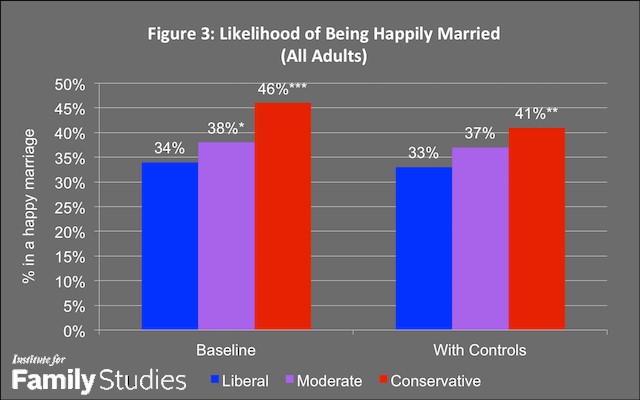
Figure 1 indicates that conservatives are significantly more likely to be married than are moderates and liberals. In fact, they are about 15 percentage points more likely to be married than their liberal fellow citizens. Moreover, this relationship remains strong after controlling for race or ethnicity, age, sex, and… income and education.

[…]Figure 3 examines the effects of political ideology on the chances of being in a very happy marriage among all Americans, not just those who are currently married, as Figure 2 depicted. Figure 3 shows that in the baseline model, conservatives are 12 percentage points more likely to be in happy marriages than are liberals. This gap persists, albeit to a diminished extent, after controlling for race or ethnicity, age, sex, income, and education. After adjusting for these differences between General Social Survey respondents, conservatives are about eight percentage points more likely than liberals to be in a happy marriage.

So basically, if you are a leftist, then you are much less likely to be happily married. And if you are a conservative, then you are much more likely to be happily married.

Why?

The answer lies in the design of marriage. Marriage is not about two people moving in together so that they can feel good about doing whatever they want to do. Marriage is a design that works best with a man and a women who are equipped at the worldview level with the capacity for resilient, self-sacrifice love.

Progressives are not equipped for the kind of self-denial, self-control, and self-sacrifice that marriage requires. They don’t believe in God, generally, so they don’t believe in objective morality. And if you don’t believe in objective morality, then there is no foundation there for self-sacrificial love, and honoring moral obligations when it goes against your self-interest. Atheism as a worldview doesn’t have the foundation for the kinds of behaviors that marriage entails. And that’s why you see Peter Atkins, Richard Dawkins, Richard Carrier, Michael Shermer, etc. divorcing their wives. The atheist worldview and the atheist community do not enable the sort of character that is suited for the design of marriage.

In contrast, conservatives typically do have a rationally-grounded morality. They tend to believe in God, and so the rightness of following the moral law when it goes against their self-interest makes sense to them. They think that there is a design to marriage, and design for the flourishing of children. They are more likely to be able to compromise and solve problems in order to keep a commitment going. There is an “ought to do” there in the conservative worldview that is objective – it exists independent of their feelings. The obligations to override selfishness is there regardless of how unfair life seems – it is resilient to challenges.

One of the ways you can tell how serious someone is about their religion, and therefore their morality, is by looking at the person’s church attendance. Church attendance is typically not as fun as other things you can do in life. So people who go are indicating that they put their relationship with God and their dedication to following the moral law above their own self-interest. So does that tendency help religious people to stay married?

Yes it does:

Brad Wilcox, director of the National Marriage Project at the University of Virginia, agrees there’s been some confusion.

“You do hear, both in Christian and non-Christian circles, that Christians are no different from anyone else when it comes to divorce and that is not true if you are focusing on Christians who are regular church attendees,” he said.

Wilcox’s analysis of the National Survey of Families and Households has found that Americans who attend religious services several times a month were about 35% less likely to divorce than those with no religious affiliation.

Nominal conservative Protestants, on the other hand, were 20% more likely to divorce than the religiously unaffiliated.

“There’s something about being a nominal ‘Christian’ that is linked to a lot of negative outcomes when it comes to family life,” Wilcox said.

So the bottom line is that marriage is a moral enterprise. It works better when each spouse has a worldview and a community that recognizes objective, prescriptive morality. And objective, prescriptive morality has no rational foundation in a non-theistic worldview. Progressives tend to be non-theists, so of course they are going to struggle with any enterprise that requires them to set aside their natural self-centeredness in order to honor moral obligations to another person.

New study: leftists have less self-control than conservatives

Dina tweeted this article from the UK Daily Mail, and it’s worth a look.

It says:

In three studies, US scientists tested the abilities of two groups: undergraduates who considered themselves politically conservative and ‘liberals’.

They classed conservatives as those who endorse traditional values and the status quo, while liberals ‘endorse egalitarian ideals and progressive change’.

They found that the conservatives were better at ‘regulating their attention’ and persisting with tasks.

And they found the difference between the two groups was linked to how closely they believed in free will.

The authors wrote in the Proceedings of the National Academy of Sciences: ‘Three studies document a clear difference in self-control as a function of political ideology, as political conservatism (versus liberalism) was consistently related to greater self-control.’

[…]The researchers from the universities of Cincinatti, Indiana and Florida said their research followed on from previous studies that found conservatives tended to be more studious at university than their left-wing counterparts.

The authors suggest that a belief that success is down to one’s own efforts rather than being pre-determined is key to academic success.

Explaining findings that conservative students do better at university, they suggest it ‘could be that conservatives believe they have greater control over their performance and thus expend greater self control in their academic pursuits.’

This is interesting. The theistic view is that human beings are non-physical souls, and the non-physical souls tell the body what to do. Since the non-physical soul is not material, it’s behavior is not governed by fixed physical processes. This is in contrast with the naturalistic view, which is that you are your body, there is no free will, and no personal responsibility.

Isn’t it interesting that the people who do believe in free will also believe in personal responsibility, and this causes them to take more responsibility for their own choices? I cannot imagine how a person can deny free will, yet this is the natural outworking of saying “nature is all there is”.

For those who don’t like the Daily Mail, you can read about the study here in Science Daily.