
Tag Archives: Labor

Indian auto sales surge 71.9% while free trade vaults Chile into the first world

Map of India
Map of India

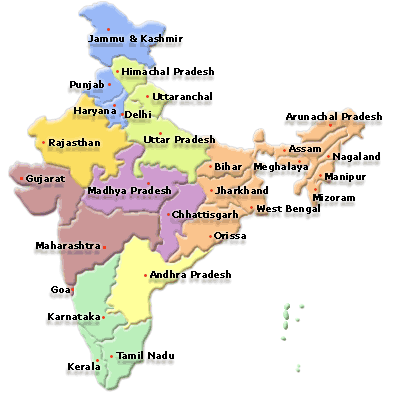
Before, I wrote about India’s election results and the decision of the ruling Congress Party to drastically cut income taxes. And I also wrote about China’s decision to cut taxes on purchases of new automobiles. So did those tax cuts work out for India and China?

Story from the Associated Press

Excerpt:

China extended its lead over the U.S. as the world’s biggest auto market in November, with production and sales both surpassing 1 million vehicles, and India saw sales jump 71.9-percent.

[…]China’s auto market is sizzling, thanks largely to tax cuts and subsidies aimed at supporting the industry and encouraging use of more fuel-efficient vehicles. The boom has clinched China’s status as the world’s biggest vehicle market due to languishing sales in the U.S.

[…]The surge is also a sign of how the Indian consumer — encouraged by government tax cuts, a big disbursement of back pay for government employees and falling interest rates — is fueling economic growth in Asia’s third-largest economy.

As everyone knows, the Democrats chose to bail out auto companies with taxpayer money and reward people with taxpayer money for destroying fully functional vehicles. And we all know how well that has worked out.

Chile poised to jump from the third world to the first world

Check out this editorial from Investors Business Daily. (podcast here)

Excerpt:

Chile is expected to win entry to OECD’s club of developed countries by Dec. 15 — a great affirmation for a once-poor nation that pulled itself up by trusting markets. One thing that stands out here is free trade.

[…]It’s not like Chile was born lucky. Only 30 years ago, it was an impoverished country with per capita GDP of $1,300. Its distant geography, irresponsible neighbors and tiny population were significant obstacles to investment and growth. And its economy, dominated by labor unions, wasn’t just closed, but sealed tight.

In the Cato Institute’s 1975 Economic Freedom of the World Report it ranked a wretched 71 out of 72 countries evaluated.

Today it’s a different country altogether. Embracing markets has made it one of the most open economies in the world, ranking third on Cato’s index, just behind Hong Kong and Singapore. Per capita GDP has soared to $15,000.

Besides its embrace of free trade, other reforms — including pension privatization, tax cuts, respect for property rights and cutting of red tape helped the country grow not only richer but more democratic, says Cato Institute trade expert Daniel Griswold.

But the main thing, Griswold says, is that the country didn’t shift course. “Chile’s economy is set apart from its neighbors, because they have pursued market policies consistently over a long period,” he said. “Free trade has been a central part of Chile’s success.”

Democrats oppose free trade, and their hostility to free trade angers many other countries in the world.

What does it take for a country to succeed?

I gave my Dad my copy of “Money, Greed and God” by Jay Richards, and although he thought that it started out slow, he’s warmed up to it. He calls me on the phone at least twice a day, and last night he alerted me to this web site, where you can track each countries average citizen’s life span and per-capita GDP over time. My Dad was pretty liberal on economics before, so naturally I’ve been working on him with lots of introductory books on economics. He’s read about a dozen now, and Thomas Sowell is his favorite.

Anyway, my Dad says that this is what a country needs to succeed:

  • free trade with other nations
  • the rule of law
  • low judicial activism
  • low tax rates
  • private property protections
  • currency not threatened by inflation
  • low government spending
  • minimal regulation of commerce

And at that web site, you can track the success of countries like Singapore and Hong Kong, which embrace conservative small government free market fiscal policies, and compare them with countries like Zimbabwe and North Korea, which embrace big government protectionist fiscal policies. Countries fail because they adopt the wrong policies. They succeed when they adopt the right policies. It doesn’t matter how poor they start, if they have the right policies, they grow rich over time.

Why are the Democrats so incompetent on economic policy?

Well, it’s because there is almost no one in the Obama socialist regime who has ever run a business or worked in a business. Check out this graphic. (H/T Flopping Aces)
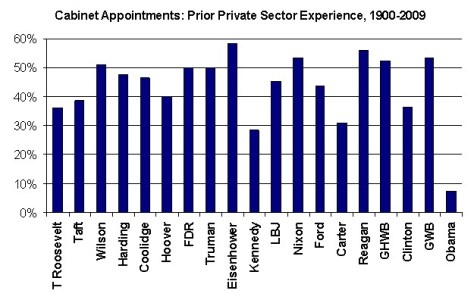
You can read more about the Obama administration’s ignorance of business and economics here in Forbes magazine.

This Reuters article discusses the price of economic ignorance: (H/T Gateway Pundit)

Excerpt:

Hunger is spreading while the number of homeless families is increasing as a result of the recession and other factors, according to a report on Tuesday.

The U.S. Conference of Mayors said cities reported a 26 percent jump in demand for hunger assistance over the past year, the largest average increase since 1991.

Middle-class families as well as the uninsured, elderly, working poor and homeless increasingly looked for help with hunger, which was mainly fueled by unemployment, high housing costs and low wages.

Democrats really don’t know what they are doing. It’s like putting pre-schoolers in charge of Amazon.com. It doesn’t work. Their ivory tower, silver-spoon worldview cannot comprehend real-world, grown-up complexities. So long as the Democrats continue to attack the businesses that employ citizens while redistributing wealth from people who produce to people who vote Democrat, our economic troubles will continue.

Related Cato Institute podcasts

Australian conservatives elect social conservative as new leader of opposition party

Story here from LifeSiteNews. (H/T Thoughts Out Loud)

Excerpt:

Tony Abbott, the former federal minister for health and a pro-life Catholic, has won the leadership of the opposition Liberal Party of Australia, putting him in line for possible leadership of the country in Australia’s next general election.

The Federal Member for Warringah and shadow Minister for Families, Housing, Community Services and Indigenous Affairs, was voted in at the party’s Dec 1st leadership convention, beating the incumbent Malcolm Turnbull by a single vote. The vote makes Tony Abbott the first social conservative to lead the Liberal party since the resignation of John Howard.

Abbott is known for his outspokenness on life issues.

[…]In 2006, as health minister, Abbott refused to allow the abortion drug RU486 to be made available in Australia, arguing that it was more dangerous to women than surgical abortion. This led to a conscience vote in which the House of Representatives deprived the health minister of regulatory control of the drug.

[…]Abbott has also opposed the use of embryonic stem cells and cloning in health research in another conscience vote, preferring continued use of adult stem cells. In family law, Abbott proposed a return to at-fault divorce to reduce the divorce rate, a system that required spouses to prove offences like adultery, habitual drunkenness or cruelty before a divorce was granted.

[…]In comments after this week’s leadership race, Abbott also blasted the current Rudd government’s climate change legislation, a key issue for parliament in the coming weeks, denouncing it as a tax grab.

The article talks more about some of his positions and accomplishments. Does this guy ever sound awesome! Would my readers from Australia, New Zealand, India and the Phillipines please comment on Abbott? It seems to me like Australian conservatives have selected the equivalent of Michele Bachmann or Maurice Vellacott or Edward Leigh to head their party. Wow!

By the way, in Australia, the conservative party are called the Liberal party, and they usually form a coalition with the National party. The secular leftists are the Labor party and the Green party. The leftists are currently in power.

How Democrat policies cause corporations to outsource jobs overseas

David Farr is the CEO of Emerson Electric, a $1.7-billion-dollar company heavily involved in manufacturing. What does he think about the job that the Democrats are doing in Washington?

In this Bloomberg article, he explains:

Emerson Electric Co. Chief Executive Officer David Farr said the U.S. government is hurting manufacturers with regulation and taxes and his company will continue to focus on growth overseas.

“Washington is doing everything in their manpower, capability, to destroy U.S. manufacturing,” Farr said today in Chicago at a Baird Industrial Outlook conference. “Cap and trade, medical reform, labor rules.”

Emerson, the maker of electrical equipment and InSinkErator garbage disposals with $20.9 billion in sales for the year ended September, will keep expanding in emerging markets, which represented 32 percent of revenue in 2009. About 36 percent of manufacturing is now in “best-cost countries” up from 21 percent in 2003, according to slides accompanying his speech.

Companies will create jobs in India and China, “places where people want the products and where the governments welcome you to actually do something,” Farr said.

The unemployment rate in the U.S. jumped to 10.2 percent in October, the highest level since 1983. Emerson, which Farr said employs about 125,000 people worldwide, has eliminated more than 20,000 jobs since the end of 2008 to lower expenses.

“What do you think I am going to do?” Farr asked. “I’m not going to hire anybody in the United States. I’m moving. They are doing everything possible to destroy jobs.”

[…]Mature markets such as the U.S., Western Europe and Japan continue to decline in importance and the company will keep investing in emerging markets, Farr said during the presentation.

“We as a company today are putting our best people, our best technology and our best investment in these marketplaces to grow,” he said. “My job is to grow that top line, grow my earnings, grow my cash flow and grow my returns to the shareholders. My job is not to shrink and roll over for the U.S. government.”

[…]In renewable and alternative-energy markets, Emerson had 2009 sales of $50 million and plans to increase that to more than $800 million in five years.

“But you are not going to see Emerson going out there with fancy commercials or sitting at the right hand of some president, talking about this,” Farr said. “We do it.”

When it comes to manufacturing jobs, the only person whose opinion counts is the CEO of the manufacturing company, because he makes the hiring decisions.

Why Obamanomics will not improve the economy

I noticed the Bloomberg article because it was linked to this American Thinker article, which was linked at Marshall Art’s blog.

The American Thinker article analyzes why Obamanomics will not improve the economy.

Excerpt:

The reason that Obamanomics will not and cannot work is because an economy cannot be managed from the top. Economics is a bottom-up process that depends upon individual incentives. Critical incentives have been diminished or destroyed by recent economic policies. Fear, uncertainty, threats, tax increases, penalties, and violations of the rule of law are but some of the conditions anathema to entrepreneurs, small business, and large business. Businesses will not hire, invest, or expand in a climate of disincentives. No commands from on high can force economic activity. That was a lesson that should have been learned from Eastern Europe and the former USSR.

If these disincentives are left in place, our economy will continue to shrink and our standard of living will continue to diminish. Capital has no nationality, and it will start to flee our shores. Talent will follow. We will not recover from this economic downturn until businesses and individuals have a more favorable incentive structure.

You can’t argue with the 10.2% unemployment rate, and it’s only going to get worse. Everything that Obama has done has been bad for business, and has contributed to raising unemployment. Democrats, (and the people who voted Democrat), know less about economics than my keyboard.