Two tough rams butt heads, and may the best ram win!
Michael Behe and Keith Fox debate evolution and intelligent design. (See below for link to video)
Details:
Michael Behe is professor of biochemistry at Lehigh University, Pennsylvania and the founder of the modern Intelligent Design movement. His book “Darwin’s Black Box” ignited the controversy 14 years ago when it claimed that certain molecular machines and biological processes are “irreducibly complex” and cannot be explained by Darwinian evolution.
Keith Fox is Professor of biochemistry at the University of Southampton and chairman of Christians in Science. As a theistic evolutionist he believes that Evolution is the best explanation going for the complexity we see and that ID is a blind scientific alley and theologically unappealing to boot.
They debate whether micromachines in the cell such as the “bacterial flagellum” could have evolved by a Darwinian process of evolution. When inference to design is and isn’t acceptable in science. Whether random mutation can mathematically stack up to complex life, and whether God is reduced to a divine “tinkerer” by ID.
Here’s the debate:
Summary
Note: the following debate summary is rated “S” for Snarky. Reader discretion is advised.
Michael Behe:
ID is not Biblical creationism
ID is not religion
ID is a scientific research program
People refuse to discuss ID because of personal philosophical assumptions
ID is like the Big Bang – it is based on evidence, but it has broad religious implications
Keith Fox:
ID is not Biblical creationism, but it isn’t science
Michael Behe:
ID is compatible with common descent
ID is only opposed to unplanned, unguided evolution (Darwinism)
ID is not necessarily opposed to long periods of time
Behe’s first book – the bacterial flagellum
Keith Fox:
Here are a couple of papers that show how parts of the flagellum evolved
They are possible pathways
Michael Behe
No, those are studies that show that there are similarities between bacterial flagella in multiple organisms
Similarities of proteins between different organisms do not necessarily imply a developmental pathway
The problem of having the instructions to BUILD the flagellum still remains
Keith Fox:
Maybe parts of the flagellum had other functions before they were used in the flagellum
Maybe you can use the parts of the flagellum for other purposes
Maybe, one can imagine, it’s possible that!
Michael Behe:
No, parts have to be modified and re-purposed in order to be used for other functions
Keith Fox:
But maybe the proteins can be used in other systems for other things
I re-purpose parts from of designed things to other purposes in my house when I do maintenance
Michael Behe
Uh, yeah – but aren’t you an intelligent designer? What does your home maintenance have to do with Darwinian evolution?
Is ID another God-of-the-gaps argument?
Michael Behe:
Well consider the Big Bang… there was a build-up of scientific evidence for that theory
Just because a theory has religious implications, doesn’t mean that it isn’t true
You really have to look at the specific evidence for a theory, and not decide in advance
Keith Fox: (I’m paraphrasing/inventing/mocking from now on)
But the Big Bang is based on discoveries, and intelligent design is based on gaps in our scientific knowledge
What if I did have evidence of a step by step pathway (which I don’t right now)? Then I would win the argument – what would you do then?
Michael Behe:
Well, if tomorrow you do manage to find expiremental evidence of a pathway, which you don’t have today, then I would be wrong
ID is falsifiable by experimental evidence
But what about your your view? Is that falsifiable by experimental evidence?
What if someone goes into a lab (someone like Scott Minnich?) and performs gene knockout experiments, and publishes the results
You knock out a gene from the bacterial flagellum, you wait for a large number of generations, and it never develops the missing gene
You repeat this with every one of the 50 genes in the bacterial flagellum and it never recovers for any of the 50 genes
There is no pathway to build up even one of the 50 genes – according to actual experiments
What do Darwinists do with experimental evidence that falsifies Darwinism?
Keith Fox:
No, I would not accept that experimental evidence could falsify Darwinism
Just because known published experimental evidence that we have today falsifies Darwinism, it doesn’t mean Darwinism is false because it’s not falsifiable
We don’t know how Darwinism even works – it happened so long ago, and it’s not repeatable or testable, so how could lab ,experiments falsify it?
Darwinism is science and intelligent design is faith, though
Lenski has presided over 50,000 generations, (millions of years of evolution)
The bacterium did evolve and they did get better but not by evolving features, but by disabling features
Keith Fox:
But those are just LAB EXPERIMENTS! What do lab experiments prove?
What if? What if? What if? You don’t know, it happened so long ago, and you weren’t there! You weren’t there!
(clutches Flying Spaghetti Monster idol tighter and sobs pitifully)
Michael Behe:
See, the thing is that I have actual experiements, and here’s some more evidence that just got published last week
So I’ve got evidence and then some more evidence and them some other evidence – experimental evidence
And all the evidence shows that adaptation is done losing traits not by gaining traits
And the published observations are what we see in nature as well
Keith Fox:
But doesn’t Darwinism explain some things that we observe?
Michael Behe:
Well, I am not saying that micro-evolution doesn’t explain some things – it explains bacterial resistance, and other micro-evolution
it just doesn’t explain macro-evolution, and that’s what the experiments show
Keith Fox:
But ID is a science stopper! It stops science! You can’t produce experimental evidence to falsify Darwinism – that would stop science!
Michael Behe:
Well, you have to understand that the Big Bang postulated a non-material cause to the entire physical universe and yet the experimental evidence was allowed to stand because it was testable and verifiable evidence, even if the theory does have religious implications
All explanations in science are design to settle a question and it stops rival explanations that are not as good at explaining the observations
Finding the best explanation stops further study because it is better than rival explanations
Keith Fox:
Well you have to come up with a materialist explanation because that’s the only kind that a functional atheist like me will allow
Michael Behe:
Well, what if the best explanation for an observed effect in nature is non-material, as with the Big Bang?
Keith Fox:
But I have to have a material explanation because I am a functional atheist! (i.e. – a theistic evolutionist = functional atheist)
Michael Behe:
Well what about the cosmic fine-tuning argument? Do you accept that?
That’s an inference to design based on the latest scientific discoveries
Keith Fox:
Well I do accept that argument, but I don’t accept design in biology
When you apply it to biology, somehow it’s bad and you can’t do that or you losing research money and get fired
Anyway, your argument is based on a gap in our current knowledge
Michael Behe:
No, back in Darwin’s time we had a gap in our knowledge – we didn’t know what the cell was – we thought it was jello
Now, we know what the cell is really like, it’s irreducibly complex, and you can’t build up those molecular machines in a step-wise manner
The inference to design is based on the progress of science revealing the increasing levels of complexity
In experiments, Darwinian mechanisms cannot build anything useful, instead genes are disabled or dropped
You guys don’t have the evidence to prove your view that naturalistic mechanisms can do the creating
You keep issuing promissory notes
Keith Fox:
Well, you’re just seeing design subjectively, because you are a non-scientist
I’m being objective when I tell you that we will discover a materialist explanation later on – really really soon now, maybe even tomorrow, yeah
You won’t accept my speculations and you insist on these published experiments
You’re subjective and I’m objective
Just give me more research money so I can hide the decline better
Michael Behe:
Uh, you’re the one who is subjective – I cited evidence, and you are the one who is speculating
You have arguments from credulity, and I’ve got the lab experiments
You refuse to be skeptical, I am the one who is being skeptical
Keith Fox:
Maybe, maybe, maybe! Maybe tomorrow! Maybe in a parallel universe! Maybe aliens from Planet 9 from Outer Space!
Who knows! I certainly don’t know! And that somehow means you don’t know either! See?
Michael Behe:
Well, to prove me wrong, go into the lab, and run experiments and evolve some new genes (using Darwinian mechanisms) that have new useful functionality
Are there limits to what evolution can do?
Michael Behe:
You need multiple changes in the genome to get a new helpful feature (let’s say two specific mutations)
One specific change is possible
the odds are against getting multiple beneficial changes are really really small – you need two SPECIFIC changes to occur in order
Keith Fox:
Well, lots of things are really unlikely – any permutation of dice rolls is as unlikely as any other
Michael Behe:
Well, we are talking about TWO SPECIFIC mutations that are needed to get a beneficial function – lots of other mutations are possible, but we are looking for a specific outcome that requires two SPECIFIC mutations out of the whole genome
You aren’t going to get useful outcomes unless you direct the mutations
Stephen Meyer is a leading proponent of Intelligent Design who directs the Centre for Science and Culture at the Discovery Institute in Seattle. His [first] book “Signature in the Cell” claims to show that the DNA code is the product of intelligent mind, not naturalistic processes. Keith Fox is Professor of Biochemistry at Southampton University. He chairs the UK Christians in Science network but disagrees strongly with ID. They debate how life could have originated and whether design is allowed as an explanation in science.
Summary: (stuff in italics is my snarky paraphrase)
Meyer:
background and how he got interested in intelligent design
his research focus is on the origin of life – the first replicator
summarizes the history of origin of life studies
authored the book “Signature in the Cell”
the DNA enigma: where did the information in DNA come from?
naturalistic explanations of the DNA information have failed
but intelligent agents are known to be able to produce information
the best explanation of the information in DNA is that an intelligent agent authored it
Meyer’s book was named by atheist philosopher of science Thomas Nagel as a Times Literary Supplement Book of the Year in 2010
why is design so controversial? Many people think that Darwin explained why nature appears design
the Darwinian view is that nature can create the appearance of design using mutation and selection
however, Darwinian mechanisms cannot explain the origin of the first living cell, it assumes replication, and the origin of life is about where the first replicator comes from
Fox:
Meyer’s argument is not about the evolution of life after the first cell
Meyer’s case for design is about the origin of life
naturalists do not know a naturalistic explanation for the origin of life
there are a number of naturalistic hypotheses for the origin of life, like the RNA-first hypothesis
maybe in a few years one of them will turn out to be correct
what intelligent design is arguing from a gap in our current naturalistic knowledge to infer that God intervened in nature
Meyer:
that’s not what intelligent design is at all
the approach ID theorists use is the inference to best explanation
you evaluate all explanations, non-intelligent causes and intelligent causes
you prefer the best possible explanation
we know that minds are capable of producing information just like the information we find in DNA
Fox:
living cells replicate, so they have the ability to introduce mutations as they replicate and then some of those mutations can be selected
so maybe the process of replicating that living cells do created the first living cell
maybe the first living cell created itself, X brought X into being, self-creation, what’s irrational about that?
Meyer:
the issue is the origin of life – where did the first living cell come from?
you cannot appeal to the operations that a living cell can perform to explain the origin of the first living cell
there was no first living cell operating before the first living cell
there was no replication, mutation or selection before the first living cell
in fact, in my book I show that there is no known naturalistic mechanism that is able to produce the information needed for the first living cell
nothing can create itself, that is self-contradictory
Fox:
Well, you are just saying that because something is complex that God did it
Meyer:
Sadly, no. What I actually said needed to be explained was the information, not complexity
And we know from software engineering that the process of adding information to code is performed by programmers
in the absence of any adequate naturalistic explanation for information, we are justified in taking the explanation that we are familiar with – namely, intelligent agency – based on our uniform, universal experience of what causes information
Fox:
well, maybe we can appeal to the mutation and selection in existing living cells to explain the origin of the first living cell
maybe there were living cells before the first living cell, and then these other living cells created the first living cell
Meyer:
we can’t keep invoking mutation and selection when those processes are not operating prior to the origin of the first living cell
Fox:
well maybe some bare-bones self-replication molecule was a precursor to the first living cell
Meyer:
even to generate very limited replicator would require a large amount of information
the argument I am making is – where does the evolution come from?
Fox:
well, maybe we will think of an explanation for information that is naturalistic in 20 years
we’ve thought of explanations to things that were NOT information before
so maybe we will be able to think of something to explain information based on our ability to explain NOT information before
Moderator: Change topics: the Dover decision
Meyer:
the Discovery Institute opposed the policy that causes the trial
the wording of the statute was poor
the judge was completely wrong in his decision
young earth creationists used the phrase “intelligent design” to cover their agenda
intelligent design is an inference using the normal methods of science
Fox:
intelligent design is a science stopper because it stops looking for a naturalistic explanation
everything in nature must have a naturalistic explanation
everything has to be explained using matter and time and chance
it just has to be that way!!!!
Meyer:
well, what luck would you have explaining an effect like Mt. Rushmore?
can you explain that using matter,time and chance?
Mt. Rushmore was the product of intelligence, not wind and erosion
similarly, there is information in the cell, and we know that intelligence causes information
Fox:
So you are saying that we don’t understand and therefore an intelligence is necessary?
Meyer:
no I am saying we DO understand and we are making an inference based on that understanding
you are the one who is insisting on a material explanation because you pre-suppose materialism
we know that minds have causal powers, and we can infer mind as an explanation from information
Fox:
well nature is a seamless chain of material causes and effects
Meyer:
agents can act without violating the laws of nature
even humans can act as intelligent agents to create information in books, and they don’t violate the laws of nature
intelligent causes are real, and they explain effects in nature
Fox:
you’re trying to impose on science something to do with meaning and purpose
Meyer:
no that’s not what we’re doing, we’re inferring from from the fact that we ourselves are known causes of information to the fact that an intelligence cause is the best explanation for information in the cell
Fox:
but I am a materialist, I need a materialist explanation
Meyer:
mind IS an answer to the how question
we infer to mind in many other scientific disciplines, like cryptography, archaeology, etc.
a materialist might accuse an archaeologist of engaging in a “scribe-of-the-gaps” argument, but the best explanation of an artifact with information is a scribe
we are inferring that mind is the cause from the nature of the effect: information
Moderator: is it appropriate to call DNA “information”
Fox:
well DNA is just a molecular polymer, any reference to information is just by analogy
Meyer:
DNA is a molecular polymer, but it also exhibits the property of specified complexity
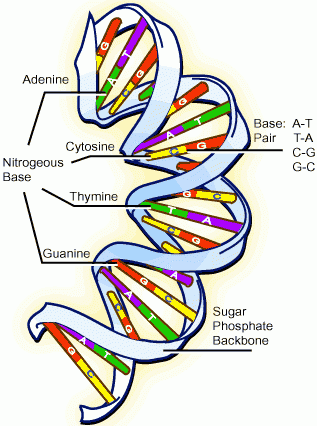
the arrangement of bases, which function as machine instructions in a software program, for performings task in the cell
we have observed that the property of specified complexity always comes from an intelligence
Fox:
well, maybe there are other sequences that would work, so maybe it’s really not uncommon to develop functioning sequences by chance alone, without an intelligence
Meyer:
you can measure how precise the functional specificity is in DNA and proteins
Moderator: is Shannon information the same as functional information
Meyer:
Shannon information refers to the sequences of digits or symbols that do not necessarily have any function, i.e. – a four character string QSZX has as much Shannon information as WORD. However, only the latter is functional against the pattern of the English language. There are arrangements of DNA bases and amino acids that have the same number of symbols/characters as a functional sequence would have, but they have no biological function – they do not exhibit specified complexity
Fox:
Well, maybe there are lots and lots of sequences of DNA and proteins so that it is fairly easy to get a functional one by chance
Meyer:
DNA sequences that are functional are extremely rare, protein sequences are even more rare
this is not my opinion, this is what the research shows – functional protein sequences are rare
Fox:
well maybe there are other functional sequences that are occur before the first functional sequence that are precursors to the first functional sequence
maybe there are billions of years of replication, mutation and selection before the first replication, mutation and selection
Meyer:
you can’t get to the first selectable functional sequence by appealing to precursor selectable functional sequences – there are no selectable functional sequences before the FIRST one
you have to get the first selectable functional sequence by chance alone, because there is nothing to mutate or select before the first replicator
the chance hypothesis has been rejected because the minimal amount of information for the simplest replicator is too high to get by chance alone, given the resources, including time, that are available
Moderator: Keith are you confident that naturalism will be able to substantiate these naturalism-of-the-gap speculations that you offer in response to Meyer’s actual science that we have today?
Fox:
well, it is hard to know for sure because it was just a fluke event
but there’s nothing irrational or unscientific or miraculous about it – the fluke would have a material explanation
there is nothing that we can detect that would implicate God, my speculations about a fluke which I cannot observe or measure or test would all be compatible with an atheistic worldview that omits God as a causal entity
Meyer:
where are those material processes that could account for this fluke then?
the whole point of this argument is that the information in DNA transcends the material components in the sequence
it’s the arrangement of the material parts/letters/characters/symbols/instructions that needs to be explained
Fox:
Well, I just have a different philosophy of science that rules out intelligent causation a priori
Meyer:
Yes, that’s the difference between us – you pre-suppose that all explanations of natural phenomena must exclude intelligent causes
There is a bit more where Meyer talks about how parts of the cell are implementations of various design patterns (Gang of Four design patterns) that are used by software architects who design software.
Stephen Meyer is a leading proponent of Intelligent Design who directs the Centre for Science and Culture at the Discovery Institute in Seattle. His [first] book “Signature in the Cell” claims to show that the DNA code is the product of intelligent mind, not naturalistic processes. Keith Fox is Professor of Biochemistry at Southampton University. He chairs the UK Christians in Science network but disagrees strongly with ID. They debate how life could have originated and whether design is allowed as an explanation in science.
Summary: (stuff in italics is my snarky paraphrase)
Meyer:
background and how he got interested in intelligent design
his research focus is on the origin of life – the first replicator
summarizes the history of origin of life studies
authored the book “Signature in the Cell”
the DNA enigma: where did the information in DNA come from?
naturalistic explanations of the DNA information have failed
but intelligent agents are known to be able to produce information
the best explanation of the information in DNA is that an intelligent agent authored it
Meyer’s book was named by atheist philosopher of science Thomas Nagel as a Times Literary Supplement Book of the Year in 2010
why is design so controversial? Many people think that Darwin explained why nature appears design
the Darwinian view is that nature can create the appearance of design using mutation and selection
however, Darwinian mechanisms cannot explain the origin of the first living cell, it assumes replication, and the origin of life is about where the first replicator comes from
Fox:
Meyer’s argument is not about the evolution of life after the first cell
Meyer’s case for design is about the origin of life
naturalists do not know a naturalistic explanation for the origin of life
there are a number of naturalistic hypotheses for the origin of life, like the RNA-first hypothesis
maybe in a few years one of them will turn out to be correct
what intelligent design is arguing from a gap in our current naturalistic knowledge to infer that God intervened in nature
Meyer:
that’s not what intelligent design is at all
the approach ID theorists use is the inference to best explanation
you evaluate all explanations, non-intelligent causes and intelligent causes
you prefer the best possible explanation
we know that minds are capable of producing information just like the information we find in DNA
Fox:
living cells replicate, so they have the ability to introduce mutations as they replicate and then some of those mutations can be selected
so maybe the process of replicating that living cells do created the first living cell
maybe the first living cell created itself, X brought X into being, self-creation, what’s irrational about that?
Meyer:
the issue is the origin of life – where did the first living cell come from?
you cannot appeal to the operations that a living cell can perform to explain the origin of the first living cell
there was no first living cell operating before the first living cell
there was no replication, mutation or selection before the first living cell
in fact, in my book I show that there is no known naturalistic mechanism that is able to produce the information needed for the first living cell
nothing can create itself, that is self-contradictory
Fox:
Well, you are just saying that because something is complex that God did it
Meyer:
Sadly, no. What I actually said needed to be explained was the information, not complexity
And we know from software engineering that the process of adding information to code is performed by programmers
in the absence of any adequate naturalistic explanation for information, we are justified in taking the explanation that we are familiar with – namely, intelligent agency – based on our uniform, universal experience of what causes information
Fox:
well, maybe we can appeal to the mutation and selection in existing living cells to explain the origin of the first living cell
maybe there were living cells before the first living cell, and then these other living cells created the first living cell
Meyer:
we can’t keep invoking mutation and selection when those processes are not operating prior to the origin of the first living cell
Fox:
well maybe some bare-bones self-replication molecule was a precursor to the first living cell
Meyer:
even to generate very limited replicator would require a large amount of information
the argument I am making is – where does the evolution come from?
Fox:
well, maybe we will think of an explanation for information that is naturalistic in 20 years
we’ve thought of explanations to things that were NOT information before
so maybe we will be able to think of something to explain information based on our ability to explain NOT information before
Moderator: Change topics: the Dover decision
Meyer:
the Discovery Institute opposed the policy that causes the trial
the wording of the statute was poor
the judge was completely wrong in his decision
young earth creationists used the phrase “intelligent design” to cover their agenda
intelligent design is an inference using the normal methods of science
Fox:
intelligent design is a science stopper because it stops looking for a naturalistic explanation
everything in nature must have a naturalistic explanation
everything has to be explained using matter and time and chance
it just has to be that way!!!!
Meyer:
well, what luck would you have explaining an effect like Mt. Rushmore?
can you explain that using matter,time and chance?
Mt. Rushmore was the product of intelligence, not wind and erosion
similarly, there is information in the cell, and we know that intelligence causes information
Fox:
So you are saying that we don’t understand and therefore an intelligence is necessary?
Meyer:
no I am saying we DO understand and we are making an inference based on that understanding
you are the one who is insisting on a material explanation because you pre-suppose materialism
we know that minds have causal powers, and we can infer mind as an explanation from information
Fox:
well nature is a seamless chain of material causes and effects
Meyer:
agents can act without violating the laws of nature
even humans can act as intelligent agents to create information in books, and they don’t violate the laws of nature
intelligent causes are real, and they explain effects in nature
Fox:
you’re trying to impose on science something to do with meaning and purpose
Meyer:
no that’s not what we’re doing, we’re inferring from from the fact that we ourselves are known causes of information to the fact that an intelligence cause is the best explanation for information in the cell
Fox:
but I am a materialist, I need a materialist explanation
Meyer:
mind IS an answer to the how question
we infer to mind in many other scientific disciplines, like cryptography, archaeology, etc.
a materialist might accuse an archaeologist of engaging in a “scribe-of-the-gaps” argument, but the best explanation of an artifact with information is a scribe
we are inferring that mind is the cause from the nature of the effect: information
Moderator: is it appropriate to call DNA “information”
Fox:
well DNA is just a molecular polymer, any reference to information is just by analogy
Meyer:
DNA is a molecular polymer, but it also exhibits the property of specified complexity
the arrangement of bases, which function as machine instructions in a software program, for performings task in the cell
we have observed that the property of specified complexity always comes from an intelligence
Fox:
well, maybe there are other sequences that would work, so maybe it’s really not uncommon to develop functioning sequences by chance alone, without an intelligence
Meyer:
you can measure how precise the functional specificity is in DNA and proteins
Moderator: is Shannon information the same as functional information
Meyer:
Shannon information refers to the sequences of digits or symbols that do not necessarily have any function, i.e. – a four character string QSZX has as much Shannon information as WORD. However, only the latter is functional against the pattern of the English language. There are arrangements of DNA bases and amino acids that have the same number of symbols/characters as a functional sequence would have, but they have no biological function – they do not exhibit specified complexity
Fox:
Well, maybe there are lots and lots of sequences of DNA and proteins so that it is fairly easy to get a functional one by chance
Meyer:
DNA sequences that are functional are extremely rare, protein sequences are even more rare
this is not my opinion, this is what the research shows – functional protein sequences are rare
Fox:
well maybe there are other functional sequences that are occur before the first functional sequence that are precursors to the first functional sequence
maybe there are billions of years of replication, mutation and selection before the first replication, mutation and selection
Meyer:
you can’t get to the first selectable functional sequence by appealing to precursor selectable functional sequences – there are no selectable functional sequences before the FIRST one
you have to get the first selectable functional sequence by chance alone, because there is nothing to mutate or select before the first replicator
the chance hypothesis has been rejected because the minimal amount of information for the simplest replicator is too high to get by chance alone, given the resources, including time, that are available
Moderator: Keith are you confident that naturalism will be able to substantiate these naturalism-of-the-gap speculations that you offer in response to Meyer’s actual science that we have today?
Fox:
well, it is hard to know for sure because it was just a fluke event
but there’s nothing irrational or unscientific or miraculous about it – the fluke would have a material explanation
there is nothing that we can detect that would implicate God, my speculations about a fluke which I cannot observe or measure or test would all be compatible with an atheistic worldview that omits God as a causal entity
Meyer:
where are those material processes that could account for this fluke then?
the whole point of this argument is that the information in DNA transcends the material components in the sequence
it’s the arrangement of the material parts/letters/characters/symbols/instructions that needs to be explained
Fox:
Well, I just have a different philosophy of science that rules out intelligent causation a priori
Meyer:
Yes, that’s the difference between us – you pre-suppose that all explanations of natural phenomena must exclude intelligent causes
There is a bit more where Meyer talks about how parts of the cell are implementations of various design patterns (Gang of Four design patterns) that are used by software architects who design software.


 WINTERY KNIGHT