Tag Archives: Jobs

How good a job is Obama doing running car companies?

Investors Business Daily explains.

Excerpt:

President Obama’s electric car vision is off to a hot start. First the heavily subsidized Chevy Volt started catching fire. Then government-backed Fisker Automotive had to recall all its cars due to a fire hazard.

Late last month, Fisker, the electric car startup that is busy spending its $529 million in Department of Energy loans, announced a recall of its entire fleet of luxury Karmas because of a faulty battery that posed a fire risk.

The battery maker at fault — A123 Systems — is another Obama grantee, having gotten $380 million in taxpayer support to make advanced car batteries.

Fisker says it’s already fixed the problem, but this is just the latest in a series of troubles plaguing the new car company.

Although it once promised to be profitably churning out 1,200 cars a month by now, Fisker has so far sold only about 240 — at a price almost 14% higher than promised. And the more moderately priced electric sedan it says it will build in an abandoned Delaware plant is still nowhere to be seen.

Bad as this is, Fisker’s troubles are just a taste of the expensive and dangerous mess in store for car buyers should Obama succeed in forcing the industry to bend to his green dreams.

In May, a Chevy Volt caught fire three weeks after a government crash test of the car. In follow-up tests in November, a second Volt caught fire after a test crash, and a third began to smoke and emit sparks.

[…]Volt sales came in about 30% below GM’s forecast for 2011 — in a year when overall retail car sales beat industry analyst forecasts by almost 12% — earning the Volt third place on 24/7 Wall Street’s list of worst product flops of 2011.

And that’s despite the substantial tax break to Volt buyers and the hundreds of millions in grant money to its suppliers.

Obama is spending a lot of taxpayer money on his Solyndra-style boondoggles. Taking money away from employers and families and just throwing it in the trash. We are now officially over 100% debt-to-GDP. We are entering a Greece-style debt situation and this dingbat is throwing our money away on Peter Pan energy policies.
Oil prices rise over tensions between US and Iran

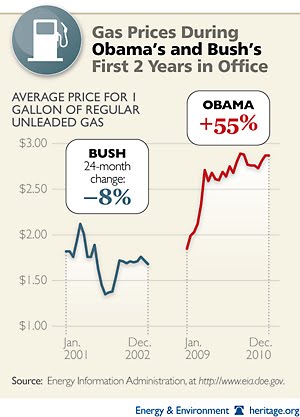
Gas Prices under Obama and Bush

From the liberal Los Angeles Times.

Excerpt:

Oil prices soared Tuesday as tensions grew over key Persian Gulf oil shipments.

In afternoon trading benchmark crude jumped $3.80, or 3.8 percent, to $102.63 per barrel in New York.

Brent crude, which is used to price foreign oil varieties that are imported by U.S. refineries, rose $3.87, or 3.6%, to $111.25 per barrel in London.

Prices climbed as soon as exchanges opened for the first day of 2012 trading. Commodity prices tend to rise at the beginning of January as investors start the new year with a fresh round of trading. This year prices were driven by heightened concerns that Iran might try to close the Strait of Hormuz in the Persian Gulf to oil tankers, if Western nations impose new sanctions.

Iran warned the U.S. to stay out of the strategic waterway, where one-sixth of the world’s oil shipments pass every day. On Monday its navy fired a cruise missile as part of a military exercise.

The U.S. and European nations are mulling further economic sanctions against Iran because of its nuclear program. A standoff could result that would be damaging to the global economy.

A dustup with Iran could slow crucial oil supplies at a time when the world needs every drop. Global oil demand is expected to rise to a record 89.5 million barrels per day in 2012.

Three of the world’s largest economies — the U.S., China and India — continued to grow with increased manufacturing activity in December.

Meanwhile, Obama continues to dither over the Keystone XL pipeline.

Could Obama have done better? He could learn from Canada’s success

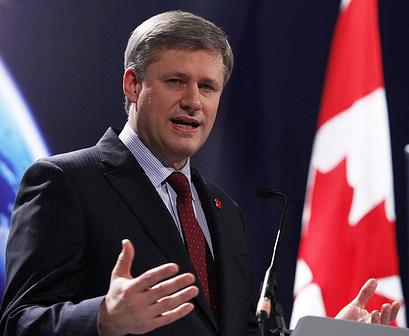
Prime Minister Stephen Harper

Here’s an editorial from Investors Business Daily.

Excerpt:

Away from the low growth and high regulation of an America under Washington’s thumb, our northern neighbor is economically strong. As 2011 ends, Canada has announced yet another tax cut — and will soar even more.

The Obama administration and its economic czars have flailed about for years, baffled about how to get the U.S. economy growing.

In reality, the president need look no further than our neighbor, Canada, whose solid growth is the product of tax cuts, fiscal discipline, free trade, and energy development. That’s made Canada a roaring puma nation, while its supposedly more powerful southern neighbor stands on the outside looking in.

On Thursday, Canadian Prime Minister Stephen Harper announced that he will slash corporate taxes again on Jan. 1 in the final stage of his Economic Action Plan, dropping the federal business tax burden to just 15%.

Along with fresh tax cuts in provinces such as Alberta, total taxes for businesses in Canada will drop to 25%, one of the lowest in the G7, and below the Organization of Economic Cooperation and Development average.

“Creating jobs and growth is our top priority,” said Minister Jim Flaherty. “Through our government low-tax plan … we are continuing to send the message that Canada is open for business and the best place to invest.”

It’s not just that Canada’s conservative government favors makers over takers. Harper’s also wildly popular for shrinking government. “The Harper government has pursued a strategic objective to disembed the federal state from the lives of citizens,” wrote University of Calgary Professor Barry Cooper, in the Calgary Herald.

Harper also has made signing free trade treaties his priority. Canada now has 11 free trade pacts in force, and 14 under active negotiation — including pacts with the European Union and India, among others.

“We believe in free trade in Canada, we’re a free-trading nation. That’s the source of our strength, our quality of life, our economic strength,” Flaherty said last month.

Lastly, Canada has pursued its competitive advantage — oil. And it did so not through top-down “industrial policy,” but by getting government out of the way.

Harper has enacted market-friendly regulations to accomplish big things like the Keystone Pipeline — and urged President Obama to move forward on it or else Canada would sell its oil to China.

These policies have been well-known since the Reagan era. But in a country that’s been institutionally socialist since the 1950s, Harper’s moves represent a dramatic affirmation for free market economics.

For Canada, they’ve had big benefits.

Canada’s incomes are rising, its unemployment is two percentage points below the U.S. rate, its currency is strengthening and it boasts Triple-A or equivalent sovereign ratings across the board from the five top international ratings agencies, lowering its cost of credit.

Is it too much to ask Washington to start paying attention to the Canadian success story?

These sound principles work every time they are tried, and they have led to a transformation in Canada.

Although this article doesn’t mention it, Stephen Harper is also the most solid statesman on foreign policy issues as well.

And here’s a view from up north from Canadian journalist Brian Lilley.

Excerpt:

Prime Minister Stephen Harper has put out his own list of accomplishments for the year that just ended but here are a few of the key conservative minded actions that spring to mind for me.

  • Ending political welfare. The per-vote subsidy that made political parties lazy and unresponsive to the voters of this country and insulated them from angering their core supporters will be gone by 2015-2016. Legislation ending the subsidy has already passed but the parties are slowly being weaned off the money and will get smaller amounts each year until the subsidy is gone.
  • They saw the light of common sense and released the names of those on their wanted list of suspected foreign war criminals. These were people that officials admitted should not be in the country, had been ordered out but that were still in Canada. At first officials would only admit there was a list of suspected war criminals but not say who they were. After much pressure, common sense won the day.
  • Ending the insane rules that would see farmers from certain provinces jailed for daring to sell their wheat to the customer of their choice. The Canadian Wheat Board still exists for those that want to use its centralized system. For those that want freedom, they now have that choice.
  • While much attention has been paid to Bill C-10, the omnibus crime bill, the government has passed C-2 (the mega-trials bill), this bill will make it easier to conduct the mega-trials now associated with organized crime without infringing on the right to a fair trial.
  • While the bill to end the gun registry has not been passed yet, it has been introduced and will pass early this year.
  • Immigration. On this file the Conservatives continue to push for ever higher numbers of newcomers while keeping those skeptical of high immigration onside by cracking down on fraud, cleaning up the system and putting Canada first.

Another thought for those, often myself included, that like to say this government is not conservative enough.

Lilley also notes that electing Harper presented a national day care program (which punishes families with stay-at-home), increasing unemployment benefits (which encourages people not to work), etc.