In celebrating Ohio’s comeback, Obama is unintentionally repudiating his own policies. It turns out that, in spite of Obama, Ohio is 4th in the nation in job creation and tops in the Midwest. In the previous four years before Republican Gov. Kasich came into office, Ohio was 48th.
Even the states that are ahead of Ohio in job creation are far larger. Check out the other members of the top five job-creating states: Texas, New York, California and Florida. All are far more populous than Ohio. Florida, for instance, has 6.5 million more people, yet Ohio edged it out in job creation.
In fact, February’s BLS data showed that Ohio created more jobs than any other state. When was the last time that happened? Can’t tell, because the BLS doesn’t offer data prior to the Clinton era, so it’s been at least that long.
In short, Ohio proves that conservative fiscal policies work in spite of Barack Obama. While Obama’s “leadership” destroyed America’s pristine AAA credit rating, S&P was simultaneously upgrading Ohio’s rating.
[…]Kasich has a damn good record when it comes to fiscal policies. Bill Clinton won’t ever admit it in public, but the real architect of the much-ballyhooed ‘Clinton Surplus’ was none other than John Kasich, the Paul Ryan of Newt Gingrich’s House of Representatives.
John Kasich is one of three governors that I am watching closely. The other two really good ones are Scott Walker in Wisconsin and Bobby Jindal in Louisiana. I personally think that Kasich is the best governor in the United States of America. And Ohio has a great Senate candidate too, named Josh Mandel.
The Canadian government released details Tuesday of its plan to dramatically streamline reviews for big energy and mining projects, capping the timeline for federal reviews and ceding more regulatory oversight to the country’s provinces.
The Conservative government of Prime Minister Stephen Harper has said for months it would move to speed up the regulatory review of big energy, mining and infrastructure projects. It has expressed frustration at the sometimes-lengthy review timelines for big projects.
Mr. Harper’s government said in its annual budget announcement last month that it would cap federal reviews. Resources Minister Joe Oliver released details Tuesday, saying that federally-led hearings would be applied only to major initiatives that risk some environmental harm.
Further, the government said it was prepared to hand over more responsibility for the review to Canadian provinces, so long as their regulations meet or exceed federal standards. Canadian provinces already enjoy considerable regulatory oversight.
“It is counterproductive to have the federal and provincial governments completing separate reviews of the same project,” Oliver said in a speech in Toronto.
[…]The government had previewed in its budget last month that reviews for major projects would be limited to 24 months. Meanwhile, regular inter-provincial pipeline reviews, as conducted by the National Energy Board, would be limited to 18 months.
Oliver said Tuesday that Enbridge Inc.’s (ENB) proposed Northern Gateway pipeline – which envisions shipping oil from Alberta to Canada’s West Coast — would benefit from the quicker review. The line has been mired in stiff opposition from native groups in British Columbia, and the government has accused foreign-funded environmental groups of tying up the project in regulatory hearings. Government officials said the new rules would also limit who could participate as intervenors in the review process.
[…]In Toronto, Oliver said the current process is unworkable, with over 40 federal departments involved in reviews. He said he would pare that back to only three federal agencies: the Canadian Environmental Assessment Agency; the National Energy Board; and the Canadian Nuclear Safety Commission.
The Canadian process, as it stands, forces investors to go “through hoops and hurdles as far as the eye can see,” Oliver said. “We simply have to turn that around.”
Canadians don’t want to scare businesses away from Canada – they want the jobs to come to Canada. That’s the exact opposite of what Obama’s socialist “Environmental Protection Agency” does – they regulate energy development, in order to block it or slow it down.
And Canada lowered corporate taxes to 15% compared to our 35% – and their revenues held steady.
Canada: Corporate tax cuts, not stimulus spending
They cut their corporate tax rate, but then businesses saw the lower rate and just kept on expanding in order to make more money. As businesses grow, they pay more in taxes. So government revenues from taxes haven’t dropped at all, even with the lower corporate tax rates! More businesses moved in to Canada to capitalize on the lower tax rates, generating revenue for the government. More workers moved off of unemployment and welfare as demand for labor grew, and they started paying income taxes and sales taxes, generating even more revenue for the government. Do you know what makes consumers more confident, so that they spend more? Having a job. Not being dependent on government.
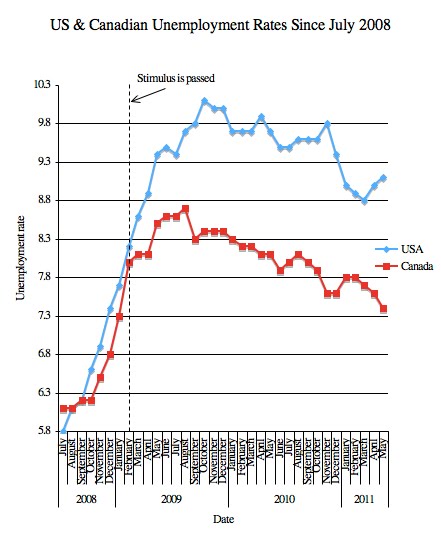
Look at their unemployment rate:
Canada and US unemployment rates
When we embraced “stimulus” spending, they went for the corporate tax cuts. Our unemployment rate used to be LOWER than theirs, before Pelosi and Reid took over Congress in January 2007. Now we are HIGHER than they are. That’s not rhetoric – that’s data. Even though Canada’s economy is linked to ours, and has suffered as a result of that, they have been signing free trade deals left, right and center. They did this in order to decouple themselves from our collapsing economy, massive debt and devalued currency. Barack Obama, of course, opposes free trade. He has to – he’s in the back pocket of the socialist labor unions.
Free trade empire: (click for larger image)
Canada: Free Trade Empire
What a contrast Canada’s energy policy makes with Obama’s politicized “Cash for Cronies” energy policy. But then again, Canada hired a conservative right-wing capitalist economist to run their country. We could have just done the same and put in economists like Thomas Sowell or Walter Williams to run our economy, but we put in an unqualified community organizer instead.
Forget Warren Buffett, or whatever other political prop the White House wants to use for its tax agenda. This week the Administration officially endorsed what in essence is the Obama Rule: Taxes must be high simply to spread the wealth, never mind the impact on the economy or government revenue. It’s all about “fairness,” baby.
This was long apparent to those fated to closely watch the 2008 campaign, but some voters might have missed the point amid the gauzy rhetoric about hope and change. Now we know without any doubt. White House aides made it official Tuesday in their on-the-record briefing on the new federal minimum tax that travels under the political alias known as the “Buffett rule.”
The policy goal is to impose an effective minimum tax of 30% on the income of anyone who makes more than $1 million a year. When President Obama first proposed this new minimum tax he declared that the rule “could raise enough money” so that we “stabilize our debt and deficits for the next decade.”
Then he added: “This is not politics; this is math.” Well, remedial math maybe.
The Obama Treasury’s own numbers confirm that the tax would raise at most $5 billion a year—or less than 0.5% of the $1.2 trillion fiscal 2012 budget deficit and over the next decade a mere 0.1% of the $45.43 trillion the federal government will spend. When asked about those revenue projections, White House aide Jason Furman backpedaled from Mr. Obama’s rationale by explaining that the tax was never intended “to bring the deficit down and the debt under control.”
So if it doesn’t do what Obama says it’s supposed to do, what would really do?
The Buffett rule is really nothing more than a sneaky way for Mr. Obama to justify doubling the capital gains and dividend tax rate to 30% from 15% today. That’s the real spread-the-wealth target. The problem is that this is a tax on capital that is needed for firms to grow and hire more workers. Mr. Obama says he wants an investment-led recovery, not one led by consumption, but how will investment be spurred by doubling the tax on it?
The only investment and hiring the Buffett rule is likely to spur will be outside the United States—in China, Germany, India, and other competitors with much more investment-friendly tax regimes. The Buffett rule would give the U.S. the fourth highest capital gains rate among OECD nations, according to a new study by Ernst & Young, to go along with what is now the highest corporate tax rate (a little under 40% for the combined federal and average state rate). That’s what happens when politicians pursue fairness over growth.
When you make it less attractive for people with capital to invest their capital here at home then they will take their capital and invest it abroad. What Obama’s proposal accomplishes is to outsource jobs – the exact thing that he is always complaining about. It’s higher taxes and more regulation, especially EPA regulation, that causes capital (and consequently jobs) to move overseas. If you want capital to come into America, you lower the tax rates.




 WINTERY KNIGHT