Tag Archives: Jobs

Many of Obama’s young supporters now unemployed, living with parents

From Bloomberg News.

Excerpt:

In the hard economic times since 2008, when Foster voted for President Barack Obama’s message of hope, America’s young voters have been battered. They’ve disproportionately sustained job losses, wage declines and detours on their career paths.

For many, even the normal rites of passage to adulthood have been disrupted, as they delay such life steps as leaving home, getting married and having children.

[…]One in six 16- to 24-year-olds last year was idle, neither working nor attending school even for just an hour a week, according to an analysis of Labor Department data by Lawrence Katz, a Harvard economics professor. Among 20- to 24-year-old men, almost one in five was idle last year.

As of May, 41 percent of the nation’s net decline in full- time jobs from four years earlier was among under-25-year-olds, an age group that represents just 14 percent of the workforce, according to the Bureau of Labor Statistics. Under-35-year-olds account for 65 percent of the decline in full-time employment, though they comprise only 35 percent of the labor force.

Even among young people who have full-time work, real wages have dropped, while older workers’ pay has kept even or slightly improved. Median weekly earnings after inflation fell 6 percent among 18- to 24-year-olds in full-time jobs from 2007 to 2011, according to an analysis of Labor Department data by the Pew Research Center in Washington.

[…]The portion of 18- to 24-year-olds who say they will definitely vote dropped to 47 percent this year from 64 percent in 2008, according to polls conducted by the Institute of Politics during March and April of each election year.

Support for Obama also has declined, with the president besting Republican Mitt Romney 41 percent to 29 percent in the age group compared with 53 percent to 32 percent against Republican John McCain in 2008, according to the poll.

Sixty-six percent of voters under 30 cast ballots for Obama in the last election, the highest share for a presidential candidate from that age group going back to the start of modern exit polls in 1980. Turnout in the age group was the highest in 16 years, according to the U.S. Census Bureau.

Note that Romney’s support among young people is DOWN to 29 from McCain’s level of 32. DOWN.

What amazes me is that the support is still so high for Obama. But I think this just goes to show you how thoroughly indoctrinated young people are in the public schools, and how little diversity of opinion and critical thinking there is in higher education.
Ohio governor John Kasich’s energy policy: sustainability and job creation

All of the above makes a lot of sense in Ohio, as John Kasich explains in the Columbus Dispatch.

Excerpt:

Ohio’s agriculture and manufacturing sectors are highly productive and among our state’s largest employers. They’re also big energy users and part of the reason why Ohio ranks seventh nationally in energy generation.

With energy being so important to major Ohio job creators, it’s critical that we do everything possible to make it inexpensive, plentiful and reliable.

Unfortunately, Ohio faces major headwinds on energy from Washington. The U.S. lacks the kind of comprehensive energy policy it takes to achieve energy independence and help job creators secure low prices and reliable supplies. Furthermore, coal — which supplies 86 percent of our electricity — irritates the current president, and his administration’s EPA repeatedly threatens more red tape on Ohio’s growing shale-oil-and-gas industry.

This uncertainty from Washington isn’t sustainable for Ohio. If we want to see more Ohioans working again, we need to foster low costs and greater certainty in energy, and if we can’t get it with help from Washington, then Ohio must seek it ourselves.

That’s his thesis – now let’s see some of the details:

[M]y administration worked with Ohio State University and Battelle to convene the Governor’s 21st Century Energy & Economic Summit. Over two days, the summit brought together 50 panelists from business, government, academia and environmental groups and more than 1,000 attendees to discuss the latest, brightest thinking on energy. These conversations were the first step in helping Ohio’s policymakers develop a comprehensive energy policy to support job creation. That work continued over the winter and produced a comprehensive plan covering the full range of Ohio energy issues. I’m proud to say I’m signing that plan into law on Monday.

A major focus of Ohio’s new energy policy is oil-and-gas production in our state’s Utica shale formations. With new technologies making it possible to tap oil, natural gas and natural-gas liquids in shale rock deep beneath the surface, the potential exists to permanently lift the economy of eastern Ohio and turn Ohio into a major oil-and-gas producer. It’s only smart to make sure that as this new industry comes on the scene, strong policies are in place that can help ensure its safety and success. Ohio’s energy policy does that by modernizing our regulatory structure to protect the public, the environment and the industry’s workers and to facilitate the industry’s growth.

Ohio’s new energy policy also promotes clean-energy generation. While Ohio’s manufacturers are certainly big energy users, they’re also potential sources of clean energy. The U.S. Department of Energy estimates that as much as 2,000 megawatts of energy could be generated by capturing and reusing the waste heat in Ohio factories. That’s enough to power more than 1.4 million Ohio homes. To help encourage this, Ohio’s new energy policy adds waste heat to the list of clean-energy sources, along with solar and wind, that can earn special “renewable energy credits,” credits that manufacturers can then sell for extra income.

Other highlights of Ohio’s new energy policy include efforts to encourage the use of cars that run on natural gas, to improve state buildings’ energy efficiency, to get electricity to the places where it’s most needed to create jobs, to create programs that link Ohioans who need jobs with training for the new jobs in the oil-and-gas industry, and to make valuable investments in clean-coal research   and technology.

If I had to pick the 3 best governors in the USA, I would pick Scott Walker in Wisconsin, John Kasich in Ohio and Bobby Jindal in Louisiana. These guys punch way above their weight, and all 3 states are swing states. You have to have better ideas to win those states. You have to win on the merits.

Obama: private sector job creation is “doing fine”

From CNS News.

Excerpt:

“The private sector is doing fine,” Obama said at a press conference on Friday. “Where we’re seeing weaknesses in our economy, have to do with state and local government — oftentimes, cuts initiated by governors or mayors who are not getting the kind of help that they have in the past from the federal government and who don’t have the same kind of flexibility as the federal government in dealing with fewer revenues coming in.”

State and local leaders were not the only ones to blame for a bad economy, as the president also blamed Republicans in Congress.

What are the facts? Is Obama right?

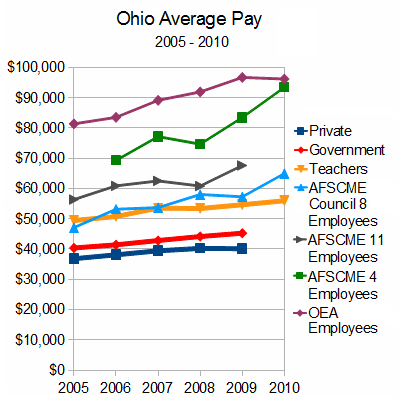
Here is a comparison of public and private pay in Ohio, for example:

Ohio Average Pay: Public vs. Private

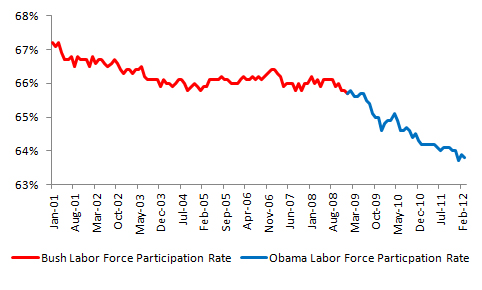
Does Obama know how to create jobs? Let’s compare him to Bush:

Labor Force Participation 2012 (click for larger image)

There is no recovery. We haven’t created any jobs. We’ve actually lost 5 million jobs since the Democrats took over the House and Senate in January 2007.

When George W. Bush was President, we had unemployment around 4 or 5 percent for 8 years, which deficits as low as $160 billion in 2007. Barack Obama has had four budget deficits of a trillion or more in a row, and his unemployment rate has been double Bush’s rate. Bush has an MBA from Harvard and had private sector job creation experience. Obama doesn’t know anything about economics. He’s a lawyer who benefited from affirmative action, and who has never released his grades. You can’t elect an unqualified person and get performance.