UPDATE: Welcome, visitors from Pursuing Holiness! Thanks for linking to me, Laura!
The Foundry, the blog of the Heritage Foundation, has an amazing story on the cost of regulations against energy producers. This is a preview of what we can expect from Obama’s crazy cap and trade plan!
Here’s the first story about a cement manufacturer in California:
And a second video, featuring a debate about this:
And here’s the bottom line:
Heritage’s research on U.S. manufacturing vulnerability shows roughly 4 million jobs nationwide will disappear or relocate to other countries. This massive climate bill is a minefield for American families, who will pay extremely higher prices for energy and goods, and for American businesses who will suffer under the heavy hand of government.
If you haven’t already bookmarked The Foundry, I would highly recommend it.
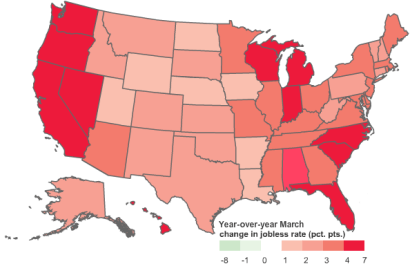
The state-by-state employment figures showed only a few states avoiding the deterioration seen nationwide. Unemployment rose in 46 states during the month, and 12 states plus the District of Columbia posted unemployment rates in March that were significantly higher than the 8.5% nationwide figure the government released earlier this month.
The chief economist for California’s finance department, Howard Roth, said the state’s unemployment rate hasn’t been this high since reaching 11.7% in January 1941. The highest level on record in California is 14.7% in October 1940, he said.
…Most economists expect job losses across all U.S. nonfarm employers to continue in April at or near the rapid pace seen in March, when 663,000 jobs disappeared.
Here’s WSJ’s map of the numbers. Click the map for more details.
ICE is expanding in much of Antarctica, contrary to the widespread public belief that global warming is melting the continental ice cap.
The results of ice-core drilling and sea ice monitoring indicate there is no large-scale melting of ice over most of Antarctica, although experts are concerned at ice losses on the continent’s western coast.
Antarctica has 90 per cent of the Earth’s ice and 80 per cent of its fresh water. Extensive melting of Antarctic ice sheets would be required to raise sea levels substantially, and ice is melting in parts of west Antarctica. The destabilisation of the Wilkins ice shelf generated international headlines this month.
However, the picture is very different in east Antarctica, which includes the territory claimed by Australia.
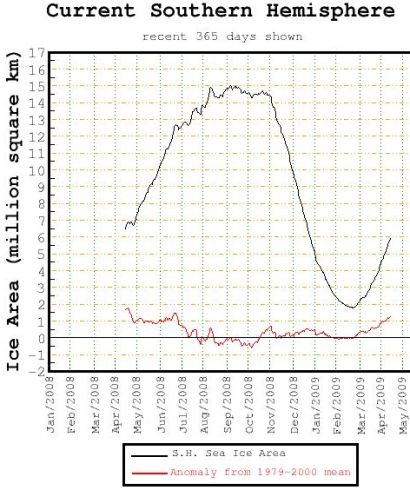
East Antarctica is four times the size of west Antarctica and parts of it are cooling. The Scientific Committee on Antarctic Research report prepared for last week’s meeting of Antarctic Treaty nations in Washington noted the South Pole had shown “significant cooling in recent decades”.
And here’s the graph that goes with the findings:
Source: Cryosphere Today
Why are global warming alarmists wrong?
Now we know that they’re wrong. Why are they wrong? Well, maybe I should start by showing that the media is cherry-picking data in order to delude the public. This post by Anthony Watts which explains how the media deliberately recycles the images and stories about imminent climate catastrophes. This time, it’s about a vast antarctic shelf that’s about to collapse.
Only one problem. It was just about to collapse last year, but the media is re-using the the same scary stock photo and story again this year and telling us again that it’s just about to collapse.
Excerpt:
Those masters of disaster are at it again, and it appears our friendly scientists at that National Snow and Ice Data Center (NSIDC) help this story along each year.
…It seems that not only is the photography recycled, so is the storyline. It seems to happen every year, about this time. Note the photos show shear failure and cracks, not melted ice. Shear failure is mostly mechanical-stress related, though ice does tend to be more brittle at colder temperatures.
National Geographic reported this story headline last year, March 25th 2008.
“[It’s] an event we don’t get to see very often,” Ted Scambos, lead scientist at the U.S. National Snow and Ice Data Center in Boulder, Colorado, said in a press statement.
Now, how is it that an ice shelf breaks up in the spring of 2008 and again in the spring of 2009 and it’s “not very often”? Hmmm.
Watts goes on in his post to take a look at how much the ice shelf has really changed over the years (it hasn’t) and whether the air temperatures have gotten warmer (theyhaven’t) such that the air would be causing cracks. So all we really have is a scary re-used photo and a lot of propaganda.
What are the economic effects of policies based on global warming alarmism

 WINTERY KNIGHT