
Tag Archives: Jesus

What is the definition of marriage according to Jesus?

Marriage and family
Marriage and family

I noticed that there is some silly Democrat running around harassing Mike Pence because he accepts Jesus’ definition of marriage. What’s annoying about this particular Democrat is that he calls himself a Christian, despite being in a gay relationship with another man. I thought it might be a good idea to remind everyone what the actual definition of marriage is, according to Jesus.

Here’s what Jesus says about marriage.

Matthew 19:1-11:

1 Now when Jesus had finished these sayings, he went away from Galilee and entered the region of Judea beyond the Jordan.

2 And large crowds followed him, and he healed them there.

3 And Pharisees came up to him and tested him by asking, “Is it lawful to divorce one’s wife for any cause?”

4 He answered, “Have you not read that he who created them from the beginning made them male and female,

5 and said, ‘Therefore a man shall leave his father and his mother and hold fast to his wife, and the two shall become one flesh’?

6 So they are no longer two but one flesh. What therefore God has joined together, let not man separate.”

7 They said to him, “Why then did Moses command one to give a certificate of divorce and to send her away?”

8 He said to them, “Because of your hardness of heart Moses allowed you to divorce your wives, but from the beginning it was not so.

9 And I say to you: whoever divorces his wife, except for sexual immorality, and marries another, commits adultery.”

10 The disciples said to him, “If such is the case of a man with his wife, it is better not to marry.”

11 But he said to them, “Not everyone can receive this saying, but only those to whom it is given.

To be a Christian, minimally, is to be a follower of Jesus Christ. That means that we accept what Jesus teaches, on whatever he teaches about. We don’t overturn the teachings of Jesus in order to make people who are rebelling against God feel better about their rebellion. It is central to the Christian worldview that Christians care more about what God thinks of them than what non-Christians think of them. In fact, Christians are supposed to be willing to endure suffering rather than side with non-Christians against God’s authority.

Matt Walsh had a fine article about this issue.

He said:

As Christians, our goal is not to avoid being like the big bad “other Christians,” but to strive to be like Christ Himself. This is one of the advantages to having an Incarnate God. He went around acting and speaking and teaching and generally functioning in our realm, thereby giving us a model to follow. This is the model of a loving and merciful man, and also a man of perfect virtue who fought against the forces of evil, condemned sin, defended his Father in Heaven with sometimes violent force, spoke truth, and eventually laid down His life for those He loved (which would be all of us).

[…]This is what it means to believe in Christ. Not just to believe that He existed, but to believe that Christ is Truth itself, and that everything He said and did was totally and absolutely and irreversibly true forever and always. Many Christians today — not only the ones in the video, but millions alongside them — seem to think we can rightly claim to have “faith” in Jesus or a “relationship” with Him while still categorically denying much of His Word. This is a ridiculous proposition. We can’t declare, in one breath, that Christ is Lord, and in the next suggest that maybe God got it wrong on this or that point. Well, we can make that declaration, but we expose our belief as fraudulent and self-serving. We worship a God we either invented in our heads, which is a false idol, or a God who is fallible, which is a false idol.

If you really accept Jesus as God, then you can’t think he is wrong when he explains what marriage is. Period. End of issue.

Real Christians don’t make excuses for sin. Real Christians present the gospel. The gospel is that all men have rebelled against God and fallen short of perfect submission to and obedience of him. For this, they deserve to be separated from God eternally. Jesus paid the price for this rebellion on the cross, and anyone who accepts him as Savior and Lord will be with God eternally after they die. There is no salvation apart from Jesus. That’s what Christians say. And they say it regardless of how weird they look, and how many non-Christians don’t like them for saying it.
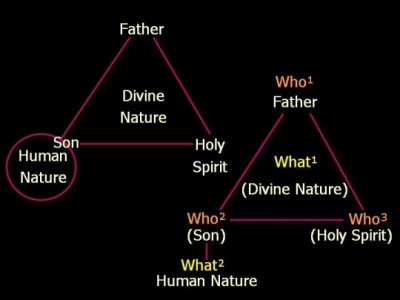

Did the early church invent the divinity of Jesus over a long period of time?

The Christian doctrine of the Trinity

How early is the doctrine of the divinity of Jesus?

When I answer this question, I only want to use the earliest, most reliable sources – so I can defend them on historical grounds using the standard rules of historiography.

The 4 sources that I would use are as follows:

  • The early creed in 1 Corinthians 15:3-8, and 1 Corinthians 1
  • A passage in Philippians 2
  • Two passages from Mark, the earliest gospel
  • A passage from Q, which is an early source of Matthew and Luke

So let’s see the passages.

1 Corinthians

I’ve written before about the early creed in 1 Corinthians 15:3-8, which skeptical scholars date to 1-3 years after the death of Jesus, for a variety of reasons I covered in the previous post. Here’s the creed which definitely makes Jesus out to be more than an ordinary man. Ordinary men don’t get resurrection bodies after they die.

Here’s the passage: (1 Cor 15:3-8)

3For what I received I passed on to you as of first importance: that Christ died for our sins according to the Scriptures,

4that he was buried, that he was raised on the third day according to the Scriptures,

5and that he appeared to Peter, and then to the Twelve.

6After that, he appeared to more than five hundred of the brothers at the same time, most of whom are still living, though some have fallen asleep.

7Then he appeared to James, then to all the apostles,

8and last of all he appeared to me also, as to one abnormally born.

Additionally, 1 Corinthians 1:21-25 talks about Jesus being “the power of God and the wisdom of God”. Paul is identifying Jesus with the divine.

21For since in the wisdom of God the world through its wisdom did not know him, God was pleased through the foolishness of what was preached to save those who believe.

22Jews demand miraculous signs and Greeks look for wisdom,

23but we preach Christ crucified: a stumbling block to Jews and foolishness to Gentiles,

24but to those whom God has called, both Jews and Greeks, Christ the power of God and the wisdom of God.

25For the foolishness of God is wiser than man’s wisdom, and the weakness of God is stronger than man’s strength.

But it gets even stronger! You all probably already know that the most important passages in the Old Testament for Jews is the famous “Shema“, which is found in Deuteronomy 6:4-9. The Shema is a strong statement of Jewish monotheism.

Here’s the passage:

4 Hear, O Israel: The LORD our God, the LORD is one.

5 Love the LORD your God with all your heart and with all your soul and with all your strength.

6 These commandments that I give you today are to be upon your hearts.

7 Impress them on your children. Talk about them when you sit at home and when you walk along the road, when you lie down and when you get up.

8 Tie them as symbols on your hands and bind them on your foreheads.

9 Write them on the doorframes of your houses and on your gates.

So how does Paul fit Jesus in with this strong statement of Jewish monotheism?

Paul alludes to the Shema in 1 Corinthians 8:4-6.

4So then, about eating food sacrificed to idols: We know that an idol is nothing at all in the world and that there is no God but one.

5For even if there are so-called gods, whether in heaven or on earth (as indeed there are many “gods” and many “lords”),

6yet for us there is but one God, the Father, from whom all things came and for whom we live; and there is but one Lord, Jesus Christ, through whom all things came and through whom we live.

Holy mackerel! How did that get in there? Paul is splitting the roles of God in the the Shema and identifying Jesus in one of the divine roles! Jesus is not an ordinary man. That passage “through whom all things came” foreshadows John identifying Jesus as “the Word of God”, which “became flesh and dwelt among us”. Holy snark – did you guys know that was all in here so early?

The date for 1 Corinthians is 55 AD. It should be noted that skeptical scholars like James Crossley accept these passages, and you can check it out in the debate audio yourself.

Philippians

Check out Philippians 2:5-11.

5Your attitude should be the same as that of Christ Jesus:

6Who, being in very nature God, did not consider equality with God something to be grasped,

7but made himself nothing, taking the very nature of a servant, being made in human likeness.

8And being found in appearance as a man, he humbled himself and became obedient to death— even death on a cross!

9Therefore God exalted him to the highest place and gave him the name that is above every name,

10that at the name of Jesus every knee should bow, in heaven and on earth and under the earth,

11and every tongue confess that Jesus Christ is Lord, to the glory of God the Father.

The date for Philippians is 60-61 AD. Still within the lifetime of the eyewitnesses, and written by an eyewitness who was in contact with the other eyewitnesses, like Peter and James, whom Paul spoke with numerous times on his journeys to Jerusalem.

Mark’s gospel

Mark’s gospel is the earliest and atheists like James Crossley date it to less than 40 AD, which is 10 years after the death of Jesus at most. When you read the gospel of Mark, you are getting the earliest and best information available about the historical Jesus, along with Paul’s epistles. So what does Mark say about Jesus? Is Jesus just a man, or is he something more?

Check out Mark 12:1-9:

1He then began to speak to them in parables: “A man planted a vineyard. He put a wall around it, dug a pit for the winepress and built a watchtower. Then he rented the vineyard to some farmers and went away on a journey.

2At harvest time he sent a servant to the tenants to collect from them some of the fruit of the vineyard.

3But they seized him, beat him and sent him away empty-handed.

4Then he sent another servant to them; they struck this man on the head and treated him shamefully.

5He sent still another, and that one they killed. He sent many others; some of them they beat, others they killed.

6“He had one left to send, a son, whom he loved. He sent him last of all, saying, ‘They will respect my son.’

7“But the tenants said to one another, ‘This is the heir. Come, let’s kill him, and the inheritance will be ours.’

8So they took him and killed him, and threw him out of the vineyard.

9“What then will the owner of the vineyard do? He will come and kill those tenants and give the vineyard to others.

And Mark 13:32, talking about the date of the final judgment.

32“No one knows about that day or hour, not even the angels in heaven, nor the Son, but only the Father.

And again, this passage is establishing a hierarchy such that Jesus is being exalted above all men and the angels, too. And the passage is embarrassing to the early church, because it makes Jesus look ignorant of something, so they would not have made this passage up. Jesus is not an ordinary man, he is above the angels – God’s unique Son.

The “Q” source for Matthew and Luke

Here’s Matthew 11:27, which is echoed in Luke 10:22:

27“All things have been committed to me by my Father. No one knows the Son except the Father, and no one knows the Father except the Son and those to whom the Son chooses to reveal him.

22“All things have been committed to me by my Father. No one knows who the Son is except the Father, and no one knows who the Father is except the Son and those to whom the Son chooses to reveal him.”

Since this passage is in both of Matthew and Luke, but not in Mark, scholars believe that it is in the earlier “Q” source used by both Matthew and Luke. Q predates both Matthew and Luke, and so it is also fairly early (maybe 67-68), although not as early as Mark and Paul. Bill Craig writes that this passage is also embarrassing because it says that no one knows Jesus.

Podcast: Was Jesus a socialist? Does Christianity teach socialism?

Let's take a deep dive into the Bible
Let’s take a deep dive into the Bible

I noticed that Christianity Today, which has turned hard left in recent years, is now openly endorsing socialism. So, I thought it might be a good idea to listen to this new episode of the Think Biblically podcast, which deals with the issue of Christianity and socialism. The hosts actually brought an economist on to define socialism, then they analyze the teachings of Jesus.

Here’s the description: (H/T Nathan)

It has not been uncommon for advocates of virtually every economic system to invoke Jesus in support of their views, though some of the most ardent advocates for both capitalism and socialism did not have any particular religious views themselves (Rand, Marx). Over the years, some of the more recent advocates of socialist type economic arrangements have appealed to Jesus and the gospels in support of such systems. Economist Lawrence Reed helps us sort out the application of the teaching of Jesus to economics and its relevance for economic life today. Join us for this provocative conversation as he tackles the question of Jesus and socialism.

Show notes, including a full transcript, are available at: biola.edu/thinkbiblically

Topics:

  • who plans the economy in socialism?
  • who should own the means of production in socialism?
  • how should wealth be distributed in socialism?
  • what tools does socialism use to provide people with health care, employment, security, etc.
  • which countries have adopted socialism? North Korea? Cuba? Venezuela? How about the Scandinavian countries?
  • what in the New Testament has caused people to think that Jesus was a socialist?
  • did Jesus ever advocate for concentrating power in the government in order to meet the material needs of people?
  • did Jesus ever advocate for voluntary charity in order to meet the material needs of people?
  • in our experience, is government seen to be more compassionate or less compassionate than individual people?
  • does voluntary charity have any advantages over forced redistribution by a powerful central government?
  • what about the example of common possessions among the earliest Christians?
  • what is the Bible’s view of wealth? is it always bad to be wealthy, or does it matter how you obtained it and how you use it?
  • what does the parable of the talents tell us about socialism vs capitalism?
  • what does the parable of the good Samaritan tell us about socialism vs capitalism?
  • what does the parable of the three different shifts of workers tell us about socialism vs capitalism?
  • what about socialist policies and higher tax rates in countries like Canada and Scandinavian countries?

I have to be honest. I think that some of the economics reasoning about the parables was a stretch, because those parables are talking mainly about other topics, not economics. But it’s true that the parables aren’t friendly to socialism even if they are interpreted as being about economics.