
Tag Archives: Jesus

Why do so many atheist historians think that 1 Corinthians 15 is reliable history?

Investigation in progress

Which passage of the Bible is the favorite of Christians who like to defend the Christian worldview? I don’t mean which one is most inspirational… I mean “which one is the most useful for winning arguments?” Well, when it comes to the historical Jesus, the most important passage has to be 1 Corinthians 15:3-7.

The tradition in 1 Corinthians 15 is an early creed that was received from the eyewitnesses Peter and John when Paul visited them several times in Jerusalem, as documented in Galatians 1 and 2, where Paul meets the eyewitnesses. And of course, Paul records his own eyewitness experience, documented in 1 Cor 15:8.

So, is this passage accepted as historically reliable by all ancient historians? Or only by the Bible-believing ones?

Here’s something posted by Dr. William Lane Craig about the 1 Corinthians 15 passage:

The evidence that Paul is not writing in his own hand in I Cor. 15.3-5 is so powerful that all New Testament scholars recognize that Paul is here passing on a prior tradition. In addition to the fact that Paul explicitly says as much, the passage is replete with non-Pauline characteristics, including, in order of appearance: (i) the phrase “for our sins” using the genitive case and plural noun is unusual for Paul; (ii) the phrase “according to the Scriptures” is unparalleled in Paul, who introduces Scriptural citations by “as it is written”; (iii) the perfect passive verb “has been raised” appears only in this chapter and in a pre-Pauline confessional formula in II Tim. 2.8; (iv) the phrase “on the third day” with its ordinal number following the noun in Greek is non-Pauline; (v) the word “appeared” is found only here and in the confessional formula in I Tim. 3.16; and (vi) “the Twelve” is not Paul’s nomenclature, for he always speaks of the twelve disciples as “the apostles.”

Now the visit during which Paul may have received this tradition is the visit you mention three years after his conversion on the road to Damascus (Gal. 1.18). This puts the tradition back to within the first five years after Jesus’ death in AD 30. So there’s not even an apparent inconsistency with Paul’s appropriating the language of the formula to encapsulate the Gospel he was already preaching during those first three years in Damascus.

Ancient historian Gary Habermas loves to read non-Christian scholars… and then he writes about what THEY think about Jesus in peer-reviewed articles, published in academic journals. Let’s look at this one: Dialog: A Journal of Theology, Vol. 45; No. 3 (Fall, 2006), pp. 288-297; published by Blackwell Publishing, UK.

He writes:

(1) Contemporary critical scholars agree that the apostle Paul is the primary witness to the early resurrection experiences. A former opponent (1 Cor. 15:9; Gal. 1:13-14; Phil. 3:4-7), Paul states that the risen Jesus appeared personally to him (1 Cor. 9:1; 15:8; Gal. 1:16). The scholarly consensus here is attested by atheist Michael Martin, who avers: “However, we have only one contemporary eyewitness account of a postresurrection appearance of Jesus, namely Paul’s.”[3]

(2) In addition to Paul’s own experience, few conclusions are more widely recognized than that, in 1 Corinthians 15:3ff., Paul records an ancient oral tradition(s). This pre-Pauline report summarizes the early Gospel content, that Christ died for human sin, was buried, rose from the dead, and then appeared to many witnesses, both individuals and groups.

Paul is clear that this material was not his own but that he had passed on to others what he had received earlier, as the center of his message (15:3). There are many textual indications that the material pre-dates Paul. Most directly, the apostle employs paredoka and parelabon, the equivalent Greek terms for delivering and receiving rabbinic tradition (cf. 1 Cor. 11:23). Indirect indications of a traditional text(s) include the sentence structure and verbal parallelism, diction, and the triple sequence of kai hoti Further, several non-Pauline words, the proper names of Cephas (cf. Lk. 24:34) and James, and the possibility of an Aramaic original are all significant. Fuller attests to the unanimity of scholarship here: “It is almost universally agreed today that Paul is here citing tradition.”[4] Critical scholars agree that Paul received the material well before this book was written.[5]

This is important:

The most popular view is that Paul received this material during his trip to Jerusalem just three years after his conversion, to visit Peter and James, the brother of Jesus (Gal. 1:18-19), both of whose names appear in the appearance list (1 Cor. 15:5; 7). An important hint here is Paul’s use of the verb historesai (1:18), a term that indicates the investigation of a topic.[6] The immediate context both before and after reveals this subject matter: Paul was inquiring concerning the nature of the Gospel proclamation (Gal. 1:11-2:10), of which Jesus’ resurrection was the center (1 Cor. 15:3-4, 14, 17; Gal. 1:11, 16).

He’s an eyewitness (verse 8), and he met with the other eyewitnesses, James and Peter. 1 Corinthians is early. Galatians is early. The creed is extremely early – right after the events occurred. There was no time for legends to develop.

And atheistic / critical historians agree, the creed is reliable:

Critical scholars generally agree that this pre-Pauline creed(s) may be the earliest in the New Testament. Ulrich Wilckens asserts that it “indubitably goes back to the oldest phase of all in the history of primitive Christianity.”[7] Joachim Jeremias agrees that it is, “the earliest tradition of all.”[8] Perhaps a bit too optimistically, Walter Kasper even thinks that it was possibly even “in use by the end of 30 AD . . . .”[9]

Indicating the wide approval on this subject, even more skeptical scholars frequently agree. Gerd Ludemann maintains that “the elements in the tradition are to be dated to the first two years after the crucifixion of Jesus. . . . not later than three years. . . . the formation of the appearance traditions mentioned in I Cor.15.3-8 falls into the time between 30 and 33 CE. . . .”[10] Similarly, Michael Goulder thinks that it “goes back at least to what Paul was taught when he was converted, a couple of years after the crucifixion.”[11] Thomas Sheehan agrees that this tradition “probably goes back to at least 32-34 C.E., that is, to within two to four years of the crucifixion.”[12] Others clearly consent.[13]

Overall, my recent overview of critical sources mentioned above indicates that those who provide a date generally opt for Paul’s reception of this report relatively soon after Jesus’ death, by the early to mid-30s A.D.[14] This provides an additional source that appears just a half step removed from eyewitness testimony.

(3) Paul was so careful to assure the content of his Gospel message, that he made a second trip to Jerusalem (Gal. 2:1-10) specifically to be absolutely sure that he had not been mistaken (2:2). The first time he met with Peter and James (Gal. 1:18-20). On this occasion, the same two men were there, plus the apostle John (2:9). Paul was clearly doing his research by seeking out the chief apostles. As Martin Hengel notes, “Evidently the tradition of I Cor. 15.3 had been subjected to many tests” by Paul.[15]

These four apostles were the chief authorities in the early church, and each is represented in the list of those who had seen the resurrected Jesus (1 Cor. 15:5-7). So their confirmation of Paul’s Gospel preaching (Gal. 2:9), especially given the apostolic concern to insure doctrinal truth in the early church, is certainly significant. On Paul’s word, we are again just a short distance from a firsthand report.

(4) Not only do we have Paul’s account that the other major apostles confirmed his Gospel message, but he provides the reverse testimony, too. After listing Jesus’ resurrection appearances, Paul tells us he also knew what the other apostles were preaching regarding Jesus’ appearances, and it was the same as his own teaching on this subject (1 Cor. 15:11). As one, they proclaimed that Jesus was raised from the dead (15:12, 15). So Paul narrates both the more indirect confirmation of his Gospel message by the apostolic leaders, plus his firsthand, direct approval of their resurrection message.

Now, some of the people he lists are really biased against the supernatural, and they really hate the idea that the claims of Christianity exclude other religions. And yet they don’t deny the historical reliability of 1 Corinthians 15, or that it is based on eyewitness testimony.

That’s why when you watch debates about the historical Jesus, you see skeptical historians like Bart Ehrman, Gerd Ludemann, James Crossley, Michael Goulder, etc. accepting that the disciples thought they saw Jesus after his death. They’re not just being nice to Dr. Craig when they give him that. They are forced to accept it, because it passes the historical tests. Every Christian ought to be aware of which passages of the New Testament are seen by the broad spectrum of ancient historians as “historical”, regardless of their various biases. You can believe everything in the Bible. But when you debate non-Christians, you have to use the historical core of Christianity which successfully passes historical analysis.

You can see the creed used as evidence in the debate between James Crossley and William Lane Craig.

William Lane Craig explains the doctrine of penal substitutionary atonement

I have a key that will unlock a puzzling mystery

Probably one of the most common questions that you hear from people who don’t fully understand Christianity is this question: “why did Jesus have to die?”. The answer that most Christians seem to hold to is that 1) humans are rebelling against God, 2) Humans deserve punishment for their rebellion, 3) Humans cannot escape the punishment for their rebellion on their own, 4) Jesus was punished in the place of the rebellious humans, 5) Those who accept this sacrifice are forgiven for their rebelling.

Are humans rebellious?

Some people think that humans are not really rebellious at all, but it’s actually easy to see. You can see it just by looking at how people spend their time. Some of us have no time for God at all, and instead try to fill our lives with material possessions and experiences in order to have happy feelings. Some of us embrace just the parts of God that make us feel happy, like church and singing and feelings of comfort, while avoiding the hard parts of that vertical relationship; reading, thinking and disagreeing with people who don’t believe the truth about God. And so on.

This condition of being in rebellion is universal, and all of us are guilty of breaking the law at some point. All of us deserve to be separated from God’s goodness and love. Even if we wanted to stop rebelling, we would not be able to make up for the times where we do rebel by being good at other times, any more than we could get out of a speeding ticket by appealing to the times when we drove at the speed limit, (something that I never do, in any case).

This is not to say that all sinners are punished equally – the degree of punishment is proportional to the sins a person commits. However, the standard is perfection. And worse than that, the most important moral obligation is a vertical moral obligation. You can’t satisfy the demands of the moral law just by making your neighbor happy, while treating God like a pariah. The first commandment is to love God, the second is to love your neighbor. Even loving your neighbor requires you to tell your neighbor the truth – not just to make them feel good. The vertical relationship is more important than the horizontal one, and we’ve all screwed up the vertical relationship. We all don’t want God to be there, telling us what’s best for us, interfering with our fun. We don’t want to relate to a loving God if it means having to care what he thinks about anything that we are doing.

Who is going to pay for our rebellion?

The Christian answer to the problem of our rebellion is that Jesus takes the punishment we deserve in our place.

However, I’ve noticed that on some atheist blogs, they don’t like the idea that someone else can take our punishment for us to exonerate us for crimes that we’ve committed. So I’ll quote from this post by the great William Lane Craig, to respond to that objection.

Excerpt:

The central problem of the Penal Theory is, as you point out, understanding how punishing a person other than the perpetrator of the wrong can meet the demands of justice. Indeed, we might even say that it would be wrong to punish some innocent person for the crimes I commit!

It seems to me, however, that in other aspects of human life we do recognize this practice. I remember once sharing the Gospel with a businessman. When I explained that Christ had died to pay the penalty for our sins, he responded, “Oh, yes, that’s imputation.” I was stunned, as I never expected this theological concept to be familiar to this non-Christian businessman. When I asked him how he came to be familiar with this idea, he replied, “Oh, we use imputation all the time in the insurance business.” He explained to me that certain sorts of insurance policy are written so that, for example, if someone else drives my car and gets in an accident, the responsibility is imputed to me rather than to the driver. Even though the driver behaved recklessly, I am the one held liable; it is just as if I had done it.

Now this is parallel to substitutionary atonement. Normally I would be liable for the misdeeds I have done. But through my faith in Christ, I am, as it were, covered by his divine insurance policy, whereby he assumes the liability for my actions. My sin is imputed to him, and he pays its penalty. The demands of justice are fulfilled, just as they are in mundane affairs in which someone pays the penalty for something imputed to him. This is as literal a transaction as those that transpire regularly in the insurance industry.

So, it turns out that the doctrine of substitionary atonement is not as mysterious or as objectionable as everyone seems to think it is.

What do ancient non-Christian sources tell us about the historical Jesus?

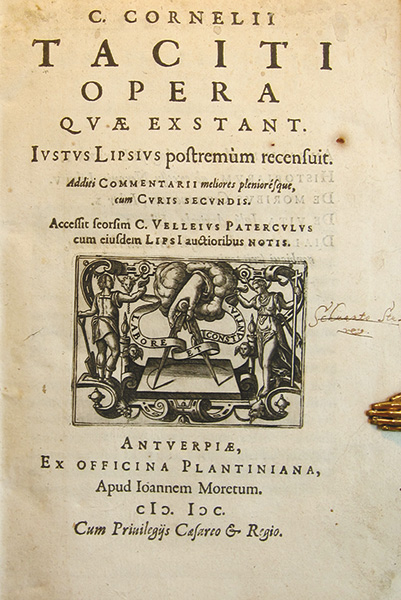
The Annals, by Roman historian Tacitus

This article from Biblical Archaeology covers all the non-Christian historical sources that discuss Jesus.

About the author:

Lawrence Mykytiuk is associate professor of library science and the history librarian at Purdue University. He holds a Ph.D. in Hebrew and Semitic Studies and is the author of the book Identifying Biblical Persons in Northwest Semitic Inscriptions of 1200–539 B.C.E. (Atlanta: Society of Biblical Literature, 2004).

Here are the major sections:

  • Roman historian Tacitus
  • Jewish historian Josephus
  • Greek satirist Lucian of Samosata
  • Platonist philosopher Celsus
  • Roman governor Pliny the Younger
  • Roman historian Suetonius
  • Roman prisoner Mara bar Serapion

And this useful excerpt captures the broad facts about Jesus that we get from just the first two sources:

We can learn quite a bit about Jesus from Tacitus and Josephus, two famous historians who were not Christian. Almost all the following statements about Jesus, which are asserted in the New Testament, are corroborated or confirmed by the relevant passages in Tacitus and Josephus. These independent historical sources—one a non-Christian Roman and the other Jewish—confirm what we are told in the Gospels:31

1. He existed as a man. The historian Josephus grew up in a priestly family in first-century Palestine and wrote only decades after Jesus’ death. Jesus’ known associates, such as Jesus’ brother James, were his contemporaries. The historical and cultural context was second nature to Josephus. “If any Jewish writer were ever in a position to know about the non-existence of Jesus, it would have been Josephus. His implicit affirmation of the existence of Jesus has been, and still is, the most significant obstacle for those who argue that the extra-Biblical evidence is not probative on this point,” Robert Van Voorst observes.32 And Tacitus was careful enough not to report real executions of nonexistent people.

2. His personal name was Jesus, as Josephus informs us.

3. He was called Christos in Greek, which is a translation of the Hebrew word Messiah, both of which mean “anointed” or “(the) anointed one,” as Josephus states and Tacitus implies, unaware, by reporting, as Romans thought, that his name was Christus.

4. He had a brother named James (Jacob), as Josephus reports.

5. He won over both Jews and “Greeks” (i.e., Gentiles of Hellenistic culture), according to Josephus, although it is anachronistic to say that they were “many” at the end of his life. Large growth
in the number of Jesus’ actual followers came only after his death.

6. Jewish leaders of the day expressed unfavorable opinions about him, at least according to some versions of the Testimonium Flavianum.

7. Pilate rendered the decision that he should be executed, as both Tacitus and Josephus state.

8. His execution was specifically by crucifixion, according to Josephus.

9. He was executed during Pontius Pilate’s governorship over Judea (26–36 C.E.), as Josephus implies and Tacitus states, adding that it was during Tiberius’s reign.

Some of Jesus’ followers did not abandon their personal loyalty to him even after his crucifixion but submitted to his teaching. They believed that Jesus later appeared to them alive in accordance with prophecies, most likely those found in the Hebrew Bible. A well-attested link between Jesus and Christians is that Christ, as a term used to identify Jesus, became the basis of the term used to identify his followers: Christians. The Christian movement began in Judea, according to Tacitus. Josephus observes that it continued during the first century. Tacitus deplores the fact that during the second century it had spread as far as Rome.

I remember reading the 1996 book by Gary Habermas entitled “The Historical Jesus: Ancient Evidence for the Life of Christ“. This book is a little before the time of most of you young Christian apologists, but back before the time of Lee Strobel and J. Warner Wallace, this is the stuff we all read. Anyway, in the book he makes a list of all that can be known about Jesus from external sources. And fortunately for you, you don’t have to buy the book because you can read chapter 9 of it right on his web site.

From Tacitus he gets this:

From this report we can learn several facts, both explicit and implicit, concerning Christ and the Christians who lived in Rome in the 60s A.D. Chronologically, we may ascertain the following information.

(1) Christians were named for their founder, Christus (from the Latin), (2) who was put to death by the Roman procurator Pontius Pilatus (also Latin), (3) during the reign of emperor Tiberius (14 37 A.D.). (4) His death ended the “superstition” for a short time, (5) but it broke out again, (6) especially in Judaea, where the teaching had its origin.

(7) His followers carried his doctrine to Rome. (8) When the great fire destroyed a large part of the city during the reign of Nero (54 68 A.D.), the emperor placed the blame on the Christians who lived in Rome. (9) Tacitus reports that this group was hated for their abominations. (10) These Christians were arrested after pleading guilty, (11) and many were convicted for “hatred for mankind.” (12) They were mocked and (13) then tortured, including being “nailed to crosses” or burnt to death. (14) Because of these actions, the people had compassion on the Christians. (15) Tacitus therefore concluded that such punishments were not for the public good but were simply “to glut one man’s cruelty.”

And from Josephus he gets this:

(1) Jesus was known as a wise and virtuous man, one recognized for his good conduct. (2) He had many disciples, both Jews and Gentiles. (3) Pilate condemned him to die, (4) with crucifixion explicitly being mentioned as the mode. (5) The disciples reported that Jesus had risen from the dead and (6) that he had appeared to them on the third day after his crucifixion. (7) Consequently, the disciples continued to proclaim his teachings. (8) Perhaps Jesus was the Messiah concerning whom the Old Testament prophets spoke and predicted wonders. We would add here two facts from Josephus’ earlier quotation as well. (9) Jesus was the brother of James and (10) was called the messiah by some.

So when you are reading the New Testament, these facts are the framework that you read within. It’s a good starting point when dealing with people who have never looked into who Jesus was and what he taught and what his followers believed about him, right from the start.