
Tag Archives: Interest

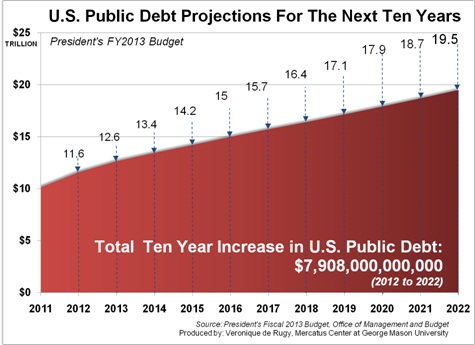
Obama’s new budget adds $8 trillion to the debt over the next 10 years

Obama 2013 Budget Debt Projection

What does the liberal Associated Press think?

Excerpt:

Taking a pass on reining in government growth, President Obama unveiled a record $3.8 trillion election-year budget plan Monday, calling for stimulus-style spending on roads and schools and tax hikes on the wealthy to help pay the costs. The ideas landed with a thud on Capitol Hill.

Though the Pentagon and a number of Cabinet agencies would get squeezed, Obama would leave the spiraling growth of health care programs for the elderly and the poor largely unchecked. The plan claims $4 trillion in deficit savings over the coming decade, but most of it would be through tax increases Republicans oppose, lower war costs already in motion and budget cuts enacted last year in a debt pact with GOP lawmakers.

[…]By the administration’s reckoning, the deficit would drop to $901 billion next year – still requiring the government to borrow 24 cents of every dollar it spends – and would settle in the $600 billion-plus range by 2015.The deficit for the current budget year, which ends Sept. 30, would hit $1.3 trillion, a near record and the fourth straight year of trillion-plus red ink.

Obama’s budget blueprint reprises a long roster of prior proposals: raising taxes on couples making more than $250,000 a year; eliminating numerous tax breaks for oil and gas companies and approving a series of smaller tax and fee proposals. Similar proposals failed even when the Democrats controlled Congress.

The Pentagon would cut purchases of Navy ships and F-35 Joint Strike Fighters – and trim 100,000 troops from its rolls over coming years – while NASA would scrap two missions to Mars.

But there are spending increases, too: The Obama plan seeks $476 billion for transportation projects including roads, bridges and a much-criticized high-speed rail initiative.

The Heritage Foundation has more.

Excerpt:

Spending in the President’s budget rises inexorably from today’s $3.8 trillion to $5.8 trillion in 2022. Throughout the decade, outlays hold stubbornly above 22 percent of gross domestic product (GDP), more than twice the New Deal’s share of the economy in its peak years. In constant dollars, outlays are more than three times the peak of World War II.

In 2012, his budget results deliver a fourth consecutive annual deficit exceeding $1 trillion and then make it worse with another round of not-so-shovel-ready construction projects and government “investments” totaling $178 billion. Among these are the typical road, bridge, and school construction, but then they go alarmingly beyond the usual “infrastructure” arguments to fund teachers’ pay.

Obama’s future deficit reduction comes mainly from Budget Control Act cuts already in place, $848 billion in discredited phantom “savings” from the wind-down of operations in Iraq and Afghanistan, taking credit for reductions in 2011 appropriations, and roughly $1.8 trillion in unnecessary tax increases on those earning above $250,000 and the oil and gas industry.

Yet even with the hefty tax increases and illusory savings, the President’s deficits over the next decade never fall below $575 billion (in 2018) and climb back to $704 billion (in 2022)—but again only assuming the tax increases and mystical savings cited above.

Debt held by the public in the President’s budget rises from 74.2 percent of GDP today to an economically hazardous 76.5 percent of GDP in 2022. These are historically high debt levels: the post–World War II average is just 43 percent. Moreover, the President’s debt estimates are low because of the unreal nature of much of his proposed deficit reduction.

Regarding the most critical fiscal challenge of the day—the need to restructure Medicare, Medicaid, and Social Security—the President has once again taken a pass. By the middle of this century, these three programs and Obamacare will consume about 18 percent of GDP, soaking up all the historical average of federal tax revenue. The notion of “protecting” them through benign neglect only ensures their collapse, and the longer Congress and the President wait to address the problem, the more wrenching will be the consequences. But the President merely reruns previous ideas, such as more cuts to medical providers, ignoring the need for fundamental reform.

For other entitlements, the President repeats a range of mere chipping-around-the-edges proposals from last year’s budget, many of which are really tax or fee increases, not spending reductions.

In short, the President’s budget is the same worn-out collection of higher spending and higher taxes he has offered three times before—with the same inevitable result of more spending, higher taxes, and still more government debt.

Here’s a Republican reaction from Senator Bob Corker:

The libertarian Reason magazine has more budget charts.

Budget guru Paul Ryan discusses the economy at the Heritage Foundation

My favorite GOP ideas-man speaking at my favorite think tank. Here’s the full transcript courtesy of National Review.

Excerpt:

The Treasury Department’s latest study on income mobility in America found that during the ten-year period starting in 1996, roughly half of the taxpayers who started in the bottom 20 percent had moved up to a higher income group by 2005.Meanwhile, half of all taxpayers ended up in a different income group at the end of ten years. Many moved up, and some moved down, but economic growth resulted in rising incomes for most people over this period.

Another recent survey of over 500 successful entrepreneurs found that 93 percent came from middle-class or lower-class backgrounds. The majority were the first in their families to launch a business.

Their stories are the American story: Millions of immigrants fled from the closed societies of the Old World to the security of equal rights in this land of upward mobility.

Telling Americans they are stuck in their current station in life, that they are victims of circumstances beyond their control, and that government’s role is to help them cope with it – well, that’s not who we are. That’s not what we do.

Our Founding Fathers rejected this mentality. In societies marked by class structure, an elite class made up of rich and powerful patrons supplies the needs of a large client underclass that toils, but cannot own. The unfairness of closed societies is the kindling for class warfare, where the interests of “capital” and “labor” are perpetually in conflict. What one class wins, the other loses.

The legacy of this tradition can still be seen in Europe today: Top-heavy welfare states have replaced the traditional aristocracies, and masses of the long-term unemployed are locked into the new lower class.

The United States was destined to break out of this bleak history. Our future would not be staked on traditional class structures, but on civic solidarity. Gone would be the struggle of class against class.

Instead, Americans would work, compete, and co-operate in an open market, climb the ladder of opportunity, and keep the fruits of their efforts.

Self-government and the rule of law would secure our equal, God-given rights. Our political and economic systems – rooted in freedom and responsibility – would reward, and thus cultivate, traditional virtues.

Given that the President’s policies have moved us closer to the European model, I suppose we shouldn’t be surprised that his class-based rhetoric has followed suit.

We shouldn’t be surprised… but we have every right to be disappointed. Instead of appealing to the hope and optimism that were hallmarks of his first campaign, he has launched his second campaign by preying on the emotions of fear, envy, and resentment.

This has the potential to be just as damaging as his misguided policies. Sowing social unrest and class resentment makes America weaker, not stronger. Pitting one group against another only distracts us from the true sources of inequity in this country – corporate welfare that enriches the powerful, and empty promises that betray the powerless.

Ironically, equality of outcome is a form of inequality – one that is based on political influence and bureaucratic favoritism.

That’s the real class warfare that threatens us: A class of bureaucrats and connected crony capitalists trying to rise above the rest of us, call the shots, rig the rules, and preserve their place atop society. And their gains will come at the expense of working Americans, entrepreneurs, and that small businesswoman who has the gall to take on the corporate chieftain.

It’s disappointing that this President’s actions have exacerbated this form of class warfare in so many ways:

While the EPA is busy punishing commercially competitive sources of energy, a class of bureaucrats at the Department of Energy has been acting like the world’s worst venture capital fund, spending recklessly on politically favored alternatives. While the unemployment rate remains stuck above 9 percent, a class of bureaucrats at the National Labor Relations Board is threatening hundreds of jobs by suing an American employer for politically motivated reasons. And while millions of Americans are left wondering whether their employers will drop their health insurance because of the new health care law, a class of bureaucrats at HHS has handed out over 1,400 waivers to those firms and unions with the political connections to lobby for them.

These actions starkly highlight the difference between the two parties that lies at the heart of the matter: Whether we are a nation that still believes in equality of opportunity, or whether we are moving away from that, and towards an insistence on equality of outcome.

If you believe in the former, you follow the American Idea that justice is done when we level the playing field at the starting line, and rewards are proportionate to merit and effort.

If you believe in the latter kind of equality, you think most differences in wealth and rewards are matters of luck or exploitation, and that few really deserve what they have.

That’s the moral basis of class warfare – a false morality that confuses fairness with redistribution, and promotes class envy instead of social mobility.

When you think of talented Republicans who will one day be President, you think of people like Paul Ryan, Marco Rubio, Bobby Jindal, Ted Cruz and Josh Mandel. It’s to take a look at these guys before they become famous. Paul Ryan is the best we have on the budget – he is universally respected. And, he is also 100% pro-life and 100% solid on foreign policy. You don’t have to pick and choose with Paul Ryan – you get everything. All of the above.

Related posts

Economist Paul Ryan disgusted with Obama’s childish emotional bloviating

Republican economist Paul Ryan responds to the community-organizer/teleprompter-reader.

Here’s the transcript. (H/T Lonely Conservative)

Excerpt:

I’m very disappointed in the president. I was excited when we got invited to attend his speech today. I thought the president’s invitation to Mr. Camp, Mr. Hensarling and myself was an olive branch. Instead, what we got was a speech that was excessively partisan, dramatically inaccurate, and hopelessly inadequate to addressing our countries pressing fiscal challenges.

What we heard today was not fiscal leadership from our commander-in-chief. What we heard today was a political broadside from our campaigner-in chief.

I guess it’s no coincidence that last week when the president launched his billion dollar re-election campaign was the week we launched our effort to try and get this debt and deficit under control and get our economy growing.

Last year, in the absence of a serious budget, the president created a fiscal commission. Then with his budget he disavowed his fiscal commission. He ignored all of its recommendations. Now he wants to delegate leadership yet again to a new commission. How are we to expect different results? And the measurements of results of this new commission are lower than the measurements of success of the last commission that ended a few months ago.

We need leadership. We don’t need a doubling down on the failed politics of the past.

[…]Exploiting people’s emotions of fear, envy, and anxiety is not hope; it’s not change. It’s partisanship. We don’t need partisanship. We don’t need demagoguery. We need solutions. And we don’t need to keep punting to other people to make tough decisions. If we don’t make those decisions today, our children will have to make much, much tougher decisions tomorrow.

Paul Ryan and Jeb Hensarling are the two best-known Republican budget wonks.

You can read more about Paul Ryan in this Business Week interview.

Excerpt:

President Obama called your plan “a vision that says if our roads crumble and our bridges collapse, we can’t afford to fix them … but we can somehow afford more than $1 trillion in new tax breaks for the wealthy.” How do you respond?
I don’t even know what to say about that. First of all, we’re not even talking about cutting taxes. We’re talking about keeping tax revenues where they are [by making the Bush tax cuts permanent] and cleaning up all the junk in the tax code for a flatter, fair, simpler tax system. So we’re not talking about cutting taxes. We want to keep the tax revenues where they are and fix the tax code. And with respect to all the spending—you know, that partisan-spending rhetoric—if you don’t fix entitlements, Charlie, if you don’t get spending under control, there’s not going to be any money left for those other things, for roads, for bridges, for education, for the environment. So I’m amazed that he would use that kind of hyperbolic, hyperventilating rhetoric to describe our plan.

I find it interesting that last week we heard William Lane Craig chastise the child Sam Harris for making “stupid and insulting” remarks about Christians, we are now getting Paul Ryan making similar assessments of our naive, childish President. Have Christians and conservatives finally reached their limit of tolerating stupidity and incompetence?

More about Paul Ryan and his budget proposal in my previous post.