Tag Archives: Intelligent Cause

James Shapiro: an honest naturalist admired by ID supporters

As a pro-ID person, I am naturally suspicious of naturalistic scientists. They always say that material forces and chance can explain every single thing in nature, and there are no effects in nature that are best explained by an intelligence. Well, some in nature are best explained by unintelligent causes alone. But I think there are some effects in nature that are more like meaningful sentences or meaningful computer code – and that those are best explained as a result of an intelligence.

One effect in nature where that is clearly analogous to language/code is the biological information in proteins and in DNA. ID people keep telling naturalists that functional information in the first living cell cannot be generated by blind forces in the time available in Earth’s history. But naturalists always seem to diminish the problem and say that blind forces can create information. Well, most naturalists do.

Here’s one who doesn’t, though: James Shapiro. Dr. Shapiro is a microbiologist and a professor in the Department of Biochemistry and Molecular Biology at the University of Chicago. His undergraduate is from Harvard University.

He is very frank about how much naturalistic mechanisms can explain when it comes to the origin of life.

Excerpt: (links removed)

Around here we have a lot of respect for microbiologist James Shapiro, who had the guts and integrity to come over to ENV recently and spar over evolution with William Dembski, Doug Axe and Ann Gauger. Besides having a new book out that details his own dissatisfactions with conventional Darwinian evolutionary theory and that champions a provocative alternative view, Shapiro also blogs at the Huffington Post.

He continues to win our admiration, while evoking some poignancy as well.

In one post that got a fair amount of attention he had some sensible things to say to fellow evolutionists. Rather than hide behind “absolutist statements like ‘all the facts are on my side,'” as his University of Chicago colleague Jerry Coyne does, Shapiro advocates “active engagement” with Darwin critics. Enter into the controversy over evolution, he says, rather than pretend it doesn’t exist.

Perhaps even teach about it? Shapiro doesn’t go that far, but the permissibility of admitting the truth even to young people would seem to follow from his premise:

We need to demonstrate that evolution science is alive and well, as well as show how it is making remarkable progress through the application of molecular technologies — even though it does not have all the answers.

To the thoughtful scientist whose job is to uncover natural processes, this is surely a better way of advocating the scientific method than dogmatically asserting that we found all the scientific principles we need in centuries past.

Evolution supporters, he counsels, should admit they don’t have all the answers, including on a key question like the origin of life. In a remarkably candid statement, he writes:

In order to be truthful, we must acknowledge that certain questions, like the origins of the first living cells, currently have no credible scientific answer. However, given the historical record of science and technology in achieving the “impossible” (e.g., space flight, telecommunications, electronic computation and robotics), there is no reason to believe that unsolved problems will remain without naturalistic explanations indefinitely.

I don’t mind a naturalist who is honest about what we do and do not know.

More:

Surely there’s room to question Shapiro on why our ability to fly to the moon gives grounds for certainty that a purely “naturalistic” explanation of life’s origin will be forthcoming. Space flight is an accomplishment enacted in a material world but, more to the point, it’s a triumph of engineering — aka, intelligent design. It could not be accomplished at all without the direction of purposeful designers.

But note the implicit agreement with Stephen Meyer (Signature in the Cell: DNA and the Evidence for Intelligent Design): materialist explanations for “the origins of the first living cells” have, to date, indeed all miserably failed. In his book, Meyer shows how the evidence points persuasively to the action of some source of intelligent agency. Under the circumstances, if Shapiro is right, that would make intelligent design by default the lone viable theory of life’s origin.

Apart from gesturing to the advance of technology as a reason for keeping faith in naturalism, it would be interesting to know how Shapiro responds to Meyer’s case.

James Shapiro has debated with pro-ID people before. I have a set of audio cassettes from WAY WAY BACK which contains a debate between Robert Shapiro and Walter Bradley, whose lectures on the evidence for design in nature I have featured before. Although some naturalists like Richard Dawkins run away from debates, some, like Shapiro do not. And that’s good for science.

If you want to read a great book on what intelligent design is really about, you really need to read Signature in the Cell. This is the best on the argument for intelligent design in nature from the evidence of proteins and DNA. We are still waiting for a really great pro-ID book on the Cambrian explosion, the sudden origin of all major body plans 540 million years ago – but maybe Dr. Meyer is already working on that now, since he published a peer-reviewed paper on it in a science journal, a while back.
What is the case for intelligent design?

Everyone knows that blog posts and Java programs are the result of an intelligent agent, who arranges symbols into long, improbable sequences that have function. I write blog posts and I write Java programs, and both are the result of my intelligence sequencing letters by typing into my keyboard. Now what should we infer if we look at the universe and we see similar sequences that have functions?

This article from Evolution News explains how a person can look at the universe, find functional sequences of symbols, and infer a designer. (H/T J Warner Wallace of Please Convince Me)

Excerpt:

Intelligent design is a scientific theory that holds some aspects of life and the universe are best explained by reference to an intelligent cause. Why? Because they contain the type of complexity and information that in our experience comes only from intelligence.

As a result, intelligent-design theorists begin by studying how intelligent agents act when they design things. Intelligence is a process, or a mechanism, which we can observe at work in the world around us. Human designers make a great dataset for studying how intelligent agency works.

When we study the actions of humans, we learn that intelligent agents produce high levels of complex and specified information (CSI). Something is complex if it’s unlikely, and specified if it matches some independent pattern. William Dembski and Stephen Meyer explain that in our experience, only intelligent agents produce this type of information:

  • “[T]he defining feature of intelligent causes is their ability to create novel information and, in particular, specified complexity.” (William A. Dembski, No Free Lunch: Why Specified Complexity Cannot Be Purchased without Intelligence, p. xiv (Rowman & Littlefield Publishers 2002).)
  • “Agents can arrange matter with distant goals in mind. In their use of language, they routinely ‘find’ highly isolated and improbable functional sequences amid vast spaces of combinatorial possibilities.” (Stephen C. Meyer, “The Cambrian Information Explosion,” inDebating Design (edited by Michael Ruse and William Dembski; Cambridge University Press 2004).)

Meyer further explains that in our experience, only intelligence produces high levels of CSI:

[W]e have repeated experience of rational and conscious agents — in particular ourselves — generating or causing increases in complex specified information, both in the form of sequence-specific lines of code and in the form of hierarchically arranged systems of parts. … Our experience-based knowledge of information-flow confirms that systems with large amounts of specified complexity (especially codes and languages) invariably originate from an intelligent source, from a mind or personal agent.” (Stephen C. Meyer, “The origin of biological information and the higher taxonomic categories,” Proceedings of the Biological Society of Washington, Vol. 117(2):213-239 (2004).)Thus, in our experience, high levels of complex and specified information — such as in codes and languages — arise only from intelligence. By assessing whether natural structures contain the type of complexity — high CSI — that in our experience comes only from intelligence, we can construct a positive, testable case for design.

And what happens when we study nature? Well, the past 60 years of biology research have uncovered that life is fundamentally based upon:

  • A vast amount of complex and specified information encoded in a biochemical language;
  • A computer-like system of commands and codes that processes the information.
  • Molecular machines and multi-machine systems.

But where in our experience do things like language, complex and specified information, programming code, or machines come from? They have one and only one known source: intelligence.

One of the strangest things about intelligent design is how many people use the phrase without even being able to define it or point to an academic book or paper where the concept is defined.  There are several places where information is found in nature: the origin of life (“biological information”) and Cambrian explosion (“higher taxonomic categories”) are two of them. There is no known naturalistic method of producing large amounts of functional information in these two areas. But we know that human intelligence are capable of creating the sequences – we’ve seen it done. Intelligent design is the view that functional information sequences in nature are the result of intelligence. That’s all we know that can produce it.

Does intelligent design theory require that the designs be perfect?

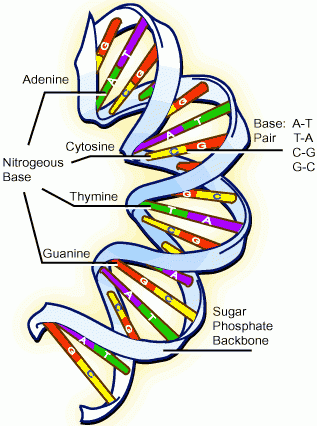
Structure of DNA
Structure of DNA

From Evolution News.

Excerpt:

By the word “intelligent,” ID proponents simply mean to indicate that a structure has features requiring a mind capable of forethought to design the blueprint. Thus, ID proponents test ID by looking for complex and specified information, which is an indicator that some goal-directed process, capable of acting with will, forethought, and intentionality, was involved in designing an object.

We do not test ID by looking for “perfect design” or “undesirable design,” because minds don’t always make things that are “perfect,” and sometimes they make things that are “undesirable” (to other minds, at least). Holding biological systems to some vague standard of “perfect design” where they are refuted by “undesirable design” is the wrong way to test ID. Examples like broken machinery, computer failures, and decaying buildings all show that a structure might be designed by an intelligent agent even if it subsequently breaks or shows flaws. Intelligent design does not necessarily mean “perfect design.” It doesn’t even require optimal design. Rather, “intelligent design” means exactly what it sounds like: design by an intelligent agent.

“Undesirable design” arguments share three general problems, some or all of which can be found in each of Gilmour’s 130 examples. Here are the three main problems:

  1. An object can have imperfections and be undesirable, but still be designed.
  2. Critics’ standards of perfection are often arbitrary.
  3. “Bad design” arguments don’t hold up under their own terms, as the objects often turn out to be well designed when we inspect them more closely.

Problem (1) applies to every single example Gilmour gives. Problems (2) and (3) apply to many, though not all, of his examples. In fact, some of them are legitimate examples of undesirable design. I mean, who likes “easily worn out knees” or hernias — both examples of how our bodies break down? Objectively speaking, those are flaws or imperfections. But as much as you might not like “undesirable design,” they don’t refute ID because ID is a scientific argument that isn’t concerned with the moral value, perfection, or desirable/undesirable quality of a structure. Computers break down but were still intelligently designed. In the same way, the fact that our bodies break down doesn’t mean they weren’t intelligently designed.

If you would like  quick introduction to intelligent design, click here. The best introductory book on the subject is “The Politically Incorrect Guide to Darwinism and Intelligent Design” by Dr. Jonathan Wells, and the best complex book is “Signature in the Cell: DNA and the Evidence for Intelligent Design” by Dr. Stephen C. Meyer.

Related posts