Tag Archives: Infertility

Fertility and pregnancy: how long can a woman wait before having a baby?

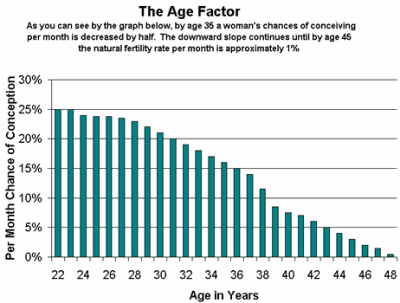
Woman's fertility by age
Woman’s fertility by age

This is from Aeon magazine. The author writes for several ultra-leftist publications, including the New York Times, the Los Angeles Times, Salon and Slate.

She writes:

Many studies show that women are not only woefully ignorant when it comes to fertility, conception and the efficacy of assisted reproductive technologies (ART) – but they overestimate their knowledge about the subject. For instance, a 2011 study in Fertility and Sterility surveyed 3,345 childless women in Canada between the ages of 20 and 50; despite the fact that the women initially assessed their own fertility knowledge as high, the researchers found only half of them answered six of the 16 questions correctly. 72.9 per cent of women thought that: ‘For women over 30, overall health and fitness level is a better indicator of fertility than age.’ (False.) And 90.9 per cent felt that: ‘Prior to menopause, assisted reproductive technologies (such as IVF) can help most women to have a baby using their own eggs.’ (Also false.) Many falsely believed that by not smoking and not being obese they could improve their fertility, rather than the fact that those factors simply negatively affect fertility.

Fertility fog infects cultures and nations worldwide, even those that place more of a premium on reproduction than we do in the West. A global study published for World Fertility Awareness Month in 2006 surveyed 17,500 people (most of childbearing age) from 10 countries in Europe, Africa, the Middle East and South America, revealing very poor knowledge about fertility and the biology of reproduction. Take Israel, a country that puts such a premium on children that they offer free IVF to citizens up to age 45 for their first two children. According to a 2011 study in Human Reproduction, which surveyed 410 undergraduate students, most overestimated a women’s chances of spontaneous pregnancy in all age groups, but particularly after receiving IVF beyond age 40. Only 11 per cent of the students knew that genetic motherhood is unlikely to be achieved from the mid-40s onward, unless using oocytes or egg cells frozen in advance. ‘This can be explained by technological “hype” and favourable media coverage of very late pregnancies,’ the authors concluded.

[…]For a woman over 42, there’s only a 3.9 per cent chance that a live birth will result from an IVF cycle using her own, fresh eggs, according to the American Society of Reproductive Medicine (ASRM). A woman over 44 has just a 1.8 per cent chance of a live birth under the same scenario, according to the US National Center for Chronic Disease Prevention and Health Promotion. Women using fresh donor eggs have about a 56.6 per cent chance of success per round for all ages.

Indeed, according to research from the Fertility Authority in New York, 51 per cent of women aged between 35 and 40 wait a year or more before consulting a specialist, in hopes of conceiving naturally first. ‘It’s ironic, considering that the wait of two years will coincide with diminished fertility,’ the group says.

[…]‘No one talks about fertility,’ said [reproductive endocrinologist Janelle Luk, medical director of Neway Fertility in New York City], who does not believe women are really open to hearing about it. ‘I don’t think women know that there’s a limit: the message is equal, equal, equal. Women say: “We want to go to college, we want to work on our careers, we want to be equal to men.” But our biological clock is not.’

[…]Another way women might even out the fertility playing field is by focussing on the so-called male biological clock. But is there one? Although there have been recent news stories about how advanced age in men (over 40 or 50) increases time to conception and the incidence of autism and schizophrenia, the absolute risk is negligible. ‘When you look at the numbers, you have to separate what the absolute risk and the increased risk is,’ said Natan Bar-Chama, director of male reproductive medicine and surgery at Mount Sinai Medical Center in New York. ‘The absolute risk is still really very small.’

I think if I ever have a daughter, I will be sure to urge her to be skeptical of her emotions and intuitions, to learn how to assess probabilities, to disregard exceptional cases when making plans, to resist the feminism in the culture, to get wisdom from older married women with children instead of young unmarried childless women, to accept that she is not so special that laws and rules don’t apply to her, and to accept that the universe is not malleable according to her needs and desires. I hope my wife will see the value of reining our daughter in before the catastrophes like infertility happen.

Where does the organized opposition to educating young women about fertility facts come from?

‘We feel that women should be able to talk to their ob/gyn about fertility,’ said Sandra Carson, ACOG’s vice president for education. ‘We certainly want to remind women gently that, as they get older, fertility is compromised, but we don’t want to do it in such a way that they feel that it might interfere with their career plans or make them nervous about losing their fertility.’ In other words, there are no guidelines for talking to a woman about her fertility unless she herself brings it up.

All this talk of ‘gentle’ reminders and ‘appropriate’ counselling has a history – a political one. Back in 2001, the ASRM devoted a six-figure sum to a fertility awareness campaign, whose goal was to show the effects of age, obesity, smoking and sexually transmitted diseases on fertility. Surprisingly, the US National Organization for Women (NOW) came out against it. ‘Certainly women are well aware of the so-called biological clock. And I don’t think that we need any more pressure to have kids,’ said Kim Gandy, then president of NOW. In a 2002 op-ed in USA Today, she wrote that NOW ‘commended’ doctors for ‘attempting’ to educate women about their health, but thought they were going about it the wrong way by making women feel ‘anxious about their bodies and guilty about their choices’.

We don’t want women to feel bad, so it’s best to let them follow their hearts. That view is not helpful to women! If we want to help women, we must tell them the truth, and take the consequences.

All this talk about fertility could be accompanied by a discussion of the hard fact that a woman’s attractiveness will decline as she ages. This is a troubling lesson that countless women have had to learn the hard way. When you are young, you stand a much better chance of finding a successful male with good values and who is willing to commit to marriage and parenting. Many women will testify that, as you get older, this convenience deteriorates quickly. The good men will be claimed by the responsible women who don’t waste their youthful years seeking thrills.  Men who are contemplating marriage value a woman’s appearance, fertility, vulnerability and submissiveness to his leadership. Women need to be careful not to embark on a course that will reduce their ability in any of these areas that are important to men, e.g. – careerism, premarital promiscuity, etc.

Related posts

New study: adopted kids struggle, even with well-educated, wealthy parents

I’ll explain why I am posting this below, but for now, let’s take a look at the study, which is discussed at Family Studies. (H/T Brad Wilcox tweet)

Excerpt:

To expand what we know about adopted students, for this Institute for Family Studies research brief, I carried out a fresh analysis of data from a large longitudinal study of 19,000 kindergarten students that was conducted by the National Center for Education Statistics beginning in 1998.

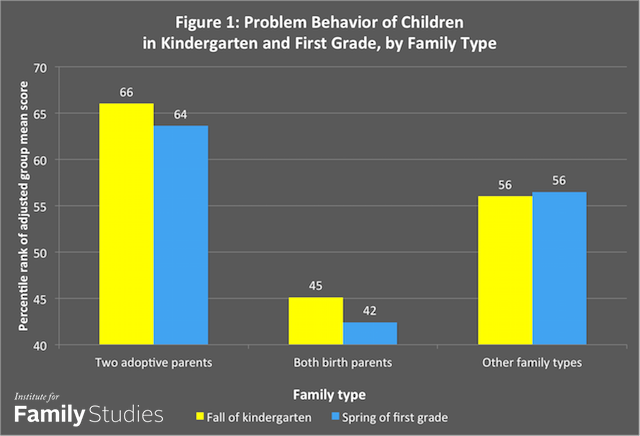
[…]Kindergarten and first-grade teachers were asked to rate the classroom behavior of children in the ECLS-K sample—how well they got along with other children in a group situation. In both the fall of kindergarten and the spring of first grade, adopted children were more likely than biological ones to be reported to get angry easily and often argue or fight with other students.

Here’s the first chart:

Adopted kids struggle in school
Adopted kids more likely to engage in problem behaviors

And more results:

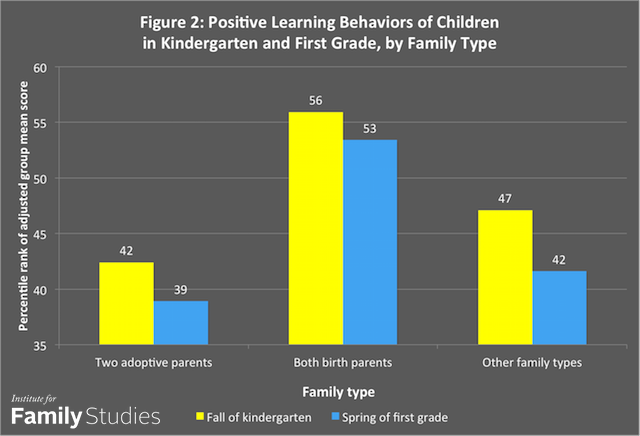
Children in the ECLS-K were also rated by their teachers on how well they paid attention in class, whether they seemed eager to learn new things, and whether they persisted at challenging learning tasks. Scores on these measures have proven to be predictive of later academic performance and career success beyond elementary school.5 Adopted children were rated less highly with respect to such positive approaches to learning than were children being raised by both birth parents.

Here’s the second chart:

Adopted kids struggle to pay attention in class

And even more results:

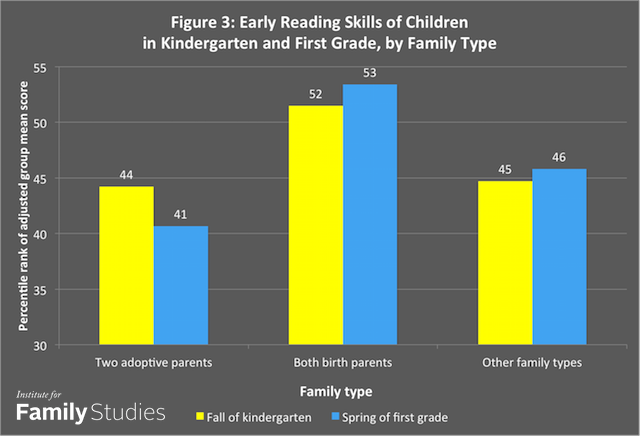
As the participating children began kindergarten, the ECLS-K assessed their pre-reading skills, such as recognizing letters by name, associating sounds with letters, identifying simple words by sight.

Here’s the third chart:

Adopted kids struggle with reading skills

And now math results:

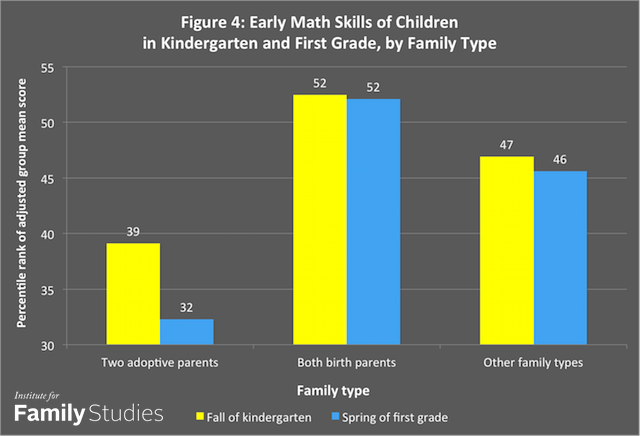
In the fall of their kindergarten year, the ECLS-K assessed children’s pre-arithmetic skills like counting by rote, recognizing written numerals, and understanding greater, lesser, and equal relationships.

Here’s the fourth chart:

Adopted kids struggle with math skills

The article concludes:

Attachment theory holds that a warm, intimate, and continuous relationship with at least one adult, usually the mother, is essential for the mental health of infants and young children. Children who do not develop a stable and secure bond during early childhood, or have the bond disrupted, are subject to both short-term distress reactions and longer-term abnormalities in their feelings and behavior toward other people. Not having a stable maternal bond is apt to produce long-lasting deficits in the child’s social development, deficiencies that are not easily remedied by a new home environment, no matter how favorable.

Some adopted children experienced neglect, abuse, or other stressful events prior to their adoption. According to traumatic stress theory, the likelihood of long-term emotional scars depends on the intensity and duration of the stress. Severe or prolonged early stress can have long-lasting effects on a child’s development, effects that a supportive adoptive family may only partly ameliorate.

So what do I want to say about this? I want to warn young women, especially young Christian women, that children work best when grown-ups plan their lives in such a way that they can provide for what the children need, at the time they need it. And if you miss the window of opportunity to have your own kids and raise them yourself, then you can’t just fix it at the last minute with ad hoc alternatives.

But for some reason, I get a lot of kickback from young women when I tell them what studies say about things like marriage, premarital sex, cohabitation, infertility, day care, and on and on and on. The Christian women in particular dismiss all the facts with stuff like:

God is leading me to choose fun and thrills now. That’s what my feelings say (and all my friends and family tell me that my feelings are God speaking to me). Tingles and peer-approval rationalize my choice to delay marriage and child-bearing. Who cares about stuff evidence? I don’t like to hear about constraints and deadlines. So I’ll just keep up this plan to run up debts, go on missionary trips, and have fun traveling till I’m 90 years old. God always calls people to do what feels good. I’m going on an adventure! And it will be easy to find a good husband and raise happy and effective kids later – whenever I feel like it. Er, I mean when God leads me to feel like it. Yeah.

So even though all of these studies show the need for timings, pre-conditions, best practices, and so on, that can all be dismissed because the feelings are God speaking to her, and God can somehow magically make all the data not apply to her. One of my married friends once wrote to a young, single fun-seeking feminist telling her about the risks of delaying marriage and child-bearing for too long, and the fun-seeker came back to me dismissing the whole letter because “I don’t like the feeling that I am being constrained”. So, the advice of old Christian women (Titus 2:4) can be dismissed because the young adventurous feminist didn’t like the feeling of being confronted by reality by someone who had more wisdom and experience than she did.

What young children need is their mom, and a Dad who can provide for her to stay home during the crucial first 5 years of their lives. That is more important than pursuing fun and thrills, then grabbing for children as if they were handbags at the last second after natural child-bearing becomes impossible. The right thing to do is to use your 20s preparing financially and otherwise to have kids when you are young, and to be financially set up to stay home with them during the critical years. Choosing a man who can provide, and who understands the best practices for having and raising children is vital, if you want your children to be effective and influential for Christ and his kingdom.

I do think that if a couple is intentionally adopting because they want the challenge and want to help a child who really needs it, then it’s praiseworthy to do that. I just don’t want someone who isn’t ready for the challenge thinking that adoption is the same, so they can delay marriage and children.I know that I am lazy, and I always want to do things the easy way. E.g. – I buy new cars, not used cars. I will buy hand-fed birds, not rescue birds. I would buy a new house, not a fixer-upper. I’m just not cut out for doing things that are hard. I have no ability to struggle through when there is resistance. When I face rejection or resistance to trying to grow or lead someone, I just give up. I think what I was saying to young women was – don’t delay marriage and child-bearing, you’ll get better results with less work.

Related posts

New study: women seeking to have a child should start before age 32

Brain vs Heart, from: theawkwardyeti.com

Dina sent me this sobering piece of research from the New Scientist which is perfect for all the young feminists who have been taught in college that marriage should be put off, and women can easily get pregnant after age 40.

Excerpt:

It’s a question many people will ask themselves at some point in their lives: when should I start a family? If you know how many children you’d like, and whether or not you would consider, or could afford, IVF, a computer model can suggest when to start trying for your first child.

Happy with just one? The model recommends you get started by age 32 to have a 90 per cent chance of realising your dream without IVF. A brood of three would mean starting by age 23 to have the same chance of success. Wait until 35 and the odds are 50:50 (see “When to get started”).

The suggestions are based on averages pulled from a swathe of data so don’t give a personal prediction. And of course, things aren’t this simple in real life – if only family size and feelings about IVF were the only factors to consider when planning a family. But the idea behind the model is to help people make a decision by condensing all the information out there into an accessible form.

“We have tried to fill a missing link in the decision-making process,” says Dik Habbema at Erasmus University in Rotterdam, the Netherlands, one of the creators of the model. “My son is 35 and many of his friends have a problem deciding when to have children because there are so many things they want to do.”

It’s a scenario that will be familiar to many; the age at which people have their first child has been creeping up over the last 40 or so years. For example, the average age at which a woman has her first child is 28 in the UK and has reached 30 in Italy, Spain and Switzerland. In the US, the birth rate for women in their 20s has hit a record low, while the figures for those over 35 have increased over the last few decades.

The decision is more pressing for women thanks to their limited supply of eggs, which steadily drop in quantity and quality with age. Female fertility is thought to start declining at 30, with a more significant fall after the age of 35.

[…]The new model incorporates data from studies that assess how fertility naturally declines with age. The team took information on natural fertility from population data collected over 300 years up to the 1970s, which includes data on 58,000 women.

I have often tried to talk to young women about the need to get their lives in gear. I advise them to work summers during high school, obtain a STEM degree in university, minimize borrowing money by going to community college for the generic prerequisites, don’t have premarital sex, get a job related to their STEM field straight out of college, pay off their debts, move out of their parents’ house, start investing from the first paycheck, marry between age 25-30, and then start having children after the first two “stabilizing” years of marriage. This is sound advice, rooted in my careful reconnaissance of the things that human beings care about and need in their old age. This advice is not bullying, it comes from reading many, many relevant papers. It comes from putting the knowledge gained from reading the papers into practice, and seeing results where appropriate.

I am giving you the numbers. Straight out of a peer-reviewed study. Don’t follow your heart. Don’t listen to your friends. Follow the science. Make your decisions within the boundaries of reality. God will not save you from foolish decisions.

Related posts