Tag Archives: Income Inequality

Democrat policies hurt the poor, and actually increase income inequality

Two articles from Investors Business Daily. The first discusses how big government tax policies actually encourage poor people not to work. The second one looks at major cities, and finds that 9 out of the top 10 cities with the most “inequality” are run by Democrats.

Let’s start with the first article.

It says:

The nonpartisan Tax Foundation has put out a new report titled “Income Tax Illustrated .” OK, cue the jokes. But it isn’t boring. Really.

[…]”As low-income households earn more money, not only do their tax burdens grow rapidly, but they also receive fewer benefits from federal social assistance programs,” the report said. “In fact, individuals who move to higher-paying jobs sometimes end up with less overall disposable income, after taxes and transfers.”

The report uses two examples, as noted by the Washington Beacon. In one, a single parent earns $4,800 in salary before taxes. That’s not much, but because of entitlements such as Medicaid, Temporary Assistance for Needy Families, the Children’s Health Insurance Program, food stamps, and Housing Choice Vouchers, that person’s take-home pay for the year jumps to $22,090 — not a lot, granted, but it’s more than 4-1/2 times greater than what that person actually earned working.

That compares to someone who earns $21,000 before taxes but, because of taxes and entitlements, takes home $24,057 for the year.

Yes, that person earns $16,200 more from work, but takes home just $1,967 more, thanks to the tax code and generous benefits to those with less income.

“As low-income households earn more money, not only do their tax burdens grow rapidly, but they also receive fewer benefits from federal social assistance programs,” the report said.

“In fact, individuals who move to higher-paying jobs sometimes end up with less overall disposable income, after taxes and transfers.”

[…]Believe it or not, this bizarre distortion gets worse when you consider a married couple with two kids.

Because the Earned Income Tax Credit is phased out at higher incomes, a family of four making $48,000 faces a marginal tax burden of 43.7% — an absurd disincentive to work harder and earn more for families.

When Republican presidential candidates like Jindal, Cruz and Rubio talk about simplifying the tax code, their intent is to solve these perverse incentives that keep poor people dependent on government. We have make changes to the tax code so that people who are able to work can do better by working, rather than by not working. Republicans are in favor of encourage people to work, marry and have kids. Democrats… just want them to keep voting for dependence on big government.

On to the second article.

Which states have the most income inequality?

The Washington Post looked into the numbers and found that 5 of the top 7 states are decidedly blue — New York, Connecticut, California, Massachusetts and Rhode Island.

And Washington, D.C., which is ground zero of big government liberalism, has the highest level of income inequality of all.

At the other end of the spectrum, the three states with the lowest levels of income inequality are solid red: Utah, Wyoming and Alaska. Nebraska comes in fifth and Nevada ninth.

And what about down at the city level?

The liberal-leaning Brookings Institution looked at inequality by city, and the results show that 9 of the top 10 are run by Democratic mayors — including San Francisco, Boston, D.C., New York, Chicago, Los Angeles and Baltimore.

In contrast, 7 of the 10 least unequal cities are run by Republican mayors, and 9 of 10 are in red states.

And what about Obama, has he helped to reduce income inequality, or has it increased under his watch?

Now take a look at the national level. As the chart above shows, income inequality as measured by the Census Bureau was flat over the course of the George W. Bush years. But under President Obama, it’s been on the rise.

Under Obama, the poor have gotten poorer and the rich richer. Incomes for the bottom 20% have fallen in each of the past four years and are now 8% below where they stood when Obama took office. Meanwhile, incomes of the wealthiest 5% have climbed under Obama, after adjusting for inflation.

IBD had a nice graph for that last point:

The Gini index measures income inequality

So, why is this happening? Why does taking money from “the rich” and giving it to “the poor” makes income inequality worse?

IBD explains:

As we’ve seen over the past seven years, higher taxes, vast new regulations and sharp increases in spending primarily benefit a relatively small number of well-connected people and those companies that can afford an army of lobbyists. In other words, the rich.

At the same time, higher taxes, more mandates and onerous new regulations stifle innovation and make it harder to start up new companies — the sort of companies that create new jobs and new opportunities. The Kauffman Index of business startups, for example, has been below average since 2011.

Incomes are down, because there aren’t enough job creators. We have a 38-year LOW in labor force participation. People rise when there are lots of job offers from job creators. The more people looking to hire, the more people can shop around and get the most salary and benefits for their labor. But wages have not gone up under Obama. He punished job creators with taxes and regulations, so they are creating fewer jobs. Fewer jobs means less competition. Less competition means lower wages and fewer worker benefits.
Mitt Romney: Hillary’s Clinton Foundation Uranium One scandal “looks like bribery”

What looks like bribery? Well, read this story from the radically leftist New York Times, of all places. It should be the end of Hillary’s campaign.

Excerpt:

The headline in the website Pravda trumpeted President Vladimir V. Putin’s latest coup, its nationalistic fervor recalling an era when its precursor served as the official mouthpiece of the Kremlin: “Russian Nuclear Energy Conquers the World.”

The article, in January 2013, detailed how the Russian atomic energy agency, Rosatom, had taken over a Canadian company with uranium-mining stakes stretching from Central Asia to the American West. The deal made Rosatom one of the world’s largest uranium producers and brought Mr. Putin closer to his goal of controlling much of the global uranium supply chain.

But the untold story behind that story is one that involves not just the Russian president, but also a former American president and a woman who would like to be the next one.

At the heart of the tale are several men, leaders of the Canadian mining industry, who have been major donors to the charitable endeavors of former President Bill Clinton and his family. Members of that group built, financed and eventually sold off to the Russians a company that would become known as Uranium One.

Beyond mines in Kazakhstan that are among the most lucrative in the world, the sale gave the Russians control of one-fifth of all uranium production capacity in the United States. Since uranium is considered a strategic asset, with implications for national security, the deal had to be approved by a committee composed of representatives from a number of United States government agencies. Among the agencies that eventually signed off was the State Department, then headed by Mr. Clinton’s wife, Hillary Rodham Clinton.

As the Russians gradually assumed control of Uranium One in three separate transactions from 2009 to 2013, Canadian records show, a flow of cash made its way to the Clinton Foundation. Uranium One’s chairman used his family foundation to make four donations totaling $2.35 million. Those contributions were not publicly disclosed by the Clintons, despite an agreement Mrs. Clinton had struck with the Obama White House to publicly identify all donors. Other people with ties to the company made donations as well.

And shortly after the Russians announced their intention to acquire a majority stake in Uranium One, Mr. Clinton received $500,000 for a Moscow speech from a Russian investment bank with links to the Kremlin that was promoting Uranium One stock.

At the time, both Rosatom and the United States government made promises intended to ease concerns about ceding control of the company’s assets to the Russians. Those promises have been repeatedly broken, records show.

[…]The path to a Russian acquisition of American uranium deposits began in 2005 in Kazakhstan, where the Canadian mining financier Frank Giustra orchestrated his first big uranium deal, with Mr. Clinton at his side.

The two men had flown aboard Mr. Giustra’s private jet to Almaty, Kazakhstan, where they dined with the authoritarian president, Nursultan A. Nazarbayev. Mr. Clinton handed the Kazakh president a propaganda coup when he expressed support for Mr. Nazarbayev’s bid to head an international elections monitoring group, undercutting American foreign policy and criticism of Kazakhstan’s poor human rights record by, among others, his wife, then a senator.

Within days of the visit, Mr. Giustra’s fledgling company, UrAsia Energy Ltd., signed a preliminary deal giving it stakes in three uranium mines controlled by the state-run uranium agency Kazatomprom.

[…][T]he company’s story was hardly front-page news in the United States — until early 2008, in the midst of Mrs. Clinton’s failed presidential campaign, when The Times published an article revealing the 2005 trip’s link to Mr. Giustra’s Kazakhstan mining deal. It also reported that several months later, Mr. Giustra had donated $31.3 million to Mr. Clinton’s foundation.

[…][T]he ultimate authority to approve or reject the Russian acquisition rested with the cabinet officials on the foreign investment committee, including Mrs. Clinton — whose husband was collecting millions of dollars in donations from people associated with Uranium One.

Romney, in his interview with Hugh Hewitt, explained that because Bill and Hillary are married, their assets are co-mingled.

So what’s the problem with this deal?

The national security issue at stake in the Uranium One deal was not primarily about nuclear weapons proliferation; the United States and Russia had for years cooperated on that front, with Russia sending enriched fuel from decommissioned warheads to be used in American nuclear power plants in return for raw uranium. Instead, it concerned American dependence on foreign uranium sources. While the United States gets one-fifth of its electrical power from nuclear plants, it produces only around 20 percent of the uranium it needs, and most plants have only 18 to 36 months of reserves, according to Marin Katusa, author of “The Colder War: How the Global Energy Trade Slipped From America’s Grasp.”

“The Russians are easily winning the uranium war, and nobody’s talking about it,” said Mr. Katusa, who explores the implications of the Uranium One deal in his book. “It’s not just a domestic issue but a foreign policy issue, too.”

It’s a national security issue. We shouldn’t be selling uranium companies to countries like Russia who not only invade their neighbors, but also sell long-range missiles to Iran – and a host of other nasty things, too. This country is not friendly to us.

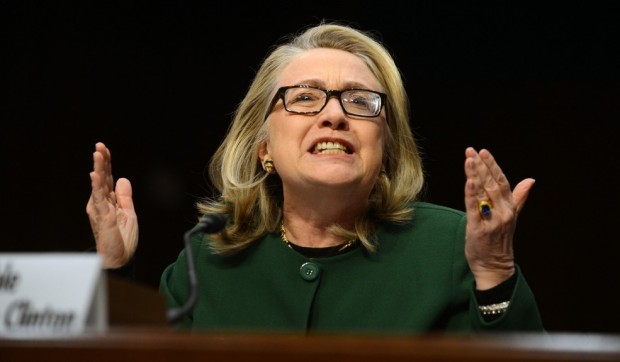
Hillary Clinton: secretive, entitled, hypoctritical

What was Hillary’s response? It’s a distraction invented by the vast right-wing conspiracy:

That’s some vast right-wing conspiracy that makes its way onto the nation’s most respected leftist national newspaper.

So, does this explain why Hillary Clinton deleted tens of thousands of e-mails and then wiped her private e-mail server clean? We’ll never know, because she destroyed all the evidence. But one thing is for sure – there is no reason to vote for this candidate for President, although some people will:

That’s the only “reason” that people will vote for her, because on the merits, she’s a stinker.

Related posts

Do tax hikes, welfare spending and minimum wage hikes lower income inequality?

Here’s Heritage Foundation economist Stephen Moore to explain.

He writes:

Massachusetts Sen. Elizabeth Warren recently appeared on one of the late night talk shows, beating the class warfare drum and arguing for billions of dollars in new social programs paid for with higher taxes on millionaires and billionaires. In recent years, though, blue states such as California, Illinois, Delaware, Connecticut, Hawaii, Maryland and Minnesota adopted this very strategy, and they raised taxes on their wealthy residents. How did it work out? Almost all of these states lag behind the national average in growth of jobs and incomes.

So, if income redistribution policies are the solution to shrinking the gap between rich and poor, why do they fail so miserably in the states?

The blue states that try to lift up the poor with high taxes, high welfare benefits, high minimum wages and other Robin Hood policies tend to be the places where the rich end up the richest and the poor the poorest.

California is the prototypical example. It has the highest tax rates of any state. It has very generous welfare benefits. Many of its cities have a high minimum wage. But day after day, the middle class keeps leaving. The wealthy areas such as San Francisco and the Silicon Valley boom. Yet the state has nearly the highest poverty rate in the nation. The Golden State, alas, has become the inequality state.

In a new report called “Rich States, Poor States” that I write each year for the American Legislative Exchange Council with Arthur Laffer and Jonathan Williams, we find that five of the highest-tax blue states in the nation—California, New York, New Jersey, Connecticut and Illinois—lost some 4 million more U.S. residents than entered these states over the last decade. Meanwhile, the big low-tax red states—Texas, Florida, North Carolina, Arizona and Georgia—gained about this many new residents.

What’s wrong? Isn’t raising taxes, growing government and spending more on welfare supposed to make reduce income inequality? Well, the trouble is that you need to think about things from the point of view of the people who create the jobs. People who want to start a business prefer to move to states where they can keep more of the money they earned. So, that’s why there is a mass exodus from states that don’t allow job creators to keep the money they earn. And naturally, they hire workers in their new state once they get there. Eventually people in the high-tax states move to where the jobs are, too.

Stephen Moore has actually measured it:

The least “regressive” tax states [high tax states] had average population growth from 2003 to 2013 that lagged below the national trend. The 10 most highly “regressive” tax states [low tax states], including nine with no state income tax, had population growth on average 4 percent above the U.S. average. Why was that? Because states without income taxes have twice the job growth of states with high tax rates. 

[…]Ohio University economist Richard Vedder and I compared the income gap in states with higher tax rates, higher minimum wages and more welfare benefits with states on the other side of the policy spectrum. There was no evidence that states with these liberal policies had helped the poor much and, in many cases, these states recorded more income inequality than other states as measured by the left’s favorite statistic called the Gini Coefficient.

[…]The 19 states with minimum wages above the $7.25 per hour federal minimum do not have lower income inequality. States with a super minimum wage—such as Connecticut ($9.15), California ($9.00), New York ($8.75), and Vermont ($9.15)—have significantly wider gaps between rich and poor than states without a super minimum wage.

No, I am not an economist, but I think that this is because the real minimum wage is ZERO, and that’s what more people in high minimum wage states make compared to people in low minimum wage states. If Seattle raises the minimum wage to $15 and the workers end up making the real minimum wage (ZERO) because job creators can’t pay them, then naturally the gap between rich and poor increases.

I think it’s always a good idea for people to think about things from the point of view of the small business job creator, and it all makes sense. If you want to get trained in how to do this, I recommend picking up introductory books by economists like Thomas Sowell, Milton Friedman or even F.A. Hayek. The goal here is to achieve good results, not to have good intentions.