Tag Archives: Incentive

Which political party raises unemployment more? Democrats or African communists?

First, let’s look at the fiscal policies of ANC party in South Africa. (H/T Eleanor via Mary)

Excerpt:

If the government has its way, private companies will no longer be able to hire employees without first considering people listed on a government database of unemployed South Africans.

Failure to do so could result in heavy fines for companies.

This is according to the Employment Services Bill gazetted in December last year.

According to the proposed bill, the government intends to establish a public employment service, whose task will be to create a database of all unemployed people in the country. The employment service will then link job seekers to companies that have vacancies.

The bill, one of four tabled last year, also stipulates that employers will have to register all their vacancies with the service in 14 days.

The government will then provide the companies with the names of possible candidates to fill those posts.

According to the proposed bill, if companies fail to appoint candidates from the database who meet the requirements, they will need to provide written reasons for their actions.

The bill also proposes conditional employment of foreigners. If a company employs a foreigner, it will have to prove to the employment service that it was unable to find a suitable local candidate, including those provided by the government.

The government has also vowed to deal with recruitment agencies that charge job seekers fees. It has proposed that all agencies be registered or face punitive measures.

The bill proposes that the agencies must charge employers the fees instead.

In addition, the bill provides for temporary workers to be paid at the same rate as permanent workers.

This may be the most anti-jobs policy I have EVER heard of. If Satan himself wanted to design a policy to destroy jobs and stop businesses from hiring, then he could not do more to raise the unemployment rate than this evil, evil job-killing policy.

Let’s take a closer look:

  • first, government has no money of its own – it must steal money from productive businesses. Businesses who create products and services that consumers actually want. That means that the money that is used for this database and the government employees will take money away from businesses. When businesses have less money, they hire fewer workers. Therefore, this policy will raise the unemployment rate.
  • second, government will fine companies who do not waste time and money complying with this new regulation. Complying with the regulation not only requires time to query the database, but also to interview candidates who match the job requirements, and then to provide written reasons why they did not hire those candidates. The time spent complying with these regulations will cost the company money, reducing the amount of money that is available to hire workers. Therefore, this policy will raise the unemployment rate.
  • Third, the fee for hiring foreign workers will cause companies to settle for a local employee, who may not be as skilled as the foreign worker. The extra paperwork to hire a better-qualified foreign worker will cost the company money, reducing the amount of money that is available to hire workers. Therefore, this policy will raise the unemployment rate.
  • Fourth, in the case where the employer has to pay an extra fee to hire a worker who has been found by a headhunter, it just raises the cost of hiring this person and may cause the company NOT to hire this worker. Whereas before, a company would have to pay X to hire a worker P, now they will have to pay X + some fee in order to hire worker P. This extra fee will cost the company money, reducing the amount of money that is available to hire workers. Therefore, this policy will raise the unemployment rate.

Since the stated “good intention” of this bill is to reduce unemployment, I can only conclude that the ANC is a party of diabolical liars, or that they are not competent enough to run a lemonade stand. When you raise the cost of employees, either through fees or through fines or through paperwork, then you get fewer employees hired. What will happen is that more South African businesses will ship their jobs overseas. This is where outsourcing comes from – from stupid anti-business policies.

But wait! What about Obama? Isn’t he economically illiterate, too?

Consider this story from the Wall Street Journal. (H/T Michelle Malkin)

Excerpt:

President Barack Obama’s budget proposal is expected to give states a way to collect more payroll taxes from businesses, in an effort to replenish the unemployment-insurance program. The plan could cause controversy at a time when the administration is seeking to mend fences with corporate America.

The proposal would aim to restock strained state unemployment-insurance trust funds by raising the amount of wages on which companies must pay unemployment taxes to $15,000, more than double the $7,000 in place since 1983.

The plan, which would take effect in 2014, could increase payroll taxes by as much as $100 billion over a decade, according to a person involved in its construction.

By proposing to enlarge the pool of wages subject to unemployment taxes, the White House appears to be offering states a more politically palatable way to raise revenues than to boost tax rates. States could keep the tax rates they have, or even lower them somewhat, and still raise considerably more revenue than they are raising now.

…To avoid hitting businesses with a tax increase during the economic recovery, the proposal would delay the new rules until 2014. The plan is expected to be included in Mr. Obama’s budget proposal for fiscal 2012, to be released Monday.

Any proposal would need congressional approval.

Michelle Malkin explains:

Just remember: There is no such thing as a “free” government benefit. Who pays? Dentists, tavern owners, maid services, mom-and-pop shops — small businesses that are the backbone of the American economy. And the businesses that have the lowest claims histories are getting punished the most to make up the jobless benefits fund deficit.

So much for Do No Harm.

This policy will basically raise the cost of hiring an employee. It is nothing but a new tax on businesses who hire employees. Businesses will have to pay the government more money for every employee they hire. Their only way out is to not hire anyone (here), but to move their businesses abroad, away from Obama and his anti-business regulations and taxes.

Remember what happened to the unemployment rate since the Democrats took over Congress in 2007:

Labor Force Participation Rate

Click the graph for a larger image. When you tax something, you get less of it.
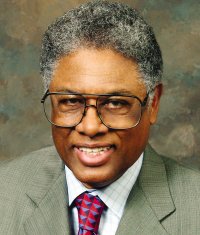
Thomas Sowell urges us to reflect on economic trade-offs and incentives

Thomas Sowell

Article here on Creators.

Excerpt:

With all the laments in the media about skyrocketing unemployment among young people, and especially minority young people, few media pundits even try to connect the dots to explain why unemployment hits some groups much harder than others.

Yet unusually high unemployment rates among young people is not something new or even something peculiar to the United States. Even before the current worldwide recession, unemployment rates were 20 percent or more among workers under 25 years of age in a number of Western European countries.

The young have less experience to offer and are therefore less in demand. Before politicians stepped in, that just meant that younger workers were paid less. But this is not a permanent situation because youth itself is not permanent, and pay rises with experience.

Enter politicians. By mandating a minimum wage that sounds reasonable for most workers, they put a price on inexperienced and unskilled labor that often exceeds what it is worth.

Mandated pay rates, like mandated insurance coverage, impose on buyers and sellers alike things that they would not choose to do otherwise.

Workers of course prefer higher wage rates. But the very fact that the government has to impose those wage rates means that workers were unwilling to risk not having a job by refusing to work for less than the wage rate that has been mandated. Now that choice has been taken out of their hands, with the hidden cost in this case being higher unemployment rates.

The law of unintended consequences – hurting the very people they intended to help, because of their economic ignorance. They priced the youngest and most vulnerable workers out of a job, by mandating a minimum wage that no employer will pay to an inexperienced worker. During a recession, you LOWER minimum wage in order to make sure that those most in need can find a job rather than depend on the government.

When people have jobs, they have confidence to spend more money. Making sure that no policy harms job creation is a primary responsibility of government. Jobs, jobs, jobs. No one (especially Christians) should be dependent on the government for money – because the one who pays the piper calls the tune. And no Christian should dance to the tune of a secular leftist government.

If you are a Christian, but not yet a solid small-government fiscal conservative, then read the WHOLE thing. Christians need to understand that the free market is the best guarantor of our freedom of conscience.

Thomas Sowell is my favorite living economist. Walter Williams is number 2. If you click this link, you can read something from Walter Williams about the economic problems that are created by forcing insurance companies to cover people with pre-existing conditions.

Related posts

Canadian court rules that student need not repay 50K of student loans

Story from Yahoo News.

Excerpt:

A Nova Scotia court has ruled that a former university student does not have to pay back tens of thousands of dollars he borrowed from a bank.
Alfredo Abdo won his case in bankruptcy court this week, with the court concluding that the Royal Bank of Canada was at least partly responsible for what happened.

“I question whether advancing all that money at one time was prudent banking on the part of RBC,” registrar Richard Cregan said in a written decision.

Abdo was a promising engineering student at Dalhousie University in September 2004. He had good grades, a scholarship and lived at home with this family.

In his second year, at the age of 19, he borrowed $20,000 from RBC though a student line of credit. He made bad investments online, according to court documents, and he accepted an offer from the bank for another loan of $30,000 to solve his problem.

Abdo started having dizzy spells. Finding his engineering program very stressful, he switched to commerce. But he dropped out of university in his third year.

The dizziness and social anxiety never went away, Abdo said, and therefore he couldn’t work or pay back the bank loans. He filed for bankruptcy last November.

The Canadian court probably thinks that they are compassionate, good people sticking it to the corporations. But actually what they’ve done is caused the banks to think a second time about making loans to borderline cases, so that the poorest students will now be refused student loans. If the courts refuse to enforce contracts signed by both parties, then the banks just won’t enter in to those contracts.

Down in New Zealand, they have the same problem.

Excerpt:

Thousands of people with student loans are defaulting on payments, leaving the Government to chase hundreds of millions of dollars.

More than one in five borrowers – or 114,000 people – have overdue payments and thousands of students are leaving tertiary education with no qualification and big bills.

The Education Ministry’s student loan scheme annual report shows that $306 million in payments is overdue, a $100m increase from a year ago.

The substantial growth includes a big rise in the level of payments owed by people now living overseas, more than doubling to $114m.

New Zealand University Students Association co-president Sophia Blair said it was not surprising that students with loans were heading overseas and letting the bills mount. “You can earn higher wages [overseas].”

[…]Total student loan debt had reached $10.2 billion and is predicted to grow by an average of $875m a year to more than $20b by 2022.

The report also showed about 39 per cent of students who left tertiary education with a loan did so without achieving a qualification.

About 8000 students with loans who left study in 2005 had nothing to show for it by 2007.

New Zealand, if I understand correctly is a fairly left-wing country, which probably subsidizes tuition and taxes income. So, students would be incentivized to game the system by taking out loans backed by the government, and then leaving to work abroad in more capitalist economies. Socialism encourages people to game the system and avoid taking responsibility for their own decisions.

UPDATE: New Zealand blogger Madeleine Flanagan wrote to me in an e-mail:

It’s old news, it has been the same way for years and years and that story comes out every year but as always it is interesting.

Your assessment is pretty spot on. In New Zealand student loans are pretty much available to anyone who applies for one. Acceptance at University or an alternative tertiary institution is not difficult, especially once you are over 20 as the institutions want your money – they get more funding the more students they have. Student loans are interest free and you do not have to begin repayments until you finish study. The state funds something like 75% of the tuition fees directly anyway so the loan is only for 25% of the actual cost. There are benefits available for living costs and if you don’t qualify for them you can borrow living costs and have them added to your student loan. So it is set up to make it easy to get into debt.

Being a fairly left-wing country there is a lot of regulation in the market place so of course you can pretty much always earn more overseas and once overseas the state cannot garnish your wages to get your student loan repayment.

The system has some fairly bad holes in it. For example, people who are being funded for Uni by they employer, like I was pre-accident, to study can take the cash for tuition fees from their employer, invest it and then take out an interest free student loan to pay their tuition fees. At the completion of study they then pay off the loan with the invested funds and pocket the interest – compliments of the taxpayer. Only students with cash coming from somewhere can do that as your student loan gets paid straight to the education provider apparently a lot of students with wealthy parents do this too.

As if this situation were not bad enough, organizations like New Zealand University Students Association (NZUSA), quoted below whinging about the level of pay rates in New Zealand , typically also whinge that education is not “free” anymore like it used to be when the politicians went to Uni! They argue that being educated to tertiary level benefits society so therefore society should pay for all of it (and have much higher wages).

New Zealand is crazy.

Madeleine and her husband Matt write at MandM blog.