Tag Archives: Hugo Chavez

What causes Colombia’s economy to grow? What causes Venezuela’s economy to shrink?

Political Map of South America

Would you like to have a growing economy? Then follow the lessons of Colombia.

Excerpt:

Colombia expects lower fiscal deficits in 2013 than in 2012, while economic growth is projected at 4.8 percent for both years, Finance Minister Juan Carlos Echeverry said on Thursday.

Latin America’s No. 4 oil producer has seen a strong recovery from the global economic crisis, recouping three investment-grade credit ratings and continuing to reap strong inflows in the mining and oil sectors.

Presenting the latest fiscal plan, Echeverry said the government had revised down the 2012 central government fiscal deficit target to 2.4 percent of gross domestic product from 2.8 percent previously, and the consolidated deficit to 1.2 percent of GDP from 1.8 percent. The consolidated deficit includes the central and regional governments.

The central government deficit target is seen at 2.2 percent of GDP in 2013, with the consolidated deficit at 1 percent.

“This fiscal plan is serious, reasonable, we’re not extracting liquidity from the economy, but injecting liquidity into the economy,” Echeverry told reporters.

The government expects the economy to grow 4.8 percent this year and next. Economic expansion was 5.9 percent in 2011, the fastest growth rate in four years, helped by high foreign investment and strong consumer spending growth.

Colombia has attracted billions of dollars in foreign direct investment over the past decade, mostly into the oil and mining sectors after U.S. military aid helped security forces deal crippling blows to leftist guerrillas and cocaine cartels.

Consumer prices have remained at steady levels in recent months, and economists expect 2012 annual inflation to fall within the central bank’s target of 2 percent to 4 percent.

The fiscal plan forecasts full-year inflation at 3 percent this year and next.

Under Obama, the United States has been running deficits of between 8-10% GDP. Revenue is the same as usual, but spending to reward reckless, irresponsible behavior has skyrocketed.

Would you like to avoid a shrinking economy? Then avoid the policies of Venezuela.

Excerpt:

Venezuela has devalued its currency, joining Iran, Argentina and others whose wars on math brought the same result. Some call this a “restorative.” It’s not. It’s what happens when big government hits a wall.

Venezuela’s monster 47% devaluation from 4.3 to 6.3 bolivars to the dollar, reportedly ordered by President Hugo Chavez from his hospital bed in Cuba, marks the reckoning for his regime’s big-spending ways in Venezuela’s low-growth economy.

[…]This devaluation is characteristic of all tyrannies, which benefit by effectively expropriating the savings of the private sector through monetary means rather than the more common thuggery.

Chavez’s meltdown is coming for the same reason devaluations are also shaking Argentina, which is undergoing a new fiscal disaster of its own, Egypt, which is going through a slo-mo devaluation that’s pushing up the price of food and prompted its Islamofascist rulers to actually urge people to eat less food, and Iran, whose madhouse economics has triggered hyperinflation.

It’s how dictators do business. This is Chavez’s sixth devaluation in the last decade of his big-spending power, following devaluations in 2002, 2003, 2004, 2005, 2010 and 2011. Every one of these devaluations inflates away some of his debts — but at the expense of the country’s savings and investment, which are snapped away through inflation.

What’s more, this devaluation, which was done to plug his deficit spending and prop up the state oil company, will only cover 60% of the country’s deficit, meaning more devaluations ahead this year, likely to take the bolivar to 8 by year end.

Venezuelan officials, predictably, claimed it was “good” as well as an “improvement” that protects the middle class against “speculators,” echoing the party line of establishment economists such as Joseph Stiglitz, former Bill Clinton adviser and chief economist of the International Monetary Fund, who in the past has called devaluations an economic ” restorative.”

Tell that to the panic buyers across Venezuela. There, terrified consumers who are buying goods ahead of expectations of soaring prices, while the poor have seen their life savings wiped out.

When Obama took office, a US dollar was worth over 1.20 Canadian. Today it’s worth about 98 cents. He has been devaluing the currency in order to pay for massive government spending. Private savings of individuals have been devalued, as a result. Inflation is a hidden tax on those who earn and save.

In the United States, we are doing the exact opposite of Colombia. We are embracing Venezuela policies, and expecting Colombia results. Why are we stupid enough to believe words instead of results? Socialism doesn’t work. Capitalism does work. We should choose what works.
Socialist government of Venezuela announces devaluation of their currency

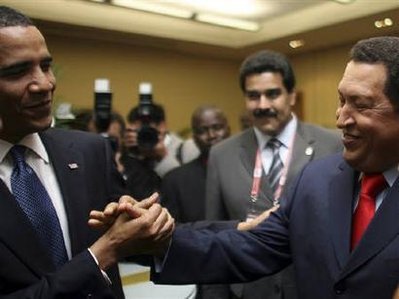
Are Barack Obama and Hugo Chavez very different?

From the Boston Globe.

Excerpt:

Venezuela’s government announced Friday that it is devaluing the country’s currency, a long-anticipated change expected to push up prices in the heavily import-reliant economy.

Officials said the fixed exchange rate is changing from 4.30 bolivars to the dollar to 6.30 bolivars to the dollar.

So, if you are earning and saving Bolivars, you just got a massive cut to your earnings and savings.

More:

By boosting the bolivar value of Venezuela’s dollar-denominated oil sales, the change is expected to help ease a difficult budget outlook for the government, which has turned increasingly to borrowing to meet its spending obligations.

[…]Economist Jose Guerra told The Associated Press that given the devaluation, he predicts inflation of more than 25 percent this year.

The announcement of the devaluation came after the country’s Central Bank said annual inflation rose to 22.2 percent in January, up from 20.1 percent at the end of 2012.

The oil-exporting country, a member of OPEC, has consistently had Latin America’s highest officially acknowledged inflation rates in recent years. Spiraling prices have come amid worsening shortages of some foods.

[…]It was the fifth time that Chavez’s government has devalued the currency since establishing the currency exchange controls a decade ago in an attempt to combat capital flight.

[…]The government’s announcement drew strong criticism from opposition leader Henrique Capriles, who said that the government’s heavy spending was to blame for the situation and that officials were trying to slip the change past the public at the start of a long holiday weekend.

The opposition party explains why this is happening:

‘They spent the money on campaigning, corruption, gifts abroad!’’ Capriles said in one of several messages on his Twitter account. Capriles was defeated by Chavez in an October presidential vote that was preceded by a burst of heavy government spending.

Who else do we know who likes to spend money and borrow from future generations? Someone whose economic policies are similar to Chavez? Who could it be? Increasing inflation is a very attractive policy to socialists who want to spend more money without raising taxes. It’s a hidden tax on those who try earn more and save their money. It punishes independence and makes dependence on the government inevitable.

Related posts

Socialist Argentina follows-up runaway inflation with price controls on groceries

Take a look at this article from the leftist Washington Post, which reports on how the socialists in Argentina have imposed price controls in order to minimize the impact of runaway inflation caused by money printing.

Excerpt:

Argentina announced a two-month price freeze on supermarket products Monday in an effort to stop spiraling inflation.

The price freeze applies to every product in all of the nation’s largest supermarkets — a group including Walmart, Carrefour, Coto, Jumbo, Disco and other large chains. The companies’ trade group, representing 70 percent of the Argentine supermarket sector, reached the accord with Commerce Secretary Guillermo Moreno, the government’s news agency Telam reported.

[…]Economist Soledad Perez Duhalde of the abeceb.com consulting firm predicted on Monday that the price freeze will have only a very short term effect, and noted that similar moves in Argentina had failed to control inflation. Consumers shouldn’t be surprised if the supermarkets are slow to restock their shelves and offer fewer products for sale, she added.

A more effective way to contain inflation would be to “reduce government spending, which is financing an expansion of the money supply, and to have a credible price index.”

Isn’t ironic that the United States is pursuing the exact same policy of printing money and overspending as Argentina has? Excerpt we are a little further along.

So what happens next in Argentina? Zero Hedge explains:

What consumers will certainly do is scramble into local stores to take advantage of artificially-controlled prices knowing very well they have two short months to stock up on perishable goods at today’s prices, before the country’s inflation comes soaring back, only this time many of the local stores will not be around as their profit margins implode and as owners, especially of foreign-based chains, make the prudent decision to get out of Dodge while the getting’s good and before the next steps, including such measures as nationalization, in the escalation into a full out hyperinflationary collapse, are taken by Argentina’s female ruler.

[…]So to summarize: first capital controls, then a currency crisis, then expectations of sovereign default, then a rise in military tensions, and finally – price controls, after which all out chaos usually follows.

Study this sequence well: it is coming to every “developed” country near you in the months and years ahead.

Just to be clear, price controls are a clear signal to suppliers to stop supplying, since they cannot make any money if prices are held low by government decree. Price controls lead to shortages, necessarily.  And that’s what’s in store for Argentina once the private sector food suppliers (and other companies) pull out of there when they can’t make a profit. There are other places they need to be.

Imagine if America elected a charismatic, incompetent fool to run our country like socialist dictators do in Argentina or Venezuela. Imagine if the mainstream media, with their non-quantitative degrees and lack of real-world experience, covered for his every blunder. Where would we be then?