Tag Archives: Holy Spirit

What is the Christian doctrine of the Trinity?

The Christian doctrine of the Trinity

I have a friend who is considering Christianity and he is stuck on the doctrine of the Trinity. Tom, this one’s for you.

Excerpt:

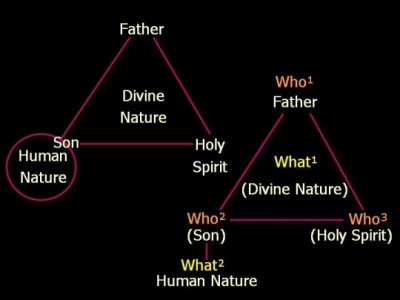
So, what exactly do we mean when we talk about the Trinity? Writing in the early third century, in hisAgainst Praxeas, Tertullian is credited with first employing the words “Trinity”, “person” and “substance” to convey the idea of the Father, Son and Spirit being “one in essence — but not one in person”. Indeed, Tertullian writes,

“Thus the connection of the Father in the Son, and of the Son in the Paraclete, produces three coherent Persons, who are yet distinct One from Another. These Three are, one essence, not one Person, as it is said, “I and my Father are One,” in respect of unity of substance not singularity of number.”

This concept was established as church orthodoxy at the famous Council of Nicaea in A.D. 325. The Nicene Creed speaks of Christ as “God of God, Light of Light, very God of very God, begotten not made, being of one substance with the Father.”

It is this definition that I am going to assume in the discussion that follows. Succinctly, then, the doctrine of the Trinity may be defined thusly: Within the one being or essence that is God, there exists three co-equal and co-divine distinct persons — namely the Father, Son and Holy Spirit — who share that essence fully and completely. This concept is not to be confused with polytheism, which maintains that there are multiple gods. While orthodox Christianity emphatically holds there to be only one God, we nonetheless understand God to be complex in his unity. The concept is also not to be confused with the ancient heresy of modalism, which maintains that God exists in three different modes. The Son has never been the Father and the Holy Spirit has never been the Son or the Father. Modalism is refuted by the picture given to us in all four gospels (Matthew 3:16-17; Mark 1:9-11; Luke 3:21-22; John 1:32-34) in which the Holy Spirit descends on Jesus in the form of a dove and a voice is heard from Heaven “This is my beloved Son. With him I am well pleased.” Similarly, it should be noted that the Father, Son and Spirit do not each make up merely a third of the Godhead. Rather, each of the three persons is God in the full and complete sense of the word.

Having shown that Scripture emphatically rejects the notion that the Father, Son and Spirit are synonymous persons, only five propositions remain to be demonstrated in order to provide Biblical substantiation for the concept of the Trinity. Those propositions are:

  1. There is only one eternal God.
  2. The Father is the eternal God.
  3. The Son is the eternal God.
  4. The Holy Spirit is the eternal God.
  5. Although the Father, Son and Holy Spirit are non-synonymous persons, the concept of the Trinity does not violate the law of non-contradiction.

Let’s take a look at each of these in turn.

He then takes a close look at what the Bible says about God with respect to those assertions. There can be no doubt that the Bible teaches that God is one divine substance, and three persons.

What is the meaning and significance of the holiday of Pentecost?

From Patheos, an article by New Testament scholar and pastor Mark D. Roberts.

Introduction:

For Christians, Pentecost is a holiday on which we commemorate the coming of the Holy Spirit on the early followers of Jesus. Before the events of the first Pentecost, which came a few weeks after Jesus’ death and resurrection, there were followers of Jesus, but no movement that could be meaningfully called “the church.” Thus, from an historical point of view, Pentecost is the day on which the church was started. This is also true from a spiritual perspective, since the Spirit brings the church into existence and enlivens it. Thus Pentecost is the church’s birthday.

I’m guessing most of you know the story of what happens. Peter preaches on who Jesus was, and the meaning of his bodily resurrection – and a whole lot of people believe him and become Christians.

Here are the topics that Roberts mentions in the article:

  1. The Presence and Power of the Spirit
  2. The Central Role of the Church in God’s Work in the World
  3. The Multilingual Nature and Mission of the Church
  4. The Inclusive Ministry of the Church

I wanted to excerpt the part of the article where Dr. Roberts explains a part that I think is important.

Excerpt:

3. The Multilingual Nature and Mission of the Church

On Pentecost, the Holy Spirit empowered believers in Jesus to praise God in many languages that they had not learned in the ordinary manner (Acts 2:5-13). Symbolically, this miracle reinforces the multilingual, multicultural, multiracial mission of the church. We are to be a community in which all people are drawn together by God’s love in Christ. As Paul writes in Galatians 3:28: “There is no longer Jew or Greek, there is no longer slave or free, there is no longer male and female; for all of you are one in Christ Jesus.”

Personal Implications: Although there are some glorious exceptions, it seems that the church has not, in general, lived out its multilingual mission. We are often divided according to language, race, and ethnicity. Pentecost challenges all of us to examine our own attitudes in the regard, to reject and repent of any prejudice that lurks within us, and to open our hearts to all people, even and especially those who do not share our language and culture. Yes, I know this is not easy. But it is central to our calling. And it is something that the Spirit of God will help us to do if we are available.

So this is a good thing to remember. Anyone who is willing to believe in Christ and re-prioritize their lives based on his identity and teachings can be a Christian.The Holy Spirit is available to anyone who is willing to respond to God’s drawing them towards himself – anyone who asks God to forgive their sins and re-orient their lives to that it is Christ-directed.

You really can’t look at a person and tell what they are going to be able to contribute to the mission of Christ. They might have a different skin color. They could come from far-away countries. And have different cultural backgrounds. They could be single and childless, or they could be married with children. They could be lonely or popular. They could be ugly or beautiful. They could be emotional and artistic, or scientific and technical. They could come from a happy family or have no family. They could be rich or they could be poor. They might not fit the mold of what we expect for what counts as a good Christian.

I’m not turning a blind eye to sin here, because sin that is celebrated and unrepented IS a reason to reject someone’s claim to be a Christian. I am trying to point out that we should not be rejecting or discounting sincere, effective Christians for non-moral considerations. This is not a country club. It’s all hands on deck.