Charles Darwin thought that “by far the strongest” evidence that humans and fish are descended from a common ancestor was the striking similarity of their early embryos. According to Darwin, the fact that “the embryos of the most distinct species belonging to the same class are closely similar, but become, when fully developed, widely dissimilar… reveals community of descent.” 2 To illustrate this, German Darwinist Ernst Haeckel made some drawings in the 1860s to show that the embryos of vertebrates (fish, amphibians, reptiles, birds and mammals) look almost identical in their earliest stages.
But Haeckel faked his drawings. Not only do they distort vertebrate embryos by making them appear more similar than they really are (in a way that Stephen Jay Gould wrote “can only be called fraudulent” 3), but they also omit classes and stages that do not fit Darwin’s theory. Most significantly, Haeckel omitted the earliest stages, in which vertebrate embryos are strikingly different from each other. The stage he portrayed as the first is actually midway through development. Yet according to Darwin’s logic, early dis-similarities do not provide evidence for common ancestry.
Haeckel used his faked drawings to support not only Darwinian evolution, but also his own “Biogenetic Law,” which stated that embryos pass through the adult stages of their ancestors in the process of development.
…Haeckel’s drawings were exposed as fakes by his own contemporaries, and his Biogenetic Law was thoroughly discredited by 20th century biologists. It is now generally acknowledged that early embryos never resemble the adults of their supposed ancestors. A modern version of recapitulation claims that early embryos resemble the embryos of their ancestors, but since fossil embryos are extremely rare, this claim is little more than speculation based on the assumption that Darwin’s theory is true.
Now the standard response from Darwinists: no textbooks are still using the fraudulent embryo images.
You can see the actual faked pictures from the modern textbooks here. These textbooks were being produced as late as 2004, even though the fraud was detected in the 1800s! Is this the vaunted self-correction of science, or science being twisted to support social and political goals?
And this excerpt from that article is interesting:
Some Darwinists continue to deny that there has been any misuse of Haeckel in recent times. If that is the case, why did Stephen Jay Gould attack how textbooks use Haeckel in 2000? Gould wrote: “We should… not be surprised that Haeckel’s drawings entered nineteenth-century textbooks. But we do, I think, have the right to be both astonished and ashamed by the century of mindless recycling that has led to the persistence of these drawings in a large number, if not a majority, of modern textbooks!” (emphasis added) Similarly, in 1997, the leading embryologist Michael K. Richardson lamented in the journal Anatomy and Embyology that “Another point to emerge from this study is the considerable inaccuracy of Haeckel’s famous figures. These drawings are still widely reproduced in textbooks and review articles, and continue to exert a significant influence on the development of ideas in this field.” (emphases added)
Here is a link to the peer-reviewed journal Science, where there is an article talking about the fraudulent embryo drawings. Yes – the drawings really are fraudulent.
And finally, Casey Luskin has a new post up at Evolution News that lists all the textbooks that contain the fraudulent drawings. One is dated 2013! The drawings just keep getting recycled over and over as a “proof” of evolution.
It was 1 a.m. on a Saturday when the call came. A friend, a University of Virginia freshman who earlier said she had a date that evening with a handsome junior from her chemistry class, was in hysterics. Something bad had happened.
Arriving at her side, three students —“Randall,” “Andy” and “Cindy,” as they were identified in an explosive Rolling Stone account — told The Washington Post that they found their friend in tears. Jackie appeared traumatized, saying her date ended horrifically, with the older student parking his car at his fraternity, asking her to come inside and then forcing her to perform oral sex on five men.
In their first interviews about the events of that September 2012 night, the three friends separately told The Post that their recollections of the encounter diverge from how Rolling Stone portrayed the incident in a storyabout Jackie’s alleged gang rape at a U-Va. fraternity. The interviews also provide a richer account of Jackie’s interactions immediately after the alleged attack and suggest that the friends are skeptical of her account.
The scene with her friends was pivotal in the article, as it alleged that the friends were callously apathetic about a beaten, bloodied, injured classmate reporting a brutal gang rape at the Phi Kappa Psi fraternity. The account alleged that the students worried about the effect it might have on their social status and how it might reflect on Jackie during the rest of her collegiate career and that they suggested not reporting it. It set up the article’s theme: That U-Va. has a culture that is indifferent to rape.
“It didn’t happen that way at all,” Andy said.
Instead, the friends remember being shocked. Although they did not notice any blood or visible injuries, they said they immediately urged Jackie to speak to police and insisted that they find her help. Instead, they said, Jackie declined and asked to be taken back to her dorm room. They went with her — two said they spent the night — seeking to comfort Jackie in what appeared to be a moment of extreme turmoil.
[…]They said there are mounting inconsistencies with the original narrative in the magazine. The students also expressed suspicions about Jackie’s allegations from that night. They said the name she provided as that of her date did not match anyone at the university, and U-Va. officials confirmed to The Post that no one by that name has attended the school.
Also, photographs that were texted to one of the friends showing her date that night were actually pictures depicting one of Jackie’s high school classmates in Northern Virginia. That man, now a junior at a university in another state, confirmed that the photographs were of him and said he barely knew Jackie and hasn’t been to Charlottesville for at least six years.
The friends said they were never contacted or interviewed by the pop culture magazine’s reporters or editors. Although vilified in the article as coldly indifferent to Jackie’s ordeal, the students said they cared deeply about their friend’s well-being and safety.
[…]They also said Jackie’s description of what happened to her that night differs from what she told Rolling Stone. In addition, information Jackie gave the three friends about one of her attackers, called “Drew” in the magazine’s article, differ significantly from details she later told The Post, Rolling Stone and friends from sexual assault awareness groups on campus. The three said Jackie did not specifically identify a fraternity that night.
[…]The article’s writer, Sabrina Rubin Erdely, did not respond to requests for comment this week.
Rolling Stone also declined to comment, citing an internal review of the story.
The leftist site Slate has an article by well-known radical feminist Hanna Rosin, who analyzes the Washington Post article.
She writes:
The Washington Post has an update on Rolling Stone‘s UVA story that strongly implies, without outright saying so, that the gang rape at the center of Sabrina Rubin Erdely’s article might be fabricated. Post reporter T. Rees Shapiro spoke at length with the three friends who met up with Jackie, the student who says she was raped, on the night in question. In the Rolling Stone story this scene was crucial. Erdely described Jackie as standing mute in her bloody dress, the Phi Kappa Psi house where the alleged rape happened looming in the background, as her friends callously debated whether they should take her to the hospital and risk ruining their social reputations. This set up the larger theme of a university culture and social scene indifferent even to the most brutalized victims of rape.
Earlier, those friends told the Post that Jackie told them she’d been forced to have oral sex—a much different story than what Jackie told Rolling Stone. This new Post article adds some details that make the entire account seem more suspicious. Jackie had told her friends—referred to by the pseudonyms “Cindy,” “Andy,” and “Randall” in the original story and in the Post’s follow-ups—that she had a date on Sept. 28, 2012, with a handsome junior in her chemistry class. (In the version she told to Rolling Stone, that date was with someone she’d met at her lifeguarding job.) But in the Post story, the friends imply that this junior might not exist and may have been invented by Jackie to make Randall jealous.
When the friends first heard about this junior, they were intrigued and asked Jackie for his number. They started exchanging text messages with him, and he described Jackie as a “super smart hot” freshman. He complained, though, that she liked a “nerd 1st yr”— meaning Randall—who is “smart and funny and worth it.” Jackie’s friends could never find this junior in the UVA database nor on social media. She provided her friends with a picture of him, but the Post has since learned that the guy in the picture is a high school classmate of Jackie’s who does not go to the University of Virginia and was in another state participating in an athletic tournament on the night of the alleged rape. (More recently, Jackie gave her friends the name of a different guy. The Post also contacted him, and he said he’d never met Jackie.)
[…]Jackie has now given her friends two different names for the man she was with that night. Neither of them was in fact with her, ever dated her, or even knew her all that well. She appears to have invented a suitor, complete with fake text messages and a fake photo, which suggests a capacity for somewhat elaborate deception. Jackie, though, has not recanted her story. Her attorney would not answer questions for the Post‘s story on Wednesday and has told reporters to stop contacting Jackie.
Here’s the most disturbing journalistic detail to emerge from the Post‘s reporting: In the Rolling Stone story, Erdely says that she contacted Randall, but he declined to be interviewed, “citing his loyalty to his own frat.” Randall told the Post he was never contacted by Erdely and would have been happy to be interviewed.
A web site called GotNews is claiming to have identified the Jackie from the story, and the Jackie they identified was a student activist in high school. That woman’s Pinterest page sported a lot of radical feminist “rape culture” memes. Also, the author of the Rolling Stone piece is a well-known feminist activist and she has in the past confessed to “shopping around” for victims in order to further her feminist agenda. That link takes you to a Youtube video where she explains her feminist agenda in her own words. This is what students learn as gospel in college, though. Our laws and our culture are built around this Sabrina / Rolling Stone view of men.
There was a story about an alleged gang rape published in the Rolling Stone, which is an ultra-left wing magazine, which came under scrutiny from left-wing news sources like The New Republic and The Washington Post because it was not fact-checked and disagreed with known facts.
Rolling Stone has clarified its apology over a story that had reported a female student was gang-raped at a University of Virginia fraternity, telling readers the mistakes were the magazine’s fault, not the alleged victim’s.
[…]The magazine said that it shouldn’t have agreed to Jackie’s request not to contact the alleged assailants to get their side of the story, out of sensitivity to her. “These mistakes are on Rolling Stone, not on Jackie,” wrote the magazine’s managing editor, Will Dana. “We apologize to anyone who was affected by the story and we will continue to investigate the events of that evening.” The decision not to contact the alleged rapists prompted criticism from other news organizations.
[…]The allegations rocked the campus and elevated the issue of sexual assault, leading to protests, a suspension of fraternity activities and an emergency Board of Visitors meeting.
Dana’s updated message added some details calling into question the magazine’s original story. He noted that Phi Kappa Psi has denied the assault, and said it didn’t host an event on the night Jackie alleged she was raped. And Dana said that Jackie is now unsure that the man who allegedly lured her into a room to be gang-raped by seven men, identified as “Drew,” was a member of Phi Kappa Psi.
“According to the Washington Post, ‘Drew’ actually belongs to a different fraternity and when contacted by the paper, he denied knowing Jackie,” Dana wrote in the new note. “Jackie told Rolling Stone that after she was assaulted, she ran into ‘Drew’ at a UVA pool where they both worked as lifeguards. In its statement, the Phi Psi says none of its members worked at the pool in the fall of 2012.” Dana also cited the Post’s account of several of Jackie’s friends doubting her “narrative,” although Jackie told the Post she stood by the account she gave to Rolling Stone.
False rape charges actually occur quite frequently – remember the Duke University rape hoax or the Lehigh University rape hoax or the Hofstra University rape hoax? The left-wing media loves to cover them because it makes men look bad, and makes women think that they need to vote for bigger government in order to protect them from dangerous men.
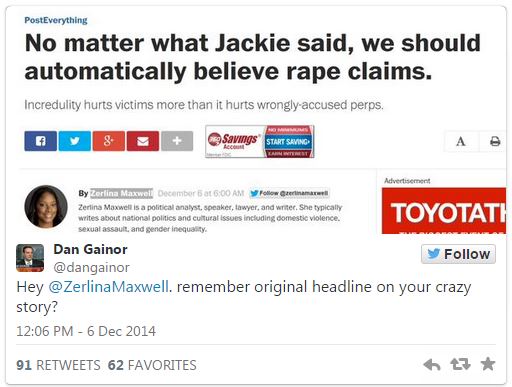
But what’s been fascinating is the reaction of feminists on the left to the Rolling Stone’s apology. Do they care about fact-checking rape charges, or do they think that all rape charges are “automatically” true?
She later changed the title of the article, but the URL still contains the word “automatically”. Automatically – believe the charge before checking the facts.
She writes:
Many people (not least UVA administrators) will be tempted to see this as a reminder that officials, reporters, and the general public should hear both sides of the story and collect all the evidence before coming to a conclusion in rape cases. This is what we mean in America when we say someone is “innocent until proven guilty.” After all, look what happened to the Duke lacrosse players.
In important ways, this is wrong. We should believe, as a matter of default, what an accuser says. Ultimately, the costs of wrongly disbelieving a survivor far outweigh the costs of calling someone a rapist. Even if Jackie fabricated her account, UVA should have taken her word for it during the period while they endeavored to prove or disprove the accusation.
The author’s bio:
Zerlina Maxwell is a political analyst, speaker, lawyer, and writer. She typically writes about national politics and cultural issues including domestic violence, sexual assault, and gender inequality.
This is how people on the left form their beliefs in college. They listen to what professors tell them, and insult anyone who questions what they believe by calling them names like “racist”, “sexist”, “homophobe” or “Islamophobe”. This is a college education – at least in non-STEM fields. People pay money to be indoctrinated like this. Lots of money.
Well, maybe this is just a lone outlier, though. One bad feminist who doesn’t care about truth.
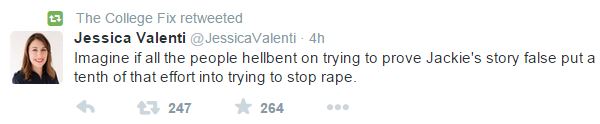
Nope! Here’s famous feminist Jessica Valenti, tweeting this:
Jessica Valenti: fake but accurate
Here’s another from Julia Horowitz, reported by Newsbusters: (links removed)
In a Politico magazine article on the UVA rape accusation debacle, in which the accuser’s allegations have unraveled, Julia Horowitz, an assistant managing editor at the college paper The Daily Cavalier, claimed “to let fact checking define the narrative would be a huge mistake.”
[I]t is becoming increasingly clear that the story that blew the lid off campus sexual assault has some major, major holes. Ultimately, though, from where I sit in Charlottesville, to let fact checking define the narrative would be a huge mistake….
It is no accident that the article came out, and it became apparent almost immediately that there were very tangible things we needed to discuss.
Yes, the story was sensational. But even the most sensational story, it seems, can contain frightening elements of truth.
Of course! Facts can be so, well, inconvenient. Viva the “narrative.” We’re with the Alice in Wonderland Queen: “sentence first — verdict afterwards.”
When the now-retracted article by the Rolling Stone magazine was published on November 19 about a brutal gang rape of a first-year student at the Phi Kappa Psi fraternity house at the University of Virginia (UVA), the major broadcast networks rushed to the story and devoted multiple segments to both the article and reaction on the school’s campus.
[…]The “big three” of ABC, CBS and NBC offered coverage on their evening newscasts over the course of November 23 and 24, with ABC’s World News Tonight and NBC Nightly News covering it on the 23rd. The following night, an additional report was filed by ABC and NBC each to go along with the first from the CBS Evening News with Scott Pelley. On those two evenings alone, the total network coverage was 11 minutes and 14 seconds.
While the three programs combined for just under 8 minutes of thorough coverage on Friday night, that does little to excuse their inability to investigate the story independently or even check the facts of the Rolling Stone piece on their own.
[…]On NBC Nightly News, anchor Brian Williams was the sole anchor to admit that his program had filed stories based off of the very article that he and NBC’s Kristen Welker would now report had major “discrepancies.”
Still, the networks had pitfalls in their coverage of the retraction. As suggested two sentences prior, ABC and CBS failed to join with NBC in not admitting to having previously blindly covered this subject.
Also, CBS and NBC fell short in only interviewing students who, respectively, suggested pieces like this are why victims hesitate coming forward and dismissed the fact that the story is now in severe doubt because the issue of sexual assault is “still a problem” on college campuses “even if it’s not real.”
Now, I thought that people who go to journalism school did nothing but learn how to discover the truth about a story. I thought that it was like police detective work – interviewing witnesses, checking facts, corroborating testimony, digging through records. How wrong I was. But I think I’ll be right about something else – I think a lot of people who read the original story will believe it based on intuitions and emotions, even now after significant portions of the story conflict with known facts. They’ll believe it because that’s what they’ve been brainwashed in non-STEM programs to believe. They’ve become incapable of critical thinking, incapable of updating their views according to evidence and incapable of respectful dialog with those who disagree with them.




 WINTERY KNIGHT