
Tag Archives: History

Archaeologists discover entrance to Herod’s palace near Bethlehem

Herod's palace
Herod’s palace

Baptist Press reports on the story.

Full text:

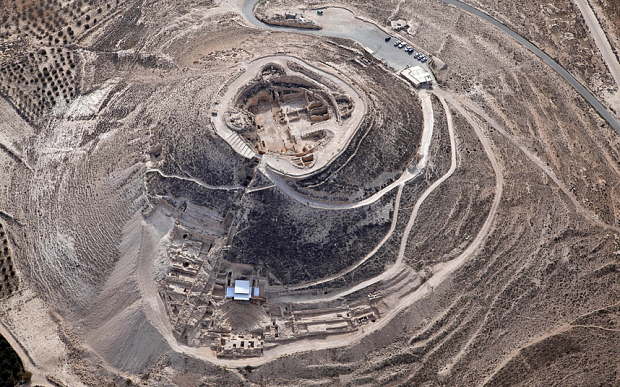
Israeli archeologists have uncovered an impressive entrance to Herod’s palace at Herodium. Located only three miles southeast of Bethlehem, Herodium played an important part in the events surrounding the early life of Christ.

The December announcement by Hebrew University archeologists Roi Porat, Yakov Kalman and Rachel Chachy dovetails well with the seasonal interest in the nativity accounts of Luke and Matthew in the New Testament.

While both Luke and Matthew wrote that King Herod governed Judea during the era of Jesus’ birth at Bethlehem (Luke 1:5, Matthew 2:1), they included nothing concerning Herod’s massive palace/fortress complex at nearby Herodium.

Herodium, like Herod’s other isolated palace/fortress complexes at Masada and Machaerus, was built on a mountain. To enhance its impressive scale, Herod artificially extended the height of the hill to make it the tallest mountain in the Judean desert.

While the site included the usual Herodian luxuries such as a palace, bathhouse, theatre and garden, Herodium was essentially a fortress, a place where Herod could find refuge if his people revolted.

Herod’s fear of a Jewish revolt led him to establish many fortresses in both urban centers (he maintained two in Jerusalem itself) and in isolated rural areas away from the urban centers.

A small community close to the fortress housed the construction teams and, later, the garrison soldiers and palace servants. The servants who waited on the king indeed worked in an impressive palace.

The newly uncovered entranceway apparently was still being constructed near the time of the monarch’s death.

As shown in one of the photographs, the entryway included three levels of arches in a 65-foot corridor that was 19 feet across and 65 feet in height leading to the palace’s courtyard. Curiously enough, the nearly completed entrance was abruptly stopped and backfilled around the time of Herod’s death. The archeologists speculated that the now-aging Herod instead sought to convert the entire palace into a memorial mound for his upcoming burial at the site.

Indeed, Herod’s plans for Herodium unfolded as Jesus was born and as He spent His early life in nearby Bethlehem. When the magi arrived in Jerusalem and announced they had come to worship the “king of the Jews,” Herod sent them to Bethlehem after learning the location of the Messiah’s birthplace from the chief priests and learned scholars. The monarch hoped to ascertain from the magi which of the town’s small children was the designated royal candidate. Then Herod hoped to execute the child (Matthew 2:1-8, 2:16).

When the magi failed to return with this information, Herod ordered his soldiers into Bethlehem to murder all children age 2 and under. Warned to flee to Egypt, the holy family escaped Herod’s plans, but an undisclosed number of children were killed by Herod’s soldiers. Although never stated in the biblical account, the soldiers who carried out the old king’s infamous order were either stationed in Jerusalem (seven miles from Bethlehem) or in the closer post at Herodium. In fact, Herodium overlooked Bethlehem and could have functioned as a convenient headquarters for Herod’s deadly operation.

While the holy family resided in Egypt, another Herodium connection to the early life of Christ took place. After a long and terribly painful illness, Herod died. His surviving eldest son (Herod had murdered his three oldest sons), Archelaus, then buried him in Herodium at a pre-selected tomb and gave his father an elaborate funeral at the site and spared no expense, according to the Jewish historian Josephus (Jewish War, 1,673).

Israeli archeologist Ehud Netzer claimed to have found Herod’s tomb and damaged sarcophagus (stone coffin) in 2007 at Herodium, but in 2013 and 2014 other archeologists have raised doubts about the tomb and the sarcophagus. Israeli archeologists Joseph Patrich and Benjamin Arubas largely based their doubts on the modest tomb site and the unimpressive sarcophagus. They believe that the mega-maniacal Herod would have commissioned a larger tomb and a more elaborate sarcophagus.

With Herod now buried in Herodium and with Archelaus eventually ruling over much of his father’s former kingdom as an “ethnarch” (“ruler of the people”), the New Testament noted the change in political leadership (Matthew 2:19-22). The change prompted Joseph to consider a move back to Judea (perhaps back to Bethlehem itself where the family had lived for about two years), but his misgivings about a Judea under the rule of an already unpopular Archelaus and a warning in a dream led him to reconsider. The decision was a wise one. A return to Bethlehem in the “shadow of Herodium” and the nearby royal city of Jerusalem placed the holy family at potential risk.

Instead, Joseph took his family back to Nazareth in Galilee (Matthew 2:22-23). Galilee was governed by Herod Antipas, the younger brother of Archelaus. At the time, this Herodian ruler, with the title of “tetrarch” (“ruler over a fourth”), was regarded as a milder alternative to the volatile Archelaus. Located far away from the recent unpleasant associations connected to Herodium and the slaughter of the children in Bethlehem, Joseph and Mary would raise Jesus in the peaceful surroundings of Nazareth.

The recent archeological find in Herodium and the continuing dispute concerning Herod’s tomb and sarcophagus calls attention to the background story of the early life of Christ as detailed in the Gospel of Matthew. Perhaps some further archeological discoveries at Herodium will uncover additional information about the familiar nativity narrative.

I liked this article on Baptist Press so much, I pasted it here in full – because of the links between history and the Bible. It’s also reported in secular news sources like NBC News and the UK Telegraph.

When I read stories like this, it really makes me question people who think that the New Testament books were not intended to be history. I think the default view has to be that the authors intended to write history, and then we do the work to see which parts pass historical tests – i.e. – how early, how many sources, how many eyewitnesses, etc. And, do we have archaeological evidence to corroborate the narrative.

Was Stalin an atheist? Is atheism or communism responsible for mass murders?

Let’s take a look at what Josef Stalin did during his rule of Russia in the 1920s and 1930s.

The Library of Congress offers this in their “Soviet Archives exhibit”:

The Soviet Union was the first state to have as an ideological objective the elimination of religion. Toward that end, the Communist regime confiscated church property, ridiculed religion, harassed believers, and propagated atheism in the schools. Actions toward particular religions, however, were determined by State interests, and most organized religions were never outlawed.

The main target of the anti-religious campaign in the 1920s and 1930s was the Russian Orthodox Church, which had the largest number of faithful. Nearly all of its clergy, and many of its believers, were shot or sent to labor camps. Theological schools were closed, and church publications were prohibited. By 1939 only about 500 of over 50,000 churches remained open.

Let’s see more from a peer-reviewed journal article authored by Crispin Paine of the University College, London:

Atheist propaganda and the struggle against religion began immediately after the Bolsheviks seized power in 1917. While social change would, under Marxist theory, bring religion to disappear, Leninists argued that the Party should actively help to eradicate religion as a vital step in creating ‘New Soviet Man’. The energy with which the Party struggled against religion, though, varied considerably from time to time and from place to place, as did its hostility to particular faith groups. The 1920s saw the closure of innumerable churches and synagogues (and to a lesser extent mosques) and the active persecution of clergy and harassment of believers. From 1930, though, Stalin introduced a less aggressive approach, and wartime support for the government earned for the Russian Orthodox Church, at least, a level of toleration which lasted until Stalin’s death. Under Khrushchev antireligious efforts resumed, if spasmodically, and they lasted until the end of the Soviet Union.

An article from the pro-communism Marxist.com web site says this about Stalin:

During the ultra-left period of forcible collectivisation and the Five Year Plan in Four an attempt was made to liquidate the Church and its influence by government decree. Starting in 1929 churches were forcibly closed and priests arrested and exiled all over the Soviet Union. The celebrated Shrine of the Iberian Virgin in Moscow – esteemed by believers to be the “holiest” in all Russia was demolished – Stalin and his Government were not afraid of strengthening religious fanaticism by wounding the feelings of believers as Lenin and Trotsky had been! Religion, they believed, could be liquidated, like the kulak, by a stroke of the pen. The Society of Militant Atheists, under Stalin’s orders, issued on May 15th 1932, the “Five Year Plan of Atheism” – by May 1st 1937, such as the “Plan”, “not a single house of prayer shall remain in the territory of the USSR, and the very concept of God must be banished from the Soviet Union as a survival of the Middle Ages and an instrument for the oppression of the working masses.”!

Now, if all you read were atheist web sites, you’d think that Stalin loved religion and wasn’t opposed to Christianity at all. An atheist I know told me that Stalin was a Christian because that’s what he was as a child at one point. Funny sort of way to carry out your Christian faith, isn’t it? If you read atheist web sites, you’d expect Stalin to have had the career of a William Lane Craig or a J.P. Moreland. And yet in the fever swamp of atheist web sites, this is what they tell themselves. They believe it because they want to believe it. They have to believe it, in order to keep God at bay.

Now, if you were going to pick a hero of the Christian faith, you’d probably pick a real fundamentalist like William Wilberforce, who freed the slaves – because of his evangelical Christian convictions. Wilberforce took Christianity seriously – he believed every verse of the Bible, he tried to convert people to his faith, and he pushed his faith on others by passing laws. He was the worst nightmare of atheism – a politically active Evangelical Christian.

But who is a great atheist who was politically active? When I think of a great atheist, someone who really did the most to oppose the “lie” of God’s existence, I think of Josef Stalin. So what kind of morality can we expect from someone who takes the message of Richard Dawkins and Dan Barker seriously and has the political power to really do something about it?

The Ukraine Famine

Take a look at this UK Daily Mail article about a great achievement of the atheist Josef Stalin, which occurred in 1932-1933.

Excerpt:

Now, 75 years after one of the great forgotten crimes of modern times, Stalin’s man-made famine of 1932/3, the former Soviet republic of Ukraine is asking the world to classify it as a genocide.

The Ukrainians call it the Holodomor – the Hunger.

Millions starved as Soviet troops and secret policemen raided their villages, stole the harvest and all the food in villagers’ homes.

They dropped dead in the streets, lay dying and rotting in their houses, and some women became so desperate for food that they ate their own children.

If they managed to fend off starvation, they were deported and shot in their hundreds of thousands.

So terrible was the famine that Igor Yukhnovsky, director of the Institute of National Memory, the Ukrainian institution researching the Holodomor, believes as many as nine million may have died.

[…]Between four and five million died in Ukraine, a million died in Kazakhstan and another million in the north Caucasus and the Volga.

By 1933, 5.7 million households – somewhere between ten million and 15 million people – had vanished. They had been deported, shot or died of starvation.

This is what follows when you believe that the universe is an accident, that there is no objective good and evil, that human beings are just animals, that no God will hold us accountable, and that human beings are not made in the image of God for the purpose of freely choosing to come into a relationship with him. The Ukrainian famine is an action that came from a man whose worldview was passionate atheism.

Atheism today

You might think that today’s atheists are much different than Josef Stalin, but understand that according to a recent survey of atheists conducted by atheists, 97% of atheists are pro-abortion. How many people have been killed by abortion? 56 million in the United States alone. Atheists in a society like ours, founded on Judeo-Christian values, are obviously going to live a lot better than Stalin. For one thing, they don’t have the power that Stalin had to eradicate theism, although you can see Stalinism in the anti-Christian activities of groups like the Freedom From Religion Foundation. But take away the Judeo-Christian foundations of this society, and what would you see atheists doing?

Remember the words of Richard Dawkins:

The total amount of suffering per year in the natural world is beyond all decent contemplation. During the minute that it takes me to compose this sentence, thousands of animals are being eaten alive, many others are running for their lives, whimpering with fear, others are slowly being devoured from within by rasping parasites, thousands of all kinds are dying of starvation, thirst, and disease. It must be so. If there ever is a time of plenty, this very fact will automatically lead to an increase in the population until the natural state of starvation and misery is restored. In a universe of electrons and selfish genes, blind physical forces and genetic replication, some people are going to get hurt, other people are going to get lucky, and you won’t find any rhyme or reason in it, nor any justice. The universe that we observe has precisely the properties we should expect if there is, at bottom, no design, no purpose, no evil, no good, nothing but pitiless indifference.

(“God’s Utility Function,” Scientific American, November, 1995, p. 85)

Now, having said that, I readily admit that many atheists adopt Judeo-Christian values if their society is saturated with them, but they are acting better than their worldview requires. They are acting inconsistently with what atheism really teaches. It’s good for us that they do, but for how long?

New paper from Michael Licona on historical methods and miracle claims

I hope that all my readers know who Michael Licona is!

The PDF of his new paper is here. It published in the Journal for the Study of the Historical Jesus.

Here’s the abstract:

Most biblical scholars and historians hold that the investigation of a miracle report lies outside of the rights of historians acting within their professional capacity. In this essay, I challenge this position and argue to the contrary. A definition of history should not a prioriexclude the possibility of investigating miracle claims, since doing so may restrict historians to an inaccurate assessment of the past. Professional historians outside of the community of biblical scholars acknowledge the frequent absence of a consensus; this largely results from conflicting horizons among historians. If this is the present state among professionals engaged in the study of non-religious history, it will be even more so with historians of Jesus. Finally, even if some historians cannot bring themselves to grant divine causation, they, in principle, can render a verdict on the event itself without rendering a verdict on its cause.

Here’s a bit that I found interesting:

It is clear that the horizon of atheist New Testament scholar Gerd Lüdemann is a driving force behind his historical conclusions when he a priori rules out the  historicity of the ascension of Jesus reported in Acts 1.9–11 ‘because there is no  such heaven to which Jesus may have been carried’.14 Ontological naturalism  similarly guides James Tabor. He writes:

Women do not get pregnant without a male—ever. So Jesus had a human father… Dead bodies don’t rise… So, if the tomb was empty the historical  conclusion is simple—Jesus’ body was moved by someone and likely  reburied in another location.15

Not so obvious is Geza Vermes in his 2008 volume The Resurrection: History and Myth.16 With hardly a comment, Vermes simply dismisses both ‘the out-ofh-and rejection of the inveterate skeptic’ and the hypothesis that Jesus rose from the dead since it can only be made from ‘the blind faith of the fundamentalist believer’.17

I thought these were interesting because Ludemann gives you the post-mortem “visions” of Jesus, and Vermes gives you the empty tomb – yet both are naturalists. Notwithstanding that, it’s pretty clear that these guys are not open to miracles a priori, and yet they probably think they are good historians, and able to get at the truth. Even though they rule out some explanations before even looking at the evidence.

So what would you call a detective who ruled out some causes of death but not others, before looking at the evidence?

More:

Second, methodological naturalism may handicap historians, preventing them in some cases from providing a fuller and more accurate account of the past. Molecular biologist Michael Behe provides a relevant challenge to this approach in his discipline. He writes:

Imagine a room in which a body lies crushed, flat as a pancake. A dozen detectives crawl around, examining the floor with magnifying glasses for any clues to the identity of the perpetrator. In the middle of the room, next to the body, stands a large, grey elephant. The detectives carefully avoid bumping into the pachyderm’s legs as they crawl, and never even glance at it. Over time the detectives get frustrated with their lack of progress but resolutely press on, looking even more closely at the floor. You see, textbooks say detectives must ‘get their man’, so they never consider elephants.19

In context, Behe is contending that when scientists limit their considerations exclusively to unguided natural causes they will forever keep themselves from discovering the actual cause if a Designer of some sort was responsible. A similar admonition may be issued to historians who a priori exclude a non-human agent as the cause behind a past event. Those who do so could actually be placing themselves in a position where they cannot appraise history accurately.20

The rest of the paper discusses two options for historians who want to resolve this problem.

So, I’m impressed that Mike Licona reads Mike Behe (that quote is from “Darwin’s Black Box”). Pretty cool. You should download the PDF just for the footnotes, to see what else he is reading that you might want to read too. What I like to see is lots of science and lots of debates and lots of different points of view. He reads across disciplines, he reads people who disagree with him. We one-dollar apologists all need to be like that.

Back to his paper. I see this presupposition of naturalism come up in debates on the historical Jesus, where the naturalist will just assume naturalism and then proceed to do history – even at a time where we have so many scientific arguments to undermine naturalism. It’s a bad philosophical view, and we shouldn’t let it influence how we do history.

If you run into these historians who are slaves to naturalism, it might be worth it to make them defend it. You ask them – do you believe in naturalism? If they say yes, ask them for scientific evidence for naturalism. And when they finish not giving you any, then you can go on a long monologue on the origin of the universe, the fine-tuning, the origin of life, the Cambrian explosion, the habitability (galactic and stellar), and so on. Then tell them to stop bring their blind religious faith into their historical investigations.