Tag Archives: History

Mike Licona lectures on historical methods and the New Testament

Here’s a quick overview of Michael Licona’s latest book on the resurrection, entitled “The Resurrection of Jesus“.

60 minutes of lecture, 20 minutes of Q&A.

Summary:

  • Dr. Licona’s background and education
  • The definition of history and philosophy of history
  • Postmodern approaches to history
  • Historical bedrock: facts that are historically demonstrable
  • Historical criterion 1: Explanatory scope
  • Historical criterion 2: Explanatory power
  • Historical criterion 3: Plausibility
  • Historical criterion 4: Ad Hoc / Speculation / non-evidenced assumptions
  • Inference to the best explanation
  • Investigating miracle claims: is it possible? How?
  • Objection of James D.G. Dunn
  • Objection of Bart Ehrman
  • New Testament sources: Gospels and Paul’s letters
  • The Gnostic gospels: are they good sources?
  • The minimal facts
  • The hallucination hypothesis
  • The best explanation

While watching this lecture, it struck what good preparation it was for understanding debates. This lecture is more about historical methods, but if you’re interested in Mike’s minimal facts case for the resurrection, here’s a video on that:

This is the case he uses in his debates with Richard Carrier, Dale Allison, Bart Ehrman, etc.

Mike Licona’s ministry is here: Risen Jesus.

If you are looking for a good book to read on the resurrection of Jesus, the best introductory book on the resurrection is “The Case for the Resurrection of Jesus” and the best comprehensive book is “The Resurrection of Jesus“.
Peter J. Williams lectures on the historical reliability of the gospel narratives

Investigation in progress

Here’s the main lecture: (54 minutes)

And here’s the Q&A: (9 minutes)

About Peter Williams:

Peter J. Williams is the Warden (CEO) of Tyndale House and a member of the Faculty of Divinity in the University of Cambridge. He received his MA, MPhil and PhD, in the study of ancient languages related to the Bible from Cambridge University.

Summary of the lecture:

  • What if the stories about Jesus are legendary?
  • were the gospels transmitted accurately?
  • were the gospels written in the same place as where the events happened?
  • do the gospel authors know the customs and locations where the events happened?
  • do the gospels use the right names for the time and place where the events took place?
  • do the gospels disambiguate people’s names depending on how common those names were?
  • how do the New Testament gospels compare to the later gnostic gospels?
  • how do the gospels refer to the main character? How non-Biblical sources refer to Jesus?
  • how does Jesus refer to himself in the gospels? do the later Christians refer to him that way?
  • how does Jesus teach? do later Christians teach the same way?
  • why didn’t Jesus say anything about early conflicts in the church (the Gentiles, church services)?
  • did the writers of the gospels know the places where the events took place?
  • how many places are named in the gospels? how about in the later gnostic gospels?
  • are the botanical details mentioned in the gospels accurate? how about the later gnostic gospels?

And here are the questions from the audience:

  • how what about the discrepancies in the resurrection narratives that Bart Ehrman is obsessed with?
  • what do you think of the new 2011 NIV translation (Peter is on the ESV translation committee)?
  • how did untrained, ordinary men produce complex, sophisticated documents like the gospels?
  • is oral tradition a strong enough bridge between the events and the writers who interviewed the eyewitnesses?
  • what does the name John mean?
  • why did the gospel writers wait so long before writing their gospels?
  • do you think that Matthew and Luke used a hypothetical source which historians call “Q”?
  • which gospel do critical historians trust the least and why?

I really enjoyed watching this lecture. He’s getting some of this material from Richard Bauckham’s awesome book “Jesus and the Eyewitnesses”, so if you aren’t familiar with it, you can get an idea of what’s in it. Peter Williams is a lot of fun to listen to – an excellent speaker.


Cambridge University professor Simon Gathercole lectures on geography in the Bible

BeThinking posted a new lecture featuring Dr. Simon Gathercole.

Here’s the speaker bio:

Dr Simon Gathercole is Senior Lecturer in New Testament Studies and Fellow of Fitzwilliam College, at the University of Cambridge. He is particularly fascinated by the connections between the New Testament and its contemporary literature.

Summary:

Simon Gathercole shows how the geographical information in the New Testament Gospels demonstrates their historical reliability and their basis in eyewitness sources. The illustrated lecture lasts about 60 minutes and is followed by about 20 minutes of Q&A.

BeThinking has a PDF containing all the slides used in the lecture.

The lecture is here:

Topics:

  • Detailed geography is difficult to fake, especially when it is far into the past
  • Bible authors would have to rely on eyewitness testimony if they wanted to get geographic details right
  • You can even cross-reference the geographic details mentioned in the New Testament with extra-Biblical sources of that time
  • Cities mentioned in the Bible are mentioned in other sources
  • Locations that are mentioned in Josephus, a Jewish historian
  • Locations that are mentioned in the Rabbis
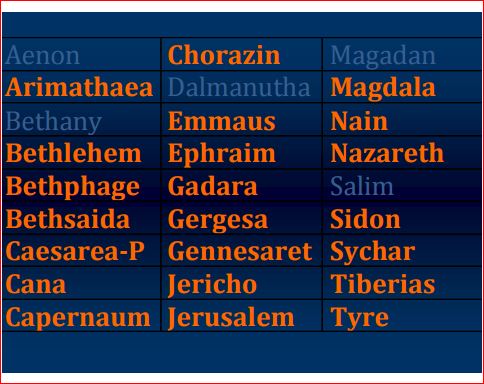
  • 22 of 27 places mentioned in the gospels are attested
  • If you compare the gospels with Josephus they are as good

Example slide – he shows where these cities in orange are mentioned outside the Bible:

At the end of the lecture 22 out of 27 cities are attested in other sources

This lecture caught my eye because it was all about connecting the Bible to evidence outside the Bible. I like evidence. You should give it a listen.