
Tag Archives: Historical Jesus

William Lane Craig lectures on the evidence for the resurrection of Jesus

Sherlock Holmes and John Watson: let's take a look at the facts
Sherlock Holmes and John Watson: let’s take a look at the facts

Here is Dr. William Lane Craig giving a long-form argument for the historical event of the resurrection of Jesus, and taking questions from the audience.

The speaker introduction goes for 6 minutes, then Dr. Craig speaks for 35 minutes, then it’s a period of questions and answers with the audience. The total length is 93 minutes, so quite a long period of Q&A. The questions in the Q&A period are quite good.

Introduction:

  • Many people who are willing to accept God’s existence are not willing to accept the God of Christianity
  • Christians need to be ready to show that Jesus rose from the dead as a historical event
  • Private faith is fine for individuals, but when dealing with the public you have to have evidence
  • When making the case, you cannot assume that your audience accepts the Bible as inerrant
  • You must use the New Testament like any other ancient historical document
  • Most historians, Christian and not, accept the basic minimal facts supporting the resurrection of Jesus

Fact #1: the burial of Jesus following his crucifixion

  • Fact #1 is supported by the early creed found in Paul’s first letter to the Corinthians (1 Cor 15)
  • Fact #1 is supported by the early Passion narrative which was a source for Mark’s gospel
  • Fact #1 passes the criterion of enemy attestation, since it praises one of the Sanhedrin
  • Fact #1 is not opposed by any competing burial narratives

Fact #2: on the Sunday following his crucifixion, Jesus’ tomb was found empty by some women

  • Fact #2 is supported by the early Passion narrative which was a source for Mark’s gospel
  • Fact #2 is implied by the early creed found in Paul’s first letter to the Corinthians (1 Cor 15)
  • Fact #2 is simple and lacks legendary embellishment, which argues for an early dating
  • Fact #2 passes the criterion of embarrassment, because it has female, not male, witnesses
  • Fact #2 passes the criterion of enemy attestation, since it is reported by the Jewish leaders

Fact #3: Jesus appeared to various people in various circumstances after his death

  • Fact #3 is supported by the early creed found in Paul’s first letter to the Corinthians (1 Cor 15)
  • Fact #3 is supported by multiple, independent reports of the events from all four gospels
  • Fact #3 explains other historical facts, like the conversion of Jesus’ skeptical brother James

Fact #4: the earliest Christians proclaimed their belief in the resurrection of Jesus

  • Fact #4 explains why the earliest Christians continued to identify Jesus as the Messiah
  • Fact #4 explains why the earliest Christians were suddenly so unconcerned about being killed

Dr. Craig then asks which hypothesis explains all four of these facts. He surveys a number of naturalistic hypotheses, such as the hallucination theory or various conspiracy theories. All of these theories deny one or more of the minimal facts that have been established and accepted by the broad spectrum of historians. In order to reject the resurrection hypothesis, a skeptic would have to deny one of the four facts or propose an explanation that explains those facts better than the resurrection hypothesis.

I listened to the Q&A period while doing housekeeping and I heard lots of good questions. Dr. Craig gives very long answers to the questions. One person asked why we should trust the claim that the Jewish leaders really did say that the disciples stole the body. Another one asked why we should take the resurrection as proof that Jesus was divine. Another asks about the earthquake in Matthewand whether it is intended to be historical or apocalyptic imagery. Dr. Craig is also asked about the Jewish scholar Geza Vermes, and how many of the minimal facts he accepts. Another questioner asked about the ascension.

If you are looking for a good book to read on this topic, the best introductory book on the resurrection is “The Case for the Resurrection of Jesus” and the best comprehensive book is “The Resurrection of Jesus“.
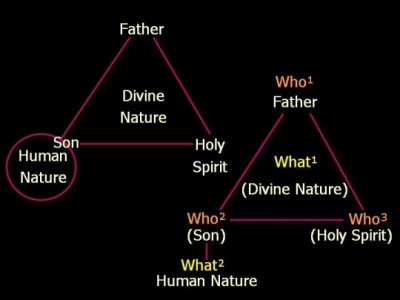

Did the early church invent the divinity of Jesus over a long period of time?

The Christian doctrine of the Trinity

How early is the doctrine of the divinity of Jesus?

When I answer this question, I only want to use the earliest, most reliable sources – so I can defend them on historical grounds using the standard rules of historiography.

The 4 sources that I would use are as follows:

  • The early creed in 1 Corinthians 15:3-8, and 1 Corinthians 1
  • A passage in Philippians 2
  • Two passages from Mark, the earliest gospel
  • A passage from Q, which is an early source of Matthew and Luke

So let’s see the passages.

1 Corinthians

I’ve written before about the early creed in 1 Corinthians 15:3-8, which skeptical scholars date to 1-3 years after the death of Jesus, for a variety of reasons I covered in the previous post. Here’s the creed which definitely makes Jesus out to be more than an ordinary man. Ordinary men don’t get resurrection bodies after they die.

Here’s the passage: (1 Cor 15:3-8)

3For what I received I passed on to you as of first importance: that Christ died for our sins according to the Scriptures,

4that he was buried, that he was raised on the third day according to the Scriptures,

5and that he appeared to Peter, and then to the Twelve.

6After that, he appeared to more than five hundred of the brothers at the same time, most of whom are still living, though some have fallen asleep.

7Then he appeared to James, then to all the apostles,

8and last of all he appeared to me also, as to one abnormally born.

Additionally, 1 Corinthians 1:21-25 talks about Jesus being “the power of God and the wisdom of God”. Paul is identifying Jesus with the divine.

21For since in the wisdom of God the world through its wisdom did not know him, God was pleased through the foolishness of what was preached to save those who believe.

22Jews demand miraculous signs and Greeks look for wisdom,

23but we preach Christ crucified: a stumbling block to Jews and foolishness to Gentiles,

24but to those whom God has called, both Jews and Greeks, Christ the power of God and the wisdom of God.

25For the foolishness of God is wiser than man’s wisdom, and the weakness of God is stronger than man’s strength.

But it gets even stronger! You all probably already know that the most important passages in the Old Testament for Jews is the famous “Shema“, which is found in Deuteronomy 6:4-9. The Shema is a strong statement of Jewish monotheism.

Here’s the passage:

4 Hear, O Israel: The LORD our God, the LORD is one.

5 Love the LORD your God with all your heart and with all your soul and with all your strength.

6 These commandments that I give you today are to be upon your hearts.

7 Impress them on your children. Talk about them when you sit at home and when you walk along the road, when you lie down and when you get up.

8 Tie them as symbols on your hands and bind them on your foreheads.

9 Write them on the doorframes of your houses and on your gates.

So how does Paul fit Jesus in with this strong statement of Jewish monotheism?

Paul alludes to the Shema in 1 Corinthians 8:4-6.

4So then, about eating food sacrificed to idols: We know that an idol is nothing at all in the world and that there is no God but one.

5For even if there are so-called gods, whether in heaven or on earth (as indeed there are many “gods” and many “lords”),

6yet for us there is but one God, the Father, from whom all things came and for whom we live; and there is but one Lord, Jesus Christ, through whom all things came and through whom we live.

Holy mackerel! How did that get in there? Paul is splitting the roles of God in the the Shema and identifying Jesus in one of the divine roles! Jesus is not an ordinary man. That passage “through whom all things came” foreshadows John identifying Jesus as “the Word of God”, which “became flesh and dwelt among us”. Holy snark – did you guys know that was all in here so early?

The date for 1 Corinthians is 55 AD. It should be noted that skeptical scholars like James Crossley accept these passages, and you can check it out in the debate audio yourself.

Philippians

Check out Philippians 2:5-11.

5Your attitude should be the same as that of Christ Jesus:

6Who, being in very nature God, did not consider equality with God something to be grasped,

7but made himself nothing, taking the very nature of a servant, being made in human likeness.

8And being found in appearance as a man, he humbled himself and became obedient to death— even death on a cross!

9Therefore God exalted him to the highest place and gave him the name that is above every name,

10that at the name of Jesus every knee should bow, in heaven and on earth and under the earth,

11and every tongue confess that Jesus Christ is Lord, to the glory of God the Father.

The date for Philippians is 60-61 AD. Still within the lifetime of the eyewitnesses, and written by an eyewitness who was in contact with the other eyewitnesses, like Peter and James, whom Paul spoke with numerous times on his journeys to Jerusalem.

Mark’s gospel

Mark’s gospel is the earliest and atheists like James Crossley date it to less than 40 AD, which is 10 years after the death of Jesus at most. When you read the gospel of Mark, you are getting the earliest and best information available about the historical Jesus, along with Paul’s epistles. So what does Mark say about Jesus? Is Jesus just a man, or is he something more?

Check out Mark 12:1-9:

1He then began to speak to them in parables: “A man planted a vineyard. He put a wall around it, dug a pit for the winepress and built a watchtower. Then he rented the vineyard to some farmers and went away on a journey.

2At harvest time he sent a servant to the tenants to collect from them some of the fruit of the vineyard.

3But they seized him, beat him and sent him away empty-handed.

4Then he sent another servant to them; they struck this man on the head and treated him shamefully.

5He sent still another, and that one they killed. He sent many others; some of them they beat, others they killed.

6“He had one left to send, a son, whom he loved. He sent him last of all, saying, ‘They will respect my son.’

7“But the tenants said to one another, ‘This is the heir. Come, let’s kill him, and the inheritance will be ours.’

8So they took him and killed him, and threw him out of the vineyard.

9“What then will the owner of the vineyard do? He will come and kill those tenants and give the vineyard to others.

And Mark 13:32, talking about the date of the final judgment.

32“No one knows about that day or hour, not even the angels in heaven, nor the Son, but only the Father.

And again, this passage is establishing a hierarchy such that Jesus is being exalted above all men and the angels, too. And the passage is embarrassing to the early church, because it makes Jesus look ignorant of something, so they would not have made this passage up. Jesus is not an ordinary man, he is above the angels – God’s unique Son.

The “Q” source for Matthew and Luke

Here’s Matthew 11:27, which is echoed in Luke 10:22:

27“All things have been committed to me by my Father. No one knows the Son except the Father, and no one knows the Father except the Son and those to whom the Son chooses to reveal him.

22“All things have been committed to me by my Father. No one knows who the Son is except the Father, and no one knows who the Father is except the Son and those to whom the Son chooses to reveal him.”

Since this passage is in both of Matthew and Luke, but not in Mark, scholars believe that it is in the earlier “Q” source used by both Matthew and Luke. Q predates both Matthew and Luke, and so it is also fairly early (maybe 67-68), although not as early as Mark and Paul. Bill Craig writes that this passage is also embarrassing because it says that no one knows Jesus.

What is the criterion of embarrassment, and what are some examples of it?

Sherlock Holmes and John Watson are going to take a look at the data

The criterion of embarrassment is just one of the historical criteria used to select the parts of a piece of ancient literature that are likely to be historical. Other things in the source may have happened, but we can’t know them as history. If significant parts of a text are historical, it is possible to accept it as historical until there are specific reasons to say that some part of it is NOT historical.

Here is William Lane Craig’s list of criteria for a saying or event to be historical:

  1. Historical congruence: S fits in with known historical facts concerning the context in which S is said to have occurred.
  2. Independent, early attestation: S appears in multiple sources which are near to the time at which S is alleged to have occurred and which depend neither upon each other nor a common source.
  3. Embarrassment: S is awkward or counter-productive for the persons who serve as the source of information for S.
  4. Dissimilarity: S is unlike antecedent Jewish thought-forms and/or unlike subsequent Christian thought-forms.
  5. Semitisms: traces in the narrative of Aramaic or Hebrew linguistic forms.
  6. Coherence: S is consistent with already established facts about Jesus.

The criteria is the same for liberal historians and conservative historians, although some historians weight one criteria more than others when trying to evaluate the historicity of different New Testament parts.

What’s amazing is that even liberal historians will give you facts that are embarrassing to the authors as “historical”.

Anyway, here are 8 examples of parts of the New Testament that exhibit the criterion of embarrassment, thanks to theologian C. Michael Patton.

  1. Jesus’ Baptism
  2. Jesus’ Family Did Not Believe
  3. John the Baptist’s Doubt
  4. The Disciples Doubted After the Resurrection
  5. Jesus Does not Know the Time of His Coming
  6. Women are the First to Witness the Resurrection
  7. Jesus Cursed a Fig Tree
  8. Death and Resurrection of Christ

I think 6 and 8 are the ones I want you to take away with you when you finish this post.

Here they are:

Women are the First to Witness the Resurrection

This is one that is often brought up. Craig Keener puts it well enough: “The witness of women at the tomb is very likely historical, precisely because it was so offensive to the larger culture — not the sort of testimony one would invent. Not all testimony was regarded as being of equal merit; the trustworthiness of witnesses was considered essential. Yet most of Jesus’ Jewish contemporaries held much less esteem for the testimony of women than for that of men; this suspicion reflects a broader Mediterranean limited trust of women’s speech and testimony also enshrined in Roman law.” (Keener, The Historical Jesus, 331)

And:

Death and Resurrection of Christ

This easily escapes our notice since the basic story of Christ is so well known. However, both the death and resurrection of Christ are, from the standpoint of the culture of the day, embarrassing and damaging. Concerning the death of Christ on a cross, Paul sees this problem: “But we preach Christ crucified: a stumbling block to Jews and foolishness to Gentiles” (1 Cor. 1:23). The word used for “stumbling block” is skandalon. Louw-Nida defines this as “that which causes offense and thus arouses opposition.” Why? Because the Jews would never have thought their Messiah would have been hung on a tree. “Cursed is one who hangs on a tree” (Gal. 3:13; Deut 21:23). The Greeks thought of the resurrection as foolishness as they were dualist, essentially believing that the material world was evil and the spiritual world good. They would have scoffed at the idea that Christ returned to physical form. This is why later Greeks attempted to adapt the Christ story, doing away with the physical resurrection. Marcion is the most famous promoter of this view (see Docitism).

Now, when you are talking about the New Testament to your non-believing friends, you definitely want to draw attention to passages that are embarrassing to the authors. It will help you to be more convincing when you explain the New Testament like a historian.

By the way, you can read an entire post I did on all the criteria that historians use to evaluate ancient historical documents.