Tag Archives: Health-care

Can we fix poverty by redistributing money, or is the problem something else?

This little blurb by a doctor is making the rounds on Facebook:

Dear Mr. President:

During my shift in the Emergency Room last night, I had the pleasure of evaluating a patient whose smile revealed an expensive Shiny gold tooth, whose body was adorned with a wide assortment of elaborate and costly tattoos, who wore a very expensive brand of tennis shoes and who chatted on a new cellular telephone equipped with a popular R&B ringtone.

While glancing over her Patient chart, I happened to notice that her payer status was listed as “Medicaid”! During my examination of her, the patient informed me that she smokes more than one costly pack of cigarettes every day and somehow still has money to buy pretzels and beer.

And, you and our Congress expect me to pay for this woman’s health care?

I contend that our nation’s “health care crisis” is not the result of a shortage of quality hospitals, doctors or nurses. Rather, it is the result of a “crisis of culture”, a culture in which it is perfectly acceptable to spend money on luxuries and vices while refusing to take care of one’s self or, heaven forbid, purchase health insurance.

It is a culture based on the irresponsible credo that “I can do whatever I want to because someone else will always take care of me”. Once you fix this “culture crisis” that rewards irresponsibility and dependency, you’ll be amazed at how quickly our nation’s health care difficulties will disappear.

Respectfully,
STARNER JONES, MD

My first reaction to this thing was HOAX, but Snopes says it’s not a hoax. In fact, it was a letter published in a newspaper.

And there was even a follow-up letter by the same doctor:

I continue to receive numerous phone calls, letters, emails and face-to-face comments about my letter (“Why Pay For the Care of the Careless”) which appeared in your newspaper a few months ago.

Most people express highest approval for the opinion set forth. Indeed, the truth has an illuminating quality all its own.

However, a few have disagreed and all of them falsely assume that a person who holds the views which I espouse must have been raised in a privileged home. Nothing could be further from the truth.

I grew up in a lower middle class, single parent home in the rural hill country of Pontotoc, Mississippi. While attending public schools, I paid attention in class and did my homework. I ran with the right crowd and stayed out of trouble. My dedication in school resulted in a full-paid scholarship to the prestigious University of the South in Sewanee, TN. After college, I left to go to medical school with everything I owned in three bags. The rest is history.

Motivation, not entitlement, is the key to personal success and happiness in life.

The fact of the matter is that it is often people who have come out of poverty themselves who most disagree with those who want to keep people in poverty by subsidizing their poor decision making. I come from a background where my parents were immigrants and my father worked 3 jobs and my mother worked one. We saw people around us who were poor like us, making these irresponsible spending decisions and they were encouraged to persist in it by welfare programs like Medicaid. They were getting tens of thousands of dollars in benefits, and they would lose those benefits if they worked their way out of poverty.

The fact of the matter is that we are doing the able-bodied non-working poor no favors by allowing them to persist in the worldview of poverty, which is encourages dependence, recklessness, consumption and waste. Eventually, the state runs out of other people’s money to subsidize the able-bodied non-working poor in their perpetual childhood, and then where will they be? We are already $16.5 trillion in debt, and this level of welfare spending is not sustainable. Eventually, they will have to fend for themselves. We will be leaving them uneducated, with no resume, and a host of addictions ranging from the lottery and cigarettes up to drugs and alcohol.

Instead of fretting over feelings, and worrying about being judgmental, we should be fretting about enacting policies that promote marriage, school choice, entrepreneurship, work and so on. Strengthening the family and rewarding hard work. If the concern is that health care costs too much, there are ways to lower the cost of health care with market-oriented reforms. We should be studying the economics of health care and promoting consumer choice, ownership and competition among health care providers. Government is not the answer.

I really recommend that everyone read a book by British doctor Theodore Dalrymple, who gives a close-up view of what government programs actually do to the people we would all like to help. I have linked to all the chapters here, so there is no excuse not to read it and get informed. Then we can read other books on consumer-driven health care in order to learn about how to reduce the cost of health care without growing government.
How does Obamacare cause medical premiums to rise?

The facts are not in dispute – Obamacare will make health insurance premiums go up.

The Wall Street Journal explains what will happen to medical insurance premiums as more of Obamacare is implemented in 2014.

Excerpt:

Central to ObamaCare are requirements that health insurers (1) accept everyone who applies (guaranteed issue), (2) cannot charge more based on serious medical conditions (modified community rating), and (3) include numerous coverage mandates that force insurance to pay for many often uncovered medical conditions.

[…]We compared the average premiums in states that already have ObamaCare-like provisions in their laws and found that consumers in New Jersey, New York and Vermont already pay well over twice what citizens in many other states pay. Consumers in Maine and Massachusetts aren’t far behind. Those states will likely see a small increase.

By contrast, Arizona, Arkansas, Georgia, Idaho, Iowa, Kentucky, Missouri, Ohio, Oklahoma, Tennessee, Utah, Wyoming and Virginia will likely see the largest increases—somewhere between 65% and 100%. Another 18 states, including Texas and Michigan, could see their rates rise between 35% and 65%.

While ObamaCare won’t take full effect until 2014, health-insurance premiums in the individual market are already rising, and not just because of routine increases in medical costs. Insurers are adjusting premiums now in anticipation of the guaranteed-issue and community-rating mandates starting next year. There are newly imposed mandates, such as the coverage for children up to age 26, and what qualifies as coverage is much more comprehensive and expensive. Consolidation in the hospital system has been accelerated by ObamaCare and its push for Accountable Care Organizations. This means insurers must negotiate in a less competitive hospital market.

Although President Obama repeatedly claimed that health-insurance premiums for a family would be $2,500 lower by the end of his first term, they are actually about $3,000 higher—a spread of about $5,500 per family.

But why? How does it happen?

Investors Business Daily has a look at the chain of causation.

Excerpt:

For years, ObamaCare critics focused on its least popular feature — the mandate that everyone buy insurance — taking their fight all the way to the Supreme Court.

But as ObamaCare’s official launch date approaches, even its backers are beginning to admit that the law could actually create powerful incentives for millions of people and thousands of businesses to drop their coverage, despite the mandate.

There is growing concern, for example, that the law’s market reforms will cause a huge “rate shock,” particularly for those young and healthy.

A February survey of major health insurance companies in five cities across the country found that they expect premiums for this group to climb an average 169%.

The cause of this rate shock is simple: ObamaCare imposes what is called “community rating” on insurance companies, effectively forcing them to charge the young and healthy more so they can charge older and sicker consumers less.

The five-city survey, for example, found that while the law will jack up rates for the young, it will lower them an average 22% for older and sicker customers.

At the same time, ObamaCare also forbids insurance companies from turning anyone down — a reform called “guaranteed issue” — which also will provide an incentive for some to drop coverage, knowing they can get it back any time.

“Even with the tax penalty … some healthy people would avoid purchasing coverage until they are sick,” Howard Shapiro, director of public policy at the Alliance of Community Health Plans, told regulators .

The problem is that if the young and healthy drop coverage, the result would be what the industry calls a “death spiral.” Premiums will climb as the pool of insured gets sicker, causing still more to cancel their policies.

This is just what happened in states that imposed strict community rating and guaranteed issue reforms in the past. In fact, of the eight states that did so, most ended up either dropping the reforms or loosening the rules after they saw enrollment decline and premiums climb.

It’s very important to understand that what Obama did with his health care plan will not cause premiums to go down. On the contrary, they have gone up and they will go up.

Should we believe what Obama says in his State of the Union speech?

Barack Obama Budget Deficits

What should we expect from the State of the Union speech tonight? We should expect Obama to argue against spending cuts, and for more spending.

Excerpt:

President Obama will use his State of the Union speech Tuesday to turn public opinion against automatic spending cuts and argue that some of the money to replace the cuts should instead come from higher taxes.

He will use the prime-time TV address to argue the economy would be damaged if $85 billion in automatic spending cuts were to go ahead on schedule on March 1, and will seek to set up Republicans to take the blame if they do.

The State of the Union address is also expected to highlight Obama’s second-term shift on the deficit.

From 2010 to 2012, the president consistently argued for new spending to spur on the economy, but also called for accompanying spending cuts and tax hikes to rein in the deficit.

But in his radio address on Saturday, Obama emphasized that the White House and Congress already have “cut our deficit by more than $2.5 trillion” through spending cuts and higher tax rates imposed on households with annual incomes above $450,000.

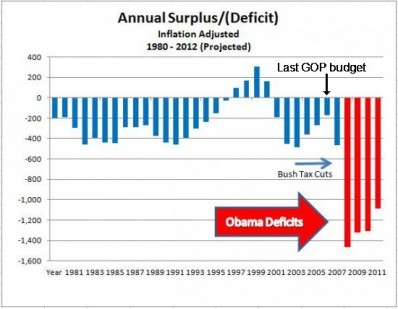
Look at the graph above. Does that look like we have cut our deficit? It used to be $160 billion in 2006/2007 under George W. Bush. Obama ran trillion dollar deficits for FOUR years. How is that cutting the deficit? What is Obama talking about? Bush added $4 trillion to the debt in 8 years, Obama’s added nearly $6 trillion to the debt in 4 years.

More:

A Congressional Budget Office report issued last week found the budget deficit will drop below $1 trillion this year to $845 billion, before falling further by 2015 to $430 billion.

In a more ominous sign, the same CBO report found an aging population and soaring healthcare costs would lead to an explosion in entitlement spending in later years, with budget deficits approaching $1 trillion again by 2023.

Obama thinks that not reforming entitlements is fiscally responsible. Should we believe that he knows what he is doing when it comes to the economy?

The Heritage Foundation says we shouldn’t believe Obama, because he lied the last time he gave a State of the Union speech.

Excerpt: (links removed)

Take a look at some of the promises Obama made back in 2009 during his first State of the Union.

“I pledged to cut the deficit in half by the end of my first term in office.”

During his first State of the Union, newly inaugurated President Obama vowed to cut the deficit in half by the end of his first term. Instead, Obama has averaged deficits nearly three timesthat of his predecessor.

For those who were concerned with President George W. Bush’s $4 trillion national debt, this pledge may have seemed like the “hope and change” the American people voted for in 2008. However, the reality of America’s additional debt over the past four years under the Obama Administration is staggering—almost $6 trillion in four years, on track to triple the amount Bush accumulated over his eight years as President. Now that Obama is heading into his second term, we’ve seen quite a change from the Barack Obama who thought $4 trillion in debt was“irresponsible” and “unpatriotic.”

“Over the next two years, this [stimulus] plan will save or create 3.5 million jobs.”

The President promised great things from the stimulus plan, but as Heritage’s J.D. Foster has said, we have to look at his record. He may have promised 3.5 million new jobs, but he’s 7.7 million jobs in the hole instead.

“…we must have quality, affordable health care for every American. It’s a commitment that’s paid for in part by efficiencies in our system that are long overdue.”

President Obama’s promise that Obamacare would provide health insurance for every American has been proven false. According to the Congressional Budget Office, 30 million Americans are projected to remain uninsured even after Obamacare is fully implemented.

The idea that Obamacare would improve the “efficiencies” of the health care system is laughable. Obama’s plan for “efficiencies” in the system was just slashing Medicare provider reimbursement rates to the tune of $716 billion to help pay for Obamacare. The mammoth law is going to take 127 million hours of paperwork per year for Americans to comply with it. And Members of Congress are already walking back their support for the law—they are grumbling about several parts of it and even repealed one part in the fiscal cliff deal.

What the Republicans should do is just walk out of there. Why sit there and listen to high-minded rhetoric that never amounts to anything? Well, except to make Obama feel good about himself.