
Tag Archives: Habitability

How common is it for a star to support complex, embodied life?

Circumstellar Habitable Zone

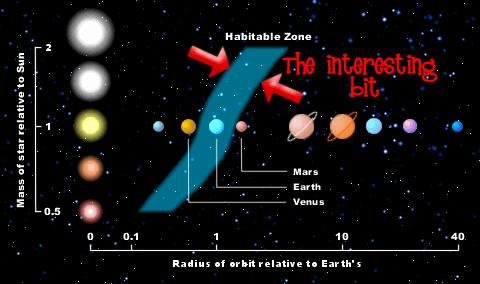
I blogged a while back about the need for a star to be massive, in order to push out the habitable zone far enough that the planet in the zone does not get tidally locked, killing the planet’s ability to support life. Recently, I blogged about another factor that’s needed – large planets further out which catch comets for us have to have a circular orbit, or they will pull us out of the habitable zone.

That’s two factors. But here’s an article from Evolution News that talks about liquid water and tidal locking, but it has even more factors that need to be fine-tuned for habitability.

Excerpt:

Stars with masses of 0.1-0.5 solar mass make up 75 percent of the stars in our Milky Way galaxy.6 These represent the red dwarfs, the M class. But these stars have low effective temperatures, and thus emit their peak radiation at longer wavelengths (red and near-infrared).7 They can have stable continuously habitable zones over long time scales, up to 10 billion years, barring other disruptions. It is also easier to detect terrestrial sized planets around them.8 But a serious problem with red dwarf stars in the K and M classes is their energetic flares and coronal mass ejection events. Potentially habitable planets need to orbit these stars closer, to be in these stars’ habitable zones. Yet the exposure to their stellar winds and more frequent and energetic flares becomes a serious issue for habitability. Because of these stars’ smaller mass, ejections get released with more violence.9 Any planet’s atmosphere would be subject to this ionizing radiation, and likely expose any surface life to much more damaging radiation.10 The loss of atmospheres in these conditions is likely, but the timescales are dependent on several factors including the planet’s mass, the extent of its atmosphere, the distance from the parent star, and the strength of the planet’s magnetic field.11 To protect its atmosphere for a long period, like billions of years, a planet with more mass and thus higher gravity could hold on to the gases better. But this larger planet would then hold on to lighter gases, like hydrogen and helium, and prevent an atmosphere similar to Earth’s from forming.12 Another consequence is that the increased surface pressure would prevent water from being in the liquid phase.13

So again, you need to have a huge, massive star in order to hold the planet in orbit over LONG distances. If it’s a short distance, you not only have the tidal-locking problem, but you also have this solar activity problem (flares, coronal ejections).

But wait! There’s more:

Another stellar parameter for advanced life has to do with UV (ultra-violet) radiation. The life-support star must provide just enough UV radiation, but not too much. UV radiation’s negative effects on DNA are well known, and any life support body must be able to sustain an atmosphere to shield them. Yet the energy from UV radiation is also needed for biochemical reactions. So life needs enough UV radiant to allow chemical reactions, but not so much as to destroy complex carbon molecules like DNA. Just this flux requirement alone requires the host star have a minimum stellar mass of 0.6 solar masses, and a maximum mass of 1.9 solar masses.14

So the ultra-violet radiation that is emitted has to be finely-tuned. (I’m guessing this assumes some sort of chemical origin-of-life scenario)

Still more:

Another requirement for habitable planets is a strong magnetic field to prevent their atmosphere from being lost to the solar winds. Planets orbiting a red dwarf star are also more affected by the star’s tidal effects, slowing the planet’s rotation rate. It is thought that strong magnetic fields are generated in part by the planet’s rotation.15 If the planet is tidally braked, then any potential for a significant magnetic field is likely to be seriously degraded. This will lead to loss of water and other gases from the planet’s atmosphere to the stellar winds.16 We see this in our solar system, where both Mercury and Venus, which orbit closer to the Sun than Earth, have very slow rotation rates, and very modest magnetic fields. Mercury has very little water, and surprisingly, neither does Venus. Even though Venus has a very dense atmosphere, it is very dry. This is due to UV radiation splitting the water molecules when they get high in the atmosphere, and then the hydrogen is lost to space, primarily, again, by solar wind.17

You have to hold on to your umbrella (atmosphere), or you get hit with dangerous rain (solar winds).

So a few more factors there, and remember, this is just the tip of the iceberg when it comes to circumstellar habitability constraints.
New study: invisible shield above the Earth protects us from electron threat

Science Daily reports on a new paper published in the prestigious peer-reviewed journal Nature.

Excerpt:

A team led by the University of Colorado Boulder has discovered an invisible shield some 7,200 miles above Earth that blocks so-called “killer electrons,” which whip around the planet at near-light speed and have been known to threaten astronauts, fry satellites and degrade space systems during intense solar storms.

The barrier to the particle motion was discovered in the Van Allen radiation belts, two doughnut-shaped rings above Earth that are filled with high-energy electrons and protons, said Distinguished Professor Daniel Baker, director of CU-Boulder’s Laboratory for Atmospheric and Space Physics (LASP). Held in place by Earth’s magnetic field, the Van Allen radiation belts periodically swell and shrink in response to incoming energy disturbances from the sun.

As the first significant discovery of the space age, the Van Allen radiation belts were detected in 1958 by Professor James Van Allen and his team at the University of Iowa and were found to be composed of an inner and outer belt extending up to 25,000 miles above Earth’s surface. In 2013, Baker — who received his doctorate under Van Allen — led a team that used the twin Van Allen Probes launched by NASA in 2012 to discover a third, transient “storage ring” between the inner and outer Van Allen radiation belts that seems to come and go with the intensity of space weather.

The latest mystery revolves around an “extremely sharp” boundary at the inner edge of the outer belt at roughly 7,200 miles in altitude that appears to block the ultrafast electrons from breeching the shield and moving deeper towards Earth’s atmosphere.

“It’s almost like theses electrons are running into a glass wall in space,” said Baker, the study’s lead author. “Somewhat like the shields created by force fields on Star Trek that were used to repel alien weapons, we are seeing an invisible shield blocking these electrons. It’s an extremely puzzling phenomenon.”

A paper on the subject was published in the Nov. 27 issue of Nature.

Something for us to be thankful for on Thanksgiving Day.

New study: gamma ray bursts make life impossible in 90% of galaxies

Galactic Habitable Zone

When you argue for theism from science, you typically use arguments like these:

  • the origin of the universe from nothing (the Big Bang)
  • the fine-tuning of cosmic constants and quantities
  • the origin of the first living cell
  • the sudden origin of animal phyla in the Cambrian explosion
  • the fine-tuning of the galaxy for complex, embodied mind
  • the fine-tuning of the solar system for complex, embodied mind
  • the fine-tuning of the planet (and moon)  for complex, embodied mind

This is a peer-reviewed article from Science, one of the most prestigious peer-reviewed journals. It speaks to the fine-tuning of the galaxy for life.

The article says:

Of the estimated 100 billion galaxies in the observable universe, only one in 10 can support complex life like that on Earth, a pair of astrophysicists argues. Everywhere else, stellar explosions known as gamma ray bursts would regularly wipe out any life forms more elaborate than microbes. The detonations also kept the universe lifeless for billions of years after the big bang, the researchers say.

[…]Astrophysicists once thought gamma ray bursts would be most common in regions of galaxies where stars are forming rapidly from gas clouds. But recent data show that the picture is more complex: Long bursts occur mainly in star-forming regions with relatively low levels of elements heavier than hydrogen and helium—low in “metallicity,” in astronomers’ jargon.

Using the average metallicity and the rough distribution of stars in our Milky Way galaxy, Piran and Jimenez estimate the rates for long and short bursts across the galaxy. They find that the more-energetic long bursts are the real killers and that the chance Earth has been exposed to a lethal blast in the past billion years is about 50%. Some astrophysicists have suggested a gamma ray burst may have caused the Ordovician extinction, a global cataclysm about 450 million years ago that wiped out 80% of Earth’s species, Piran notes.

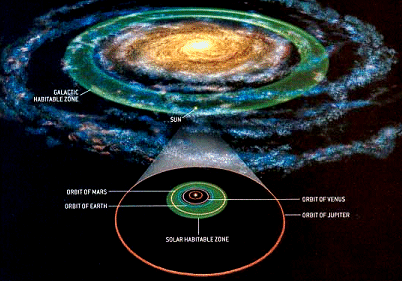
The researchers then estimate how badly a planet would get fried in different parts of the galaxy. The sheer density of stars in the middle of the galaxy ensures that planets within about 6500 light-years of the galactic center have a greater than 95% chance of having suffered a lethal gamma ray blast in the last billion years, they find. Generally, they conclude, life is possible only in the outer regions of large galaxies. (Our own solar system is about 27,000 light-years from the center.)

Things are even bleaker in other galaxies, the researchers report. Compared with the Milky Way, most galaxies are small and low in metallicity. As a result, 90% of them should have too many long gamma ray bursts to sustain life, they argue. What’s more, for about 5 billion years after the big bang, all galaxies were like that, so long gamma ray bursts would have made life impossible anywhere.

But are 90% of the galaxies barren? That may be going too far, Thomas says. The radiation exposures Piran and Jimenez talk about would do great damage, but they likely wouldn’t snuff out every microbe, he contends. “Completely wiping out life?” he says. “Maybe not.” But Piran says the real issue is the existence of life with the potential for intelligence. “It’s almost certain that bacteria and lower forms of life could survive such an event,” he acknowledges. “But [for more complex life] it would be like hitting a reset button. You’d have to start over from scratch.”

The analysis could have practical implications for the search for life on other planets, Piran says. For decades, scientists with the SETI Institute in Mountain View, California, have used radio telescopes to search for signals from intelligent life on planets around distant stars. But SETI researchers are looking mostly toward the center of the Milky Way, where the stars are more abundant, Piran says. That’s precisely where gamma ray bursts may make intelligent life impossible, he says: “We are saying maybe you should look in the exact opposite direction.”

You need to be able to pick up enough heavy elements from surrounding supernovae to make a metal-rich star, but you have to be far enough away from other stars to avoid getting blasted with gamma rays. The metal-rich star is needed to be able to support the circumstellar habitable zone, which is the zone where liquid water exists on the planet’s surface.

It’s important to understand that this factor in the study just a few of the things you need in order to get a planet that supports life. The more factors you add, the more unexpected complex, embodied life of any kind becomes.

Here are a few of the more well-known ones:

  • a solar system with a single massive Sun than can serve as a long-lived, stable source of energy
  • a terrestrial planet (non-gaseous)
  • the planet must be the right distance from the sun in order to preserve liquid water at the surface – if it’s too close, the water is burnt off in a runaway greenhouse effect, if it’s too far, the water is permanently frozen in a runaway glaciation
  • the solar system must be placed at the right place in the galaxy – not too near dangerous radiation, but close enough to other stars to be able to absorb heavy elements after neighboring stars die
  • a moon of sufficient mass to stabilize the tilt of the planet’s rotation
  • plate tectonics
  • an oxygen-rich atmosphere
  • a sweeper planet to deflect comets, etc.
  • planetary neighbors must have non-eccentric orbits

There’s a good video on the galactic habitable zone for you to watch right here:

It takes a lot to make just one planet that can support complex, embodied life of any kind.